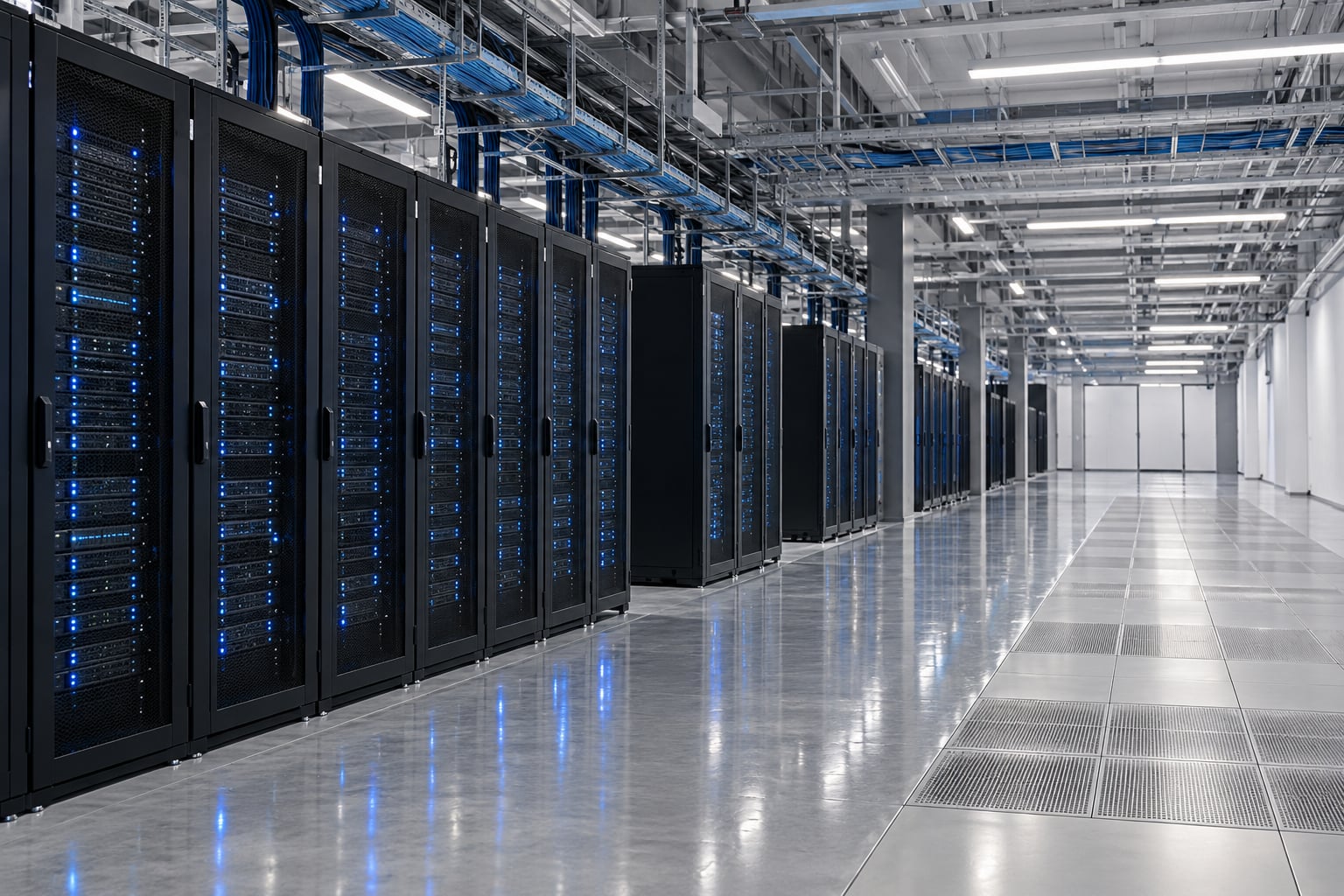
Japanese data centers are growing because cloud migration and AI workloads have hit the limits of Japan’s land, power and construction supply at the same time. Rising enterprise cloud adoption, GPU density, resilience rules and global platform expansion pull investment toward Tokyo, Osaka and regional cities, while grid connections, buildable land and available crews decide how fast capacity actually appears on the ground.
The interesting part is not the headline market forecasts. It is the gap between announced megawatts and connected megawatts, and the neighbours who now live beside the buildings.
Table of Contents
- Why Japanese Data Centers Are Growing: The Short Answer
- Cloud and AI Are Creating New Demand
- Resilience and Disaster Recovery Add Capacity Requirements
- Power, Land, and Networking Limit Expansion
- How Japan’s Data Center Market Is Expanding
- What the Growth Means for Tech Companies
- What Could Slow the Next Stage of Growth
- Frequently Asked Questions
- Why are more data centers being built in Japan?
- Are hyperscale cloud providers expanding their Japanese data center capacity?
- Does Japan have enough power and land for continued data center growth?
- Where are Japan’s main data center locations?
- Are Japanese data centers more energy efficient than facilities elsewhere?
- Will AI demand make Japanese data center capacity expensive?
- Conclusion
Why Japanese Data Centers Are Growing: The Short Answer
Five forces explain most of the build-out, and they pull in different directions.
- AI compute density. GPU racks draw several times the power of traditional servers, forcing new capacity rather than reuse.
- Public cloud migration. Japanese enterprises keep moving in-house systems onto AWS, Azure and Google Cloud.
- Resilience engineering. Seismic, typhoon and blackout rules push operators toward duplicated power and geographically split sites.
- Land and grid scarcity. Securing a powered site near Tokyo takes longer than most overseas operators expect.
- Content and platform traffic. Gaming, streaming and payments infrastructure need low-latency domestic capacity.
- Industrial policy. Central and prefectural subsidies push builds toward regional cities and cable landing sites.
Here is the frame most of the reporting fits into.
| Measure | Figure | Source framing |
|---|---|---|
| Hyperscale data center segment | 23 billion dollars in 2021 to 30 billion dollars in 2026 | EY, roughly 6.5% annual growth |
| Japan data centre market forecast | About 40.9 billion dollars by 2032 | Credence Research, roughly 4.6% annual growth |
| Tokyo’s projected position | Ahead of London and Frankfurt as a data center market by 2030 | EdgeConneX / Data Center Frontier |
| Global data centre electricity use | Roughly 945 TWh by 2030, about equal to Japan’s total consumption | IEA projection reported by Reuters |
| Typical rack density now vs AI | 5-10 kW per rack traditionally, 60 kW and above for AI | Operator data, discussed on r/datacenter |
Those figures disagree with each other on purpose. A 4.6% blended market forecast and a 6.5% hyperscale forecast are measuring different things, and both can be true: the ordinary enterprise colocation market barely moves while a small number of very large campuses add megawatts at once.
That distinction matters more than it sounds. Enterprise colocation is a slow, local business where a customer’s growth is usually measured in racks. Hyperscale is a lumpy, capital-intensive one where a single decision moves a region’s supply-demand balance for years. When I see a growth number for Japan, I check which of the two it describes before I quote it.
Cloud and AI Are Creating New Demand
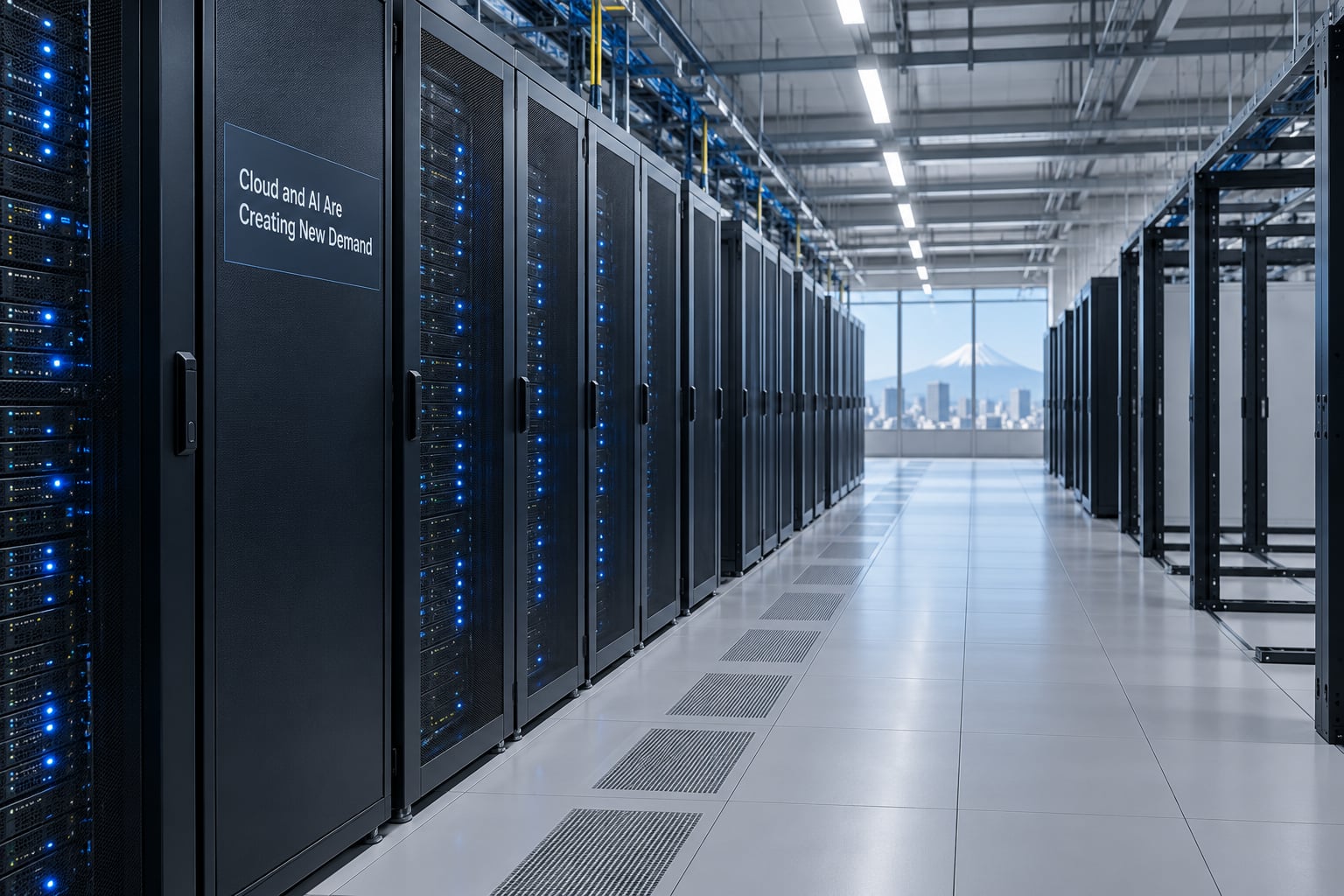
AI is the biggest single driver because it changes the physics of a data center. A traditional colocation hall runs about 5 to 10 kW per rack, which existing air handling can cope with. An AI hall runs 60 kW per rack and up, clustered far higher. r/datacenter users describe the shift plainly: the same floor area that once held a few hundred ordinary racks now holds a few dozen dense ones.
That reframes the whole conversation. Adding servers used to be a cabling and network problem. Adding AI capacity is a power, cooling and building-load problem, and the second kind cannot be solved by renting more space in an existing building.
Cloud migration is the quieter half of the story. EY’s split of the market into enterprise data centers and hyperscale data centers is useful here. The enterprise side, which serves banks, manufacturers and carriers in their own premises or in shared rooms, was already expected to plateau. The hyperscale side was forecast to grow at roughly 6.5% a year, from 23 billion dollars in 2021 to 30 billion dollars in 2026, because public cloud adoption is the stated reason capacity is being added.
Japanese companies migrated later than many peers. Long internal system lifecycles, cautious procurement and a shortage of in-house engineering meant cloud adoption accelerated after 2020 rather than before it. Once workloads moved, the practical question became where the physical capacity sits, and the answer has to be inside the country for latency, data handling and BCP reasons.
Alongside those sit workloads that never appear in market forecasts but keep capacity full: gaming and streaming distribution, payment processing, trading systems with microsecond requirements, and the content delivery networks fronting all of it. Global platforms need Japanese points of presence for the same reasons they need them in any market.
Why Japanese Data Centers Are Growing Across Different Regions
Growth is not happening in one place. Each location type solves a different problem, which is why the map is spreading out from the three metro areas.
| Location | What it is built for | Binding constraint |
|---|---|---|
| Tokyo and Greater Tokyo | Latency-sensitive enterprise, interconnection, network-dense colocation | Land and high-voltage grid capacity |
| Osaka and Greater Osaka | Western Japan enterprise demand, disaster recovery pairs with Tokyo | Power supply and permitting |
| Inzai and Chiba Prefecture | Large-footprint campus capacity close enough to the Tokyo market | Community consent and local siting rules |
| Nanto, Toyama Prefecture | Large-scale campus capacity with available land and renewable headroom | Grid connection timing and substation build |
| Akita Prefecture | Integrated AI capacity in a region with spare generation | Network latency back to population centres |
| Hokkaido and Kyushu | Cold-climate cooling advantage and regional redundancy | Fiber routes, submarine cable landing capacity |
Tokyo is where the interconnection is, so Tokyo is where low-latency colocation stays expensive. CBRE’s supply-demand view is blunt about Greater Tokyo: any loosening over the next three years is temporary, because new supply arrives in bursts and then the balance tightens again. Land and high-voltage power are genuinely hard to secure, which is why the same demand that fills Tokyo keeps spilling outward to Inzai, Nanto and the north.
Osaka carries the western half of the country’s enterprise demand and, more usefully, functions as a recovery site for Tokyo workloads. That pairing is why western Japan capacity keeps growing even when the local market is not large on its own.
Resilience and Disaster Recovery Add Capacity Requirements
Japan’s geography makes resilience a design input rather than an add-on, and resilience design consumes floor space and power like any other requirement.
Seismic design is the first one. Facilities near known fault zones need base isolation or damped structural systems, and equipment needs to stay in place during and after shaking. The engineering exists and Japanese contractors are good at it, but it is more expensive and more space-hungry than a standard box. The same applies to typhoon and flood exposure, which pushes designers toward raised floor levels, protected intakes and redundant cooling paths.
Power resilience is the second. Seismic and flood events trigger utility outages, so operators need on-site generation, multiple utility feeds and enough stored capacity to bridge until grid power returns. Backup generation is not a rounding error in the power budget; for a large site it is a meaningful share of the total connected load, and it occupies land of its own.
Then there is the requirement that a single site cannot be the only copy. Financial services, payments and carrier infrastructure all have business continuity requirements that push toward geographic separation. A Tokyo deployment with real recovery obligations needs a second site somewhere else in the country, and that second site consumes capacity that a single-region plan never had to count.
For customers, this has an upside. Seismic and flood engineering is a genuine Japan-specific differentiator, and it means a Japanese data center’s resilience argument is not just an assumption carried over from a slide deck. The downside is cost per rack, which is one reason colocation pricing here has drifted upward as operators pass through power and construction inflation.
Power, Land, and Networking Limit Expansion
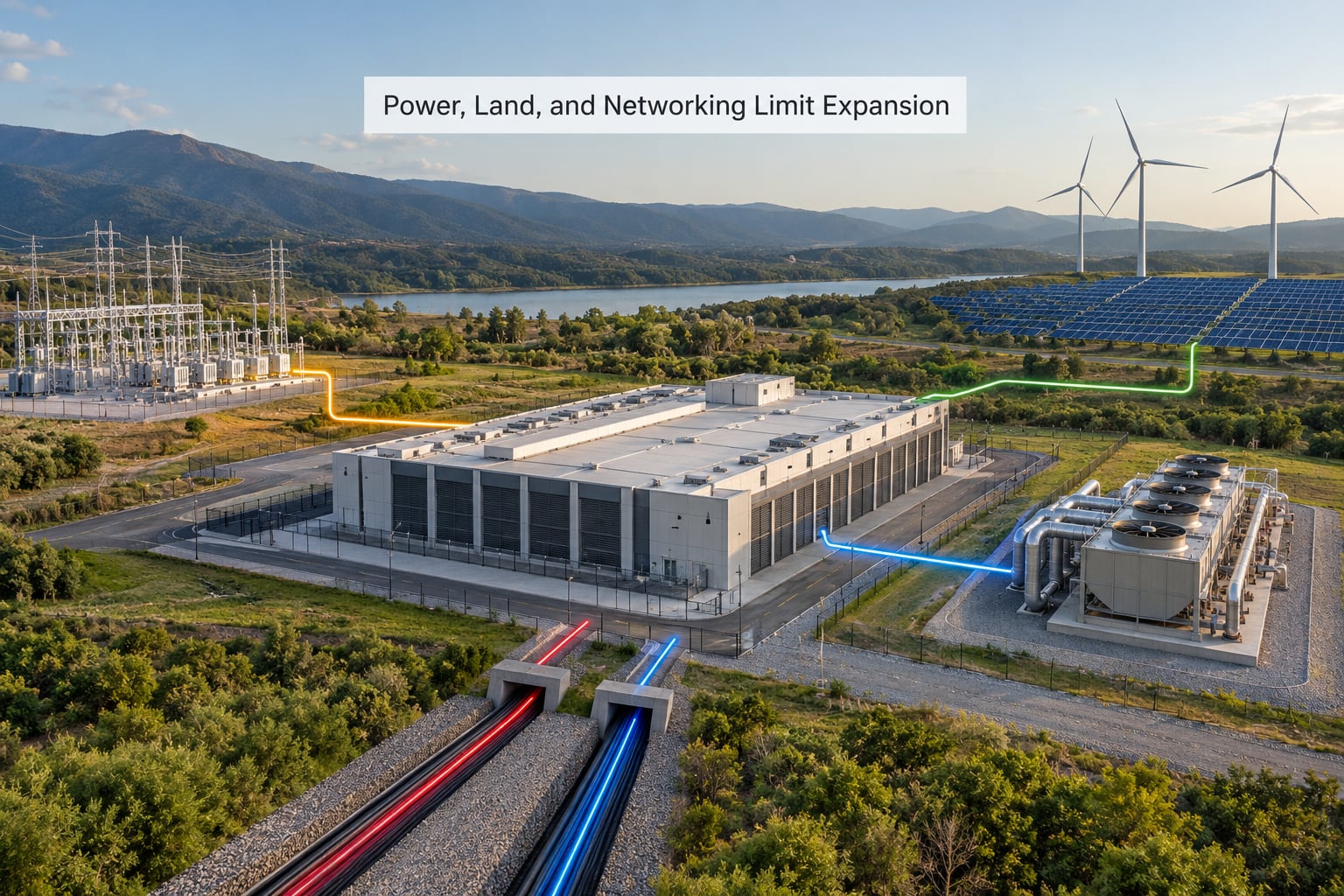
This is the constraint that decides how much of the announced pipeline ever gets built.
Grid connections. A large AI campus needs tens of megawatts, which is a utility-scale request rather than a commercial one. Connecting that load can require a new substation, and the queue for that work runs years. The IEA’s projection that global data centre electricity consumption roughly doubles to around 945 TWh by 2030, a figure roughly equal to Japan’s own total consumption, is the clearest way to see why grid capacity is a global constraint rather than a Japanese peculiarity.
Land. Urban Japan does not have cheap, flat, well-connected industrial land. A campus of the size these projects need goes to Inzai or to a regional city precisely because the metropolitan alternatives are either occupied or unaffordable.
Water and cooling. Cooling is a real cost in a humid climate, and evaporative systems are the loudest environmental complaint residents raise. Colder regions such as Hokkaido can lean on outside air for more hours a year, which is one reason northern capacity is interesting on efficiency grounds rather than just on land cost.
Networks. Capacity in a regional city is only useful if the fiber reaches it. Submarine cable landing stations and internet exchange points are part of the growth story for this reason, and central government has used subsidies to encourage landing sites and IX infrastructure outside the core metro areas.
Construction capacity. Nikkei has reported that Japan’s data center ambitions are being held back by what it calls analog-era processes, with labor shortages, rising costs and outdated building methods the specific bottlenecks. A construction consultant quoted there described a genuine surge in inbound requests from overseas developers, which is the demand side of the story, and the delivery side is where it stalls.
How Japan’s Data Center Market Is Expanding
Japanese capacity is being added through four different models, and they have very different economics and risks.
| Model | Typical workload | Where it lands | Main constraint |
|---|---|---|---|
| Hyperscale campus | AI training and inference, cloud platform capacity | Regional campuses and converted industrial sites | Grid connection and construction labor |
| Colocation and interconnection | Enterprise hosting, network peering, IX access | Tokyo, Osaka, Nagoya metro areas | Land cost and available power |
| Enterprise in-house facility | Banking, trading, carrier core, manufacturing | Campus and suburban industrial zones | Capital cost and staffing |
| Edge and regional node | Content delivery, caching, low-latency regional services | Regional cities and cable landing sites | Fiber availability and utilization |
The operators span the same range. NTT and KDDI anchor the enterprise and carrier side, SoftBank works alongside international AI partners on capacity in and near Osaka, and international colocation providers run the interconnection layer. Trading houses such as Itochu are committing several hundred billion yen to Japanese data center capacity by 2030, which is the clearest signal that this has moved beyond operator balance sheets into infrastructure investment.
Conversions are part of the pattern too. The 150 MW project in Osaka involves a former Sharp LCD manufacturing plant being repurposed for AI compute, which is a recurring trick: industrial buildings with existing power infrastructure, substation access and a shell are far easier to convert than to build from empty ground.
On the reported pipeline in and around 2026, the named projects run from a 3.1 GW planned campus in Nanto, Toyama, whose first phase of roughly 400 MW broke ground around December 2025, to a 140 MW integrated AI facility in Akita Prefecture. Those numbers are announcements, not energized load, and the gap between the two is where the rest of this article lives.
What the Growth Means for Tech Companies
If you run workloads in Japan, the build-out changes a few practical decisions rather than creating a new market.
Latency is a location choice. Tokyo-area colocation remains the answer for anything interaction-sensitive, and it stays the most expensive place in the country to buy. Regional capacity is cheaper and better for batch, training, storage and recovery roles.
Ask about the power source, not the renewable claim. Operators increasingly report carbon neutrality through market instruments. That is different from running on local renewable generation, and a company with real emissions targets should know which one it is buying.
Treat AI capacity separately. Dense GPU space is priced differently, has different cooling requirements and a shorter useful life than general-purpose colocation. Contracts that bundle both tend to age badly.
Data residency still matters. Financial and healthcare workloads in Japan continue to be shaped by residency expectations and by customer contracts that require domestic processing. More capacity in country makes those requirements easier to meet, not less.
Check power and cooling terms in the contract. Rising utility costs and rising construction costs are both being passed through. Long commitments made before 2026 are the ones most likely to look expensive now.
What Could Slow the Next Stage of Growth
Every growth story here has a plausible brake attached to it, and the brakes are mostly not financial.
Delivery speed. Labor shortage and slow building processes mean announced megawatts can sit unconnected for years. The gap between announcements and energized capacity is the single most useful thing to track.
Community resistance. The Japan Times reported on proposed facilities in Inzai, Chiba Prefecture, including a 52-metre data center next to a 15-storey residential block a short walk from a station, with residents describing buildings like that as factories rather than offices. The recurring complaints are water consumption, generator noise, 24-hour operation and the visual weight of the structure, alongside the frustration of receiving a construction notice instead of a consultation. The same reporting quotes a call for national or regional siting policy, which is the substantive part of the complaint: residents are not objecting to compute in the abstract, they are objecting to being informed late.
Utilization risk. Announced capacity that lands after demand has cooled leaves operators with expensive, power-hungry rooms. The speculative share of the pipeline is the part most exposed to that outcome.
Power cost and carbon policy. Facilities in regions with limited generation may need locally installed gas turbines, which brings fuel, emissions and local air-quality complaints rather than solving them.
Grid and permitting slippage. A substation or zoning decision that moves a year moves every dependent facility with it.
None of this means the build-out stops. It means the next phase is more local, more contested and more dependent on engineering delivery than on announcements.
Frequently Asked Questions
Why are more data centers being built in Japan?
Because cloud migration, AI compute and resilience requirements all landed at the same time. Japanese enterprises moved workloads to public cloud, AI racks need far more power and cooling than traditional servers, and disaster recovery rules push operators toward duplicated sites. Global platforms also need Japanese points of presence for latency and market access.
Are hyperscale cloud providers expanding their Japanese data center capacity?
Yes, and the expansion is concentrated in a few very large campuses rather than spread evenly. Named projects include a 3.1 GW planned campus in Nanto, Toyama, with a first phase of about 400 MW, a 140 MW integrated AI facility in Akita, and a 150 MW conversion of a former Sharp LCD plant near Osaka. Announced capacity still takes years to energize.
Does Japan have enough power and land for continued data center growth?
It depends on the region. Tokyo and Osaka have demand and connectivity but very little buildable, well-powered land, so growth is spilling toward Chiba, Toyama and northern regions. The binding constraint is usually the grid: connecting tens of megawatts can require a new substation, and those projects sit in multi-year queues. The IEA expects global data centre electricity use to roughly double by 2030.
Where are Japan’s main data center locations?
Tokyo and Greater Tokyo remain the core for low-latency enterprise and interconnection work, with Osaka serving western Japan and Nagoya as a third metro cluster. Larger campuses are going to Inzai in Chiba Prefecture, Nanto in Toyama and Akita in the north, while Hokkaido and Kyushu are pitched on cold-climate cooling and regional redundancy. Cable landing sites and IX infrastructure are being subsidized outside the core metros.
Are Japanese data centers more energy efficient than facilities elsewhere?
It varies by facility, and reported claims need reading carefully. Hokkaido sites can use outside air for cooling more hours per year, which genuinely lowers mechanical cooling load. But Japanese operators also report carbon neutrality through market instruments rather than local renewable generation, which is a different claim. Efficiency depends on the design, the climate and the grid mix as much as the country.
Will AI demand make Japanese data center capacity expensive?
Prices are already moving up, partly from AI demand and partly from power and construction cost pass-through. The larger risk is availability rather than price: dense AI space is priced separately, has a shorter useful life, and much of the announced pipeline is not energized yet. Buyers signing long commitments today are locking in terms set before most of the new capacity exists.
Conclusion
Japanese data centers are growing for a straightforward reason and a complicated one. The straightforward reason is demand: cloud migration, AI compute, resilience duplication and domestic platform infrastructure all need more capacity, and the world’s buyers of that capacity want it in Japan.
The complicated reason is delivery. Power queues, scarce buildable land, cooling in a humid climate and a construction workforce that cannot move as fast as the announcements do. That is why announced megawatts and operational megawatts are very different numbers.
So the question to ask first is not how big the market forecast is. Ask what workload you actually have, where it needs to sit, what resilience standard applies to it, and whether the site you are being sold has a substation behind it. In this build-out, the answers to those four questions matter more than any CAGR.