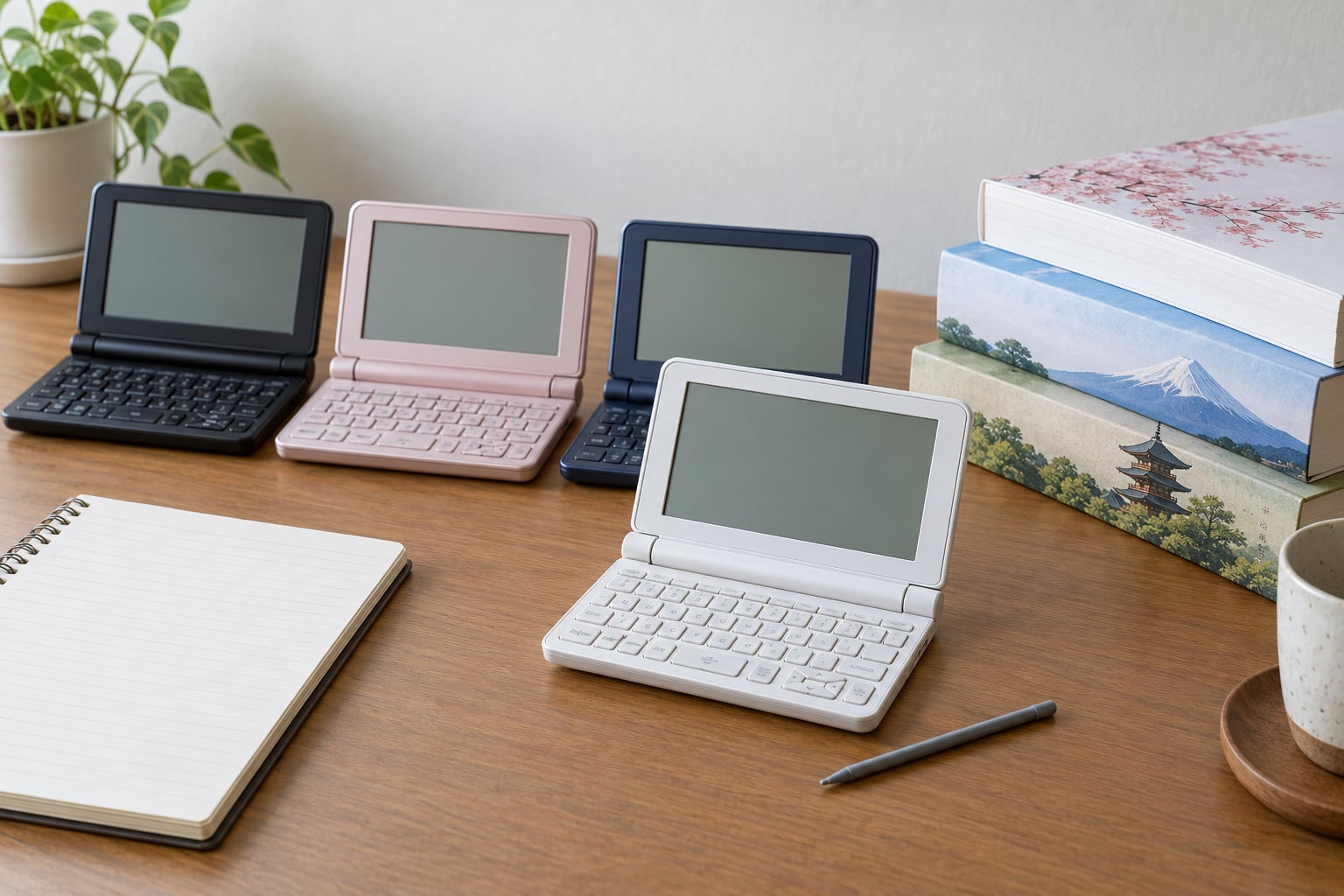
Japanese electronic dictionaries survive because the smartphone never replaced their job. A denshi jisho (電子辞書) is a dedicated handheld device sold in Japan with several professionally published dictionaries preloaded, stylus search and pitch accent data built in, and no internet connection required. Exam preparation, specialist content and classrooms that ban phones give the category a floor that free apps cannot undercut.
That is the honest answer to how Japanese electronic dictionaries survive, but it is only the opening move. The interesting part is the mechanics: how a product line that lost its main use case kept two manufacturers, a retail channel and a global second-hand market alive. It is a clean case study of a consumer electronics category retreating, narrowing its audience and deepening its content until the shrinking numbers stopped mattering.
Table of Contents
- 1Why Japanese Electronic Dictionaries Still Matter
- 2The Japanese Dictionary Market Today
- 3The Core Features Customers Still Pay For
- 4Exam Preparation as a Defensible Business
- 5Niche Dictionaries and Specialized Content
- 6Why Dedicated Hardware Still Beats a Phone for Some Users
- 7How Smartphones and AI Changed the Competitive Threat
- 8How the Surviving Products Make Money
- 9What Japanese Electronic Dictionaries Must Do Next
- 10Frequently Asked Questions
- 11How do Japanese electronic dictionaries survive against generative AI?
- 12Are Japanese electronic dictionaries useful without an internet connection?
- 13Is a dedicated Japanese electronic dictionary better than a smartphone app?
- 14Which Japanese electronic dictionary is best for exam preparation?
- 15How can I tell whether a Japanese electronic dictionary has up-to-date content?
- 16Conclusion: How Japanese Electronic Dictionaries Survive
Why Japanese Electronic Dictionaries Still Matter
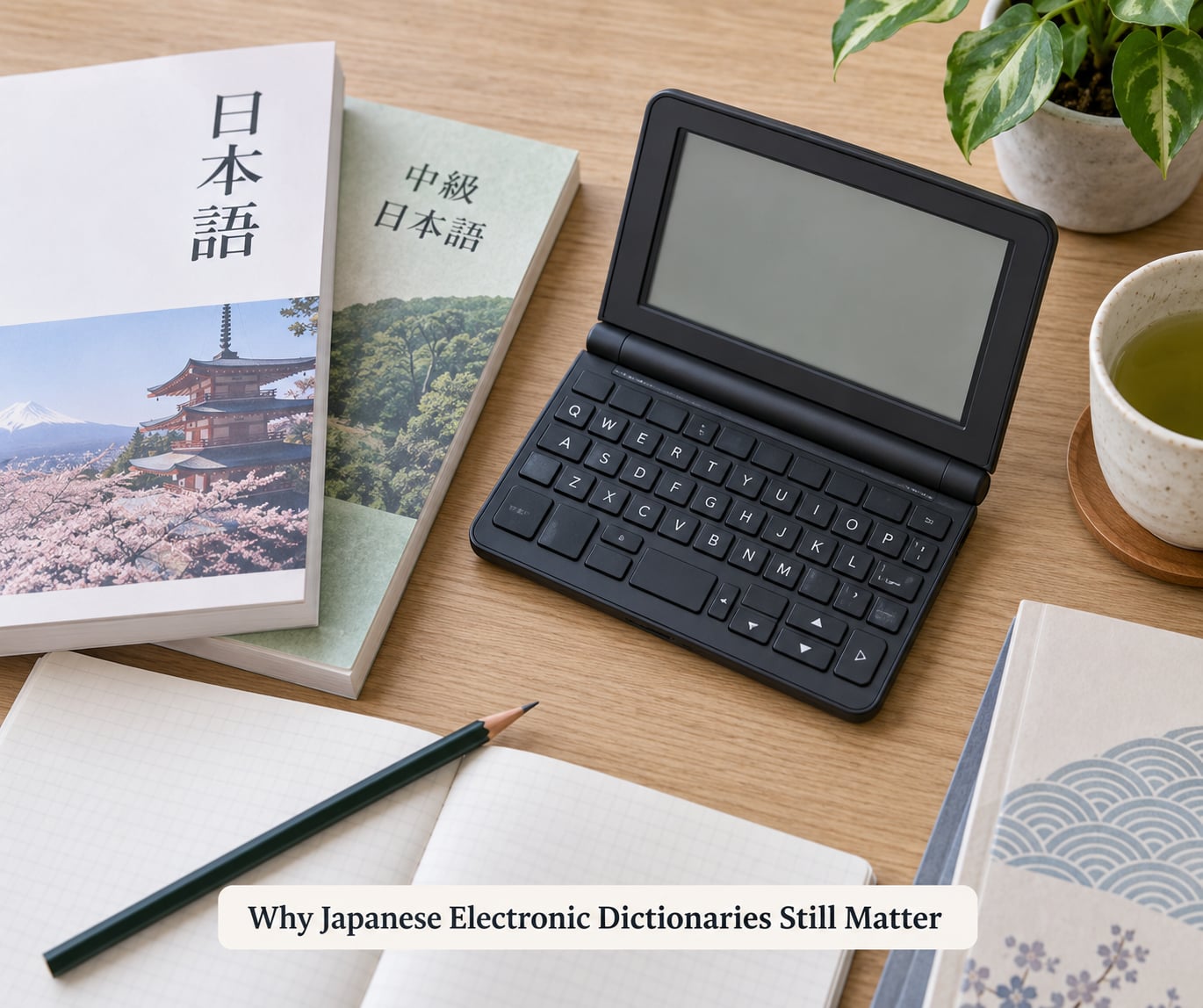
A denshi jisho is a clamshell handheld, usually with a stylus and a handwriting pad, sold mainly in Japan and preloaded with several academic dictionaries in Japanese and English. You can look up a kanji by stroke count, read the pitch accent, hear native audio and find an example sentence without a data plan, an account or a subscription.
Ask what an electronic dictionary is in general and the answer is narrower than the word suggests. It is not a small computer with a dictionary on it. It is one dictionary set, one job, and hardware built to make that job fast and dependable.
The lifecycle explains why the category still exists. It has been through a chain of technology eras, and each one forced it to change what it sold.
- 1979: Sharp released the IQ-3000, the first Japanese electronic pocket dictionary, and turned a bookshelf reference into a handheld object.
- Late 1980s to 1990s: Casio, Seiko and Canon entered with the clamshell form factor, colour screens and annual model refreshes. EX-word became the best-known line in Japan.
- Late 1990s to 2000s: CD-ROM dictionaries expanded, then free web search undercut paid reference discs almost immediately. A government-affiliated Web Japan archive entry from 2005-2006 still describes talking electronic dictionaries as a growth market to watch.
- 2010s onward: Smartphone apps absorbed the free end of the market. Translation cameras, text-to-speech and voice input took casual lookup.
- 2025: The r/denshijisho community FAQ states that Casio announced it would stop introducing new denshi jisho models while continuing to manufacture existing ones. Boing Boing, in a March 2025 piece, argued from that same shrinking-shelf evidence that the niche is finally fading.
Stopping the model cycle while keeping the factory running is a survival strategy, not an ending. It converts a product line into a supportable annuity on content the company already owns.
The Japanese Dictionary Market Today
Four tools answer Japanese questions today, and they are not interchangeable. The category that shrank is the one with the deepest bundled content and the least dependency on a server.
| Option | Content depth | Offline access | Interface | Updates | Typical use |
|---|---|---|---|---|---|
| Dedicated denshi jisho | Several licensed dictionaries, grammar and writing references on one device | Full, no connection needed | Buttons, stylus, handwriting pad, Japanese menus on most models | Content sold or downloaded through the vendor store | Exam prep, professional reference, classroom study |
| Mobile dictionary apps | One to a few titles, often freemium | Partial, larger titles download | Touch, search history, ads in free tiers | Automatic, often monthly | Quick lookup on the move |
| General web search | Unpredictable, stitched from many sources | None | Browser, ads, page noise | Live | One-off questions and cross-checking |
| AI assistants | Generated on demand, no fixed source | None | Prompt box, chat log | Model updates | Explanation, translation in context, drafting |
Only the first row ships an answer you can cite back to a named dictionary. The other three give you something useful most of the time and nothing you can point at when the answer matters.
The Core Features Customers Still Pay For
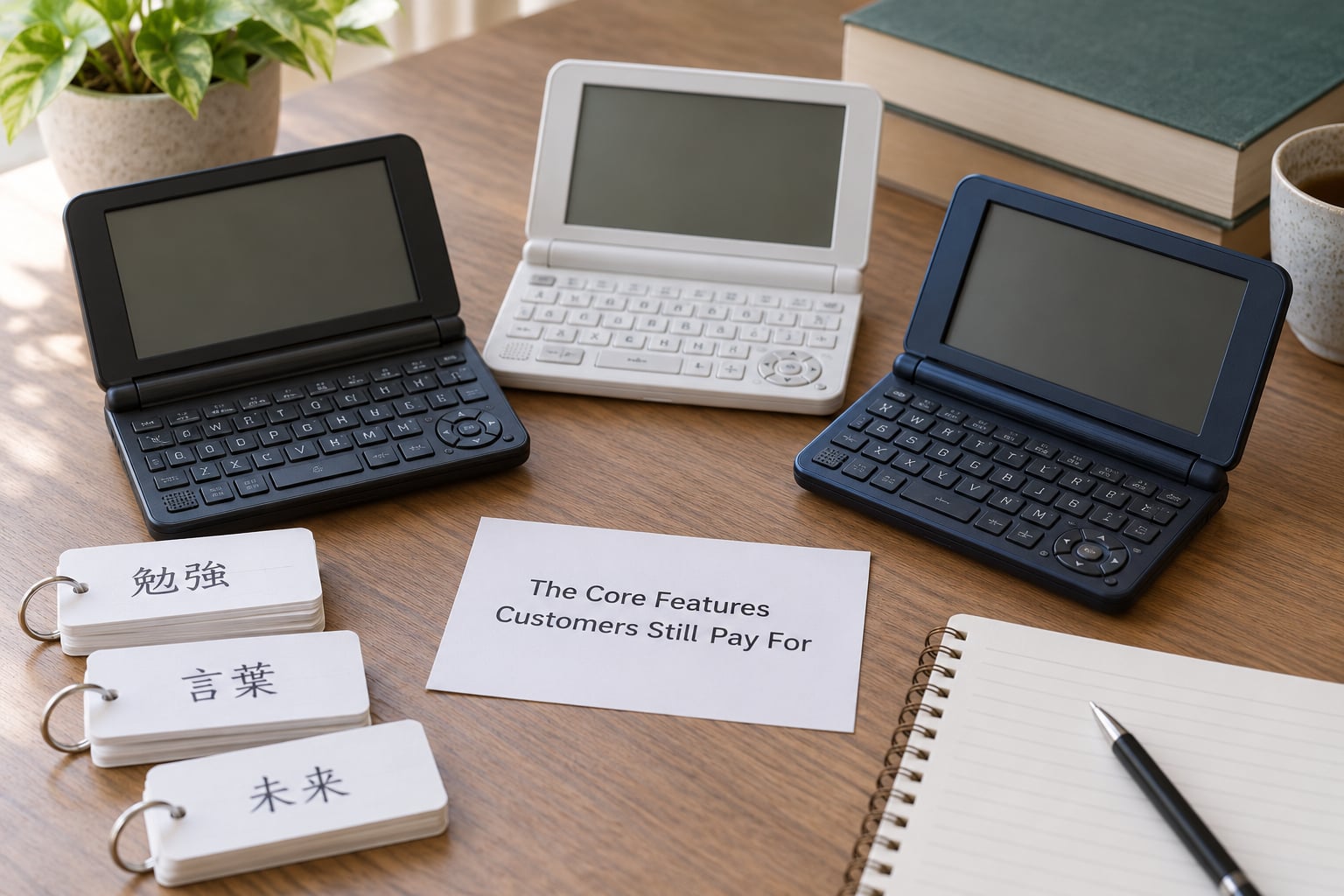
The features that survive contact with real study habits are unglamorous: instant lookup, example sentences, pitch accent, stroke order, battery life and a device that cannot ring.
| Feature | Dedicated device | Phone app | Why it matters |
|---|---|---|---|
| Instant word lookup | Keypress or stylus, no launch step | Wake, unlock, open app, wait | Decides whether you look a word up or guess |
| Dictionary content | Several titles licensed and installed | Usually one core title | Definitions differ in depth and register |
| Example sentences | Native-graded examples on device | Often present, varies by tier | Shows how the word is actually used |
| Pitch accent (kappyaku) | Notation from published accent dictionaries | Available in some dedicated apps | Marks where a particle changes the pitch |
| Stroke order and kanji search | Handwriting recognition and stroke count | Keyboard entry mostly | The fastest lookup route for beginners |
| Audio | Recorded native speaker clips | TTS or recorded, app dependent | Trains the ear, not just the eye |
| Battery | Months on cells or a long charge | A day, and shared with everything else | Removes charging from the study routine |
| Distraction | None by design | Every notification you own | Some people simply cannot read on a phone |
Community reports back that last row more than any other. On r/LearnJapanese, learners describe the moment they stop reaching for the phone mid-study because something else was on screen. Zero distraction is a stated motivation, not a spec sheet line.
Exam Preparation as a Defensible Business
Exam support is the part of the business a general-purpose app cannot copy without becoming something else. Japan’s language exams grade vocabulary range, pitch accent, written accuracy and kanji knowledge against fixed criteria, and a device can ship with tools pointed at each one.
The bundles that matter include the Obunsha JLPT Target Series for candidates working toward N1 and N2, writing correction that marks long vowels, particle mistakes and kanji errors, and grammar references such as Kenkyusha, Sanseido and the monolingual kokugo titles. The NHK Japanese Pronunciation Accent Dictionary gives the pitch data that drilled shadowing needs.
Classroom policy matters as much as content. Japanese high schools and language schools routinely allow a dedicated study device where a smartphone is locked away, and students arriving for university entrance exams often arrive already trained on the interface. On r/denshijisho, the community FAQ frames this as the single most common answer to why not just use a phone: in the room where the exam happens, the phone is not an option.
None of that is a niche extra. It is the core reason a household or a student still signs for a device the rest of the developed world has stopped buying.
Niche Dictionaries and Specialized Content
Below the exam layer sits the specialist layer, and it is the part of the catalogue a phone struggles to imitate. Devices carry medical and veterinary references, legal and constitutional terminology, classical Japanese and kanbun material, literary criticism, engineering measurement terms and name dictionaries that resolve rare characters no general dictionary covers.
The gap with free tools is structural. Jisho.org and JMDict are excellent for lookups, and r/denshijisho users run them alongside a real device rather than instead of one. But JMDict is crowdsourced and open, which means coverage is uneven, register distinctions are thin and there is no editorial authority behind a definition. Publishing a dictionary requires editors, proofing and licensing; that cost is exactly why it lives inside hardware.
Content you cannot legally and cheaply reproduce is the moat. A general AI answer may produce a fluent definition that happens to be wrong, and for a translator on a deadline or a student checking a kanji stroke, fluent and wrong is worse than nothing.
Why Dedicated Hardware Still Beats a Phone for Some Users
For most readers, a phone is the right call and this article should not pretend otherwise. For a specific set of people the hardware still wins, and the reasons are physical.
- Battery: months between charges instead of a daily top-up, which matters when the device lives in a bag.
- Privacy and travel: no roaming bill, no signal, no background location trail. Study on a plane or in a basement lecture hall.
- Tactile search: a stylus on a handwriting pad is faster than typing a kanji you cannot type yet.
- Readability: a dedicated screen showing one entry, tuned for text rather than video.
- Predictability: the same answer for the same word every time, with no model update changing it next month.
- Buying habits: Japanese families and schools still buy these at year-end and graduation season, so the purchase is understood without explanation.
The last point is worth understating. A category survives partly because it is understood. A parent who has seen one in a hand knows what to give a child studying for the JLPT, and nobody in the household has to be persuaded.
How Smartphones and AI Changed the Competitive Threat
The threat did not arrive as a rival device. It arrived as a free substitute that is always in your pocket, and it took the two use cases that made denshi jisho mass market: casual word lookup and quick translation.
Translation cameras, voice input and offline language packs removed the last friction. Then generative assistants changed the shape of the question. Instead of finding a definition, you describe a situation and get an explanation written for you, which is genuinely better for meaning and genuinely worse for citation.
Boing Boing’s March 2025 argument is that this ends the category. The evidence it leans on is real: a Japanese electronics department store once gave denshi jisho a full aisle, and that aisle is gone. Casio’s 2025 decision to stop introducing new models, as reported on r/denshijisho, points the same way. Unit volume is falling and no amount of framing reverses that.
What the decline argument misses is the direction of travel underneath it. Volume falling while the incumbent keeps manufacturing tells you the category consolidated, not that it ended. What remains is the buyer who genuinely needs licensed content, offline function and a device that cannot distract. Fewer buyers, higher willingness to pay, no new design costs.
How the Surviving Products Make Money
The business now runs on content and hardware together rather than on model refreshes alone.
- Device sales at a high unit price, where the profit per unit can carry a small market.
- Downloadable content and additional dictionaries sold through the vendor’s own store over the device’s Wi-Fi connection.
- Expansion cards: a microSD slot in the past let buyers load dictionaries themselves, and it remains a spec-sheet selling point.
- School and employer procurement, where a classroom set is sold as equipment rather than as a consumer gadget.
- Second-hand trade on Mercari, Rakuma, Fril and Book-Off, which keeps older models in circulation and holds a residual value that discourages the maker from exiting.
- Hobbyist demand from outside Japan, the channel Boing Boing’s author describes running through social platforms where the device is framed as a minimalist gadget rather than a study tool.
That secondhand market is doing more work than it gets credit for. When a used unit holds its value, owning one becomes a low-risk decision, and the maker can keep manufacturing existing designs without spending on a new generation.
What Japanese Electronic Dictionaries Must Do Next
Staying alive is not the same as growing, and several problems are visible from outside the industry.
The interface is the first one. Most models ship with Japanese menus and Japanese manuals, which r/LearnJapanese describes as a hard barrier for beginners who cannot read kana yet. Learner variants with English navigation exist, but they are a small slice of the line. The Japanese-only interface is the single biggest reason export buyers bounce off the category.
Second, content updates have to move faster than the hardware. Buyers compare devices by which dictionaries are bundled, and a device that lists last year’s reference titles is losing its main argument. Third, connectivity should be optional rather than required. Offline operation is an advantage today; a device that can pull a fresh title when you want one, then ignore the network when you do not, is better than either extreme.
AI is the awkward one. It is the obvious feature to bolt on and the least likely to help. Wrapping a chatbot around licensed dictionaries adds nothing an assistant on the phone does not already do. What would help is narrower: better handwriting recognition, faster search inside large monolingual titles, and clearer display of pitch and register. Useful intelligence inside the dictionary, not a chat window bolted to the side.
The realistic goal is a smaller, sharper product. Buyers who want a pocket reference for JLPT N1, a translator who needs legal or medical terms offline, and a teacher who wants one device for a class of students all need different things from a phone, and none of them need the phone replaced.
Frequently Asked Questions
How do Japanese electronic dictionaries survive against generative AI?
They survive by owning work a chat assistant cannot do reliably. A denshi jisho ships licensed dictionaries, pitch accent data, example sentences and exam tools, and it answers offline with the same result every time. An AI assistant writes a plausible explanation but cites no fixed source. The devices that hold on are the ones sold to exam candidates, translators, teachers and buyers who want a dedicated, distraction-free tool.
Are Japanese electronic dictionaries useful without an internet connection?
Completely. The dictionaries, grammar references, writing correction, audio and study drills are stored on the device, so a denshi jisho works on a plane, in a basement classroom or abroad with no roaming. Wi-Fi on modern models is used to buy or download additional content from the vendor store, not to make the core product work. That independence is the main technical reason the category still exists.
Is a dedicated Japanese electronic dictionary better than a smartphone app?
For quick lookups while travelling, no. An app is already in your pocket, updates itself and costs nothing to start. A dedicated device wins when you are studying for long sessions, need licensed titles such as the NHK accent dictionary, want to look up kanji by stroke with a stylus, or cannot stop opening other apps when you read on your phone. Beginners on a budget should start with an app and graduate later.
Which Japanese electronic dictionary is best for exam preparation?
Judge a device by the dictionaries it bundles rather than the model name. JLPT candidates want the Obunsha JLPT Target Series, writing correction and pitch accent data from the NHK pronunciation dictionary. On r/denshijisho, members point beginners toward the Casio EX-word XD-SV4750 and advanced learners wanting more titles toward the XD-SX9800. A model a few years old is often the sensible choice, since the dictionaries rarely change.
How can I tell whether a Japanese electronic dictionary has up-to-date content?
Open the content list on the device and read the publication year printed next to each dictionary title. Japanese reference works are dated editions, so a device listing a title from several years ago is showing you old content even if the hardware is recent. Check whether the model supports Wi-Fi downloads from the vendor store, which is the main way fresh titles arrive. Secondhand listings rarely state the content year, so ask for the menu photo before buying.
Conclusion: How Japanese Electronic Dictionaries Survive
Japanese electronic dictionaries survive because they stopped competing with phones. They serve exam candidates, translators, teachers and specialist readers who need licensed Japanese content, instant offline answers and a device that cannot distract them, and they sell that to a market small enough for two manufacturers to keep the factory running.
Start with what you actually need. A casual reader should keep using an app. Anyone preparing for the JLPT, working with legal or medical Japanese, or studying in a room where phones are banned will get more out of a dedicated device than any subscription.