Windows adoption in Japan is far more corporate-driven than in the United States. Roughly 72% of PCs shipped into the country are bought by companies rather than households, and those fleets get replaced on multi-year cycles. As a result, Japan runs a high Windows installed base but upgrades to Windows 11 more slowly than the US or UK. Add a consumer market that leans harder toward premium Macs than most Western countries, and the Japanese PC picture stops looking anything like the American one.
That single sentence covers most of the difference, but not all of it. Below I break down what the headline numbers actually measure, where the numbers came from, and what changes when you compare Japan with the United States line by line.
Table of Contents
- 1What Does Windows Adoption Mean in the Japanese Market?
- 2How Japan’s PC Market Developed
- 3Why Businesses Helped Make Windows Dominant
- 4How Windows Adoption Differs in Japan Compared With the United States
- 5What Japan-Specific Factors Change the PC Experience
- 6How Mobile Devices Changed the Meaning of Windows
- 7What the Differences Mean for Software Companies and Marketers
- 8Frequently Asked Questions
- 9What is the Windows market share in Japan?
- 10Why is Japan’s PC market so business-focused?
- 11Why is Windows 11 adoption slower in Japan than in the United States?
- 12Is macOS more popular in Japan than in the United States?
- 13What happens to Windows 10 in Japan after end of support?
- 14Which PC brands dominate the Japanese market?
- 15Conclusion: Start With the Market You Are Measuring
What Does Windows Adoption Mean in the Japanese Market?
Adoption is not one number, and most confusion about Japan comes from mixing four of them together.
Installed base is how many machines physically run Windows. This is the number enterprise IT departments care about, because it drives licensing, support contracts and endpoint management. It is also the hardest number to measure directly, so almost nobody publishes a clean Japanese figure.
OS version share is how much of that installed base sits on Windows 11 versus Windows 10. This is the number that moves when Microsoft ships a release deadline, and it is the one most people mean when they say adoption.
Active use is a separate question entirely. A Windows PC sitting switched off in a storeroom is installed but not active, and in a country where corporate refreshes lag, the gap between the two is wider than in the US.
Measured web traffic is what StatCounter reports, and it is not any of the above. It counts page views from sites running its tracking counter, which means it over-represents web-heavy users and under-represents anyone running an ad blocker.
Because of that last point, a country can show a huge number of Windows PCs and still have an internet experience that feels nothing like the American one. Japanese daily internet use happens on phones, through browsers, and mostly on services that never touch a desktop operating system at all.
Here is the desktop picture as StatCounter measured it for September 2026:
| Desktop operating system | Share of Japanese desktop web traffic, September 2026 |
|---|---|
| Windows | 78.75% |
| OS X | 10.1% |
| Linux | 5.36% |
| macOS | 4.95% |
| Chrome OS | 0.84% |
Source: StatCounter Global Stats, desktop OS market share for Japan, September 2026. Read this as traffic, not as installed machines.
One more quirk deserves a mention. StatCounter now reports an Unknown category, and in some months it is large enough to distort any headline figure. Readers on r/linux noticed Windows appearing to shed roughly ten percentage points in Japan over a three-month window, mostly to macOS, and correctly asked whether anyone had switched that many machines that fast. The honest answer is that the tracker does not support that conclusion.
How Japan’s PC Market Developed
Japan got its personal computers almost entirely through workplaces. Through the late 1980s and 1990s, Japanese households bought relatively few home PCs, while large manufacturers and trading houses standardised on desktop Windows machines bought in volume through dedicated corporate channels.
By the 2007 to 2011 period, the pattern was firmly established: the business PC was the mainstream Japanese PC. Several forces held it there. Corporate IT departments had years of build-and-image experience, training material and internal support tooling written around Windows. Office workflows were built around Excel, Outlook and groupware running on Windows servers. And local software vendors overwhelmingly shipped Windows-first.
Then smartphones arrived. Japanese mobile broadband was fast and cheap well before most of the West, and within a few years the phone replaced the home PC as the default device for checking email, banking, maps and shopping. Consumer PC sales never recovered to their pre-smartphone expectations, while corporate demand kept the Windows installed base intact.
The practical result is a two-speed country. Business desktops are numerous, long-lived and slow to change. Consumer desktops are comparatively few, more expensive, and skewed toward whatever is easiest to justify as a personal purchase.
One caution on the historical record: much of the clearest published data on this split comes from the late 2000s and early 2010s, including the shipment figures quoted below. Later market conditions, especially after the pandemic-era PC surge faded, are not captured in those numbers, so treat the historical picture as a pattern rather than a live reading.
Why Businesses Helped Make Windows Dominant
The corporate share of Japan’s PC market is the single most useful fact for understanding Windows adoption there. MMRI (MM総研) counted 15.3 million PCs shipped in Japan in 2019: 10.97 million to companies and 4.33 million to consumers. That is about 72% corporate.
Four things follow from that split.
Procurement beats preference. A Japanese office PC is usually chosen by an IT department or a reseller, not by the person who will use it. The buyer optimises for manageability, warranty coverage and a support path, and Windows with established management tooling wins that argument by default.
Refresh cycles are long. Corporate fleets in Japan are commonly kept for five to seven years rather than the three to four common in North American corporate refresh programmes. A machine that old usually cannot run Windows 11, so it stays on Windows 10 through ESU enrolment or plain inertia.
Software is localised for Windows first. Japanese business software, tax and accounting tools, and the vertical systems behind retail, logistics and manufacturing were built and certified for Windows long before anyone considered macOS or Linux parity. Switching a company means re-certifying those workflows.
Distribution runs through vendors who stock Windows SKUs. The 2020 vendor split in Japan was Lenovo group 42% (Lenovo, NEC and Fujitsu counted together), HP Japan 16%, Dell 12% and Apple 5.5%. Because NEC and Fujitsu sit inside that Lenovo group, the Windows business configurations that reach Japanese buyers are heavily shaped by domestic enterprise lines rather than by global consumer laptops.
Add the GIGA school device programme, which put large numbers of Windows laptops into Japanese classrooms, and the answer to why Windows is so entrenched here becomes straightforward: the installed base was built by institutions, and institutions do not churn.
Apple’s 5.5% total share in 2020 looks small until you notice the split underneath it. A large share of that came from consumer buyers who choose Macs deliberately for build quality and after-sales service, and who are willing to pay a premium for them.
How Windows Adoption Differs in Japan Compared With the United States
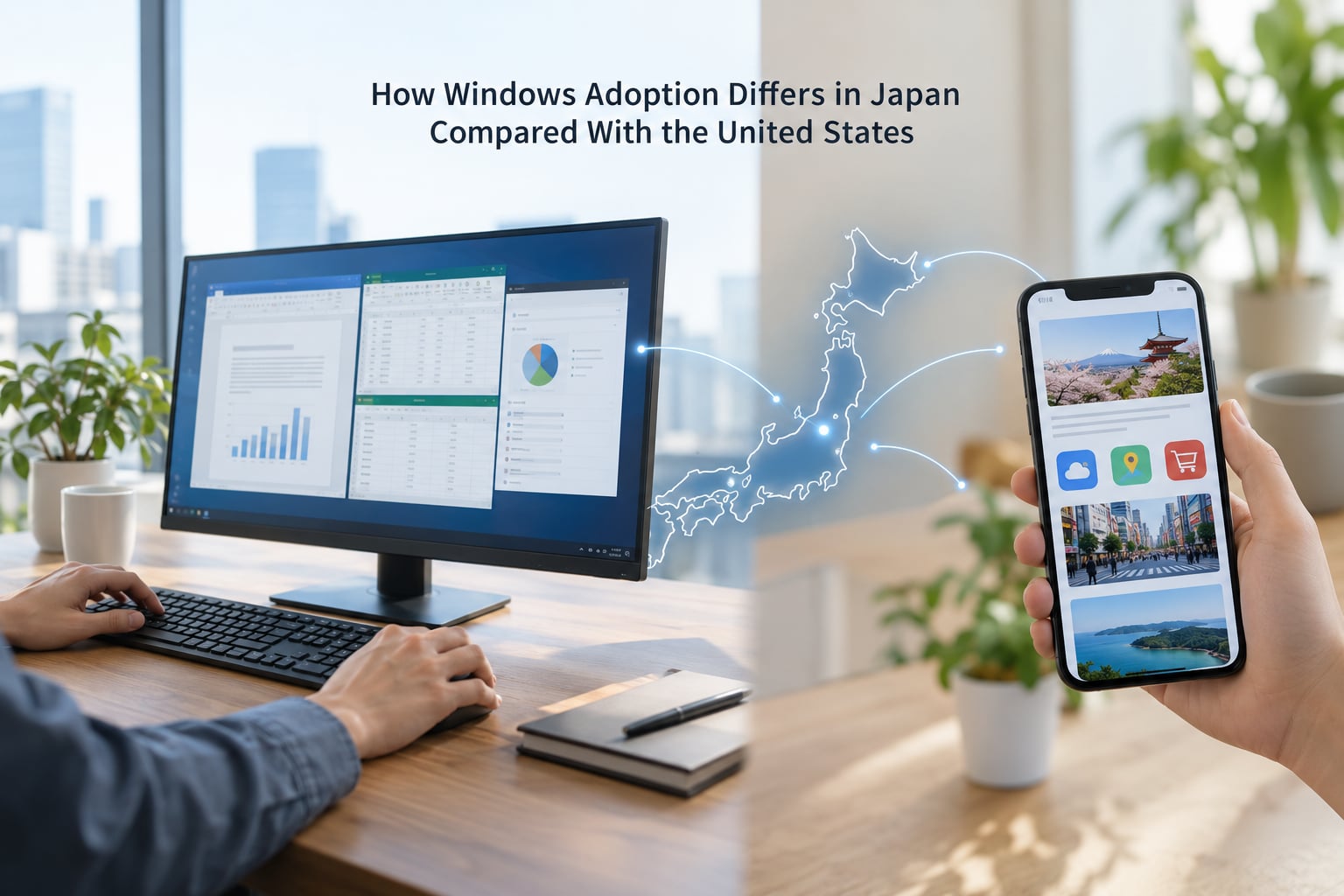
The clearest difference shows up in OS version share. As of August 31, 2025, Windows 11 accounted for 51.82% of Windows installs in Japan, against 59.28% in the United States and 60.53% in the United Kingdom. Worldwide the figure was 49.02%.
So Japan sits above the global average and well below the US and UK. That is the whole puzzle in one row.
| Region | Windows 11 share of Windows installs | Windows 10 share | Date measured |
|---|---|---|---|
| Japan | 51.82% | 44.82% | August 31, 2025 |
| United States | 59.28% | Not stated | August 31, 2025 |
| United Kingdom | 60.53% | Not stated | August 31, 2025 |
| Europe | 43.89% | 53.01% | August 31, 2025 |
| Worldwide | 49.02% | 45.65% | August 31, 2025 |
Source: StatCounter Global Stats, reported via Neowin and the Japanese-language TECH+ coverage on September 2, 2025. Treat these as directional; the tracker itself is caveated as not guaranteed accurate.
| Factor | Japan | United States | Caveat worth knowing |
|---|---|---|---|
| Installed base | Large and Windows-dominant | Large and Windows-dominant | Neither country publishes a clean installed-base count, so tracker traffic stands in for both |
| Windows 11 share | 51.82% | 59.28% | Measured from web traffic, not from fleet audits |
| Who buys the PC | Roughly 72% corporate | Much more consumer-weighted | The 72% figure comes from 2019 MMRI data |
| Refresh cycle | Five to seven years common | Shorter, with faster SMB churn | No single authoritative average exists for either country |
| Consumer Apple pull | Stronger premium tilt than the US | Weaker relative pull | Apple’s total Japan share was 5.5% in 2020 |
| Daily internet use | Mobile-first | More evenly split across devices | Desktop OS share barely registers either habit |
| Household PC ownership gap | 38.5% under 2 million yen income versus 92.7% above 10 million yen | Not measured on this income scale | FY2024 MIC survey; shows a real ownership divide inside Japan |
The household ownership gap is the row that most often gets left out. Japan’s FY2024 MIC survey found PC ownership at 38.5% among households earning under 2 million yen a year, against 92.7% for households above 10 million yen. Japan is not a country where everyone has a Windows machine at home, and treating the national average as universal hides that split.
What Japan-Specific Factors Change the PC Experience
Japanese-language interfaces come first, and they matter more than visitors expect. Menus, error messages and support flows are written in kanji and kana, and software that only ships an English interface is effectively unusable for most Japanese office workers. The same goes for input: Japanese text entry runs through conversion software layered on top of the standard layout, so keyboard and IME behaviour differs from a US machine in ways developers notice immediately.
Hardware models differ too. The domestic business lines from NEC and Fujitsu, sold through the Lenovo group, ship configurations built for corporate deployment: fixed configurations, longer warranty terms and support contracts rather than upgradeable consumer parts. Someone shopping for a home PC in Tokyo sees a different shelf than someone in Austin.
Regional services add another layer. Japanese consumers and small businesses rely on domestic platforms for banking, government services and payments, and those tend to be optimised for mobile browsers rather than desktop software. Installing a desktop client is often unnecessary.
It is worth separating cultural explanation from evidence here. The claim that Japanese buyers are inherently loyal to a single vendor is not supported by the data. The measurable drivers are procurement structure, refresh economics, software certification and hardware supply, not temperament.
Consumer and corporate systems also age differently. A business desktop might be five years into a managed lifecycle and patched on a controlled schedule. A home PC might be ten years old, unpatched, and used mostly to browse. Both count as Windows installs; they behave nothing alike.
How Mobile Devices Changed the Meaning of Windows
Smartphones did more to reshape Japanese computing than any PC release. Once daily internet use moved to phones, the desktop operating system stopped being the front door to the web for most people, and OS market share became a measure of one narrow slice of behaviour.
That shift changes what is worth tracking. Browser-based services and app ecosystems now matter more than the OS underneath them. Engagement, session counts and conversion on mobile say more about how a technology is actually adopted in Japan than any desktop share figure.
It also explains why Japan’s numbers look strange to people who expect a desktop-centric market. A huge Windows installed base coexists with a country where most daily tasks happen on a phone. Both statements are true, and neither one contradicts the other.
For anyone building for the Japanese market, the practical implication is straightforward: mobile is the default surface, and Windows is the enterprise surface. Treating either one as a proxy for the whole country is how campaigns end up aimed at nobody.
What the Differences Mean for Software Companies and Marketers
These are recommendations, not rules, and they assume you are trying to reach Japanese users or enterprises in 2026.
Ship a real Japanese interface first. A partial or machine-translated localisation costs you more in support than it saves in engineering. This is table stakes in the corporate segment and the reason many otherwise capable products simply do not appear in Japanese tenders.
Budget for enterprise procurement, not just self-serve. Japanese corporate buying runs through IT departments, resellers and formal approval paths. A trial-to-paid funnel built for US small businesses will stall here.
Test with real Japanese workflows. File name handling, local network drives, groupware and IME input all behave differently. Testing on a Japanese build in a Japanese locale catches problems that a translation review never will.
Read mobile behaviour separately. If your metrics come from desktop sessions, you are measuring a minority of Japanese internet activity.
Do not treat Japan as one audience. A national average hides the gap between a 25-year-old in Osaka on a phone and a finance department in Nagoya running a managed desktop fleet. The two need different products and different messages.
On the hardware side, watch the AI PC transition rather than assuming it follows the US timeline. In October 2026 Microsoft Japan dropped the Copilot+ PC name for new Surface hardware while keeping the neural processing unit requirement. When the branding moves but the silicon requirement does not, the practical effect for buyers is unclear, and anyone planning a fleet refresh should confirm device eligibility directly rather than inferring it from the badge.
Frequently Asked Questions
What is the Windows market share in Japan?
Windows accounted for 78.75% of Japanese desktop web traffic in September 2026, according to StatCounter Global Stats, with OS X at 10.1%, Linux at 5.36%, macOS at 4.95% and Chrome OS at 0.84%. That figure measures page views from sites running the tracker rather than installed machines, so it reflects web-heavy users and under-counts anyone using an ad blocker.
Why is Japan’s PC market so business-focused?
Because companies buy the machines. MMRI (MM総研) counted 15.3 million PCs shipped in Japan in 2019, of which 10.97 million went to corporate buyers and 4.33 million to consumers, roughly 72% corporate. Corporate purchasing brings procurement departments, IT departments and long refresh cycles into every hardware decision, which keeps the Windows installed base stable and slow to change.
Why is Windows 11 adoption slower in Japan than in the United States?
Japanese Windows 11 share stood at 51.82% as of August 31, 2025, against 59.28% in the United States and 60.53% in the United Kingdom. The gap comes down to hardware age and procurement: corporate fleets in Japan are commonly kept five to seven years, and a machine that old usually fails the Windows 11 hardware requirements, so it stays on Windows 10.
Is macOS more popular in Japan than in the United States?
Apple pulled 5.5% of Japan’s PC market in 2020, and much of that came from consumer buyers choosing Macs deliberately for build quality and after-sales service. Compared with other countries that is a strong premium tilt, but it sits on a small base and does not displace Windows in the corporate segment, where Windows-based workflows and software certification still dominate.
What happens to Windows 10 in Japan after end of support?
The support deadline pushed a large number of machines that could not run Windows 11 into ESU, Extended Security Updates, which buys security patches for Windows 10 devices that stay in service. Japanese small and business customers face a per-device cost for that coverage, so the practical choices are replacing the hardware, moving the fleet to Windows 11, or paying to keep unsupported machines patched for another period.
Which PC brands dominate the Japanese market?
In 2020 the Lenovo group, which counts Lenovo, NEC and Fujitsu together, held about 42% of the Japanese PC market, followed by HP Japan at 16% and Dell at 12%, with Apple at 5.5%. Because NEC and Fujitsu sit inside the Lenovo group, domestic enterprise configurations carry unusual weight in deciding which Windows models Japanese buyers actually receive.
Conclusion: Start With the Market You Are Measuring
Windows adoption differs in Japan because the market is built by institutions rather than individuals, and institutions buy slowly. The headline share stays high, the Windows 11 rate sits below the US and UK, and the consumer half of the market leans further toward premium Macs and phones than most Western comparisons suggest.
Before you draw a conclusion, name the market you actually measured. Corporate PC fleets, consumer Windows devices, active users and mobile internet behaviour are four different things, and they point in different directions.
Whichever one you are evaluating, the useful move is to say so out loud and date your figures. Share data moves monthly, and a number without a source and a date is not a fact, it is a rumour with a decimal point.
Sources: StatCounter Global Stats (desktop OS share for Japan, September 2026; Windows version shares as of August 31, 2025) · Neowin and TECH+ (MyNavi), September 2, 2025 · MMRI / MM総研 2019 shipment data as reported by NotebookPC.jp · 2020 Japan vendor share data (IDC) as reported by NotebookPC.jp · Ministry of Internal Affairs and Communications FY2024 Communications Usage Trend Survey · Microsoft Japan, October 2026.