Why Japanese companies returned to offices: the short answer is that the systems around them never went remote. Performance reviews that reward visible presence, approval flows built on paper and stamps, and Tokyo office leases that kept running through the pandemic all pushed employers back. Between 2024 and 2026, many large firms moved from open telework to three mandatory days in the office.
That is the short version. The longer version has less to do with a sudden change of heart and more to do with a mismatch that only showed up once everyone had the option to stay home.
The shift is real and measurable. Central Tokyo’s office vacancy rate sat at 1.87% in August, down from 6.49% in August 2022 and close to the 1.55% recorded in December 2019, according to figures from Miki Shoji Co reported by Japan Today. Demand for prime office space recovered almost all of the ground it lost during the remote-work boom.
Demand recovering does not automatically mean five days a week. What most companies settled on is a managed hybrid model: a set number of days in, some flexibility on which days, and fewer exceptions than the 2020 to 2022 period allowed. Understanding why they landed there, and what still varies, matters for anyone working in or with a Japanese company.
Table of Contents
- 1What Changed in Japanese Workplaces After the Remote-Work Boom?
- 2Why Japanese Companies Returned to Offices
- 3How Productivity, Collaboration, and New-Hire Training Shaped the Decision
- 4How Management and Security Concerns Influenced Office Mandates
- 5What Explains Why Japanese Companies Returned to Offices
- 6How Office-Return Policies Differ Across Japanese Companies
- 7Why Some Japanese Companies Still Keep Hybrid or Remote Work
- 8What Office Return Means for Employees, Managers, and Founders
- 9Frequently Asked Questions
- 10Did Japanese law force companies to bring employees back to the office?
- 11Are most Japanese technology companies back in the office five days a week?
- 12Can a Japanese employer require office attendance when a role could be done remotely?
- 13Why did some Japanese companies retain hybrid work after others issued mandates?
- 14Did remote work permanently change office attendance in Japan?
- 15What should an employee do if a company changes its office policy?
- 16Conclusion: Treat the Return to Offices as an Ongoing System
What Changed in Japanese Workplaces After the Remote-Work Boom?
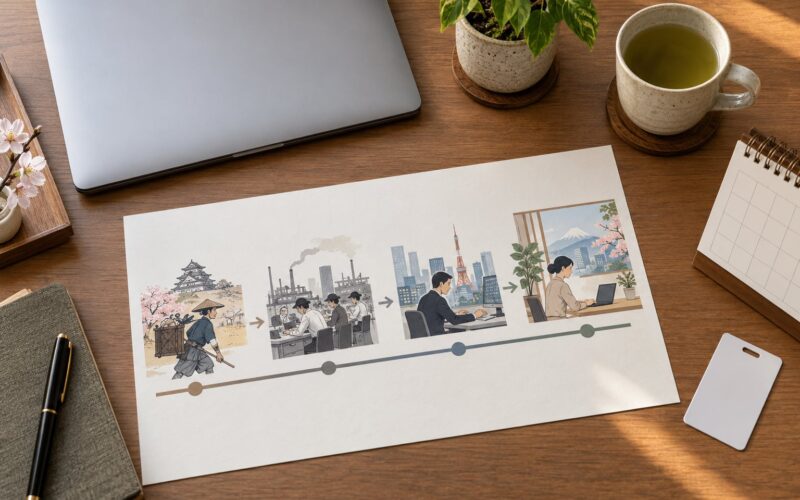
The pattern ran in four broad periods, and companies moved through them at different speeds.
| Period | Typical company position | What drove it |
|---|---|---|
| 2020 to 2022 | Telework encouraged or required, offices at low occupancy | Pandemic restrictions, plus high central Tokyo vacancy and an oversupply of sublease space |
| 2023 to 2024 | First rollbacks, voluntary return offers, team-by-team rules | Hiring resumed, new graduates onboarded, real-estate leases coming due |
| 2025 to 2026 | Named policies with day counts, often three days a week | Collaboration arguments, evaluation reform stalled, office demand tightening |
Not every employer followed the same route. Some kept flexible telework from the start and never revoked it. Others went straight from fully remote to a fixed number of days with no negotiation at all.
The building market moved faster than many policies did. Vacancy had already fallen before most firms had written a single attendance rule, which meant the office was full again whether the culture had caught up or not.
Why Japanese Companies Returned to Offices
Employers gave six connected reasons: collaboration and decision speed, evaluation and management visibility, onboarding of new graduates, the cost of offices they were already paying for, competition for talent, and control of information and security. The weight on each one varied sharply by company and by sector.
How Productivity, Collaboration, and New-Hire Training Shaped the Decision
Collaboration was the most common public reason, and the least specific. Sony Semiconductor Solutions told reporters it was bringing roughly 8,000 staff back because remote work slowed coordination on cross-divisional work, and it paired the mandate with open communication spaces and private focus rooms. LY Corporation framed its move to three days a week around cross-department relationships.
The practical version of the argument is about unplanned contact. A question that resolves in ten seconds at a desk takes a scheduled call when half the team is remote. New graduates have a harder problem still: much of what they learn in their first year is absorbed by watching, not by being told.
Employee experience reports point the same way, though reluctantly. One commenter in a Japanese forum thread described being far more productive in the office, citing fewer home distractions and cafeteria lunch, and leaving the company anyway.
How Management and Security Concerns Influenced Office Mandates
The deeper issue is measurement. Many Japanese companies still evaluate managers and staff partly on visibility: arriving early, staying late, being seen to cooperate. Remote work made that signal unreadable, and managers who were not trained to assess output on its own tended to fall back on presence.
An employee essay published on Medium in June 2026 framed the rollback as an evaluation-system problem rather than a tooling problem, pointing to hanko stamp workflows and in-person approval routes that did not digitise during the remote period. Processes designed for people in the same building did not transfer neatly to video calls.
Security and intellectual property come up too: access to internal systems, handling of unreleased product information, client data on personal devices. Those concerns existed throughout the remote period and were not usually the primary motive, but they gave compliance teams a reason to prefer controlled environments.
The practical problem is that a manager who cannot see output has no alternative metric yet, so attendance becomes the proxy. Fixing that requires evaluation reform, which is slower than issuing a policy notice.
What Explains Why Japanese Companies Returned to Offices
Put the reasons together and the pattern looks like four pressures hitting at once: processes that still assume physical co-location, evaluation systems that measure presence, fixed property costs with no easy exit, and a hiring cycle that restarted with new graduates arriving at the same time.
Property economics reinforced the rest. Rents in Tokyo did not fall enough during the boom to justify shrinking, and redevelopments were postponed or slowed by construction costs. When demand returned, companies were sitting on expensive space again. Calbee expanded its office footprint toward roughly a desk per employee rather than shrinking its footprint.
None of these forces requires a universal five-day week. They require people in the building often enough that informal exchange and in-person approval still work. Most employers picked three days as the number that satisfied that without making the commute unbearable for everyone.
How Office-Return Policies Differ Across Japanese Companies
Policy types cluster into a handful of models, and companies often run more than one at once depending on the team.
| Policy type | Office expectation | Flexibility | Typical exceptions |
|---|---|---|---|
| Full-time in office | Five days, rarely negotiated | Almost none | Rare, usually role-specific |
| Fixed hybrid | Three days, days set by team | Which days only | Childcare, caregiving, health |
| Role-based | Varies by function | Wide for IT, narrow for sales and training | Team-level discretion |
| Team-based | Team sets its own anchor days | High, but coordination matters | Individual arrangements |
| Outcome-based | No fixed day count | Wide | Common at foreign firms and smaller startups |
Named examples help calibrate expectations. LY Corporation raised attendance to three days a week. GMO Internet Group ended its remote work recommendation in July, framing the office as an element of competitiveness. Accenture abolished remote work in Japan. Each of these is one company’s decision, not a national standard, and policies change with leadership.
Why Some Japanese Companies Still Keep Hybrid or Remote Work
Flexibility did not disappear. It survived where the economics and the roles supported it.
Companies with genuinely distributed research or engineering work found co-location expensive and co-decision slow, so they kept anchor days rather than mandates. Foreign firms operating on global team norms often kept outcome-based arrangements, since their reporting lines cross borders anyway. Firms that had shrunk their real estate footprint could keep hybrid without absorbing an unused lease.
Recruiting also pushed the other way. In a shrinking domestic labor market, restrictive attendance rules make it harder to attract experienced staff and international hires who expect flexibility as standard.
One important distinction: office availability is not the same as mandatory attendance. Plenty of companies keep desks open on optional days, let staff book focus rooms, or offer coworking allowances instead of a commute. Employees often report that a nominal three-day policy can become closer to four or five once catch-up work piles up, which is where the hybrid mismatch complaint comes from: in the office, but the colleague you need is not.
What Office Return Means for Employees, Managers, and Founders
For employees, the practical changes are concrete: longer commutes from outer wards, reworking of childcare and caregiving logistics, and a different basis for career visibility. Workers in their forties report losing the relationship-based evaluation they relied on, and younger staff in single-room apartments often find home working conditions poor.
Pushback is visible in forums. In a thread on r/japan, users discussed startup cash incentives for returning to the office and generally preferred flexibility and coworking options instead. One commenter said a three-day requirement left almost no real home days in practice. Another said a mandate was the single biggest factor in leaving a 15-year job at a large motorcycle maker.
Caregiving falls unevenly across this. Of those affected by office mandates, women carry more of the childcare load, which is why childcare and caregiving exemptions appear in most new policies. Sony Semiconductor Solutions paired its mandate with a lunch subsidy and caregiving exemptions, a common mitigation package.
For managers, the work is harder than the policy notice suggests. They need to evaluate output without visibility, set clear anchor days, and avoid letting flexible roles drift into always-on availability. For founders and people leaders, the open questions are recruiting competitiveness, office cost per employee, and whether a relocation or redundancy follows a shrinking footprint.
Anyone affected should check the official attendance rules for their own company, ask how the day count is measured, and confirm what exceptions exist in writing before making arrangements. This article describes general patterns in Japanese employment, not individual legal or HR advice; specific entitlement questions belong with your employer or the relevant labor authority.
Frequently Asked Questions
Did Japanese law force companies to bring employees back to the office?
No. No Japanese law required employers to end remote work. Attendance rules are set by each employer and reflected in company policy and labor-management agreements, where they exist. Japanese law sets obligations around working hours, safety and telework handling, but it does not dictate how many days a week staff must be physically present. Individual entitlement questions should go to your employer or the relevant labor authority.
Are most Japanese technology companies back in the office five days a week?
No. Five-day mandates are the exception rather than the norm among large Japanese technology and services firms. Three in-office days per week is the pattern most often reported, and several firms have framed it around cross-department collaboration and onboarding. Some organizations run team-based anchor days or role-based rules, so the requirement depends on your company, your team and your function rather than on a national norm.
Can a Japanese employer require office attendance when a role could be done remotely?
In practice, yes. Employers set working location as part of employment conditions, and the strength of that right depends on your contract, company rules and any labor-management agreement. A remote arrangement agreed informally is much weaker than a written one. If attendance rules change, the normal expectation is that the company explains the change, applies agreed exceptions such as caregiving, and handles it through its established consultation process.
Why did some Japanese companies retain hybrid work after others issued mandates?
The usual reasons are role shape and cost. Companies whose work is genuinely distributed, or that reduced their office footprint, can run hybrid without absorbing unused space. Firms competing for scarce experienced staff or international hires often keep flexibility to stay attractive. Foreign firms applying global team norms also tend to stay outcome-based. None of this reflects a formal exemption; it reflects different jobs, leases and hiring pressure.
Did remote work permanently change office attendance in Japan?
Attendance rose again rather than settling permanently lower, and central Tokyo vacancy fell back to near pre-pandemic levels by August, which suggests demand returned. But the old model did not fully return either. What replaced it is managed hybrid: fixed in-office days, limited flexibility, and named exceptions for caregiving and health. Remote work changed expectations about flexibility, and that expectation now shapes policies rather than replacing them.
What should an employee do if a company changes its office policy?
Get the change in writing, including the required day count, how attendance is measured, and which exceptions apply. Then check whether your contract or labor-management agreement sets a consultation process for changes to working conditions. Ask how the policy affects role-specific duties, caregiving arrangements and commuting costs. If you are an inbound worker or on a fixed-term contract, confirm whether your terms differ before assuming the general rule applies.
Conclusion: Treat the Return to Offices as an Ongoing System
Japanese companies did not reverse the remote-work experiment wholesale. They rebuilt a managed hybrid system: fixed in-office days, limited flexibility, and exceptions written down.
If you are making a decision here, start with the official attendance rules of the specific company and role, then compare them with what the work actually requires. That tells you more than any statement about Japan in general.