Japanese home internet is cheap because NTT East and NTT West own the country’s fiber access network and wholesale the same physical line to dozens of competing internet providers under the Hikari Collaboration model. Because every major ISP resells the same network, prices get competed down instead of protected, and home lines carry no per-gigabyte charge at all.
That single structural fact explains most of what people notice when they arrive here. A gigabit line with unlimited data commonly costs less per month than a comparable plan in the US, and a symmetric gigabit line in a Japanese apartment is routine rather than a premium upgrade. Prices in this guide are typical figures as of October 2026; they vary by region, building and campaign, and providers change them regularly.
Table of Contents
- 1What Japanese Home Internet Costs
- 2Why Japanese Home Internet Is Cheap
- 3Why Japan’s Broadband Is Cheaper Than the US and UK
- 4What Affects the Price
- 5Why Cheap Does Not Always Mean Fast
- 6Ways to Save
- 7Frequently Asked Questions
- 8Is home internet in Japan really cheaper than in the US?
- 9Why do some Japanese internet plans become more expensive after the first year?
- 10Do Japanese apartments come with internet included?
- 11Can I use a home internet plan without a long-term contract?
- 12How fast is Japanese home internet compared with gigabit services?
- 13Can a foreigner get an English-language home internet plan in Japan?
- 14Conclusion
What Japanese Home Internet Costs
Most households in Japan pay between roughly 2,500 and 4,500 yen a month for a fiber line in an apartment block (集合住宅, read manshon), and between 3,500 and 6,500 yen for a detached house (一戸建, read ikkodate). Detached homes cost more because the fiber has to be run from the street to the building, and that construction is billed separately.
| Service type | Apartment (manshon) typical monthly | Detached house (ikkodate) typical monthly | Typical max speed |
|---|---|---|---|
| Fiber, Hikari Collaboration reseller | about 2,500-3,700 yen | about 3,700-4,700 yen | 1 Gbps down / 1 Gbps up |
| Fiber, NTT FLET’S Hikari direct | about 3,900-5,700 yen | about 4,700-6,300 yen | 1 Gbps down / 1 Gbps up |
| SoftBank Hikari or au Hikari (KDDI line) | about 2,700-4,000 yen | about 4,200-6,500 yen | 1 Gbps down / 1 Gbps up |
| 10 Gbps fiber (NURO, select Hikari lines) | about 4,500-6,500 yen | about 5,000-7,000 yen | 10 Gbps symmetric |
| Fixed wireless home WiFi (5G router) | about 4,000-6,000 yen | about 4,000-6,000 yen | service-dependent, often shared |
| Carrier bundle (mobile + fiber discount) | often 1,000-2,000 yen below list | often 1,000-2,000 yen below list | unchanged by the bundle |
Those monthly figures are only part of what you pay. The first-year all-in number is what actually matters when you compare providers, because the installation charge and the router rental can outweigh a year of savings from a cheaper monthly rate.
| Cost item | Typical range | When it applies |
|---|---|---|
| Installation / construction fee | 0 to about 20,000 yen | Often waived on a 2-year contract; a self-install line arriving in a built-out apartment often costs nothing at all |
| Router or ONU rental | 0 to about 800 yen a month | Waived on many plans; buying your own router instead often costs less over two years |
| Optional menu add-ons | 100 to about 500 yen a month each | Security, cloud storage, TV and support options are sold separately, and default-on extras are a common trap |
| Consumption tax | 10% on the monthly fee | Applied to most residential lines; some campaign pricing is already tax-inclusive |
| Early cancellation fee | 0 to about 20,000 yen | Charged inside the 2-year minimum term, and often a smaller fee for the months remaining in year two |
A term of Japanese technical vocabulary helps when you read provider pages, because almost all pricing information sits behind Japanese-only signup flows. 光 (hikari) means fiber optic. 光コラボ (hikari kyaborēshon) is the Hikari Collaboration model, where an ISP sells service over NTT’s line. The ONU (回線終端装置, kaishū shūtan sōchi) is the box where the fiber enters your home. 集合住宅 is an apartment building and 一戸建 is a detached house. 混雑時間 refers to the evening peak window when traffic slows.
Why Japanese Home Internet Is Cheap
The low prices come down to seven structural causes, and they reinforce each other. Once you see how the network is built, the monthly number stops looking like a promotion.
1. One owner builds the network, many ISPs sell it. NTT East and NTT West are overwhelmingly dominant in fiber access. They do not need to win retail customers, so they wholesale the line to competitors at a regulated-style rate rather than pricing it for margin. The ISP layer, where marketing and customer service costs live, is duplicated dozens of times; the expensive layer is not.
2. Heavy competition in the resale layer. SoftBank Hikari, au Hikari, docomo Hikari, Biglobe Hikari, Asahi Net, NURO and dozens more sell over the same NTT pipe. Because the underlying network is identical, they compete on price, bundle credits and contract terms rather than on coverage.
3. Fiber is the default, not a premium tier. ADSL has now been switched off across Japan, which pushed essentially the whole country onto FTTH. Once fiber is the standard access technology, it costs almost nothing extra to deliver gigabit, so providers price it like a commodity instead of a luxury upgrade.
4. Urban density shortens the last mile. Most Japanese apartments sit within a short run of a neighborhood fiber cabinet, and buildings are often wired back to a shared facility. That shared approach spreads one construction cost across every unit, which is the opposite of how low-density US suburbs pay for their own cable drops.
5. No cable infrastructure to build or defend. Cable broadband has almost no residential presence in Japan. Cable operators spent decades on an HFC buildout and never gained the density to be competitive with fiber, so they never became a third option that keeps prices high.
6. The wholesale floor caps retail prices. Because the line owner publishes wholesale rates, an ISP cannot invent a fat margin on access. A reseller’s profit comes from selling service and bundles, and when many firms chase the same customer with slightly different discounts, the headline price drifts down.
7. Legacy prices never reset upward. For years, ADSL lines kept basic monthly rates cheap as fiber arrived, and providers fought to keep existing customers rather than reprice them onto new fiber plans. When fiber replaced ADSL wholesale, the low base rates carried over. Japan’s baseline broadband price is still anchored to that older, cheaper market.
The practical consequence is that a Japanese gigabit line has almost no meaningful speed tiers to buy. Moving from 300 Mbps to 1 Gbps often costs less than a few hundred yen extra, and home data is uncapped, so nobody meters heavy use.
Why Japan’s Broadband Is Cheaper Than the US and UK
Japan’s broadband is structurally cheaper because the country never let one retail incumbent own a fragmented, expensive last mile. US pricing rose for the opposite reasons: multiple cable operators carved up serviceable areas, copper lines stayed in service far longer, and replacement programs were never built at national scale.
| Factor | Japan | United States | United Kingdom |
|---|---|---|---|
| Number of network owners covering a typical home | One, with dozens of ISPs reselling it | Thousands of cable operators, telcos and fiber overbuilders | Mostly Openreach, with a growing alternative network sector |
| Typical 1 Gbps residential monthly fee | about 2,500-4,500 yen for a symmetric gigabit line | Routinely several times the Japanese figure for the same nominal speed | Several times the Japanese figure over a standard long term |
| Access network owner | Effectively NTT East and NTT West | Hundreds of cable operators, telcos and fiber overbuilders | Openreach for most lines, plus growing alternative networks |
| Data cap on home lines | None | None on most fiber lines | None |
| Installation charge | 0 to about 20,000 yen, often waived | Common on promotional fiber plans | Often included in a long contract term |
| Wholesale access regulation | Fiber access lines resold to many ISPs | Limited unbundling, region-dependent fiber overbuild | Openreach wholesale to competing ISPs |
| Typical contract length | 2 years | 1 year or none | 18-24 months |
One trap worth naming: yen amounts look cheap when converted, and that comparison flatters Japan. Salaries, rent and most household costs are also in yen, so a 3,000 yen internet bill is genuinely low relative to local earnings. Comparing Japanese broadband to US broadband in yen is only fair if you also compare it to what a Japanese household spends on rent.
The stronger claim is about how the two networks are built, not about the exchange rate. Japan’s fiber access is essentially a national utility with a competitive retail layer on top. That is a structure the US never assembled, which is why US broadband prices did not follow Japan downward as fiber spread.
What Affects the Price
Japanese internet price varies with eight things: the speed tier, symmetric versus asymmetric service, the line owner, the ISP, the contract term, the promotion period, the building type, and whether a mobile line is bundled. Here is how each one moves the bill.
| Factor | Effect on the monthly bill | Effect on upfront cost |
|---|---|---|
| Speed tier (300 Mbps vs 1 Gbps vs 10 Gbps) | Higher tiers cost more, but usually a few hundred yen | 10 Gbps lines sometimes carry higher construction charges |
| Symmetric vs asymmetric fiber | Asymmetric lines (fast down, slow up) are cheaper; symmetric lines cost more | No difference |
| Line owner and ISP | Reseller lines sit below NTT direct pricing; SoftBank and au compete hardest in apartments | Some resellers waive construction on a 2-year term |
| Contract length | 2 years is the norm; monthly terms usually price higher | A longer term unlocks a waived installation fee |
| Promotion period | Campaign pricing can apply for a set number of months, then revert to list | No effect, but it changes the first-year total |
| Router or mesh equipment | Rental from 0 to about 800 yen a month; owning your own is cheaper long term | A one-time hardware purchase |
| Mobile bundling | Smart Value style discounts cut the fiber bill by roughly 1,000-2,000 yen a month per mobile line | No effect, but it can tie the two contracts together |
| Optional service menus | Small but additive fees for security, storage or TV options | No effect |
Two of those deserve extra weight. First, a symmetric gigabit line uploads at a gigabit too, which is unusual outside Japan and matters more than headline download speed for anyone doing video calls, cloud backups or large file transfers.
Second, the campaign-price trap: cheap headlines often describe a promotional period. When it ends, the monthly fee can jump sharply, and it is the post-promotion price that belongs in a long-term budget.
Why Cheap Does Not Always Mean Fast
Low price does not guarantee a good experience, and the gap comes from the building and the last mile rather than the plan. Residents on forums such as r/japanresidents and r/japanlife repeatedly report the same patterns, and they explain most of the “cheap but slow” complaints.
Evening congestion. Between roughly 7 PM and 11 PM, household traffic peaks. Residents report connections that feel fine all day and struggle in the evening, which is a load problem rather than a fault in your line. IPv6 on most Hikari services helps because it carries more traffic natively, but it cannot remove the peak.
Building-level restrictions. Some apartment buildings pre-wire for one specific ISP and refuse installation for others, or the landlord only permits one provider. In a concrete high-rise, WiFi coverage inside the unit is often weak even on an excellent line, and residents frequently fix that with their own mesh system instead of the rental router.
Rural and mountainous areas. Where fiber is unavailable, mobile broadband is the only fixed alternative, and users in places like Gunma and Okinawa report that as noticeably slow. Forum threads on that gap are the clearest example of the low national price not applying everywhere.
Old buildings with no ONU port. Concrete apartments built before fiber wiring may have no fiber socket at all, which forces either a construction charge from the line provider or a different connection type entirely.
The honest summary: urban Japanese fiber on a 1 Gbps symmetric line is fast and cheap. The complaints that get posted online are usually about buildings, coverage and evening congestion, and they are worth checking before you sign, not after.
Ways to Save
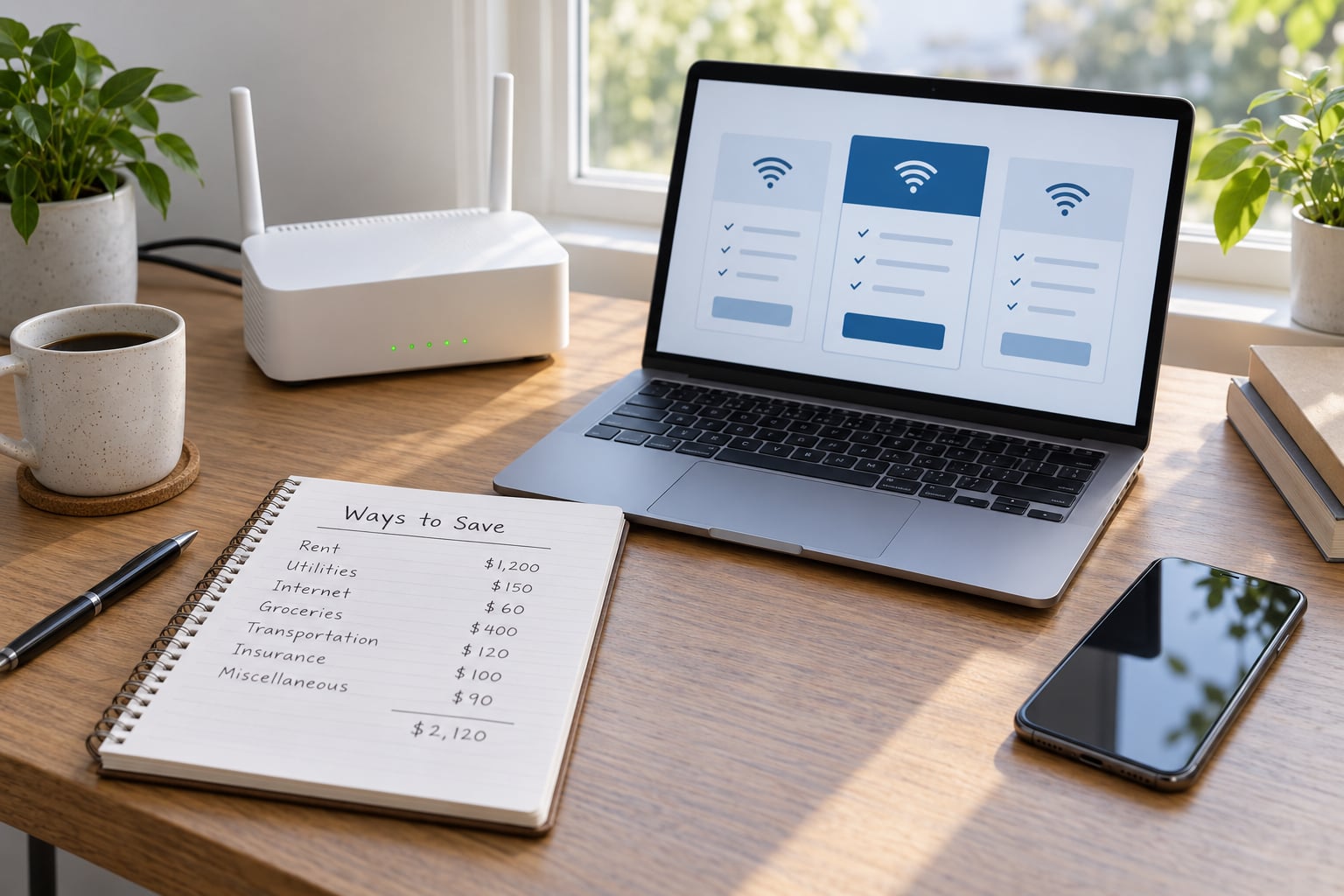
Six things reliably lower the bill, and none of them require haggling with the line owner. That last point matters: the wholesale rate is fixed, so the savings all come from the ISP layer.
Compare the first-year total, not the monthly rate. Add the construction fee, router rental and the post-promotion price together. A plan that is 300 yen cheaper monthly can cost more across a year if it carries a 19,800 yen installation charge.
Sign on a 2-year term if you’ll still be there. Construction fees are usually waived on a 2-year contract. If your stay is shorter, take the monthly-term plan and accept the higher construction charge, or use a fixed wireless service you can cancel.
Bundle only if you genuinely want the mobile line. A mobile discount of 1,000 to 2,000 yen a month is real money, but taking a mobile line you do not need to get it is a poor trade. Check whether the bundle also lengthens your commitment.
Use a price comparison site. kakaku.com lists current fiber plans with full contract terms, including optional menus and cancellation fees. It is the fastest way to see which providers are running a campaign this month.
Drop the optional menus and buy your own router. Default-on extras like security packages add up quietly each month, and a third-party mesh system often beats the rental router on coverage and cost at the same time.
Confirm what happens when the promotion ends. Ask for the regular monthly fee in writing during signup. If the answer is vague, treat the campaign price as temporary in your budget.
Before signing a lease rather than a contract, check which providers already serve the building. That single question can save you a construction charge, a longer lead time, or both.
Frequently Asked Questions
Is home internet in Japan really cheaper than in the US?
Yes, and the gap is structural rather than a short-term promotion. NTT owns the fiber access network and wholesales it to dozens of ISPs, so retail prices are competed down. US broadband costs more because thousands of cable operators and telcos each own their own last mile, and those duplicated networks have to be paid for. Home lines in Japan also carry no per-gigabyte charge and typically allow 2-year contracts with a waived installation fee.
Why do some Japanese internet plans become more expensive after the first year?
Most headline prices are campaign prices that apply for a set period, often 12 to 24 months. When the period ends, the bill reverts to the regular list price, which can be considerably higher. This is a standard sales tactic in Japan, not a sign of a bad provider. Ask for the post-promotion monthly fee in writing before you sign, and budget for that figure rather than the advertised one.
Do Japanese apartments come with internet included?
Usually not. Japanese apartments are leased unfurnished as a rule, and internet is treated as a separate utility you arrange yourself, similar to gas or electricity. The exception is a small number of serviced apartments and some newer rental developments that include a connection or a discount. Check with the property manager before moving in, and ask which ISPs already serve the building, because older concrete blocks sometimes allow only one provider.
Can I use a home internet plan without a long-term contract?
Yes, though the terms differ. Most fiber plans use a 2-year minimum term and charge an early cancellation fee if you leave early. Some providers offer shorter terms or month-to-month options at a higher monthly price, and fixed wireless 5G services are usually contract-free but slower. If your stay in Japan is under a year, a no-contract plan or fixed wireless is usually the lower-risk choice.
How fast is Japanese home internet compared with gigabit services?
On paper it matches or exceeds gigabit services elsewhere. Most apartment fiber plans deliver around 1 Gbps down, and the standard is symmetric, so uploads reach gigabit speed too, which is rare in the US and UK. 10 Gbps plans exist through providers such as NURO on select lines. Real-world results depend on the building, WiFi coverage inside the unit and evening congestion between roughly 7 PM and 11 PM.
Can a foreigner get an English-language home internet plan in Japan?
Yes, with some searching. Several providers, including Biglobe, Asahi Net, SoftBank and au, offer English-language signup and support pages, and payment methods have broadened beyond Japanese credit cards at many of them. Japanese-only signup flows remain common, so it is worth confirming before you choose a provider. Providers such as GTN and Sakura also cater specifically to foreign residents, usually for a higher monthly fee.
Conclusion
Japanese home internet is cheap because one company built the access network and sells it wholesale to everyone else. That structure, combined with fiber as the default access technology and the disappearance of ADSL, produced low baseline prices that legacy tariffs still hold down today.
Start by comparing the all-in monthly price rather than the headline rate. Include the connection type and whether it is symmetric, the length of the promotional period and what the fee becomes afterwards, the installation cost, and the contract terms with their cancellation fees. Those five numbers tell you everything the monthly price hides.