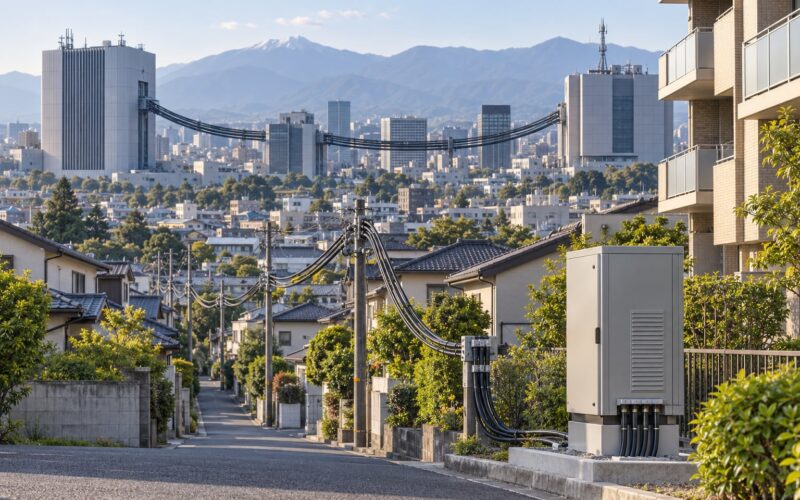
Japanese internet is fast for structural reasons rather than marketing ones: almost every home and office is wired directly to glass fiber, the country is compact and densely built so networks stay short, several trans-Pacific submarine cables land on its coast, and three national carriers have spent decades pushing symmetric gigabit down to the standard plan. Speed still depends on your address, your provider and the wiring inside your building.
Table of Contents
- 1Why Japanese Internet Speeds Are Fast
- 2Why Japanese Internet Speeds Are Fast in Major Cities
- 3How Fast Are Japanese Internet Connections?
- 4Which Technologies Make Japanese Internet Fast?
- 5Why Japanese Internet Speeds Are Fast on Fiber
- 6How Competition and Regulation Affect Internet Performance
- 7Why Do Internet Speeds Vary Between Cities and Rural Areas?
- 8Why Can a Fast Connection Still Feel Slow?
- 9Is Japanese Internet Faster Than in Other Countries?
- 10Frequently Asked Questions
- 11Are Japanese internet speeds faster than in the US or UK?
- 12Why does my Japanese internet speed drop during busy hours?
- 13Does a 1 Gbps Japanese internet plan guarantee gigabit speeds?
- 14Is Japanese internet fast enough for remote work and gaming?
- 15Should visitors use pocket Wi-Fi or an eSIM for fast internet in Japan?
Why Japanese Internet Speeds Are Fast
Japanese internet speeds are fast because fiber reaches nearly every building, distances between a home and the network are short, cable landings and backbones carry heavy international traffic, and enough providers compete on the same streets that gigabit became the default rather than a premium. None of that guarantees a gigabit line at your specific door.
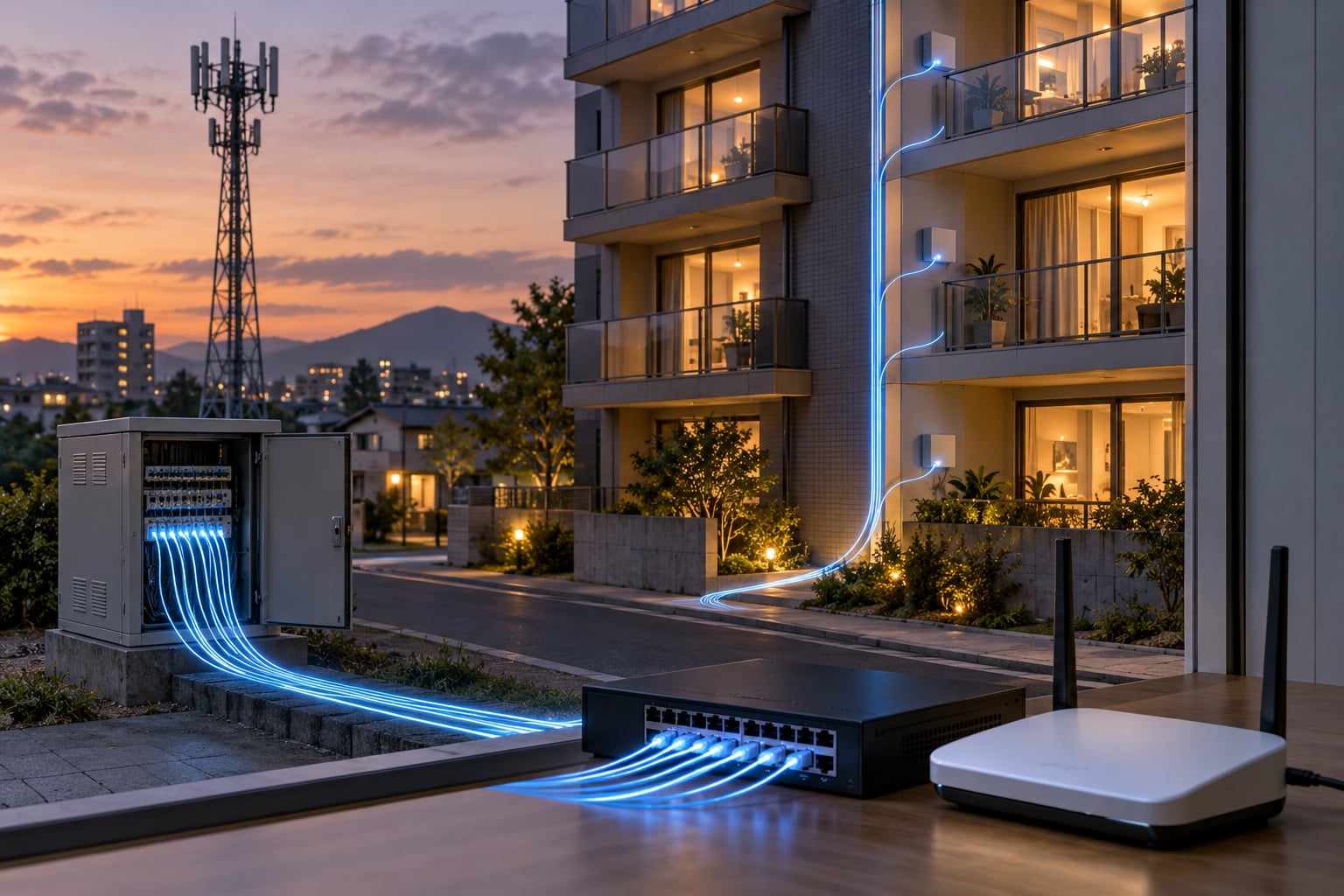
- Fiber reached almost every building. What most people mean by FTTH, fiber to the home, is a glass strand running from the street cabinet into the wall. More than 99% of Japanese households can be connected this way, so copper is the exception rather than the rule.
- The country is small and packed. A compact island means a network operator’s cable covers more customers per kilometer of trench. Digging once to serve forty units beats digging once for three.
- Submarine cables land here. Japan sits on the great circle routes between North America, East Asia and Australia, so it hosts a disproportionate share of trans-Pacific cable landings. Capacity that arrives on a beach is capacity the domestic network can use.
- Three national carriers compete. NTT, SoftBank and au KDDI all sell fiber in most urban areas, and the price of a gigabit line falls when three companies chase the same apartment block.
- Upload is symmetric. Home plans send and receive at the same rate, which matters for video calls, backups and publishing, not just downloads.
- Access equipment is not ancient. Providers have kept routers and switches current because the customer base is large enough to justify the spend.
Two further points matter for anyone evaluating a headline number. First, this is a description of infrastructure, not of every experience. Second, a Japanese fiber line and a Japanese mobile connection are two different stories, and the second one is not flattering.
Why Japanese Internet Speeds Are Fast in Major Cities
Density does most of the work in a city like Tokyo. Buildings are stacked, not spread out, so one fiber run reaches dozens of households, and the exchange that serves you is often a short walk away rather than a village away.
A central Tokyo apartment in a building built in the last twenty years usually has a fiber-ready entry point and a provider that already serves the block. The resident plugs in, runs a wired test and sees close to the plan rate.
An outer-Tokyo house gets the same technology with more distance between the cabinet and the walls. The speed drop is usually modest, but older internal wiring and a shared entry point can cost more than geography does.
A regional city such as Fukuoka or Sendai still tends to have fiber coverage and at least two providers, though the fastest plan tiers may not be sold on every street. The pattern holds more often than not, but it is not a promise, and a quick coverage check for a specific address beats any general claim.
How Fast Are Japanese Internet Connections?
Gigabit marketing describes a connection option, not a guaranteed result. These are the realistic ranges for a home in a well-served urban area, not laboratory figures.
| Measure | Typical result | What moves it |
|---|---|---|
| Advertised plan speed | 1 Gbps or 10 Gbps on many urban lines | Provider and address |
| Wired download | 700 to 950 Mbps on a gigabit line, several Gbps on a 10G line | Device, router port, server |
| Upload | Usually equal to the download rate on the same plan | Plan type |
| Latency to a nearby server | Roughly 5 to 30 ms | Distance and time of day |
| Wi-Fi in the same room as the router | Often 300 to 900 Mbps on a good 6 GHz or 5 GHz setup | Router model, walls, clients |
| Mobile on 5G | Varies widely; noticeably below the fixed experience in many areas | Coverage, handset, congestion |
| Shared connections in hotels and older buildings | Can range from unusable to excellent | Wiring age, number of users |
The gap between plan speed and measured speed is normal everywhere, not a Japanese quirk. A gigabit line measured at 850 Mbps has simply lost the overhead of the protocol, and that is fine.
Which Technologies Make Japanese Internet Fast?
Speed is not one invention. It is a stack, and each layer removes a limit that the layer below it imposes.
- Fiber to the home. Light through glass loses far less signal over distance than electricity through copper, which is why fiber can carry gigabit rates over ordinary neighborhood distances.
- Wavelength-division multiplexing. DWDM, dense wavelength-division multiplexing, sends many separate colors of light down one strand at once and separates them at the far end.
- Optical amplification. Doped-fiber amplifiers boost light without converting it to electricity. Raman amplification works by using the fiber itself as the amplifier, which keeps long-haul links cheap to run.
- Fixed wireless access. 5G can serve a home where running fiber is uneconomic, though performance varies with terrain and tower load.
- The backbone. Domestic and international routes, including the cable landings, decide how fast a request reaches a server abroad.
- The router. An older home router with 100 Mbps Ethernet ports will cap a gigabit line no matter how good the fiber is.
Why Japanese Internet Speeds Are Fast on Fiber
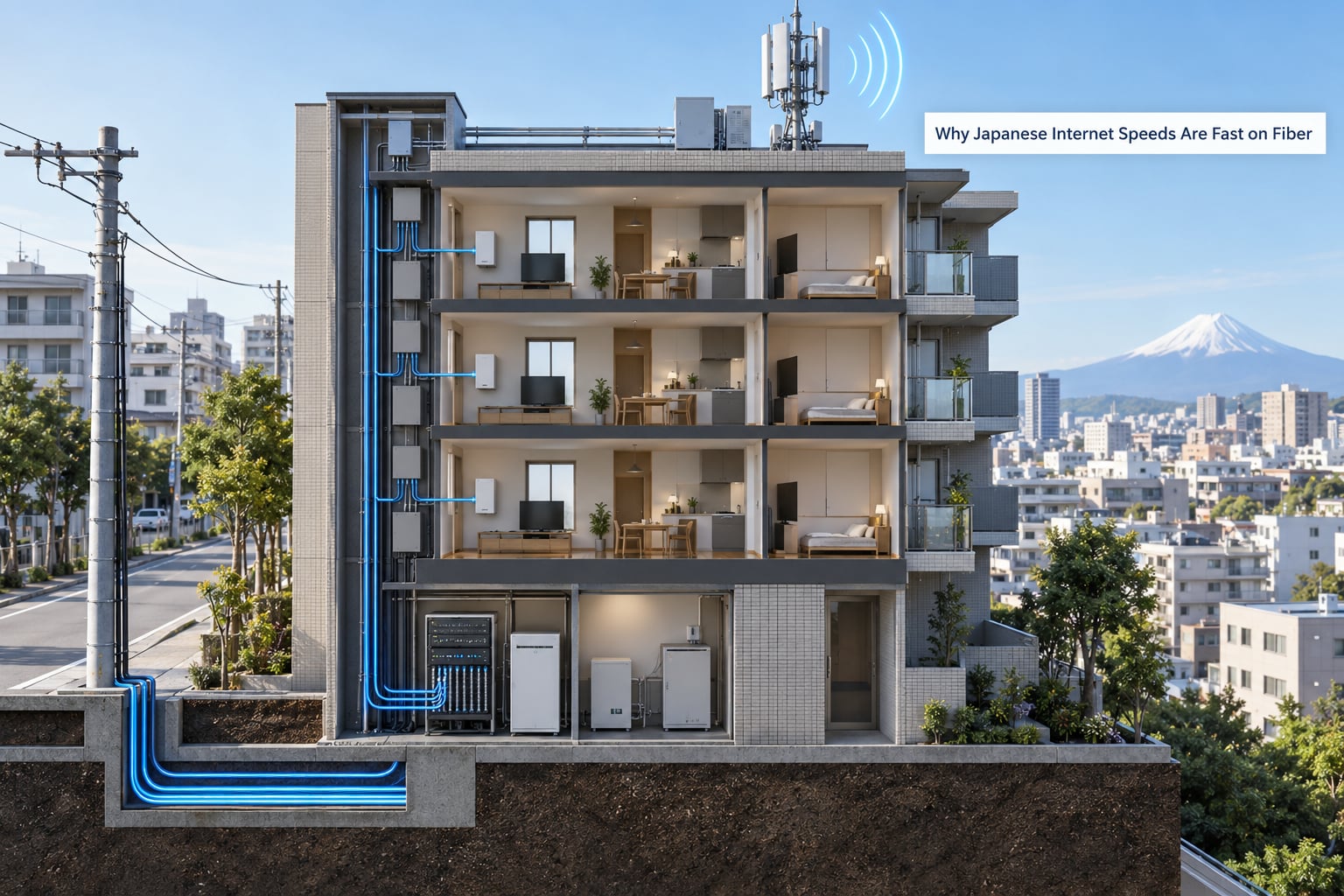
Fiber wins on three practical points. Latency stays low and steady because light does not need to be regenerated and reshaped the way electrical signals do, wired performance holds up under load, and symmetric plans let you upload at your full rate. Availability is the real constraint, and it is largely solved in cities and still being solved elsewhere.
Research teams push far past what a household can use. NICT, the National Institute of Information and Communications Technology, has posted a run of transmission records over standard fiber: 402 terabits per second across roughly 50 km using dense multiplexing from the O band to the U band plus doped-fiber and Raman amplifiers, and a later 1.02 petabits per second carried about 1,120 miles through a cable with 19 separate cores, announced in 2026.
Those numbers describe a transport capability, not a shoppable plan. A petabit per second is a million billion bits moving each second, and no consumer disk, port or processor can absorb it. The value is in proving that the physics and the equipment exist, which is what makes later commercial gains possible.
How Competition and Regulation Affect Internet Performance
Japan’s three large carriers built national fiber networks under a regulated market, and the rules shaped what households get. Where operators are required or expected to share infrastructure, the cost of a second provider in a neighborhood falls, and that price pressure shows up in the plan a resident is offered.
Urban density amplifies the effect. When thousands of households sit inside a few kilometers, three providers can each build a profitable route, and a fourth only needs a virtual network on top of an existing one. Expect choice to thin out as you move away from cities.
Competition does not work magic. In a rural area with a handful of potential customers per kilometer, building fiber means digging trenches for very few subscriptions, so one provider stays, pricing rises and availability depends on its schedule. Regulation can subsidize that build-out, but it cannot make the economics disappear.
Why Do Internet Speeds Vary Between Cities and Rural Areas?
The difference comes down to the last hundred meters and the cost of serving them.
- Urban: Fiber is already in the street, buildings were designed with a communications entry, and several providers can serve the same block.
- Suburban: Coverage is usually good, but a house that needs a new duct run or a provider-specific converter can end up with a slower plan than its neighbors.
- Rural and mountainous: Construction is expensive per customer, so availability can depend on a subsidy program or on whether a nearby town already has a fiber node.
A nearby node does not guarantee your address a fast plan. Providers have their own rules about which buildings they will enter, and shared connections in older buildings divide one incoming line among many units.
Mobile coverage has its own pattern. Above ground in a city, speeds are usually fine. Underground in a subway carriage or a basement corridor, the signal can drop away entirely.
Why Can a Fast Connection Still Feel Slow?
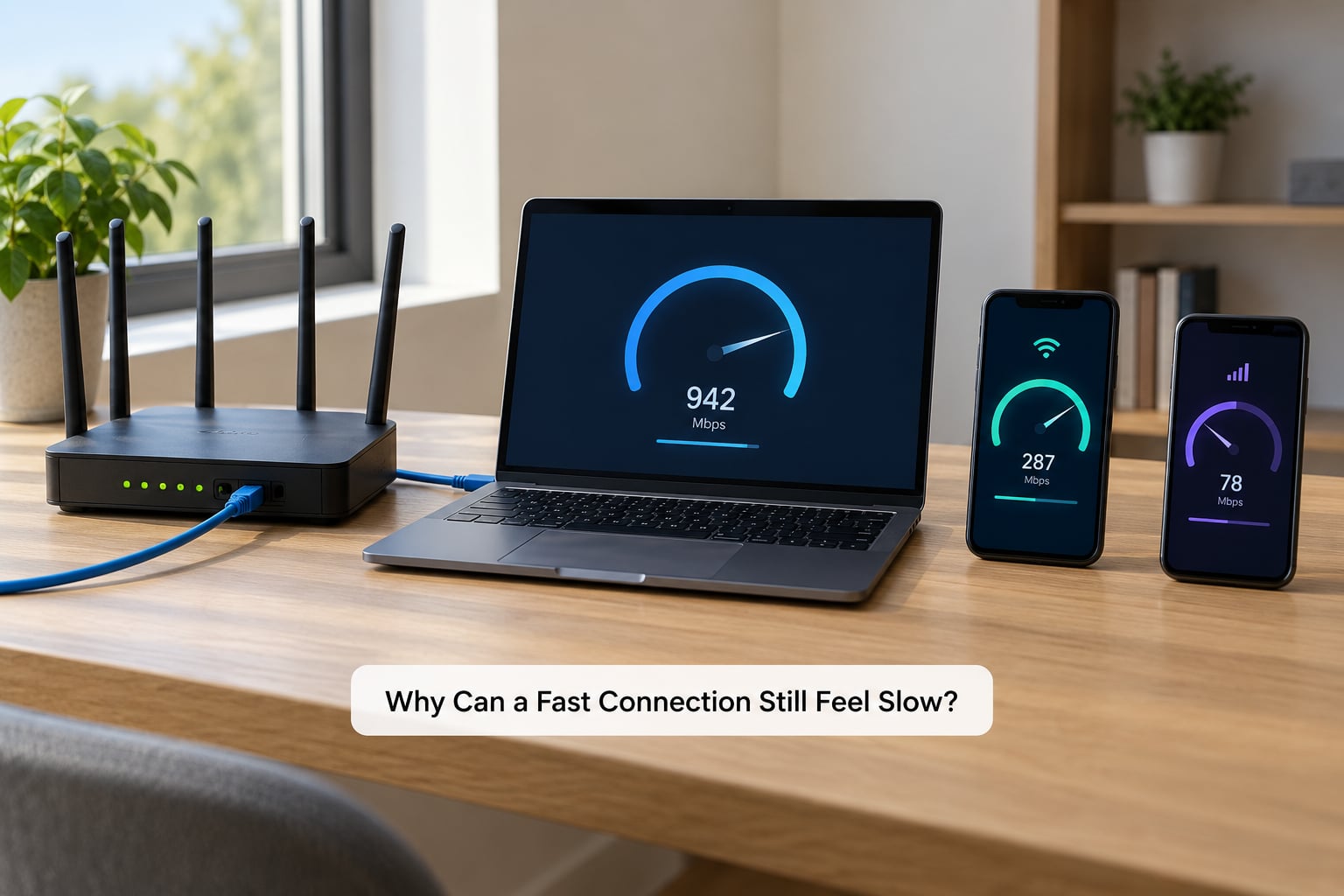
Most disappointing speed results are not network problems. Before blaming the provider, run this sequence:
- Test with a wired Ethernet connection, next to the router. If that number is healthy, the line is fine.
- Move closer to the router and test Wi-Fi there. A big jump tells you coverage was the issue.
- Check the router for old Ethernet ports, and replace equipment that predates gigabit.
- Test again at different hours. A drop in the evening points to shared capacity rather than a fault.
- Turn off any VPN and compare a second test, then try a different server or service.
Users on Reddit’s r/japanlife have reported connections that slow at a consistent hour, around 19:00, which fits a network with a busy evening profile rather than random bad luck. Others note the habit of loading content before a train enters a tunnel, where coverage drops.
A speed test only measures the route to the server it chooses. A fast result against a nearby test server says little about a distant service, and a single test in the morning says little about your evening.
Is Japanese Internet Faster Than in Other Countries?
Japan is strong on fiber availability and network quality, and average performance depends heavily on which country, city, provider and connection type you measure.
| Place | Fiber reach | Fixed experience | Mobile experience |
|---|---|---|---|
| Japan, major cities | Very high | Consistent gigabit, low latency | Good but uneven by area |
| South Korea | Very high | Comparable to the best in Japan | Generally ahead of Japan |
| United States | Patchy | Highly variable by address and provider | Strong in metro areas |
| Western Europe | High and rising | Broadly good, faster in some markets | Good, country by country |
| Japan, rural | Improving, uneven | Plan choice is limited | Patchy outside towns |
The honest ranking data cuts against the hype. In the Speedtest Global Index for August 2026, Japan placed 26th for fixed broadband and 69th for mobile. Read together, those two numbers describe the real picture: excellent wired infrastructure and a mobile network that does not match the reputation.
So “is Japanese internet fast” has a qualified answer. For a wired home connection in a city, yes, and usually without much fuss. For mobile, rural areas or older buildings, the experience is closer to the rest of the developed world than the record announcements suggest.
Frequently Asked Questions
Are Japanese internet speeds faster than in the US or UK?
For most city households on fiber, yes. Japan offers gigabit and multi-gigabit wired lines as standard rather than premium, while US speeds depend heavily on the address and UK coverage is still catching up in places. Mobile is the exception: Japan trails several peers on mobile speeds, so a national ranking depends entirely on which measure you look at.
Why does my Japanese internet speed drop during busy hours?
Shared capacity is the usual reason. Residential lines in dense areas, and connections in hotels, share infrastructure with many other users, so evening peaks from streaming and downloads reduce available throughput. Wired tests before and after the peak confirm it. Upgrading the plan, using Ethernet instead of Wi-Fi, or testing at a quieter hour will all show whether the line itself is limited.
Does a 1 Gbps Japanese internet plan guarantee gigabit speeds?
No. Gigabit is the capacity of the connection, not a promise to your device. Protocol overhead, a router with older Ethernet ports, Wi-Fi rather than a wired connection and the speed of the destination server can all hold results below the plan rate. A wired test on current equipment commonly lands between 700 and 950 Mbps, which is normal and healthy.
Is Japanese internet fast enough for remote work and gaming?
Yes, for wired connections in cities. Low latency and stable upload make video calls, large file transfers and cloud work comfortable, and symmetric upload is a genuine advantage over plans where upload is a fraction of download. Gaming depends on the server location rather than the headline speed. Mobile connections and rural lines are the cases that need checking first.
Should visitors use pocket Wi-Fi or an eSIM for fast internet in Japan?
For a short trip, an eSIM on a major network is usually simpler and avoids carrying a device. A pocket Wi-Fi unit gives a stable connection to several devices and often performs better inside buildings and underground, at the cost of battery and one more thing to charge. Avoid international roaming, which can be throttled sharply once a high-speed allowance runs out.
Before choosing a connection anywhere in Japan, run one wired speed test and one latency test, both at a busy hour and a quiet one. That pair tells you more than any national ranking, and it separates the line’s real capacity from everything happening on your Wi-Fi.