
Remote work in Japan went from an unusual exception to a permanent option in six years, and the shape it settled into is not the one many outsiders predicted. Company adoption of telework jumped from roughly 40 percent of firms before February 2020 to more than 75 percent by April 2025, per Gartner Japan, while the share of employees actually working from home landed at 16.8 percent nationally in the Ministry of Land, Infrastructure, Transport and Tourism’s March 2026 survey. That gap between offer and use is the part of how Japanese remote work adoption changed that most readers miss: access widened fast, usage stayed thin, and hybrid work became the settled default.
Table of Contents
- 1How Japanese Remote Work Adoption Changed
- 22019: the baseline
- 32020 to 2021: expansion under emergency rules
- 42022 to 2026: narrowing, then stabilizing
- 5Before 2020: Why Remote Work Was Unusual in Japan
- 62020-2021: The Pandemic Created a Forced Experiment
- 7How Much Did Adoption Actually Increase?
- 8How Japanese remote work adoption changed on paper versus in practice
- 9The Return-to-Office Shift in 2022-2026
- 10Which Jobs and Companies Retained Remote Work?
- 11Technology and digital media
- 12Finance, administration and customer support
- 13Office-dependent work
- 14Large companies versus small ones
- 15Why Japan Still Adopts Remote Work Differently
- 16What the Change Means for Founders and International Teams
- 17Ask for the number, not the label
- 18Test the location policy before you announce it
- 19Write the availability rules down
- 20Do not import US expectations
- 21Plan for a smaller domestic pool
- 22Frequently Asked Questions
- 23How common is remote work in Japan now?
- 24Did Japanese remote work adoption peak during the pandemic?
- 25Can Japanese employees work remotely by default?
- 26Why did many Japanese companies return to the office after 2021?
- 27How should an international company handle a remote employee based in Japan?
- 28Conclusion
How Japanese Remote Work Adoption Changed
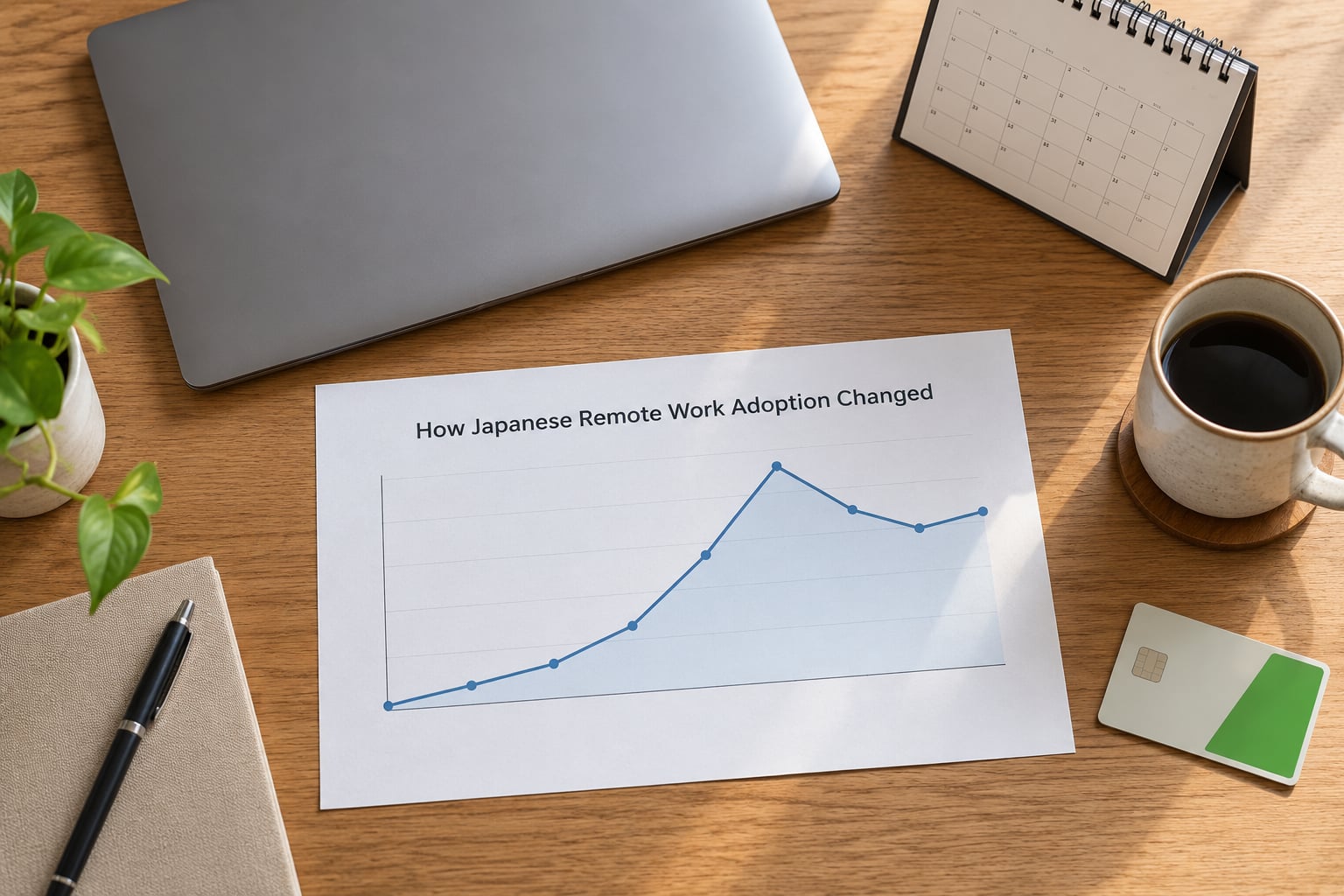
The clean way to see this is in three eras. Before 2020, working from home was a workaround for a train commute or a child being ill, and it sat outside the normal career path. In 2020 and 2021, emergency telework forced thousands of companies to run operations from home with no preparation, and the useful parts of that experiment were kept. From 2022 onward, employers pulled back from blanket flexibility, but they did not return to the old default either. The 2026 picture is a market split roughly 48 percent hybrid, 38 percent office-first and 14 percent full remote, with the flexibility concentrated in Tokyo, large firms and information-sector roles.
That is the whole story in miniature, but the useful detail lives in the gaps between those numbers.
2019: the baseline
Before the pandemic, Japanese companies that allowed home working usually framed it as a temporary measure for weather, a sick child or a delayed train. Gartner Japan’s figures put company adoption at around 40 percent, and almost none of that was a standing arrangement with set days. The employee-side number was much smaller still.
2020 to 2021: expansion under emergency rules
The First State of Emergency in April 2020 pushed remote work from a favor into a workplace condition. Companies that had never run a video meeting culture had weeks to build one, and the ones that did found productivity held up better than expected. Adoption climbed steadily through 2020 and into 2021, and for a while remote access looked like it might become the default rather than the exception.
2022 to 2026: narrowing, then stabilizing
From 2022, infection rates fell and office attendance recovered, but the pull back happened unevenly. A Kyodo survey reported in August 2023 put the share of Japanese workers teleworking at 22.2 percent, the lowest point since the outbreak began. The number has drifted lower since. What did not reverse is the underlying set of tools and the written policies: by April 2025, Gartner Japan counted more than three quarters of companies as having some remote provision in place.
Before 2020: Why Remote Work Was Unusual in Japan
The pre-pandemic baseline was not a technology gap. Japanese workers had laptops, broadband and video conferencing before 2020. What was missing was permission, and permission in a Japanese company was not a small thing.
Three structural features did most of the work. The first was office-centred management, where visibility in the room was treated as a proxy for effort. The second was long working hours, which made a hard stop at the office door hard to justify. The third was a communication culture built on hanko, the personal seal used to approve documents, and nemawashi, the slow consensus-building that happens before a decision is announced. None of that maps cleanly onto a Slack thread.
Housing reinforced the pattern. A large share of the population lives in small apartments in dense rental stock, particularly in Tokyo, Osaka and Fukuoka, and a one-room flat is not somewhere a company expected you to run a full day of calls from. Coworking spaces became the standard compromise for exactly this reason, once working from home stopped being a once-a-week treat.
Where remote access existed, it was narrow. It typically meant emailing a colleague, checking a shared document, or attending a meeting from home on a fixed day. Nobody called it telework as a job arrangement, because it was not one.
2020-2021: The Pandemic Created a Forced Experiment
What made 2020 different was that the government restricted movement rather than suggesting it. Employers who resisted were not being difficult; they were following the instruction to send staff home. That removed the approval problem entirely, and it exposed the practical problems that had been hidden.
- Childcare closed. Schools and nursery facilities shut, so the employees with the heaviest care duties were the ones least able to work from home.
- Space was tight. Sharing a flat with family while taking calls all day was not workable for most people.
- Security was untested. Companies had to decide quickly whether employees could take laptops home and how to handle customer data outside the building.
- Management had to lead remotely. Supervisors used to read the room in person. Several had to learn to run a team they could not see.
The second half of 2020 is where the durable change happened. Once companies were living with remote work, they invested in the infrastructure: cloud file systems, chat tools, video platforms, and rules about which documents could leave the office. Online meeting skills improved fast because nobody had a choice.
By 2021, most large employers had written a telework policy. Almost none of them described it as the new normal. The framing was availability rather than expectation, and in practice companies started negotiating day counts instead of principles.
How Much Did Adoption Actually Increase?

The honest answer is that adoption rose a great deal on paper and only a little in daily life, and the gap between those two numbers is the single most important fact about remote work in Japan. Companies that offer a telework policy and employees who use it are measured differently, and headlines routinely mix the two.
| Data year | Figure | What it measures | Source |
|---|---|---|---|
| Before February 2020 | About 40% of companies | Share of firms with any remote provision | Gartner Japan |
| August 2023 | 22.2% of workers | Employee telework ratio, lowest since the outbreak | Kyodo survey |
| April 2025 | Over 75% of companies | Companies with a telework option in place | Gartner Japan |
| April 2025 | 22.6% of companies | Firms with no remote plans at all | Gartner Japan |
| March 2026 | 16.8% of workers | National employee telework rate | MLIT |
| March 2026 | About 0.5 days per week | Average work-from-home days for Japanese employees | Gartner Japan |
| March 2026 | About 1.4 days per week | Average work-from-home days for US employees | Gartner Japan |
| Tokyo, recent survey | 43.3% of companies | Tokyo firms with a telework system | Tokyo Metropolitan Government |
| 2026 | 48.2% / 37.9% / 13.9% | Split across hybrid, office-centered and full remote | Industry surveys compiled 2026 |
Two things to check before you quote any of these numbers. Data year and publication year are not the same: a figure released this year may describe a survey conducted a year earlier, and older headline numbers get recycled without their date attached. And the samples are not comparable. Government surveys cover the workforce broadly, vendor surveys cover their own client base, and a company with 30 employees is not weighted the same as one with 3,000. The 0.5 days per week figure and the over 75 percent adoption figure are not describing the same population, which is exactly why they look contradictory when placed side by side.
How Japanese remote work adoption changed on paper versus in practice
The Recruit Works Institute found that many Japanese companies have a telework policy while a very small share of staff actually telework, roughly 10 percent in its measurement. That figure is the reason a company can advertise remote work in a job posting and still expect you at a desk on Thursday.
It also explains the Tokyo-versus-national split. Tokyo Metropolitan Government data put the capital’s company adoption far above the national rate, and a Tokyo job gives you a better chance of a genuine hybrid arrangement than the same role in a regional city. A remote-friendly posting in Osaka does not mean what the same posting means in Shibuya.
The Return-to-Office Shift in 2022-2026
By 2026, the return to office in Japan is real for large employers. Attendance requirements of three or more days a week are no longer controversial internally, and the pandemic-era exception has largely closed. Community discussion on forums like r/JapanLife and r/WFH treats return to office as settled for big companies, while stopping well short of treating it as the end of flexibility.
What survived the pullback was narrower and more deliberate. Companies kept remote access for work that does not need a room: individual contributors on established teams, sales preparation and follow-up, and roles that were never office-anchored to begin with. New hires are commonly expected in person for onboarding, training and the periods around monthly closes.
Full-time remote roles went the other way, from a shrinking benefit to a recruiting tool. Postings that are genuinely remote-first now compete for candidates rather than the other way round, and they tend to sit at the top of the market. The most common arrangement in the middle is a negotiated day count, and both sides have gotten better at saying the number out loud instead of talking in principles.
Which Jobs and Companies Retained Remote Work?
Adoption in Japan is not spread evenly across the economy, and role type explains more than company size does.
Technology and digital media
Software, internet and digital media companies have the highest concentration of remote arrangements. The work is screen-based, output is measurable, and these firms are used to distributed engineering teams already. Tokyo startups in particular adopted nationwide hiring early, because a Tokyo-only candidate pool was never going to be enough for a small technical team.
Finance, administration and customer support
Back-office roles in finance and administration kept more flexibility than front-office ones. These functions are document and screen heavy and were already being reorganized. Customer support sits in between, since the work is remote in nature but the schedules follow customer hours, and coverage requirements limit how far it can go.
Office-dependent work
Sales negotiation, retail, logistics, manufacturing, construction and most healthcare and education work stayed anchored to a location. The exceptions in these sectors are supervisory and administrative staff, not the core work.
Large companies versus small ones
Large firms have more to lose from a bad policy decision, so they tend to offer hybrid that is structured and narrow, with clear in-office days. Small companies and startups behave differently. They cannot afford the tooling, or the management attention, so their flexibility is often ad hoc and depends on the individual manager. A startup with a remote policy may deliver more days than a large corporation with a better one.
Why Japan Still Adopts Remote Work Differently
Japan is not late to remote work by technology standards. It is different for organizational reasons, and most of them are about how work is judged rather than how it is done.
- Physical visibility is still read as effort. Managers who pre-2020 managed by presence have not all been retrained, and the ones who have tend to demand fixed office days rather than trust output at a distance.
- Career development happens in the room. Promotion tracks, role rotation and informal mentoring are built around being seen. Workers themselves often decline remote days because they expect the visibility to matter.
- Consensus does not travel well over chat. Nemawashi assumes long conversations in a room where nobody has left. Managers who rely on it tend to keep the important decisions in person and push documentation into Slack.
- Seals and signatures need paper. The hanko chain still shapes which tasks cannot be done from home, and a surprising number of otherwise digital approvals still route through a physical seal.
- Space is tight. Small urban apartments make a full remote day expensive in comfort, which pushes willing employees toward coworking spaces instead of staying home.
- Customer and shift schedules. Roles tied to business hours in another market, to a physical location, or to service coverage cannot simply move to a sofa.
Add to that a shrinking domestic talent pool. Employers outside the major metros cannot fill locally, and the practical answer for many of them is remote access rather than relocation support. That pressure pushes the other way against the cultural resistance, most visibly in regional hiring.
None of this means Japanese workers dislike flexibility. It means the value is expressed differently: fewer commuting hours and more family time are worth having, while being invisible for a full week is a cost many people are not willing to pay.
What the Change Means for Founders and International Teams
If you are hiring in Japan or managing a team that includes people there, the practical lesson is that a national policy statement means almost nothing. What matters is the day count, the manager, and the role.
Ask for the number, not the label
A Japanese job posting that says remote work is available usually means something between zero and two days a week. What you need is the specific figure: how many days, which days, and who approves an exception. Candidates and recruiters have both become more willing to negotiate this openly, and asking is no longer as awkward as it was five years ago. Still, the most reliable check is a conversation with someone who joined in the last year rather than the company handbook.
Test the location policy before you announce it
For a distributed team, run a small trial with two or three people in different prefectures for a quarter and measure what actually breaks. Onboarding, incident response, and the informal context that new hires need are the usual failure points. A policy that has been tested by a handful of people is far easier to defend in a team meeting than one announced in a memo.
Write the availability rules down
Set a core window in JST and state clearly which collaboration happens there. Everything else should be documented asynchronously, because the default in a Japanese team is still to talk it through. A written rule about response times removes the guesswork that otherwise turns a remote day into a day of waiting.
Do not import US expectations
A policy built around five remote days will not transfer. A policy built around two or three protected days, with a clear in-office window for collaboration, matches both what Japanese workers report wanting and what their managers will actually sustain. Treating full remote as a scarce offering for specific roles is a workable compromise; treating it as the default is not, at least not yet.
Plan for a smaller domestic pool
If you are outside Tokyo, remote access is a recruiting tool before it is a benefit. Firms that keep the option open can hire nationally without relocating anyone, and that is a real advantage in a market where the local candidate pool is shrinking.
Frequently Asked Questions
How common is remote work in Japan now?
It is common as an option and uncommon as daily practice. Gartner Japan counted more than 75 percent of companies with some remote provision by April 2025, but the MLIT survey put the share of employees actually teleworking at 16.8 percent in March 2026. Japanese workers average about 0.5 work-from-home days per week, against roughly 1.4 for US workers.
Did Japanese remote work adoption peak during the pandemic?
On the company side, no. Adoption of telework policies kept climbing after 2021 and reached over 75 percent of firms by April 2025, according to Gartner Japan. On the employee side, yes: the worker telework ratio hit a low of 22.2 percent in August 2023 and has drifted down since. Japan normalized remote work as a permanent option without ever making it the default.
Can Japanese employees work remotely by default?
Rarely. Most large employers set in-office days as the default and treat remote days as something to be agreed rather than assumed. Full remote roles exist, mostly in technology, digital media and some back-office functions, but they now compete heavily for candidates instead of being a standard perk. Expect a negotiated day count rather than a binary remote or office arrangement.
Why did many Japanese companies return to the office after 2021?
Three reasons recur: managers who equate physical visibility with productivity, promotion and mentoring practices that work in person, and communication habits built around nemawashi and hanko approval chains. Onboarding and monthly closes also stayed in person by choice. None of that means the flexibility disappeared, since most large firms kept two or three days a week available.
How should an international company handle a remote employee based in Japan?
Set a core collaboration window in JST, document everything else asynchronously, and confirm in writing how many days per week are expected. Tax and residency questions come up if the employee spends long stretches outside Japan, so check the 183-day treaty threshold and residence status early. Treat the arrangement as a structured hybrid rather than an open-ended remote option.
Conclusion
Japanese remote work adoption changed in two directions at once. Between 2020 and 2026, the number of companies offering telework roughly doubled and the tools became ordinary, while the number of days Japanese employees actually worked from home fell. Hybrid work won, and it won by narrowing rather than widening.
The first thing to do with any figure you read is check what it measures and when. Company adoption and employee usage are different questions with very different answers, and a figure without a data year is not much use. Beyond that, the day count in a specific job posting matters more than any national statistic, because that is the arrangement you would actually be living with.