If you have read the phrase “Japanese MVNO” and assumed it means a cheap alternative network, the mechanics are actually simpler than the marketing makes them sound. How Japanese MVNOs work comes down to one idea: a company rents wireless capacity from a carrier that already owns the towers, then sells you a plan under its own name. The signal comes from the same tower whether you buy it from the tower owner or not.
That single fact explains almost everything else — the cheaper data, the crowd of brand names, and the one real complaint you will hear from users, which is that MVNO service can feel slower at busy times even though the coverage map looks identical. Here is how the pieces fit together, and what to check before you commit.
Table of Contents
- 1What Is a Japanese MVNO?
- 2How Japanese MVNOs Work
- 3How Japanese MVNOs work in three steps
- 4Which Networks Do Japanese MVNOs Use?
- 5What Do MVNOs Offer Beyond the Host Network?
- 6How Do SIMs, APNs and Network Switching Work?
- 7How Do You Choose a Japanese MVNO?
- 8Can You Use a Japanese MVNO with an Overseas Phone?
- 9What Are the Main Advantages and Disadvantages?
- 10How to Switch or Cancel an MVNO Service
- 11Frequently Asked Questions
- 12Is an MVNO the same as a mobile network operator?
- 13Does a Japanese MVNO provide its own mobile coverage?
- 14Can I keep the same phone number when changing Japanese MVNOs?
- 15Do Japanese MVNOs work with phones bought outside Japan?
- 16Are Japanese MVNO contracts or plans automatically renewed?
- 17Conclusion
What Is a Japanese MVNO?
An MVNO is a mobile virtual network operator: a company that sells mobile service without owning towers, base stations, or the spectrum those stations broadcast on. It signs a wholesale agreement with a network operator, buys a slice of that network’s capacity, and repackages it with its own SIM, its own billing, and its own support line.
The difference matters when something breaks. A network operator, usually called an MNO, owns the radio network and the core that routes your calls. An MVNO rents access to both. When your data is slow, the cause could sit at either layer, and that decides who you end up calling.
Japan has more of these virtual providers than most countries because the rules changed. Before 2015, mobile virtual network operators could not legally lease capacity from the big carriers, so the market was effectively closed. Once wholesale resale was permitted, a wave of new brands appeared selling very cheap data plans, and the category picked up the Japanese name 格安SIM (kakuyasui SIM, roughly “bargain SIM”).
How Japanese MVNOs Work
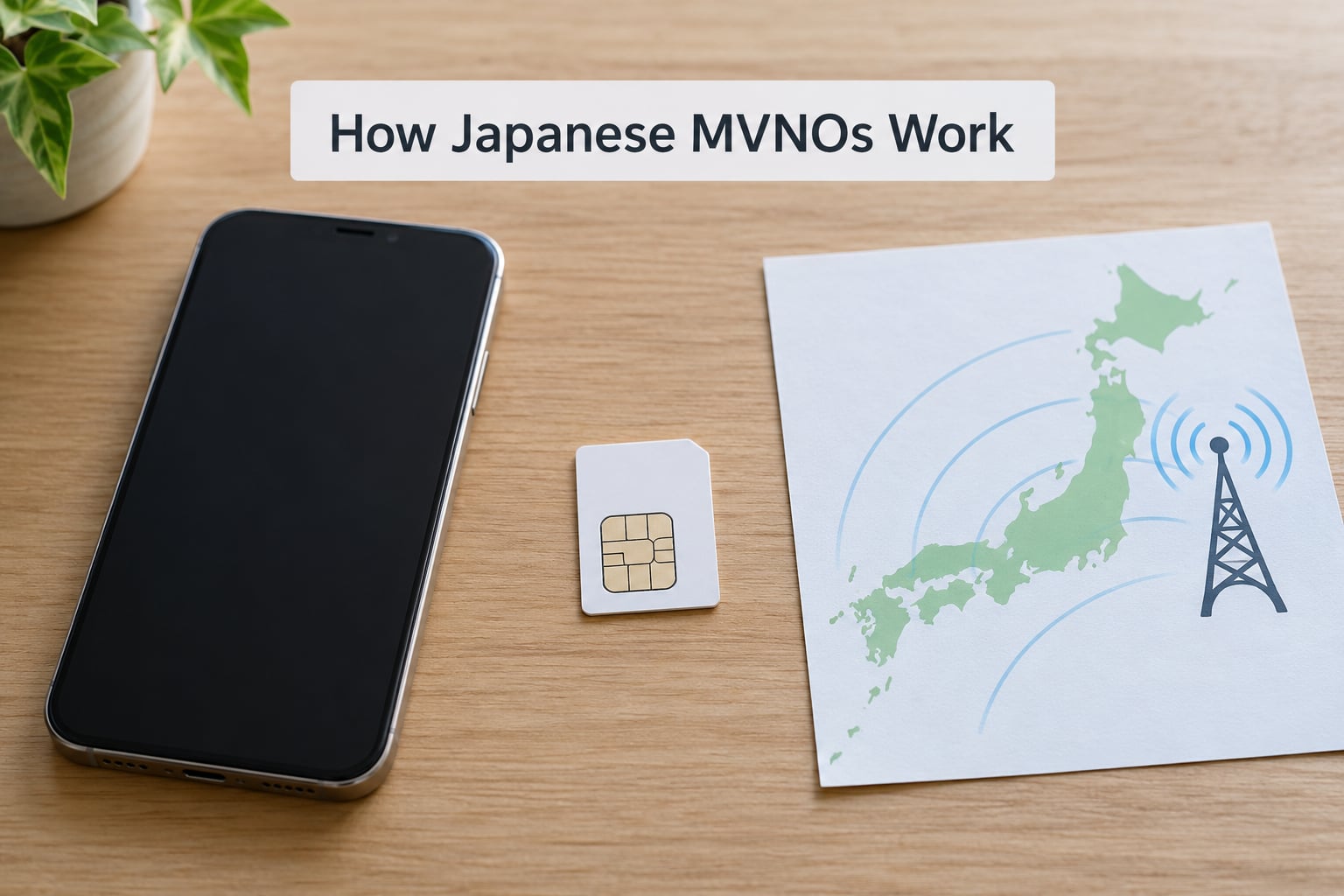
An MVNO buys capacity from a carrier that owns towers, issues a SIM or eSIM profile under its own name, handles billing and support, and sends your traffic over the host network. You buy from the MVNO; the MVNO buys from the carrier.
The chain has four moving parts and it helps to keep them apart, because each one has its own job and its own failure points.
| Layer | What it does | Who to contact when it fails |
|---|---|---|
| Your handset | Holds the SIM, connects to whichever network is strongest, must be carrier-unlocked to accept an MVNO | Your phone maker or a repair shop |
| The SIM or eSIM profile | Identifies you to the network and carries the settings that tell your phone how to use it | The MVNO |
| The MVNO | Sells the plan, issues the SIM, sends the bill, handles support, may queue you behind other users on the same network | The MVNO, in English on most brands |
| The host network | Owns the towers, the spectrum, and the core; decides priority when the cell is congested | The host carrier, via the MVNO |
How Japanese MVNOs work in three steps
First, the host carrier signs a wholesale agreement with the MVNO. The carrier commits to supply a defined amount of capacity, and in exchange the MVNO resells it under its own brand instead of the carrier’s own retail brand.
Second, the MVNO provisions SIMs and runs the billing. It decides which of the host network’s frequency bands it will support, sets its own tariffs, and issues a SIM or an eSIM profile that identifies you as its customer rather than as a customer of the host carrier.
Third, you buy the retail plan and connect to the host network’s towers. The MVNO takes your monthly fee, applies it to its wholesale bill, and takes the difference as margin — which is where the cheaper price comes from.
Which Networks Do Japanese MVNOs Use?
An MVNO’s real coverage and real speeds are decided by its host network, not by its own brand. A Docomo-based MVNO inherits Docomo’s towers, its band plan, and its congestion profile. That is why people ask about the host before the brand.
Japan has four network operators: NTT Docomo, au by KDDI, SoftBank, and Rakuten Mobile, which became the fourth full network operator rather than a reseller of somebody else’s.
| Host network | General reputation | MVNO brands riding on it | Things to know |
|---|---|---|---|
| NTT Docomo | Consistent nationwide reach, strong on trains and in rural areas | IIJmio, BIGLOBE mobile, b-mobile, OCN one mobile, ahamo, d mobile | The default host for most Japanese MVNOs, so the biggest pool of low-cost plans |
| au by KDDI | Solid urban coverage, popular sub-brand pricing | mineo, UQ mobile, au PAYPas | Fewer independent resellers than Docomo |
| SoftBank | Fast in dense cities, more variable at the edges | LINE Mobile, nuro, SoftBank sub-brands | Has a stronger pay-as-you-go culture than its rivals |
| Rakuten Mobile | Newer network built from scratch, growing quickly | None in the classic sense; it sells direct and through partner brands | Not an MVNO itself. Its network is smaller than the others and it is still maturing |
SoftBank or Docomo comes up constantly in search results, and the honest answer is that it depends on where you are. Docomo is the safer pick outside cities, SoftBank tends to hold up better in dense urban areas. Rakuten’s network is the youngest of the four, and users on Reddit have reported four years of trouble-free service on it, which suggests the early complaints have largely settled.
What Do MVNOs Offer Beyond the Host Network?
What you actually get from the MVNO layer is the plan design, the pricing, the brand, and the customer service. Everything technical sits one level down with the host carrier.
Lower data pricing is the headline. Because the MVNO’s margin is thinner than a carrier’s own retail brand, the savings usually land on data. Look at per-gigabyte cost rather than the monthly figure, and check whether a promotional rate reverts after the first few months.
Flexibility is the second thing. Carrier sub-brands like ahamo and LINE Mobile sit in the middle ground: they are operated by a big carrier, so they inherit its stability and device support, while still pricing more aggressively than the carrier’s main line. Some plans also offer tiered data where the speed stays high up to a threshold, then drops.
English support and device bundles are the third. A number of brands publish their sign-up flow, contract terms, and support in English, which is worth more than it sounds when the contract screen is otherwise dense with Japanese. A few also sell handsets alongside service, sometimes at a discount, though that is an exception rather than a rule.
None of this is uniform. Two MVNOs on the same host network can differ completely in support quality, contract length, and which device models they have tested.
How Do SIMs, APNs and Network Switching Work?
A SIM is not just a card. It carries the settings your phone needs to talk to a particular network, and with many MVNOs those settings have to be downloaded before the service works. Skipping that step is the most common reason a new SIM shows no signal.
On an Android handset, go to Settings, then Network and internet, then SIMs, then the APN settings for the active line. Your provider sends you the APN values by email or on a printed card, and you type them in. Paths differ slightly between Samsung, Google Pixel, and Xiaomi menus, but the label is always APN settings. iPhones usually take the settings from a network profile that installs itself after activation, so there is less to do by hand.
Physical SIM versus eSIM is the other fork. A physical card has to arrive by post, which adds days to the process, and it occupies a physical slot. An eSIM profile is provisioned by QR code and can be active within minutes, which is why so many travellers now start with one. Several resident MVNO plans still issue a physical card only, so read the plan description rather than assuming.
Device compatibility is checked before you commit, not after. Providers publish a tested-device list in Japanese, usually called 動作確認端末一覧, listing exact models and firmware versions. Your handset also reports an IMEI, the unique identifier providers use to register a device, and some plans are locked to devices on that list. If your model launched recently, there is a fair chance it is not on the list yet.
Network switching refers to your phone hopping between cells and, on dual-SIM handsets, between two lines. Both work normally on an MVNO. What does not work is assuming you can keep your home-country SIM active for two-factor codes and use the Japanese line as your only data connection unless the plan supports the combination you need.
How Do You Choose a Japanese MVNO?
Work through these in order and the right answer usually becomes obvious. Which host network you need comes first, because it fixes everything else.
Start with host network. Pick Docomo if you travel on trains, live outside a major city, or need reliable service in rural areas. Pick SoftBank or au for dense city living. Treat Rakuten as a reasonable choice in cities where its network is well established.
Next, size your data to how you actually use the phone. Streaming video and tethering pull very different numbers than messaging and maps, and most plans differ more in data allowance than in price per gigabyte.
Then look at the stay length. Short trips are usually better served by a travel eSIM with no contract and no number. Anything past a couple of months justifies a resident plan, because you want a Japanese number for delivery services and bank authentication.
Language support decides how painful the setup will be. A provider with English sign-up and English support removes the worst part of the process, which is reading a contract screen full of Japanese.
Payment method is the sneaky one. Many Japanese MVNOs want a Japanese bank-issued credit card or a bank account for direct debit. Foreign cards are refused more often than you would expect, so check the payment page before you fill in a long form. Some brands accept LINE Pay, some issue a convenience store payment ticket, and a few foreigner-focused providers accept cash at a branch counter.
Finally, total cost and contract terms. Factor in the SIM issuance charge, whether a promotional rate expires, the minimum contract term, and any early termination fee. One Bic Camera walkthrough reported by an expat blog showed a 65 percent bill reduction after moving from a carrier contract to a BIGLOBE Mobile data plan, which is the kind of gap that decides whether an MVNO is worth it.
Can You Use a Japanese MVNO with an Overseas Phone?
Usually yes, as long as the handset is carrier-unlocked and supports Japan’s frequency bands. Phones sold for the US market are frequently locked to their original carrier, and a locked handset will not accept an MVNO SIM at all.
Band compatibility is the second gate. A phone with full international bands will work on any Japanese host network. An Asian-market variant locked to a narrow band list may register but lose service on some networks, or drop 5G entirely. Checking your model number against the provider’s tested-device list answers both questions at once.
Roaming is different from an MVNO and worth separating. A US or European SIM roaming in Japan uses your home carrier’s roaming agreement, which works and is expensive. An MVNO gives you a Japanese number on a Japanese network, which is cheaper and behaves like a local line. If you need your home number for banking codes, keep that SIM in a second slot or as an inactive eSIM rather than trying to make one number do both jobs.
Before buying any SIM in Japan, confirm four things: that your phone is carrier-unlocked, that the exact model appears on the provider’s compatibility list, that your payment method is accepted, and that the plan includes the capabilities you need, such as a real phone number or tethering.
What Are the Main Advantages and Disadvantages?
The trade-offs line up fairly cleanly once you separate the plan layer from the network layer.
| Factor | What MVNOs usually do well | Where they fall short |
|---|---|---|
| Cost | Noticeably cheaper data, especially on Docomo-based plans | Promotional rates often expire, and the SIM issuance charge is extra |
| Coverage | Identical to the host network’s map | Only the bands provisioned in the wholesale agreement are available |
| Speed | Excellent when the cell is quiet | Often deprioritized at peak times, so evenings in cities feel slower |
| Support | Several brands run English-language support | Sign-up flows are frequently Japanese-only |
| Choice | Dozens of brands, plan shapes, and data tiers | So many brands make comparisons genuinely hard |
| Flexibility | Most plans are month to month now, after the two-year auto-renewing contract was abolished in 2021 | Some plans still carry a minimum service obligation of six to twelve months |
| Devices | New handset support varies by brand | Newest iPhone and Android models can take months to appear on the tested-device list |
How to Switch or Cancel an MVNO Service
Switching between Japanese providers is a normal, in-country process once number portability is involved. The sequence is the same whether you are moving from a carrier to an MVNO or from one MVNO to another.
First, order the new service and choose the number transfer option at checkout. You will need a Mobile Number Portability authorization code from your current provider, which you get from their account page or by calling support while still on the old line. Ask the new provider to apply the transfer at activation, so the change happens in one step.
Keep the old line alive until the new one is working. Do not cancel first. Once the transfer completes, the old SIM stops connecting, which is the confirmation that it worked.
If you are leaving a carrier with a device loan or a trade-in, handle that separately. Some handsets bought through carrier financing must be returned or paid off, and that obligation survives your move to an MVNO.
Cancelling is simpler. Check whether you are inside a minimum term, settle any top-up balance so a small refund is not held up, and confirm whether your service auto-renews. Most consumer plans today renew monthly rather than on a locked annual cycle, but the terms differ enough by provider that reading your specific contract beats trusting a general rule.
Frequently Asked Questions
Is an MVNO the same as a mobile network operator?
No. A network operator, or MNO, owns the towers, the spectrum and the core network. An MVNO leases capacity from one of those operators and resells it under its own brand with its own SIM and billing. In Japan that means NTT Docomo, au by KDDI and SoftBank are operators, while brands like IIJmio, mineo and b-mobile are virtual operators running on someone else’s towers. Rakuten Mobile is the exception: it owns its own network and sells direct.
Does a Japanese MVNO provide its own mobile coverage?
No. Coverage comes entirely from the host network. If the brand you buy from resells Docomo, you get Docomo’s towers, in-building reach and band plan, which is why coverage maps look identical across brands. The differences between MVNOs are plan design, price, support and how their traffic is prioritised when a cell is busy. If you want to know where you will have signal, check the host network’s coverage map, not the MVNO’s brand name.
Can I keep the same phone number when changing Japanese MVNOs?
Yes, using Mobile Number Portability, known in Japan as 番号移植. Ask your current provider for an MNP authorization code while your old line still works, then give that code to the new provider and select number transfer at checkout. The port usually completes within the activation window, and the old SIM stops connecting once it does. A US or other overseas number cannot be ported into a Japanese line, so keep that separate from a home-country SIM for banking codes.
Do Japanese MVNOs work with phones bought outside Japan?
They usually do, with two conditions. The handset must be carrier-unlocked so it will accept a third-party SIM, and it must support Japan’s frequency bands. A phone sold for the US market is often locked to its original carrier and cannot take an MVNO SIM at all. Check your exact model number against the provider’s tested-device list, published in Japanese as 動作確認端末一覧, because a variant that registers may still lose 5G or indoor coverage.
Are Japanese MVNO contracts or plans automatically renewed?
Most consumer plans today are month to month, since the two-year auto-renewing contract was abolished in 2021. That said, some plans still impose a minimum service obligation of six to twelve months with an early termination fee, and data add-ons or top-up balances behave differently from the base plan. Read your specific contract terms rather than assuming. If you are leaving, settle any remaining balance first so a small refund is not delayed.
Conclusion
Check the host network first, because that single choice determines your coverage and your speed. Then confirm your exact phone model is on the provider’s tested-device list, that your payment method works without a Japanese bank account, and that the plan includes what you need, such as a real phone number or tethering.
Get those four right and the rest is ordinary online sign-up. Understanding how Japanese MVNOs work mostly means accepting that you are buying a plan from one company and a signal from another, and holding the two ideas apart.