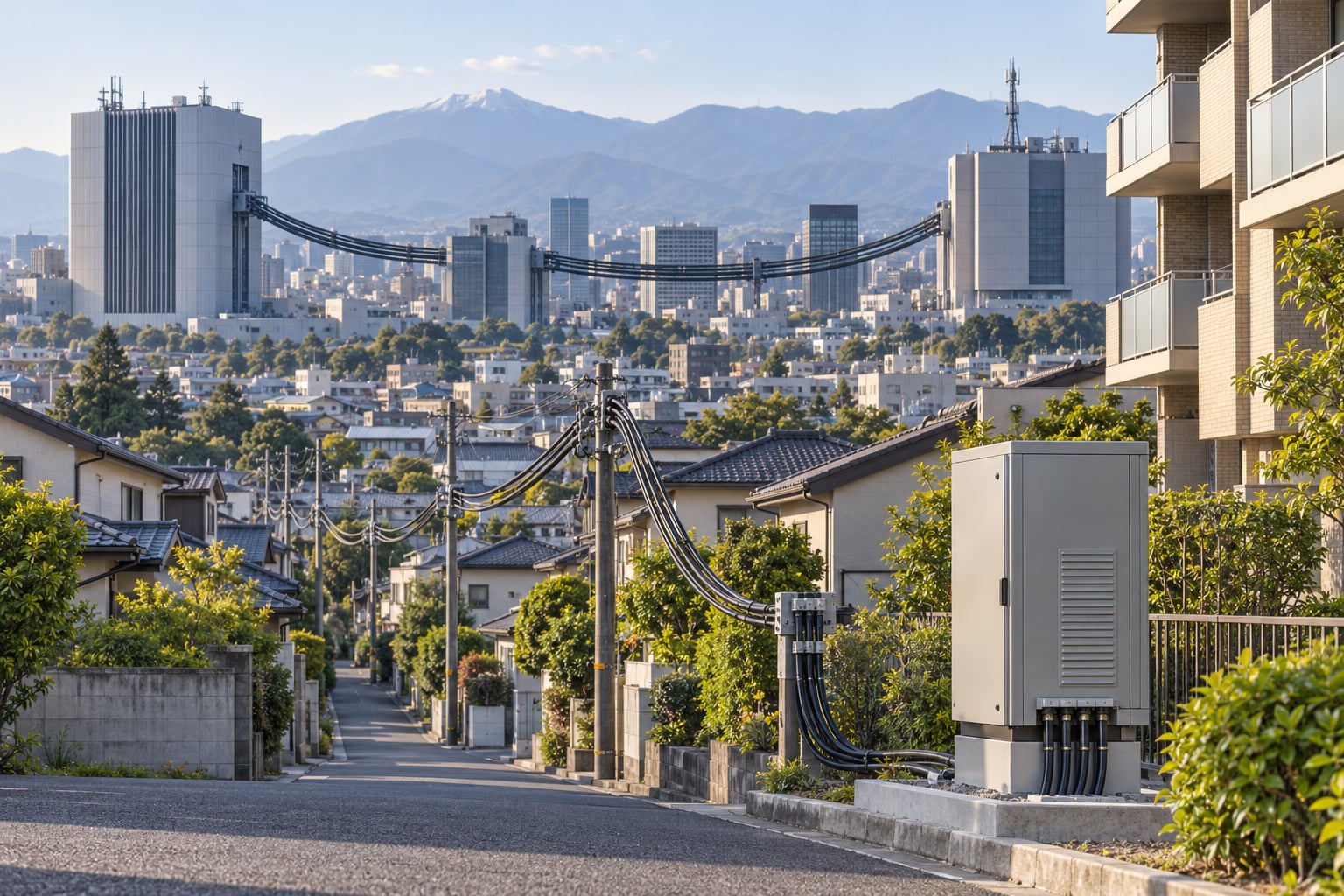
Japan’s fiber network was not built by a single national broadband project. It grew out of optical trunk lines that the state-run telephone monopoly laid for research and corporate traffic in the late 1970s and 1980s, then spread through a 1985 liberalisation that let rival carriers build on top of it, a price war in the early 2000s that pulled households off ADSL, and public subsidies for the rural routes that private operators would never touch on their own.
If you want the short version of how Japanese fiber rollout happened, think of four stages: the state builds the core, the state sells the core to the private sector, competition drags prices down while the incumbent upgrades its own network, and public money closes the last few percent of coverage. That sequence explains almost everything about broadband in Japan today, including the parts that still frustrate residents.
There is a reason English-language explanations of this topic are thin. Searches for the topic mostly return speed-record posts rather than history. What follows is the chronological version, with the policy decisions and numbers attached.
Table of Contents
- 1How Japanese Fiber Rollout Happened: A Short Answer
- 2Why Japan Needed Fiber Before the Internet Boom
- 3Who laid the first fiber in Japan
- 4How Policy and Regulation Changed Fiber Access
- 5Soft-gauge policy: prices held on purpose
- 6Why access charges decided everything
- 7Public money for the unprofitable routes
- 8What Made National Expansion Technically Difficult
- 9Apartments turned out to be the harder half
- 10How the Rollout Changed: From Regional Networks to Nationwide FTTH
- 11How Competition and Infrastructure Sharing Shaped the Network
- 12Two businesses, two invoices
- 13Densification as a policy tool
- 14Why Japan Reached Gigabit and Multi-Gigabit Broadband
- 15What Limits and Lessons Remain Today
- 16Why Japan and not the United States
- 17Frequently Asked Questions
- 18Who built Japan’s fiber-optic internet network?
- 19How much did the Japanese government invest in fiber?
- 20Did NTT alone build Japan’s broadband network?
- 21Why did fiber adoption in Japan take until the 2000s?
- 22Is fiber internet available throughout rural Japan?
How Japanese Fiber Rollout Happened: A Short Answer
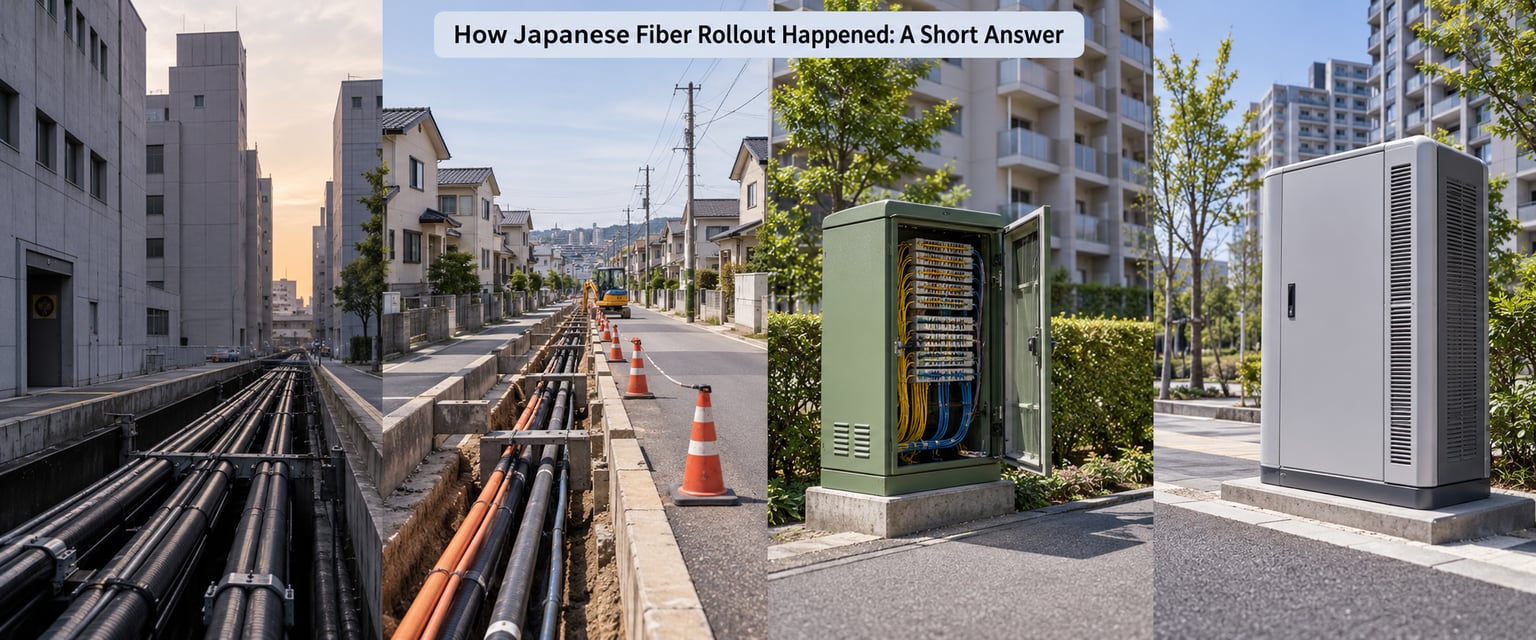
Nippon Telegraph and Telephone Public Corporation, usually just NTT, ran Japan’s telephone network as a government-owned corporation from 1952. Because NTT already owned the ducts, the local exchanges and the subscriber lines nationwide, it could upgrade the network to fiber without rebuilding the country’s physical infrastructure from scratch.
Three policy moves turned that asset into mass broadband. Liberalisation in 1985 allowed competing carriers in and privatised KDD. Price regulation then stopped NTT from holding wholesale fiber rates artificially high for too long. Finally, subsidy programmes paid for routes in places where a household count alone would never justify a build.
| Period | Milestone | Why it mattered |
|---|---|---|
| 1970s-1980s | NTT and KDD lay optical trunk lines between cities for telephone and research traffic | The fibre that later reached homes already existed, just not where consumers were |
| 1985 | Telecommunications liberalisation; NTT and KDD move from public corporations toward private companies; new common carriers enter | Ended the monopoly and created buyers for capacity NTT had no incentive to retail |
| 1985-1995 | Market growth, falling charges, heavy new-carrier entry | Industry revenue rose from 14.5 to 25.4 trillion yen and capital spending from 2.2 to 3.8 trillion yen over the period the ministry tracked |
| 1992 | NTT separates its long-distance and regional divisions, with mobile following in July | Created the regional structure that later carried FTTH investment decisions |
| 1994-1999 | Fiber-specific ventures and entrants appear, including Japan Telecom’s US-Japan cable project and eAccess and So-net in the late 1990s | Alternative carriers and foreign-funded capacity started to compete for the same routes |
| 2001 | Residential FTTH service launches | Fiber moved from business pricing to a consumer product |
| Early 2000s | ADSL peaks, then the fiber war sends FTTH prices sharply downward | Consumers moved to symmetrical fiber once it became the cheaper option |
| 2000s | u-Japan policy, fixed-mobile convergence, densification of exchange areas | Fiber became the default new-build medium rather than an experiment |
| 2010s | Gigabit becomes the standard tier; apartment and rural build programmes expand | Penetration moved past the 90% range for households able to be connected |
| 2020s | Multi-gigabit tiers and dense research transmission records | Research capacity now compounds on top of a network that is already in the ground |
Two numbers explain the scale of what liberalization set off. By the mid-1990s, NTT still handled 99% of intra-prefectural calls, and the three long-distance carriers were handing it 49.4% of their telephone income as access charges. That single figure is the clearest measure of how completely one company sat between other carriers and their customers.
Why Japan Needed Fiber Before the Internet Boom
Japan did not wait for consumer demand to start laying fiber. The trunk network went in because universities, national research institutes and large manufacturers needed to move more data between sites than copper could carry, and because NTT was already building and maintaining a national telephone plant.
These early networks were closed. A university research link or a corporate backbone carried that organisation’s own traffic and almost nothing else, so calling it broadband is misleading. It had enormous capacity by the standards of the time and no public access at all.
Who laid the first fiber in Japan
The first demonstrations of optical fiber transmission came out of Japanese laboratories and manufacturers in the 1970s, and Japan built commercial-grade fiber optics hardware early. The practical transmission technology, low-loss optical fiber, is credited to Narinder Singh Kapany, working with Chinese-born physicist Charles Kao at Standard Telecommunication Laboratories in the United Kingdom in the 1960s. Kao’s insight was that long-distance communication over glass was an engineering problem rather than a physics problem, and the first generation of commercial systems ran on his work.
Japan’s contribution was different in character: fibre hardware from Sumitomo Electric, Fujikura and Furukawa, plus the plant and engineering capacity to deploy it at national scale. Other countries’ networks ended up running on Japanese-made fiber and Japanese-made transmission equipment. That hardware layer is separate from the access network story below.
So the pre-broadband fiber in Japan was real, substantial and closed. It mattered for the rollout because it meant the hardest, most expensive part of a national communications network, the intercity core, was already there by the time anyone wanted to sell homes a gigabit.
How Policy and Regulation Changed Fiber Access
The single most important date in this story is 1985. Before it, telecommunications in Japan was a closed system run by public corporations, and any change to it required an act of the Diet. After it, the Ministry of Posts and Telecommunications opened the market and NTT began operating under a statute, the NTT Law, that set obligations on what the company could and could not do.
Liberalisation did three things at once. It let new common carriers, the NCCs, build long-distance networks, starting with Japan Telecom and its US-Japan cable in the mid-1990s. It privatised KDD, restoring a competitor on international routes. And it converted NTT into a private company with a legal obligation to behave in ways the market alone would not have forced.
Soft-gauge policy: prices held on purpose
For years after 1985, regulation deliberately kept NTT’s wholesale fiber prices high, benchmarked to what FTTH plus ADSL together would have cost a new entrant to undercut. Regulators called this soft-gauge policy. The reasoning was that new carriers needed room to build, and cheap capacity from the incumbent would have kept them small.
It worked, in the sense that carriers did build. It also kept consumer fiber prices high far longer than they needed to be. By the early 2000s, with the networks in place and competition established, the argument had reversed, and regulators pushed NTT to cut wholesale rates. The resulting drop is usually called the fiber war.
Why access charges decided everything
The access charge is the price one carrier pays another for the right to use the local loop, the wire running from the street to the customer. As long as NTT controlled almost all of it, NTT’s tariff decisions set the cost floor for every competitor. NTT holding 99% of intra-prefectural calls was not a curiosity in the report cards; it was the bottleneck.
Over time the regulator pushed in three directions at once: interconnection rules that made the bottleneck network usable by rivals, unbundling of parts of the local loop, and price caps on the access itself. Each step loosened NTT’s grip without asking it to hand over the network.
Public money for the unprofitable routes
The other policy lever was subsidy. A fiber route through a sparsely populated prefecture might serve a few thousand households, which does not cover construction. Government programmes picked up those routes, with the effect of lifting coverage statistics well beyond what the commercial market alone would have produced. Today’s near-universal availability figures are partly a private-sector outcome and partly a public expenditure, and arguments about them usually skip that second half.
What Made National Expansion Technically Difficult
Japan is about two-thirds mountain, and it is one of the most seismically active countries on earth. Both facts shape the economics of the last mile in ways that a flat, stable country would not recognise.
Terrain decides where fiber can go cheaply. Backbone routes follow the coastal plains and the corridors between them, while mountain routes require tunnelling and repeat civil engineering for every repair. A single earthquake or typhoon can cut many routes at once, because the same valleys and ridges concentrate the cables, and repair crews then queue for the same access. Resilience investment in Japan is not optional overhead; it is a large recurring cost.
Density cuts the other way. A country with dense cities can amortise a fiber route across a lot of households, and Japanese cities are dense enough that a single cabinet can serve dozens of homes at gigabit speeds. This is part of why FTTH economics worked in Japan.
Apartments turned out to be the harder half
Detached houses were not the main obstacle. Multi-dwelling units were. In a building built before fiber, wiring runs from each unit back to a riser, and a copper-era riser cannot carry optical fiber. Retrofitting means re-pulling cable through every floor of the building, or running new duct externally, and the landlord or the unit owner has to agree to pay for it.
This produces a gap that national statistics hide. A Tokyo neighbourhood can have fiber available on the street and no fiber in a specific building, and residents report that the building, not the neighbourhood, decides what they can get. When a lease is signed, the practical check is whether that specific unit has fiber, not whether the area is listed as covered.
The building issue also explains a market oddity worth mentioning: in Japan the line and the internet service are usually separate contracts. You buy the fiber connection from a line provider and the internet service from an ISP, and they bill separately.
How the Rollout Changed: From Regional Networks to Nationwide FTTH
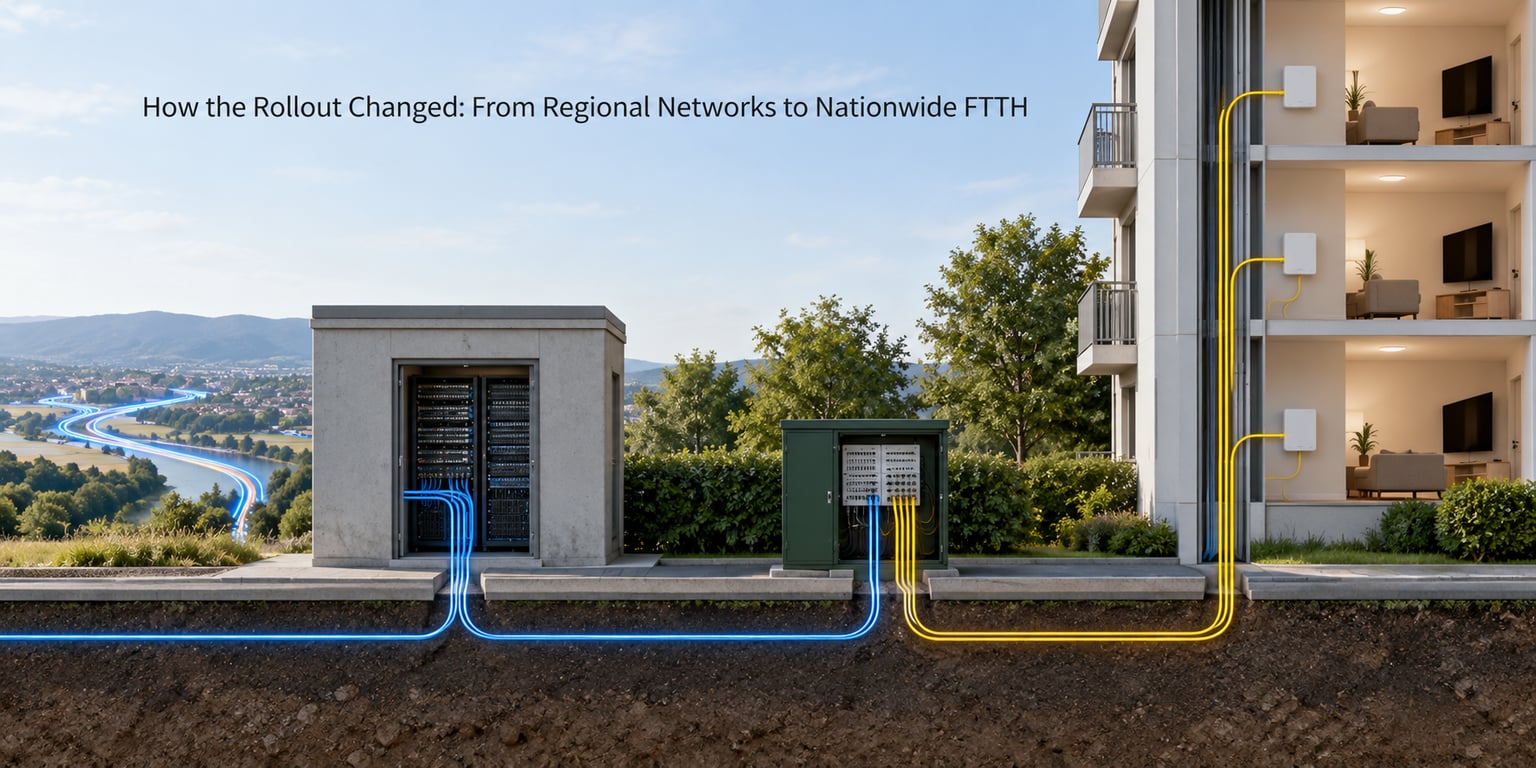
The path from trunk fiber to fiber in the home ran through several different technologies, and each one left something behind. Understanding the sequence explains why Japan’s network ended up where it is rather than somewhere more ordinary.
| Period | Dominant technology | What changed |
|---|---|---|
| 1980s | Copper and leased lines | Fiber existed only on the trunk; homes had copper, or nothing |
| 1990s | Cable and leased-line ISDN services | Cable operators, including J:COM, became the first real alternative to NTT on the access network |
| 2000-2004 | ADSL peaks, then FTTH launches | FTTH subscriber lines crossed into the tens of millions as fiber undercut ADSL |
| 2008 onward | Converged fixed and mobile services | Mobile operators bundled fiber with handsets, pushing fiber into homes that had stayed on cable |
| 2010s | Gigabit as the standard tier | Symmetrical gigabit became the default expectation for a home connection |
| 2020s | Multi-gigabit tiers and dense optical research | Residential tiers moved to 10 Gbps in some areas while research networks pushed transmission records |
Cable was the quiet hinge of the whole story. Before J:COM and its peers started passing homes, the access network was NTT’s alone, and a new carrier had no way to reach a customer. Cable broke that grip and, more importantly, gave consumers a second choice at a moment when fiber to the home was still expensive and technically awkward.
When residential FTTH launched around 2001, it did not immediately win. For a few years, asymmetric speeds were good enough for web browsing, and fiber’s selling point was symmetry, which most households did not yet value. The reversal came with the fiber war, as competing carriers cut FTTH prices hard enough that the faster symmetric option became the cheaper one.
From there the network consolidated. NTT split its regional structure into NTT East and NTT West, which then made densification decisions closer to the exchanges where the density economics actually applied. Regional providers, cable operators and the mobile carriers’ fiber arms, including the Hikari lines sold alongside mobile service, all added capacity in parallel.
By the middle of the 2010s, fiber had passed from the majority technology to the assumed one for new homes, and the OECD still counted only a minority of Japan’s fixed broadband subscriptions as fiber in the early 2010s, which shows how fast the tail of the transition moved.
How Competition and Infrastructure Sharing Shaped the Network
Competition in Japan ran through the carriers rather than over their heads. Because most carriers leased the same underlying fiber, the terms of that leasing decided consumer prices more than any individual operator’s strategy.
Two businesses, two invoices
The split between line provider and ISP is the clearest example. A line provider owns the physical circuit to the premises; an ISP provides the service running over it. Retail customers buy them separately and get two bills, which surprises newcomers and generates a steady stream of support calls about charges they did not know they had signed up for.
The quirk has a purpose. It lets ISP competition happen without duplicating physical construction, and it lets a customer switch internet providers without new civil engineering. It also means national fiber availability can look excellent while a particular apartment remains unreachable.
Densification as a policy tool
Splitting the network into smaller service areas is what makes gigabit economics work. A fiber from the exchange serves a limited number of homes, so capacity has to be pushed closer to the premises as speeds rise. Regulators pushed this repeatedly, and each push lowered how much capacity a household shared.
Unbundling went further, giving competitors access to specific network elements rather than only to a wholesale circuit. Combined with interconnection rules, it meant the incumbent’s network became a platform others sold services over, which is the arrangement the whole fiber war ran on.
The costs of that arrangement were real too. Regulated access does not come free to build or maintain, and the ministry’s own assessments of the NTT Law repeatedly raised the question of how much obligation a private company carrying public obligations should carry. That tension has never been fully resolved, and it sits underneath today’s coverage figures.
Why Japan Reached Gigabit and Multi-Gigabit Broadband
Gigabit speeds in Japan are not the result of a faster network than elsewhere so much as a more compressed one. The reasons are structural: wide use of gigabit passive optical network technology, dense exchange and cabinet topology, an unusually strong domestic appetite for symmetric speeds, and a demand pattern that concentrates in exactly the places fiber is cheapest to deliver.
That last point matters. Dense cities, a large apartment-building stock and heavy streaming and gaming use all push fiber economics in the same direction. In a country of scattered households, the same network would deliver a much lower average.
Once fiber was the default, moving from 1 Gbps to higher tiers was mostly a matter of pushing capacity closer, since the fiber in the ground was already there. The 2020s brought 10 Gbps services from providers such as NURO Hikari and from NTT’s own higher tiers, available where the local cabinet can carry it.
Research transmission records sit alongside that, and they are worth mentioning because the search results for this topic are mostly about them. In 2026‘s recent laboratory work, Japanese researchers reported dense wavelength division multiplexing over new transmission bands with multi-core fiber, pushing laboratory throughput past the one-petabit-per-second mark. Those results are not residential service and will not be for some time; they show that the research capacity compounds on top of a network already built everywhere.
The practical limit remains the building and the local cabinet, not the backbone. A resident with an unwired apartment gets no benefit from any of it.
What Limits and Lessons Remain Today
Japan’s fiber rollout is close to finished but not complete, and the remaining gaps are structural rather than temporary.
Rural economics is the first. Remote municipalities and islands have the same construction costs as anywhere else with a fraction of the customers, so coverage there depends on subsidy programmes that are politically easy to cut. Island communities report options that differ sharply from national marketing.
Apartment access is the second, and it is the one people actually run into. No amount of national coverage fixes a building that has no fiber riser.
The third is market consolidation. After two decades of a fiber price war, several of the alternative carriers that drove that competition have merged or withdrawn, and fewer independent providers compete on access than there were in the mid-2000s. Cheaper access can also mean less pressure to invest in the places where returns are weakest.
Why Japan and not the United States
The comparison people ask for is instructive because the two countries started from opposite structures.
| Factor | Japan | United States | South Korea |
|---|---|---|---|
| Access network in the 1980s | One state-run incumbent with a national duct and exchange map | Fragmented local exchanges, many already owned by cable operators | State-led build with heavy public investment |
| Main fibre route to homes | Incumbent upgraded its own network while selling capacity to rivals | Multiple carriers built overlapping routes, with uneven economics | Aggressive national programmes driving household adoption |
| Typical consumer pattern | FTTH available over a very wide share of households, speed tiers from gigabit upward | Fibre and cable both common, with a large share of homes still choosing cable | FTTH coverage very high, with fast take-up driven by pricing |
| Structural difficulty | Mountainous terrain, seismic retrofitting, apartment wiring | Low density across large areas, making per-household builds expensive | Dense and urban, which lowers construction cost per home |
The point is not that Japan is richer. It is that a single owner of the local loop can upgrade it once and sell the result to many rivals, whereas a market with many local owners has to convince each one. That is a slower process, and it is still running.
The transferable lessons for other countries are unglamorous. Coverage statistics mean little if a household cannot be connected. Symmetrical speeds matter more to real use than headline download numbers. Separating the line from the service lets competition happen without duplicating construction. And where private capital genuinely will not go, coverage is bought with public money and should be described honestly as bought.
Frequently Asked Questions
Who built Japan’s fiber-optic internet network?
Mostly NTT, which owned the ducts, local exchanges and subscriber lines nationwide, plus competing carriers including Japan Telecom, eAccess, So-net, cable operators such as J:COM and the Hikari fiber arms of the mobile carriers. Early intercity optical lines were laid by NTT and KDD for research and corporate traffic decades before homes were connected.
How much did the Japanese government invest in fiber?
There is no single national fiber budget. Spending was spread across decades, first through government-owned NTT, then through the ministry’s policies, and finally through subsidy programmes that paid for rural and unprofitable routes. The ministry’s own assessments tracked industry capital spending rising from 2.2 to 3.8 trillion yen across the first decade after 1985, alongside market growth from 14.5 to 25.4 trillion yen.
Did NTT alone build Japan’s broadband network?
No. NTT built the core network and most of the last mile, but rival carriers built their own long-distance routes and leased NTT capacity to reach customers. Cable operators, mobile carriers and ISPs all competed on top. The distinction matters because policy spent two decades loosening NTT’s control of access rather than dismantling the network it owned.
Why did fiber adoption in Japan take until the 2000s?
Fiber sat on the trunk network for decades while homes stayed on copper because consumers did not yet value symmetrical speeds, and regulation kept wholesale fiber prices high through what was called soft-gauge policy. Once competing carriers forced prices down in the early 2000s, fiber became both faster and cheaper than the ADSL it replaced.
Is fiber internet available throughout rural Japan?
Availability is very high in aggregate, but remote areas and islands depend on government subsidy because household numbers alone do not pay for construction. The bigger practical problem in cities is apartment buildings, where availability is decided per building rather than per neighbourhood. Check whether the specific unit is wired before signing a lease.
The clearest starting point for understanding how Japanese fiber rollout happened is the timeline above, read as four moves: the state built a national optical core, liberalisation in 1985 put that core to competitive use, price regulation in the early 2000s turned fiber into the cheaper option for households, and public money finished the routes that would never be commercial. Everything since, including gigabit tiers, the line-versus-ISP billing split and the apartment problem, follows from those four.