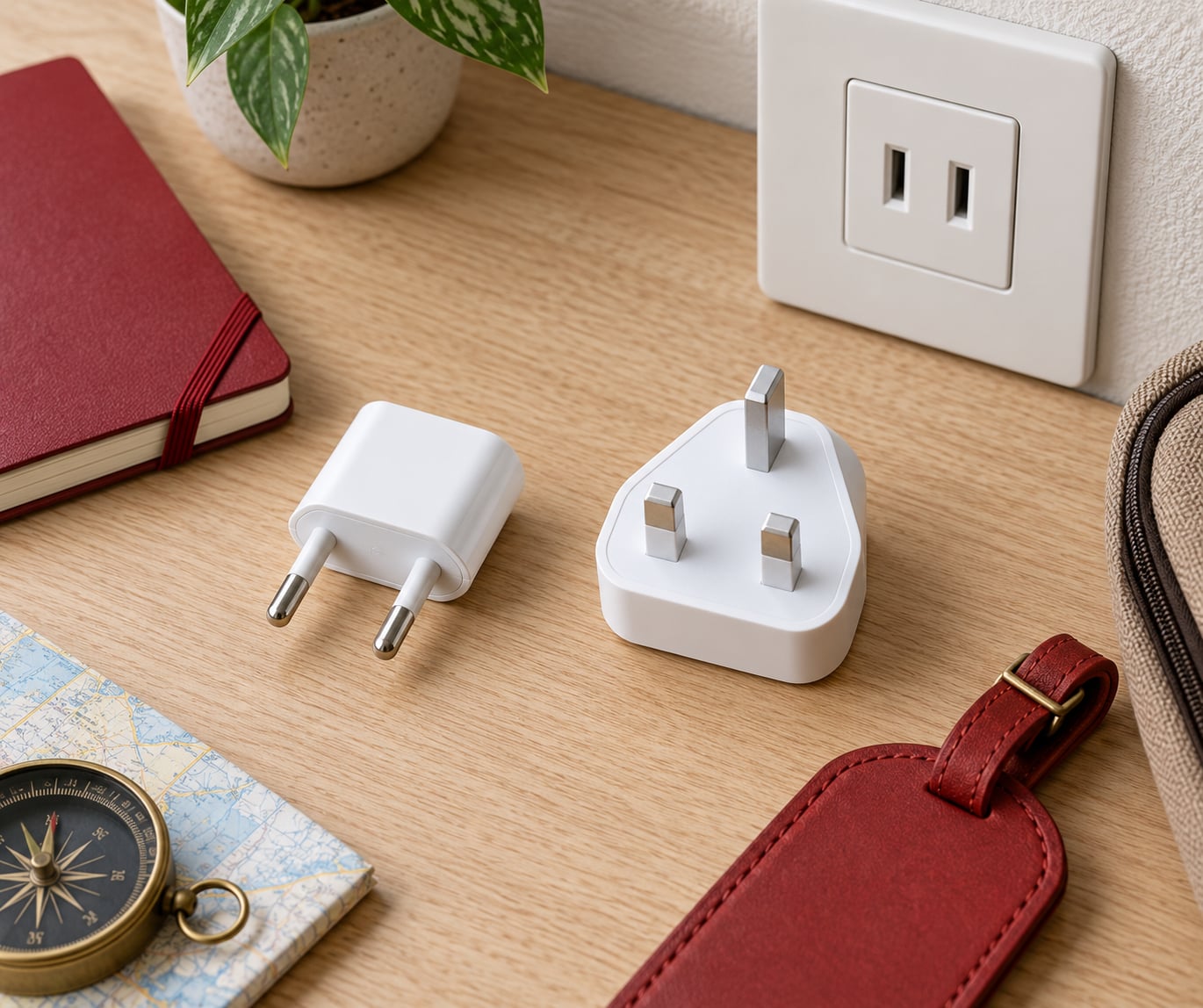
Japan uses two wall socket types: Type A, with two flat parallel pins, and Type B, the same shape plus a round earth pin. Both run on 100 volts, at 50Hz in eastern Japan and 60Hz in the west. A US two-pin plug usually fits a Japanese socket directly. Anything with three pins, or rated for 120V or 230V only, needs something else.
There is more confusion on this topic than almost any other travel question, and most of it comes from a single fact: the plug shape often fits fine while the electricity behind it does not. Japanese power plug types explained properly means separating those two problems, because the fix for each is completely different.
Table of Contents
- 1Japanese Power Plug Types Explained at a Glance
- 2Which Plug and Socket Types Are Used in Japan?
- 3How to Identify the Plug on Your Device
- 4Japanese Power Plug Types Explained by Grounding
- 5What Voltage and Frequency Does Japan Use?
- 6Can You Use Foreign Plugs and Devices in Japan?
- 7What Kind of Adapter Should You Bring?
- 8When Do You Need a Voltage Converter?
- 9How to Stay Safe When Using Electronics in Japan
- 10Frequently Asked Questions
- 11What are the most common Japanese power plug types?
- 12Are Japanese Type A and Type B sockets the same?
- 13Can I use a US plug in Japan without an adapter?
- 14Do I need a voltage converter for a phone or laptop in Japan?
- 15Will a universal travel adapter work for grounded Type B equipment?
- 16Conclusion: Check Your Plugs and Labels Before You Go
Japanese Power Plug Types Explained at a Glance
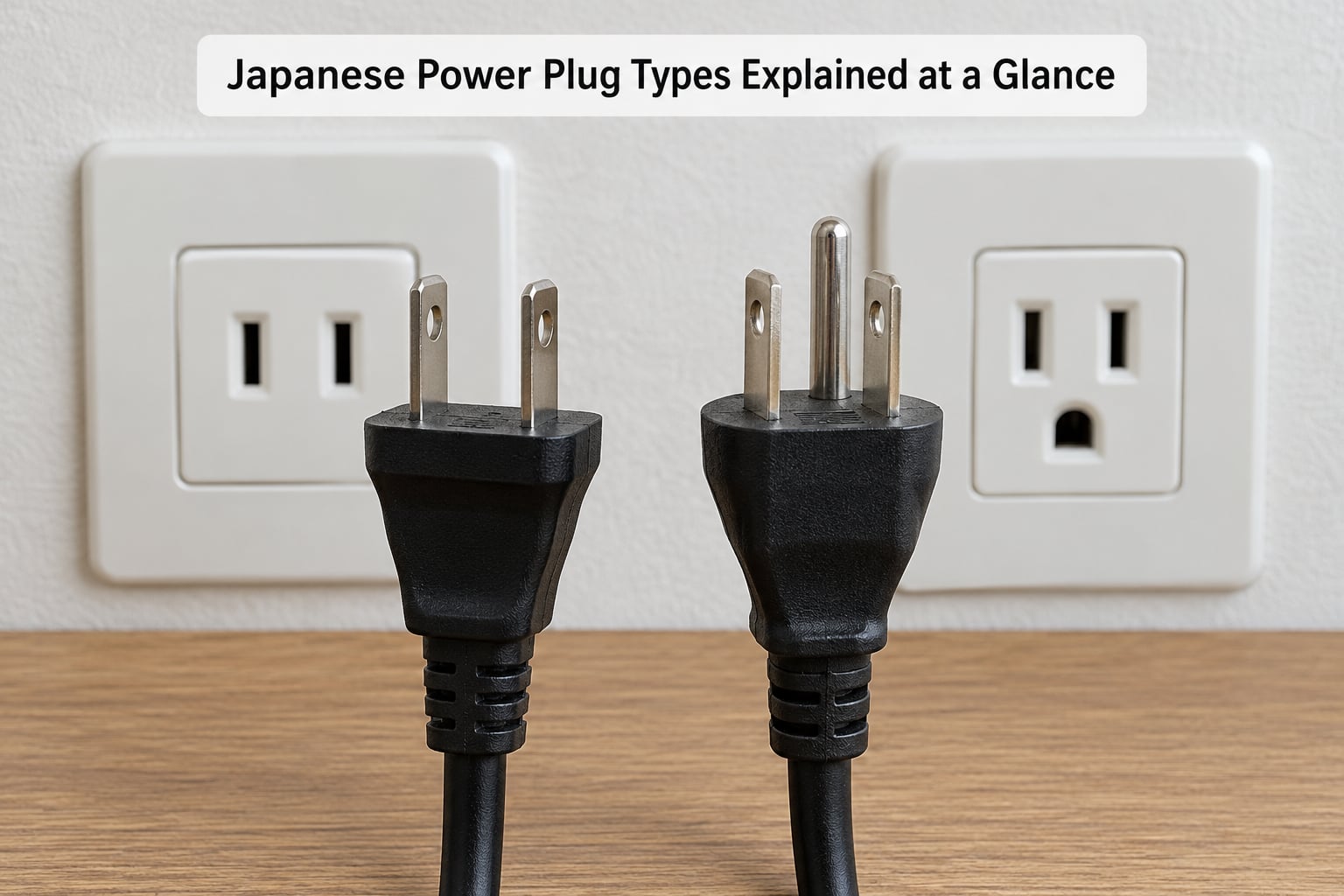
Here is the short version. Japan runs on Type A sockets at 100V, split between 50Hz in the east and 60Hz in the west. Type B sockets exist but are uncommon in homes. Most US chargers, phones and laptops work with nothing more than a flat two-pin plug. Grounded three-pin equipment and anything built for 230V will not.
| Country or region | Plug type | Voltage | Frequency | Grounded outlet common? | Adapter needed for a phone charger? |
|---|---|---|---|---|---|
| Japan | Type A (Type B rare) | 100V | 50Hz east, 60Hz west | No | No |
| United States | Type A and Type B | 120V | 60Hz | Yes | Yes |
| United Kingdom | Type G | 230V | 50Hz | Yes | Yes |
| EU and Switzerland | Type C and F | 230V | 50Hz | Yes | Yes |
| Australia and New Zealand | Type I | 230V | 50Hz | Yes | Yes |
Japan is the unusual column in that table. Most of the world sits at 230V, which is why travel advice written for Europe rarely needs adjusting for Japan and why devices built for European mains so often fail here.
Which Plug and Socket Types Are Used in Japan?
Type A is the standard Japanese wall socket. It has two vertical slots sized for flat parallel pins, and in most older buildings the live and neutral slots are identical, so the plug goes in either way. The technical name for the two-pin plug is NEMA 1-15, and the socket is usually described as a NEMA 1-15R receptacle.
Type B adds a round grounding pin below the two flat blades. It is the standard North American grounded plug, and Japan does use it in newer apartments, offices and commercial buildings. It is not the default residential socket, and you will rarely find one in a hotel room or a rental. Many Japanese desktop PCs and larger appliances ship with a three-pin cord for that reason.
Round Type C pins do show up in Japan, but not in Japanese walls. They appear on imported European appliances that are double-insulated and therefore carry no earth conductor. A Type C plug fits a Japanese Type A socket because the pin diameter is close enough for the slot to accept it, but that is a coincidence of sizing rather than a Japanese standard.
How to Identify the Plug on Your Device
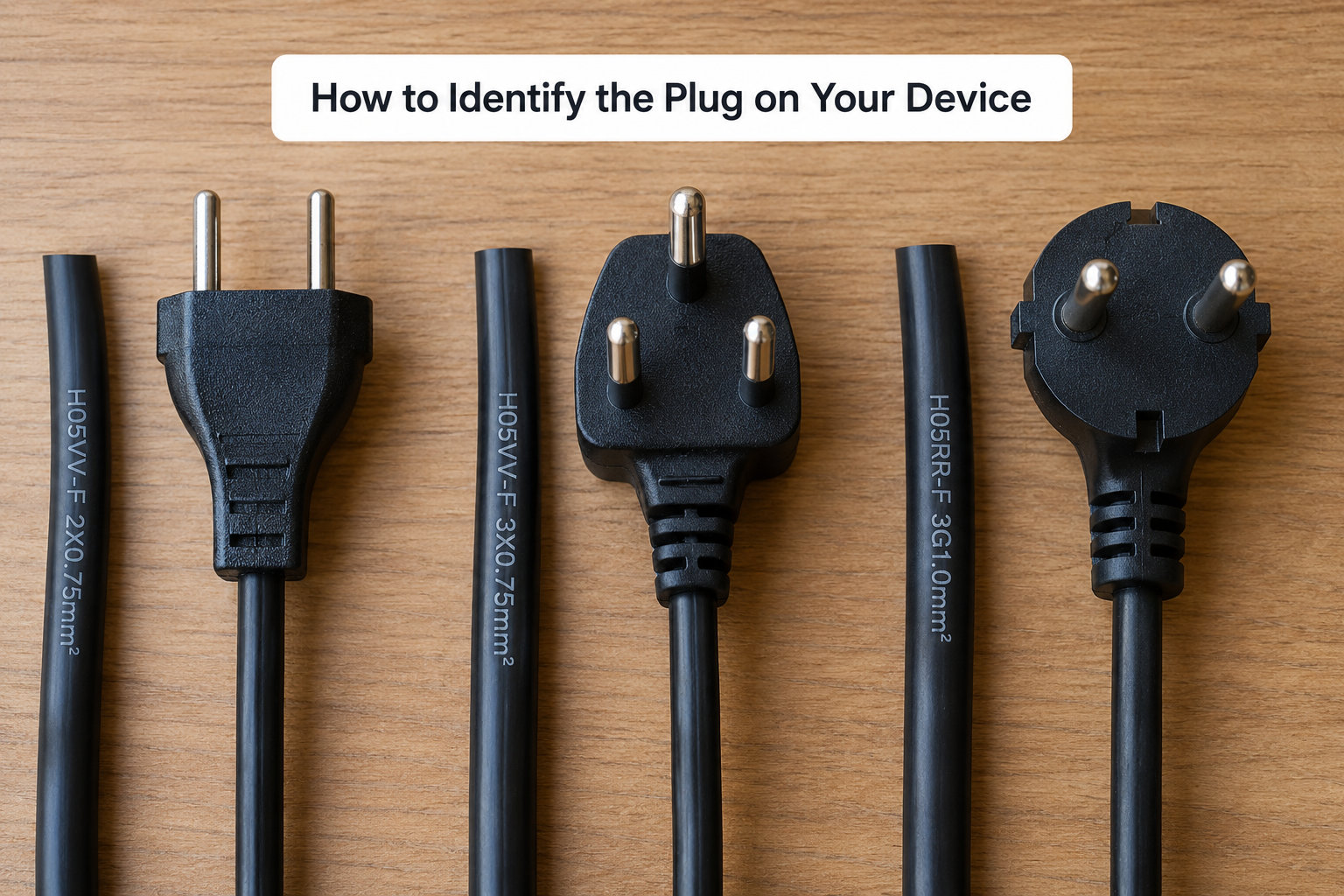
Count the pins and look at their shape. Two flat parallel blades means Type A, and that plug will fit a Japanese socket. A third round pin above or below the blades means Type B, and that will not fit a two-slot Japanese receptacle without an adapter. Two round pins in a row means a European Type C plug, which needs a converter as well as an adapter.
Do not judge grounding by shape alone, though. Plenty of double-insulated appliances ship with a detachable two-pin cord even when the device itself is well built, and some cheap three-pin cables are decorative rather than functional. The reliable source is the label on the power brick or the appliance itself, which lists the input range as something like 100-240V 50/60Hz or 110-240V 50/60Hz.
A second clue is the cord itself. Look for a double square symbol, two nested squares, printed on the device. That mark means the appliance is double-insulated and does not need an earth connection at all, so a two-pin plug is correct and no adapter is required.
Japanese Power Plug Types Explained by Grounding
Japanese power plug types explained by grounding comes down to one distinction: Type A carries live and neutral only, while Type B adds a true earth connection to a metal chassis or case. Grounding is what protects you if a fault energises the outer shell of an appliance.
A Type A plug inserted into a Type B socket stays ungrounded. The two flat blades make contact, but with no third pin there is no path to earth. So swapping sockets does not upgrade an ungrounded device, and a three-to-two prong adapter does not create a ground either. It simply lets a physically larger plug reach the two useful contacts.
If the manufacturer specifies a grounded supply, use equipment that provides one and keep the earth path intact. Medical devices, heated tools and anything with a metal case that the maker expects to be earthed are the cases where giving up the trip is the right call.
What Voltage and Frequency Does Japan Use?
Japan supplies 100 volts. Frequency divides the country in two: roughly 50Hz east of a boundary running through central Japan, including Tokyo, Nagoya and Osaka, and 60Hz to the west, covering Kyoto, Fukuoka and Sapporo. Some sources place the dividing line slightly differently, so treat cities near it as a rough guide.
Nominal voltage alone tells you very little. Many devices list an input range such as 100-240V 50/60Hz, which means the power supply handles both the voltage and the frequency, and those work anywhere. Others list a single figure like 120V 60Hz, which tells you the device expects a specific supply and will not simply adjust.
The 100V figure also matters more than the number suggests. A heating appliance designed for 230V receives less than half the power from a Japanese socket, so it heats slowly or not at all. A motor or compressor rated for 120V runs at about 83 percent of its intended voltage on a 100V supply, which means it runs cooler and less efficiently, not dangerously fast.
Can You Use Foreign Plugs and Devices in Japan?
Grouped by where you are flying from, here is what actually happens.
- United States and China, Type A two-pin: usually no adapter at all. The pin dimensions are close, and most phone and laptop bricks use NEMA 1-15 plugs.
- United States, Type B three-pin: you need a three-to-two prong grounding adapter, and you should accept that the earth pin on those adapters is decorative unless it is fitted with a proper bonding screw or the socket is grounded.
- Europe, Type C and F: you need both a shape adapter and a converter for anything not rated for 100V. Modern phone and laptop chargers are usually dual voltage and only need the shape adapter.
- United Kingdom, Type G: the thick three-rectangular-pin plug never enters a Japanese socket. An adapter plus a converter is required for mains-rate devices.
- Australia and New Zealand, Type I: two flat pins angled in a V, with an earth pin. Same rule as the UK case: adapter for shape, converter for voltage if the device is not dual rated.
Never force a plug into a socket that resists it. Japanese sockets use shutters and tight tolerances, and prying against one can bend a pin or crack a socket face. If it does not slide in with ordinary finger pressure, the wrong adapter is in your hand.
What Kind of Adapter Should You Bring?
Buy for the plugs you already own, not for the country you are visiting in the abstract. Most travelers carry a mix, so the useful move is to go through your bag, look at every power brick, and sort them into two piles: two-pin and three-pin.
For a two-pin pile, a simple Type A to Type A adapter is harmless but usually pointless, since the plug already fits. For a three-pin pile, search for a three-to-two prong grounding adapter, and pick one with a solid body and a screw or metal tab where the earth pin meets the socket if the outlet box is actually grounded.
A multi-country travel adapter with interchangeable heads covers more ground in one object. The trade-off is bulk and the loss of grounding on any position that cannot take an earth pin. If your kit is mostly modern chargers, either approach works; if you carry a laptop brick with a three-pin plug, grounding matters and a specific adapter beats a universal one.
Whatever you choose, look for the PSE mark on the plug body. It is the Japanese electrical safety compliance mark, and products sold legally inside Japan are required to carry it. It tells you the item was tested to Japanese mains conditions rather than to a generic export standard.
When Do You Need a Voltage Converter?
An adapter changes the shape of a plug. A converter changes the voltage feeding the device. They solve different problems, and packing a converter when you did not need one is the most common travel mistake in this category.
You need a step-down converter only when the device label shows a single high input voltage or a range that excludes 100V. That covers most mains-rate heating appliances such as hair dryers, straighteners, clothing irons and electric kettles from Europe and the UK, plus kitchen appliances like toasters and blenders. Anything rated at 120V only will also need attention, though most travel hair dryers sold in the US are dual voltage for exactly this reason.
You do not need a converter for phones, tablets, laptops, cameras, battery chargers, power banks, game consoles, monitors with built-in power supplies, or CPAP machines whose brick reads 100-240V 50/60Hz. Check the CPAP case specifically, since those devices are expensive and the label is easy to miss on a humidifier cable.
Two frequency notes worth knowing. Modern switched-mode electronics ignore 50Hz versus 60Hz entirely. Older induction cookers, some small motors and cheap electric clocks can behave oddly on the wrong frequency, so if a device is old and fussy, check its manual.
How to Stay Safe When Using Electronics in Japan
Four checks cover almost every situation. Confirm the adapter matches the plug exactly. Confirm the input rating on the device includes 100V. Keep the earth path intact for anything the manufacturer expects to be grounded. And confirm the adapter carries the PSE mark rather than being an unlabelled bargain item.
Watch for physical warning signs at the connection. A plug or socket that becomes hot to the touch, smells burnt, discolours, sparks when you plug in, or fits loosely enough that the device moves in it should be unplugged at the wall immediately. Do not keep using it while you think about it.
Power strips sold for Japanese use are a good idea in older accommodation, where rooms often have one or two outlets. A surge-protected strip with a proper Japanese plug gives you somewhere safe to charge a phone overnight, and the ones with USB ports save hunting for a wall socket in a ryokan with a bathroom that has no outlet at all.
If a socket in your home looks loose, scorched or warm, stop using it and tell your landlord or property manager. Have the wiring inspected by a qualified electrician rather than attempting a repair yourself, especially in older buildings where two-prong outlets were never earthed at all.
Frequently Asked Questions
What are the most common Japanese power plug types?
Type A is the standard. It has two flat parallel pins and no earth, and it appears in virtually every Japanese home, hotel and ryokan. Type B, the same shape with a round grounding pin, exists but is uncommon in residential buildings and shows up mainly in newer apartments, offices and Japanese-market computers. European Type C round pins turn up only on imported double-insulated appliances, never in Japanese walls.
Are Japanese Type A and Type B sockets the same?
They are not. Type B has a third round grounding pin that a Type A socket does not have a hole for, so a three-pin plug will not enter a two-slot Japanese receptacle without an adapter. Type A plugs do fit a Type B socket, but the device stays ungrounded because there is no earth pin to make contact. Most older Japanese outlets are also non-polarized, so a two-pin plug fits either way.
Can I use a US plug in Japan without an adapter?
Usually yes for two-pin plugs, and that covers most phones, laptops, cameras and battery packs. Japanese and US sockets look almost identical, though Japanese pins are fractionally narrower and longer, which is why a plug can feel snug or stop just short rather than sliding straight in. US three-pin Type B plugs will not fit at all and need a three-to-two prong grounding adapter. Voltage is the other half of the question: check that your device reads 100-240V or 100-120V.
Do I need a voltage converter for a phone or laptop in Japan?
No. Phone and laptop chargers are almost universally dual voltage, labeled something like 100-240V 50/60Hz, so they accept Japan’s 100V supply as long as the plug shape fits. The same goes for tablets, monitors, game consoles and power banks. Converters are for mains-rate heating appliances built for 230V, such as European hair dryers, straighteners, kettles and toasters, and for older 120V-only devices. Read the label before you pack rather than after you land.
Will a universal travel adapter work for grounded Type B equipment?
It works physically, but grounding is where universal adapters disappoint. Most multi-country adapters route the earth pin to nothing, or to a removable metal tab that only bonds if you screw it to a properly grounded socket box. A Type B device plugged into such an adapter still works, and the earth pin on the plug becomes decorative. If the manufacturer specifies grounding, use a three-to-two prong adapter designed for that purpose and keep the earth path intact.
Conclusion: Check Your Plugs and Labels Before You Go
Take ten minutes before you pack. Read the input rating on every power brick, note which plugs have three pins, and sort them into two groups. That tells you whether you need anything at all, a three-to-two prong grounding adapter, or a step-down converter.
Then pack the narrowest thing that does the job, choose adapters with the PSE mark, and buy them at home rather than paying for them on arrival.