The short version of why Japanese shipping is so fast: the whole system is built for short, dense routes and frequent handoffs, not one clever trick. A parcel usually travels a short distance, gets sorted once at a regional hub, and rides a packed delivery round to your door, often the next day.
If you order from a Japanese retailer on a Monday morning, next-day delivery across most of Honshu is normal rather than a premium perk. Shoppers notice because it is boringly reliable, which is the highest compliment in logistics.
The rest of this guide breaks down the machinery behind that reliability: how parcels move, how orders get fulfilled, why compact packaging matters, how carriers fill their routes, and where the model still falls short.
Table of Contents
- 1The Short Answer: Why Japanese Shipping Is So Fast
- 2Japan’s Logistics Network: How the System Works
- 3Fulfillment Centers and Order Processing
- 4Compact Packaging and Efficient Handling
- 5High-Density Routes and Frequent Departures
- 6Tracking, Reliability, and Customer Service
- 7Shipping From Japan Overseas: What to Expect
- 8Frequently Asked Questions
- 9Is Japanese shipping really faster than shipping from other countries?
- 10How long does standard domestic shipping in Japan usually take?
- 11Why do some Japanese delivery services use convenience stores?
- 12Does Japanese shipping mean my international order will arrive quickly?
- 13What can make a Japanese parcel take longer than expected?
- 14How should shoppers read Japanese shipping and tracking information?
- 15What to Do First
The Short Answer: Why Japanese Shipping Is So Fast
Japanese shipping is fast because dense routes, frequent departures and tight coordination work together. Parcels travel short distances, get consolidated once at a regional hub, run on packed multi-stop rounds, and are handed off quickly at one of roughly 180,000 convenience stores. Reliable tracking and a large pool of available drivers finish the job.
That combination matters more than any single factor. Plenty of countries have fast air freight. Far fewer have a delivery network where a van can drop 200 parcels a day because the addresses are all within a few kilometres of each other.
Japan’s Logistics Network: How the System Works
A Japanese parcel passes through five layers, and it moves through each one quickly because the layers are short and the interfaces between them are automated.
The first layer is the drop-off point. That could be a convenience store, a hotel reception, an airport counter, a carrier branch or, for most e-commerce orders, a warehouse in the same region as the customer. The second layer is regional consolidation, where parcels get sorted by destination area. The third is the trunk line moving freight between regions, usually by road and rail rather than air. The fourth is the destination sorting hub. The fifth, and usually the longest part in elapsed time, is the last-mile delivery round.
Domestic options differ mainly in how much of that chain they compress.
| Domestic option | Typical speed | Tracking detail | Best used for |
|---|---|---|---|
| Courier parcel service (Yamato Ta-Q-Bin, Sagawa) | Next day; two days to remote areas | Scan at every handover, plus a two-hour arrival window | Everyday parcels, e-commerce, luggage forwarding |
| Same-day courier, booked in the morning | Same day when drop-off happens before roughly 10:30am | Live driver position on the tracking page | Urgent documents, forgotten items, parts |
| Convenience store drop-off and pick-up | Adds hours, not days; stores are open around the clock | Standard parcel scans plus store reference number | Anyone without a daytime address, or returning goods |
| Japan Post parcel service | Slower than courier express; more variation in the countryside | Coarser scans, fewer status updates | Cheaper, heavier and less urgent shipments |
| Yamato airport forwarding | Reliable only with a 48 to 72 hour lead time | Full tracking, delivery time agreed with the hotel | Suitcases moved from hotel to hotel or to the airport |
One detail trips up almost everyone new to this: convenience stores handle the outbound side only. A parcel dropped at a counter is not delivered from that shop. It leaves on a courier collection run.
Fulfillment Centers and Order Processing
Most Japanese e-commerce orders never visit a retail shop. They are picked in a fulfillment centre, sometimes by machines that pull items off shelves and read barcodes as they pass, then packed at a station where the packing slip, the inventory record and the carrier label have to agree.
Accuracy there decides speed downstream. A parcel scanned into the wrong sorting zone costs a driver a return trip and the customer a day, so carriers push hard on inventory accuracy and label readability. Orders cut off in the early afternoon sit through the evening sort and ride the first trunk line out of the region; anything scanned after the local cutoff waits a full extra cycle.
Shoppers can shorten the chain themselves. Dropping a parcel at a counter instead of relying on collection from a home address removes one visit from the route, and it works at hours when nobody is at home to receive it.
Waybills are simpler than the reputation suggests. You write the recipient name and address, the size category and the phone number, choose a payment method, and the counter staff handle the rest. Size category is the part that catches visitors: carriers price on the combined length, width and height in centimetres, in bands of 60, 80, 100, 120, 140 and 160 cm, with weight caps from 2 kg up to 25 kg. Oversize charges apply above 160 cm or 25 kg, and insured cover runs to 300,000 yen.
For travellers moving luggage, hotels will accept and hold a parcel on a guest’s behalf even before check-in, which makes multi-city trips without suitcases straightforward. The one rule worth learning before you book a flight: bags sent to an airport need a 48 to 72 hour lead time, not a next-day promise.
Compact Packaging and Efficient Handling
Small parcels are the cheapest thing in the whole network to move. A box that fits through one sorting lane, under one scanner and inside one van slot gets handled at every stage without a human making a judgement call.
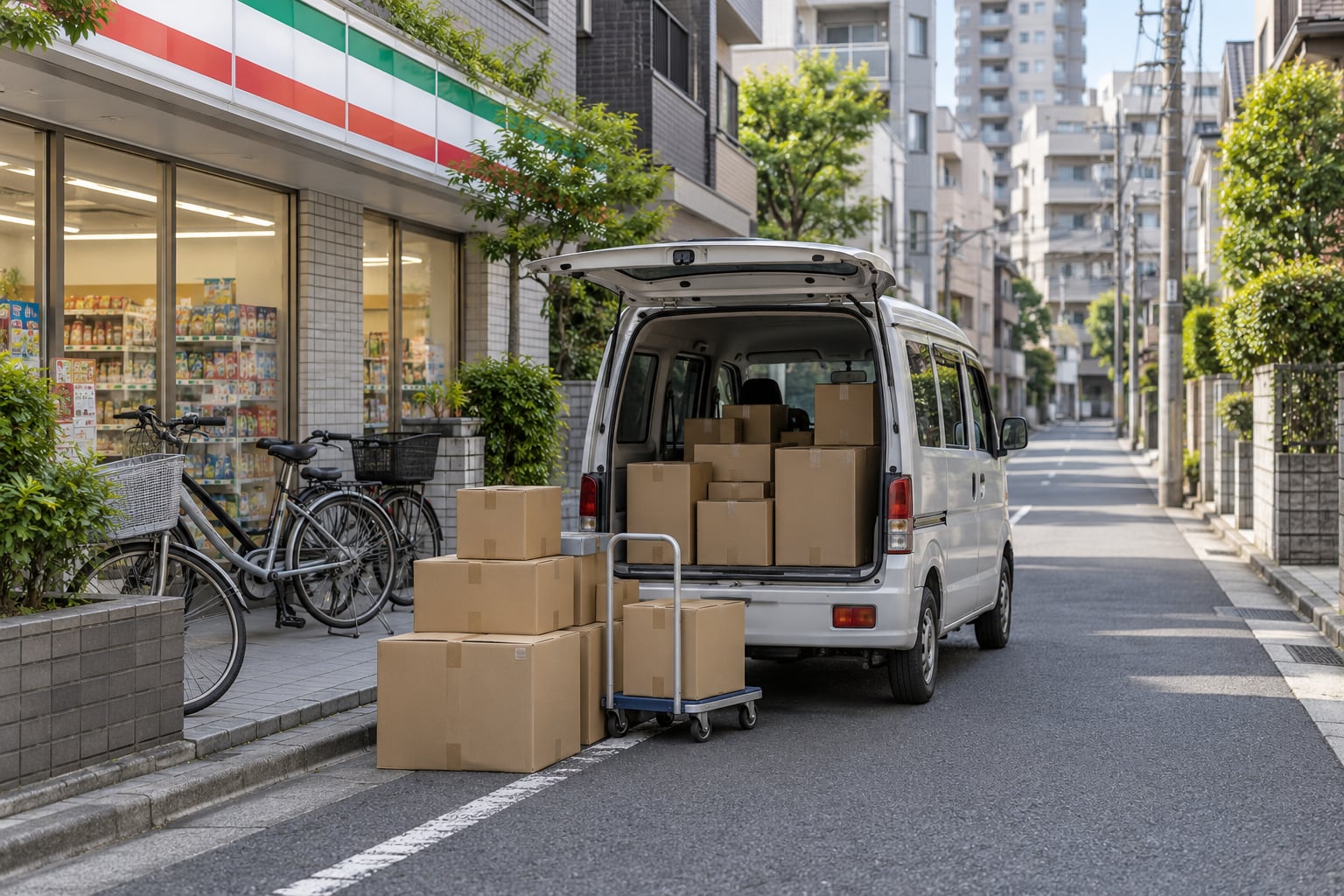
Japanese carriers push this hard. Packaging guidance favours boxes that match the contents, and anything over about 30 cm on its longest side tends to be charged as a size band rather than a standard parcel. That commercial pressure has trained retailers and buyers to ship tighter boxes, which is why Japanese parcels in a van look unusually uniform compared with mixed freight elsewhere.
Standardised labelling is the other half. A flat, square label with a machine-readable code in a consistent corner can be read at a glance in poor light, from any angle, by a scanner running at conveyor speed. Mis-sorted parcels are the expensive failure in this business, so label geometry gets as much attention in courier design as route density does.
Compact packaging also cuts damage claims, and a damaged parcel is a redelivery, which is the single biggest time sink a courier faces.
High-Density Routes and Frequent Departures
The economics of Japanese parcel delivery come down to how many parcels one driver can drop in a day. In a country where most people live in a handful of metropolitan areas and a large share of addresses sit in dense apartment blocks, a driver can work a fixed route of sixty to two hundred stops and finish on schedule.
Carriers call these scheduled collection and delivery runs, and the whole network is planned around them. Parcels are assigned to a route before the van leaves, so there is no sorting decision in the field. The driver loads a sequence, works the sequence, and scans as they go.
Part-time and spot drivers make the system elastic. A carrier can add capacity for a December surge or an event weekend without hiring permanent staff, and drivers who want a short shift or an early start can take one. Forums like r/JapanTravelTips are full of people who noticed this from the passenger side: drivers treat the work as a job with a route to finish, not a set of disconnected drop-ins.
Road usually beats air on domestic lanes for the same reason. A van carrying 200 parcels from Tokyo to the Osaka region costs less and arrives within the delivery window, while a single parcel flown by air still has to be sorted, driven out and delivered by hand.
Concentration is also why peak congestion bites so hard. Volume concentrates in a few lanes and a few weeks, and the same density that produces next-day service produces multi-day backlogs around setsubun, the New Year holiday period, Obon, and the December gifting season. Remote islands and mountain areas add another day by definition, which is why Okinawa usually sits at two days rather than one. Japan Post parcels run a step slower than courier express and show far fewer scans, which is the recurring complaint in shipping questions about the service.
Tracking, Reliability, and Customer Service
Tracking is what turns a fast parcel into a predictable one. The status codes follow a simple sequence: parcel accepted, dispatched, out for delivery, delivered. In between, a courier page usually shows the depot the parcel reached and the hour range it will arrive in.
Those arrival windows are the reason precision is affordable. Customers pick a two-hour slot in advance, which lets a planner build a route that hits each stop inside its window instead of chasing an open-ended day. Japanese shoppers accept this because missing a window means waiting until the next evening.
Recipients are usually expected to be present for a household delivery, which means a failed attempt means a redelivery, not a parcel on a step. Contactless delivery has widened the options, and the large majority of parcels the major carriers handle are eligible for leave-at-door service. If nobody answers, many couriers will call, and they will negotiate rather than simply fail. A driver phoning a customer to move a 7 to 9pm slot during heavy snow is the detail people remember, and it says something about how the promise is treated: as an appointment, not an estimate.
Shipping From Japan Overseas: What to Expect
Domestic speed does not travel well across an ocean. A parcel leaving Japan goes through export handling, customs in the destination country, and a local delivery network that may be nothing like Japan’s. Japan Post EMS typically reaches the United States in roughly a week to ten days, courier express in three to six, and neither is a same-week promise in peak season.
Two things cause most of the complaints. First, customs: international parcels need a fully itemised declaration with declared values, and an incomplete one stalls the parcel. Second, timing: sending a box home after a trip without allowing for processing delays is how parcels arrive after the traveller has left.
Domestic experience also colours expectations badly. Someone spoiled by next-day delivery in Tokyo reads a seven-day international transit as a failure, when it is simply a different service with different rules.
Frequently Asked Questions
Is Japanese shipping really faster than shipping from other countries?
Within Japan, yes, and by a wide margin. Most domestic parcels arrive the next day when they are handed in during the morning, and two days is normal for remote islands such as Okinawa. Comparing Japan with a large country like the United States, the difference comes down to geography and route density: a short average haul and tightly packed delivery rounds beat long drives between sparse addresses.
How long does standard domestic shipping in Japan usually take?
One day is the standard for courier services such as Yamato and Sagawa when the parcel is handed in before the local cut-off, usually around 10:30am for same-day options and mid-afternoon for next-day. Two days applies to remote islands, mountain regions and some islands where there is no overnight trunk line. Japan Post parcels usually take longer and vary more by destination.
Why do some Japanese delivery services use convenience stores?
Because roughly 180,000 convenience stores sit within a short walk of most homes, they give carriers a nationwide drop-off network that works around the clock. That removes the failed delivery attempt when nobody is home and lets people hand over parcels outside working hours. Stores handle the outbound side only; the parcel still travels on a courier vehicle to the recipient.
Does Japanese shipping mean my international order will arrive quickly?
No. Domestic next-day speed depends on short distances and dense routes, and neither survives an ocean crossing. Japan Post EMS typically takes about seven to ten days to the United States, while courier express runs three to six days. Allow extra time for customs clearance, and make sure the parcel carries a full itemised declaration with declared values so it is not held.
What can make a Japanese parcel take longer than expected?
Peak congestion is the biggest cause, especially around setsubun, the New Year holiday period, Obon and December gifting. Heavy snow and typhoons also slow road transport. Remote islands and mountain areas add a day by design. Senders can cut delays by using next-day service, meeting the cut-off, and keeping parcels inside a standard size band.
How should shoppers read Japanese shipping and tracking information?
Look for the size category on the label, since the combined length, width and height in centimetres determines the size band and any oversize charge, with limits running from 60 to 160 cm and 2 to 25 kg. On the tracking page, the key update is the out-for-delivery scan and the two-hour arrival window. A parcel sitting at one depot for several days usually means a missed delivery attempt rather than a problem with the address.
What to Do First
Order early in the day, keep parcels inside a standard size band, and hand them over at a counter instead of waiting for collection. That single habit removes a failed delivery attempt, a size upgrade and an extra depot cycle from the same parcel.
The speed itself is worth understanding, though, because it is not a service level that any carrier can just offer. It is what happens when short routes, dense addresses, available drivers and accepted delivery windows all line up.