Facebook struggled in Japan because it arrived late into a social market that domestic services already owned, then lost those users to messaging-first LINE, and ran head-on into local norms around real names, public self-promotion and anonymous expression. It was never blocked or restricted there. It simply never became the default way people kept in touch.
That single sentence hides two failures that get merged all the time. The first ran from the 2008 Japanese launch through 2012: Facebook could not win mainstream adoption against mixi, Mobage and GREE. The second ran from 2013 onward: even after brands pushed sign-ups up to 17.12 million at the end of 2012, those accounts evaporated, falling 19.5% to 13.78 million within about five months, according to figures reported from Japanese data tracker Jin115 in 2013.
By that point LINE was reported at 41.51 million Japanese users. A platform sitting three times smaller than the leader is not competing for the same slot.
So the honest answer to why Facebook struggled in Japan is not “Japanese people rejected it.” They did not reject social networking — they built some of the most heavily used social products in Asia. They rejected a particular product model arriving at a particular moment, in a particular ecosystem.
Below is how that market worked, what Facebook did right and wrong inside it, and what a global team should take from it before entering the next mature market.
Table of Contents
- 1What was the core problem facing Facebook in Japan?
- 2Why Facebook struggled in Japan: seven connected market forces
- 3A quick comparison of the platforms competing for Japanese attention
- 4How did Mixi and other Japanese platforms gain an advantage?
- 5Why did Facebook’s global identity model feel unfamiliar in Japan?
- 6How did Japan’s mobile-first internet shape adoption?
- 7Why Facebook struggled in Japan on mobile
- 8Why did trust and offline identity matter so much online?
- 9Why did Facebook have trouble building a local business model?
- 10What mistakes did Facebook make in its Japanese market strategy?
- 11Why Facebook struggled in Japan: what actually explains the outcome?
- 12What lessons can global technology companies learn?
- 13Frequently Asked Questions
- 14Did Facebook shut down its service in Japan?
- 15Why did Facebook struggle in Japan compared with Mixi?
- 16Was Japanese culture the main reason Facebook struggled in Japan?
- 17How did Japan’s feature-phone culture affect Facebook?
- 18What can global social platforms learn from Facebook’s experience in Japan?
- 19What to take away from Facebook’s experience in Japan
What was the core problem facing Facebook in Japan?
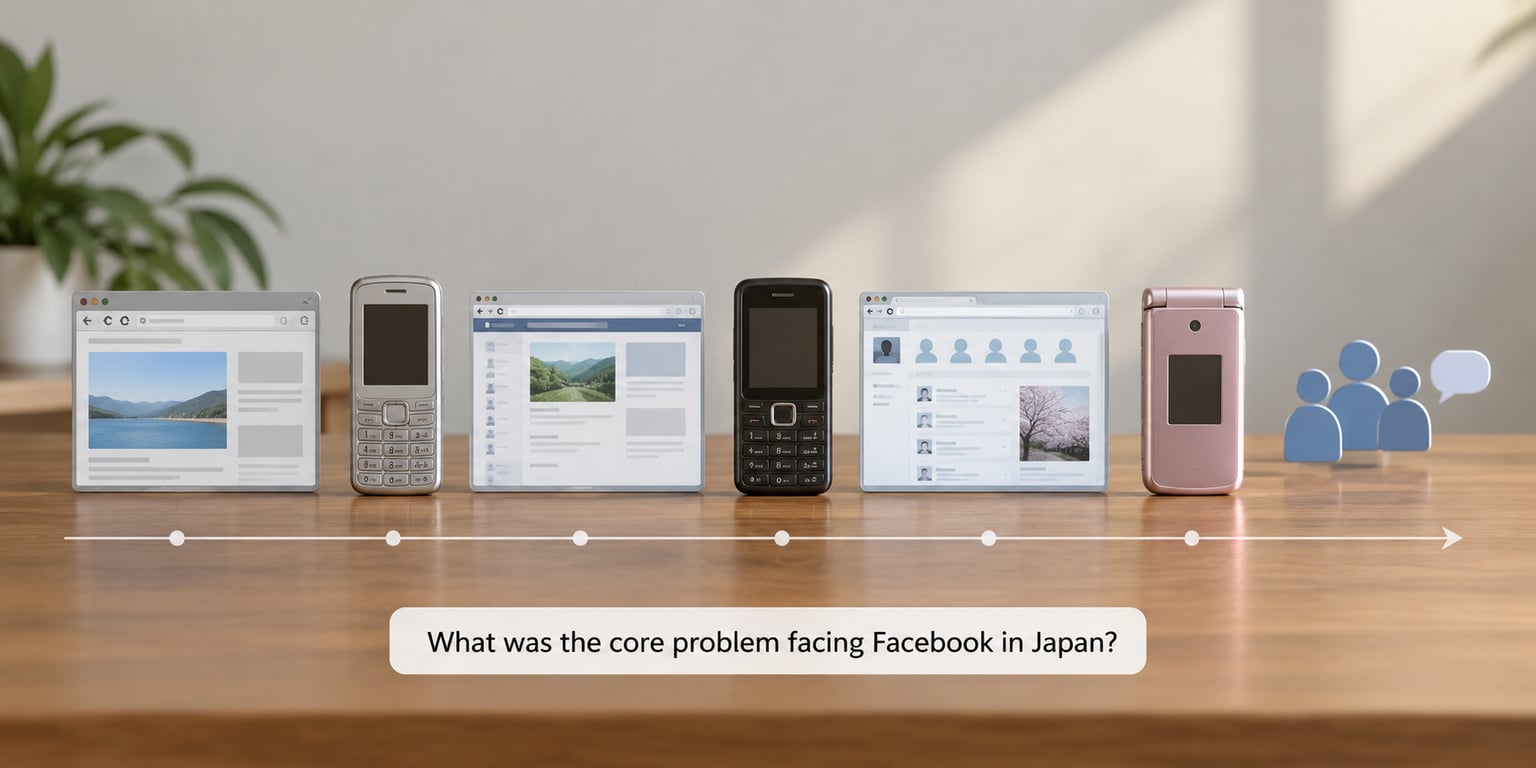
The core problem was timing against maturity. Facebook opened a Japanese-language site in 2008, by which point mixi (2004) and the mobile social game platforms Mobage and GREE already had years of habit, funding and network density behind them.
Facebook’s early years in Japan were slow. Adoption picked up when brands and marketing departments started pushing it as a campaign channel, which produced registrations without producing the daily use that a social network needs to hold.
Then LINE launched in 2011 as a messaging app, not a network. It registered people by phone number, needed no email, and put conversations inside small groups — the format Japanese users actually wanted from a social product.
So the historical pattern is: late entry, weak consumer pull, a brand-driven signup spike, and a sharp retreat once the marketing push faded. Every later problem grows out of that first one.
Why Facebook struggled in Japan: seven connected market forces
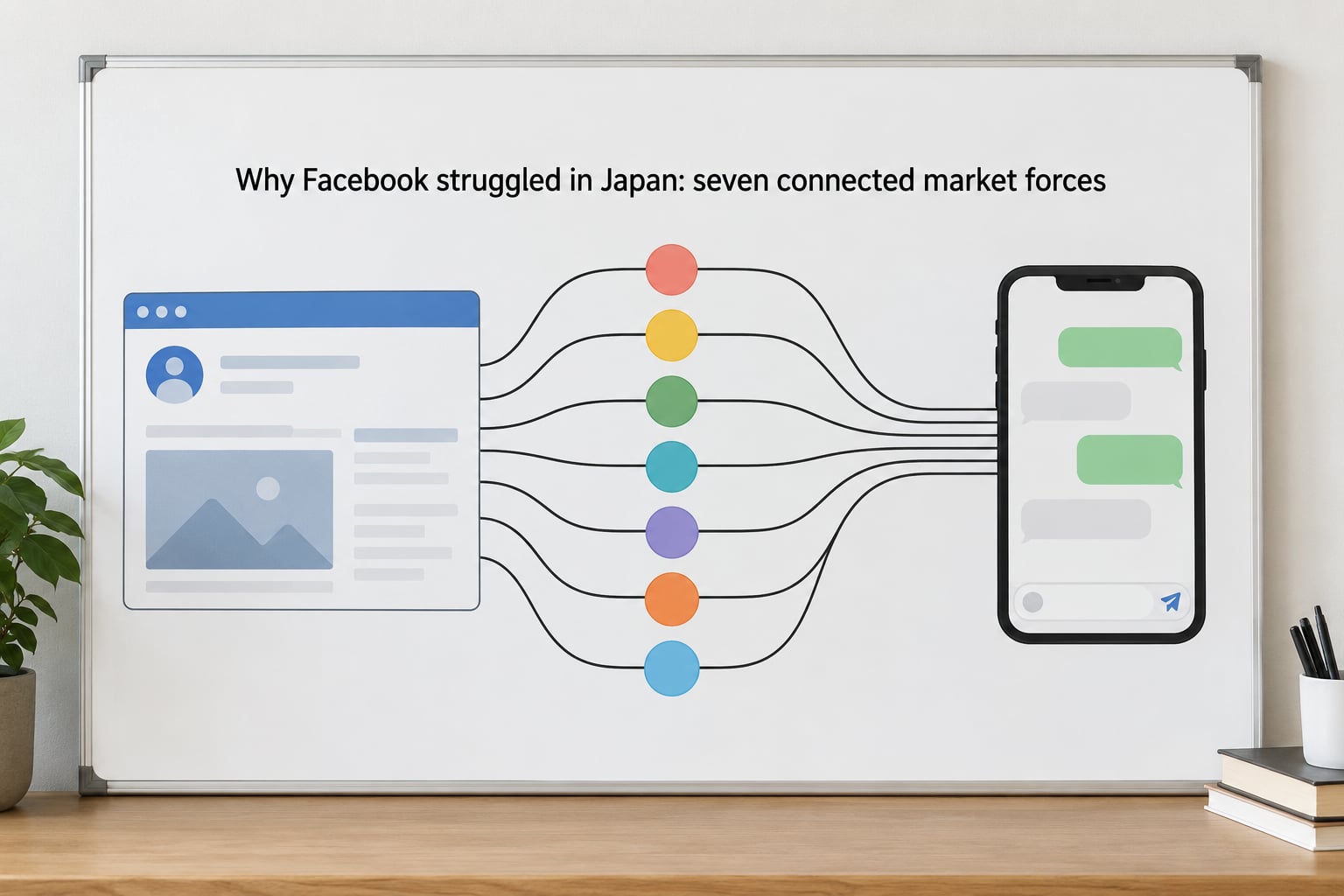
No single force decided this. Seven of them interacted, and removing any one of them would not have saved the outcome.
- It entered a mature domestic market. mixi, Mobage and GREE held the social slot years before Facebook arrived in Japan.
- The social graph worked differently. Facebook assumes an open broadcast graph. Japanese use leaned on closed groups and pseudonymous handles.
- Usage was mobile-first. Messaging apps owned the phone, not social feeds, and Facebook’s early mobile experience lagged what locals had already.
- Real-name identity cut against local habits. Japan’s internet had a long anonymous-posting tradition, and mandatory real names read as exposure.
- Competition was local and well funded. LINE, Twitter/X and the gaming platforms competed with each other before Facebook finished translating itself.
- The business model localized slowly. Japanese advertising already ran through portals, publishers and agencies, so Facebook’s ad infrastructure had less to add.
- The brand never clearly signalled its purpose. Users met it through marketing campaigns, so they filed it under business tool rather than personal space.
The forces are related rather than independent. Mobile-first behavior is what let LINE win; LINE’s closed groups are what made the social-graph mismatch matter; the anonymity tradition is what made real-name policy feel like a cost rather than a feature.
A quick comparison of the platforms competing for Japanese attention
| Platform | Launched in Japan | What it was | Why it won or lost |
|---|---|---|---|
| mixi | 2004 | Domestic social network, Japanese-language from the start | First mover, strong offline events, deep network effects; lost ground to messaging but kept a core base |
| Mobage / GREE | 2006 | Mobile social games | Caught the feature-phone generation; social was a side effect of the game |
| Twitter / X | 2010 | Public microblogging | Fast, public, Japanese-language friendly, strong with media and celebrities |
| LINE | 2011 | Messaging with closed groups | Phone-number signup, no email, free text and voice; became the default communication app |
| 2008 | Open social graph with News Feed | Strong brand/business adoption, weak everyday consumer use | |
| Instagram / TikTok | 2010s-2020s | Photo and short-video sharing | Took the public attention that social feeds once held |
One note on language: in Japan, SNS usually means broadcast-style networks like mixi and Facebook, while messaging apps like LINE sit in a separate mental category. Much of the confusion in English-language coverage comes from treating them as one thing.
How did Mixi and other Japanese platforms gain an advantage?
Category leadership did most of the work. A social network is worth nothing until the people already on it bring their friends, and mixi captured that early through recruiting circles, campus communities and offline mixi parties that turned online ties into real ones.
The interface was built in Japanese from the start, which sounds small until you compare it with translation. Local services could use honorifics correctly, react to school calendars and holiday timing, and handle the failure modes that come with meiwaku — the obligation to avoid embarrassing someone publicly.
Domestic platforms also ran physical events, which global networks struggle to copy. A gathering in a real room turns a weak online tie into a strong one, and that effect feeds back into daily use.
None of this says Japanese users avoid social networking. They use many Japanese platforms, often several at once, for different contexts.
Why did Facebook’s global identity model feel unfamiliar in Japan?
Facebook’s core assumption is that your connections are a public asset you broadcast to. You post, followers see it, and the wider your network, the more valuable the platform. That model came from a market where professional and personal identity run closer together.
Japanese usage tended to split those contexts instead. The honne to tatemae distinction — true self versus public self — describes keeping an inner circle and a public face as separate things. An open feed that mixes work contacts with close friends asks users to collapse that separation every time they log in.
Japan’s internet also carried a pseudonymous streak long before Facebook existed. 2channel, launched in 1999, let people post without their real names attached, and much of the country’s online voice grew up there. Requiring real names on a public feed felt like the opposite of what that history taught.
These are tendencies, not rules. Plenty of Japanese users ran active Facebook profiles, and plenty of handles carry heavy real-world consequences. The point is that the default model did not match the default habits.
How did Japan’s mobile-first internet shape adoption?
Japan went mobile earlier than most markets. NTT DoCoMo’s i-mode put the internet on feature phones years before smartphones, and carrier-controlled handsets shaped how people behaved online: small screens, limited storage, and texting as the primary social act.
Messaging apps fit that world well. LINE needed nothing but a phone number, which matches a carrier-centred mobile culture better than a web-era account with an email address and a password.
Why Facebook struggled in Japan on mobile
The mismatch was concrete. Facebook’s early Japanese mobile experience lagged what people already had, and the News Feed format — a reverse-chronological scroll of other people’s updates — asked for deliberate visiting rather than the ambient check-in that messaging delivers.
Later smartphone adoption widened the gap rather than closing it. Once apps like LINE, Instagram and TikTok became the default way Japanese users spent mobile time, Facebook was competing for a shrinking slice of attention on the same device.
That is also why “Facebook was not popular in Japan” is a slightly wrong framing. It was never primarily a mobile-first product in that market, so mobile-first comparison was never its test.
Why did trust and offline identity matter so much online?
In a market where an online relationship can quickly become a real-world one — a job, a date, a neighbour, a business deal — identity rules carry weight. Users were not weighing whether a like felt good; they were weighing whether a profile could be tied to them at a Monday morning.
That made invitations and local institutions valuable ways to gain legitimacy. Being vouched for by someone you already knew carried more signal than being open to anyone with an email address, and it is a big part of why closed domestic networks stayed closed.
Trust also shows up in how people leave. Japanese internet commentators use the word taiji — withdrawal or disengagement — for quietly dropping a platform rather than making a public exit. The 2013 collapse in Facebook’s Japanese numbers looked less like an angry walkout and more like that.
None of this requires assuming Japanese users distrust anonymity or foreign companies as a rule. It is enough to say that trust moved at a different speed than Facebook’s signup funnel did.
Why did Facebook have trouble building a local business model?
Japan’s advertising market was already developed and already localised. Portal sites, publishers and long-established agency networks handled brand budgets, and buyers knew how to place campaigns inside Japanese media.
Facebook’s advertising pitch assumed scale: more users, more data, better targeting. With a small user base and weak local network effects, the targeting advantage did not materialise, so the pitch had little to offer an agency already fluent in Japanese media buying.
Privacy expectations also cut in. Data practices that looked normal in one market drew scepticism in another, and Japanese companies were not eager to hand audience signals to a platform their own customers rarely used.
The result was an odd position: Facebook became well known in Japan as a marketing channel while being weak as a social network, which is precisely the combination that produces registrations without habit.
What mistakes did Facebook make in its Japanese market strategy?
Positioning was the biggest one. Being introduced through brand campaigns fixed Facebook in most users’ minds as a thing companies post to, not a thing people talk to each other on. That is a hard position to unwind, and it shaped what features got priority afterwards.
Feature priorities followed from it. Timeline mechanics, public posting and page-style tools were tuned for a broadcast audience, while closed small-group communication, the thing Japanese users actually used, was not the centre of the product.
Mobile execution arrived late relative to local competitors, and localization went beyond translation into tone and defaults — who is visible by default, what a new user sees first, whether contact lists or search lead.
Partnerships were a mixed picture. Facebook joined Keidanren, Japan’s main business lobby, which helped government relations and business credibility, but a lobby membership does not create consumer network effects.
The structural mistake was assuming a global platform could be dropped into a locally fragmented ecosystem and inherit the network. It cannot. Something has to give, and in Japan it was the mainstream consumer use.
Why Facebook struggled in Japan: what actually explains the outcome?
If you rank the forces, timing and incumbency sit at the top, because they determined whether Facebook ever had a chance to build a network at all. Everything after that is compounding.
Putting it in order:
- Incumbency. mixi, Mobage, GREE and then LINE held the ground before Facebook could build density.
- Network effects that ran the other way. Value lived in closed Japanese groups; Facebook’s open graph could not pull it across.
- Mobile-first behaviour. Messaging apps captured the phone, and Facebook’s format was not built for ambient daily use.
- Identity and trust norms. Real names plus public posting raised the cost of participation for people accustomed to pseudonymous speech.
- A slow local business model. No strong user base, no strong network effect, so the advertising product had little to sell against local channels.
- Positioning damage. Brand-led signups made Facebook read as a marketing tool from the start.
That is the full answer to why Facebook struggled in Japan: not one cause but a market that reached critical mass for other products first, in a form Facebook’s model could not join.
What lessons can global technology companies learn?
- Count the incumbents before you count your TAM. A category already owned by a local product with years of habit is a different problem from an empty category.
- Watch how people already use phones. Japan’s messaging-first habit predicted the outcome years before the user numbers did.
- Do not treat translation as localization. Defaults, visibility settings and tone decide whether a product feels like it was built nearby.
- Design for the context people split. Where users separate inner circle from public, a single blended feed asks them to do extra work every session.
- Enter through a job, not a feature. Facebook’s brand-led entry produced users without habits. A real use case produces the reverse.
- Localize the money, not just the menus. An ad product only works where the buyer already trusts the channel, and Japanese agencies had channels.
- Measure fit before scale. Dwell time, group depth and repeat posting say more in year one than registered accounts do.
None of these are Japan-specific. Markets differ in specifics, not in the order of the questions.
Frequently Asked Questions
Did Facebook shut down its service in Japan?
No. Facebook launched a Japanese-language service in 2008 and still operates in Japan. It has never been blocked, censored or restricted there. The problem was demand and fit, not availability: registrations spiked to 17.12 million by the end of 2012 through brand marketing, then fell 19.5% to 13.78 million within about five months. The service exists, it is just rarely the default social network.
Why did Facebook struggle in Japan compared with Mixi?
mixi launched in 2004, four years before Facebook reached Japan, and captured recruiting circles, campus communities and offline events while Facebook was still translating itself. That head start built the network density a social network runs on. Facebook’s open broadcast graph also asked more of users than mixi’s familiar Japanese-language mix, and LINE later absorbed the communication use that mixi had served.
Was Japanese culture the main reason Facebook struggled in Japan?
Culture was one layer, not the whole story. Real-name profiles clashed with a pseudonymous posting tradition inherited from 2channel, but the bigger driver was structural: domestic platforms reached critical mass first, messaging apps owned the phone, and Japan’s advertising market was already served by portals and agencies. Removing culture from the list would not have changed the outcome.
How did Japan’s feature-phone culture affect Facebook?
Japan’s mobile-first habits set the baseline. With i-mode, carrier handsets and text messaging, the primary social act was talking inside small groups rather than scrolling a feed. LINE matched that behaviour with phone-number signup and no email requirement, while Facebook’s mobile experience and reverse-chronological format lagged what users already had. When smartphones arrived, messaging apps simply stayed ahead.
What can global social platforms learn from Facebook’s experience in Japan?
Check who already owns the category before assuming your addressable market is open. Study how people actually use phones rather than how the home market does. Treat localization as defaults and tone, not translation. Enter through a job users already have, and expect a slow local business model. Most of all, measure fit and depth in year one instead of registered accounts.
What to take away from Facebook’s experience in Japan
If you take one thing from this, make it product-market fit and trust. Those are the two things worth investigating before anything else, because both were already settled in Japan before Facebook arrived.
Study domestic behaviour and incumbent networks before importing a mature global model. Japan’s most useful social products were built by people who watched how local users already talked, and that is the habit global entrants should copy first.