Japanese blog culture explained in one line: it is the habit of keeping a long-running, publicly readable personal website on a Japanese blogging platform, where people post near-daily diary entries, recipes, parenting logs and commentary for an audience of readers rather than followers. Most of it lives on Ameba, with livedoor, Hatena, FC2, note and mixi filling specific corners.
If you have landed on an ameblo.jp page and wondered why it looks busier than any blog you know, this guide is for you. Same if you follow Japanese tech news and keep hitting a wall: the sharpest takes on a product launch often appear on a personal blog three hours before they reach an English-language site.
I read Japanese-language tech coverage every week, and the pattern that surprises newcomers most is how much of Japan’s online conversation still runs through personal blogs that look, structurally, like they were built in 2006. That is not a failure to modernise. It is a different design for the job.
Table of Contents
- 1What Is Japanese Blog Culture?
- 2How Did Japanese Blog Culture Develop?
- 3Japanese Blog Culture Explained Through Its Main Platforms
- 4Ameba and Ameblo
- 5livedoor and Hatena
- 6FC2, mixi and anonymous boards
- 7note and video platforms
- 8Why it does not work like English-language social media
- 9What Topics Do Japanese Blogs Cover?
- 10Why Do Anonymous Posts Matter in Japan?
- 11How Do Japanese Bloggers Build Communities?
- 12How Does Japanese Blog Culture Influence Technology News?
- 13What Should English-Speaking Readers Watch For?
- 14Frequently Asked Questions
- 15What is the difference between a Japanese blog and a social media account?
- 16Are anonymous Japanese websites reliable sources of information?
- 17Can English speakers follow Japanese technology blogs?
- 18Why are Japanese internet discussions often more fragmented than Western ones?
- 19How can I judge whether a Japanese tech blog is trustworthy?
- 20What Japanese search terms are useful for finding technology news?
- 21Conclusion
What Is Japanese Blog Culture?
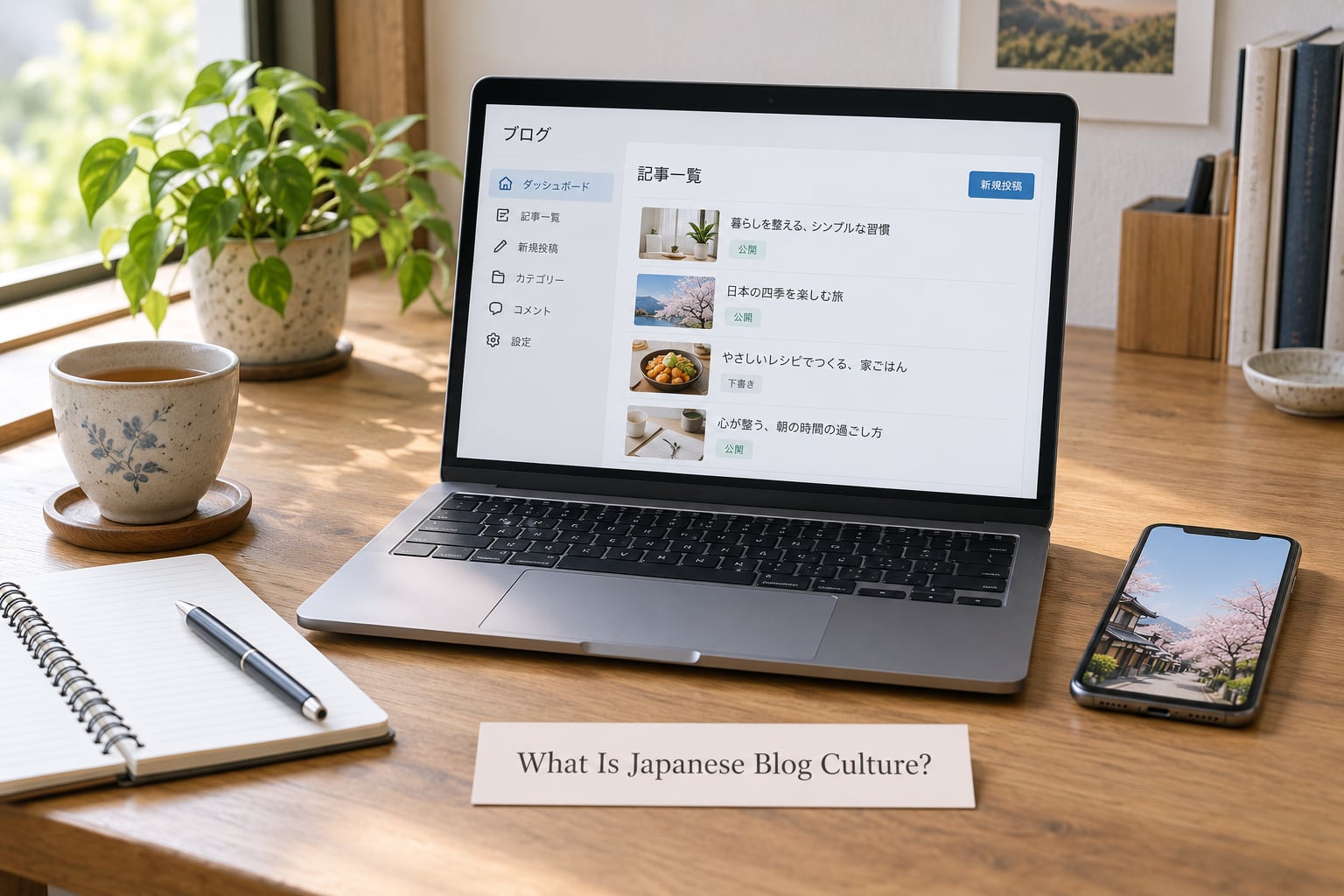
Japanese blog culture is an ecosystem rather than a single platform. It covers personal blogs, company and media blogs, social networks, anonymous boards, closed communities and professional networks, each with its own audience and its own unwritten rules.
The defining feature is the relationship between writer and reader. On a Western social platform, publishing puts you in front of a follower graph and an algorithm decides who sees it. On a Japanese blog, you publish into your own archive, you keep it, and readers arrive because they chose to.
| Format | Who publishes there | What gets posted | How readers find it |
|---|---|---|---|
| Personal blog (Ameba, Hatena, FC2) | Individuals and families | Diary entries, recipes, parenting logs, reviews, travel notes | Tags, ranking directories, links from other blogs |
| Company and media blog | Brands, newsrooms, magazines | Announcements, feature stories, product news | Search, social reposts, official accounts |
| Anonymous board | Anyone, unaccountably | Reactions, breaking chatter, criticism, memes | Direct URL, word of mouth, other boards linking to it |
| Closed community (mixi) | Members of a specific group | Niche talk: parenting, hobbies, local issues | Invites, search within the group |
| Long-form publishing (note) | Writers, professionals, side-hustlers | Essays, tutorials, explainers | Search, tags, newsletter-style subscriptions |
| Professional network | Recruiters, companies, job seekers | Job posts, company news, career advice | Recruiter search, direct messages |
One more distinction matters for outsiders. A blog is an address you own and curate; a social account is a slot on someone else’s feed. Japanese readers use the word differently too, and the vocabulary alone tells you a lot about the culture.
How Did Japanese Blog Culture Develop?
The blog boom in Japan ran roughly from 2002 to 2005, and it moved faster than almost anyone predicted. Early adopters were individuals running free platforms on company subdomains, publishing whatever they liked with no editing gate in between.
Two names did most of the early shaping. Livedoor, a hosting company, bet that anyone could run a professional-looking site for a small monthly fee. Ameba launched in 2004 under CyberAgent and became the mass-market version of the same idea, free and mobile-friendly enough that your aunt could use it.
The scale surprised the industry. By 2008 the platform was reported to have passed 13 million users, which put personal blogs in a position that seems strange now: they were infrastructure. A 2009 GIGAZINE interview with Takafumi Horie, the former Livedoor and Ameba president, made this explicit, because the interviewer had read his entire blog archive before sitting down with him, and treated that archive as the primary source.
Executives did the same. For several years, internal company reporting arrived by email threads and blog commentary was what managers and journalists actually opened, because mainstream media could not keep up with the speed people wanted.
Three forces then pulled the culture apart. Smartphones pushed everything mobile and made posting constant rather than occasional. Platform design pushed reading into feeds, where an archive nobody maintains stops existing. And anonymity moved into dedicated boards, where the conversation about a topic runs faster and with less restraint than any comment section.
There were hard lessons too. In 2013 a mass account compromise affected 243,266 Ameba accounts, an episode that still shapes how people think about handing real names to a free platform. CyberAgent has since cancelled the CyberOwl spin-off, one of the periodic corporate reshuffles that reminds readers no platform is permanent.
Japanese Blog Culture Explained Through Its Main Platforms
The platforms differ less in what they let you write than in who owns the page, who supplies the advertising, and how a stranger finds you. That is where Japanese blog culture explained through platform mechanics gets its shape.
Ameba and Ameblo
Ameba is the default. The blogging service, usually called Ameblo or アメブロ (ameburo), hosts you on a company subdomain, gives you a skin you can restyle with your own HTML and CSS, and inserts its own advertising into the page. You cannot easily remove the ad network, which is the single most common complaint foreigners have.
It also carries Ameba Pick, a built-in affiliate system that lets you recommend products inside a post. For a long-running writer with a niche, that combination of hosting, templates and monetisation in one box is why people stay for a decade.
livedoor and Hatena
Livedoor has occupied the small-fee, slightly more serious end of the market since the boom, and it still appeals to people who want their own domain. Hatena sits in a similar lane with a book-and-essay culture attached to it, so its readers tend to arrive with an expectation of length.
FC2, mixi and anonymous boards
FC2 remains the home of genuinely anonymous and pseudonymous publishing, and its value to outsiders is that it shows what Japanese writing looks like with no personal brand protecting the writer. mixi is the opposite: small, semi-private communities organised around a shared interest, closer to a group forum than a public blog.
Then there are the anonymous boards in the 2channel and 5chan tradition, where posts are numbered, threads move fast and almost nobody signs their name. These do the reacting, criticising and memeing that a comment section does elsewhere, just with far fewer brakes.
note and video platforms
note fills a different niche: long, readable essays and tutorials, many of them monetised through paid memberships, which makes it the closest thing Japanese blogging has to a subscription publication. Video platforms handle the other half of attention, and a growing number of bloggers treat a video post as the front door and the written archive as the back.
Why it does not work like English-language social media
Three rules explain most of the difference. Blogs are addressable and archives matter, so a post from three years ago still gets read. Discovery is link-based rather than algorithmic, so there is no feed fighting to rank you. And monetisation sits with the platform, so the writer trades control for a ready-made audience rather than building one from zero.
What Topics Do Japanese Blogs Cover?
Japanese blogs cover almost everything, but a handful of subject areas carry real weight. The useful way to read the map is by audience, because each category has its own posting rhythm and its own reason for existing.
Technology and gadgets. Phone reviews, camera comparisons, keyboard deep-dives and long tests of a device nobody outside Japan has heard of. This is the category where a blog often beats the manufacturer’s own page, because the writer has actually used the thing for weeks.
Internet services and apps. Which mobile apps actually save time, which ones are noise, and how Japan’s app stores and payment habits differ from elsewhere. A surprising number of posts are written by people who work in the industry, which is where the candid detail comes from.
Startups and events. Coverage of domestic funding rounds, trade shows and product demos, often posted the same evening from the venue floor. Conference coverage in Japan tends to happen in near real time on personal accounts.
Gaming and entertainment. Release-date reactions, difficulty opinions, character discussion, plus a large volume of opinion writing about adaptations and season-two announcements.
Food and cooking. Recipes adapted to available ingredients, restaurant notes, and the extremely detailed bento and lunchbox genre. This category has enormous comment sections, because people correct recipes publicly and with feeling.
Travel, fashion and hobbies. Regional trips, sewing, gardening, trains, photography. Photography in particular has a serious long-tail community with gear posts that read like product literature.
Parenting. Diaries of a child’s growth, school choices, illness and developmental worries, shared with other parents through comments and closed communities. It is one of the few categories where strangers write to each other with real warmth.
Personal finance and work. Salary negotiation, side income, tax filing, office politics and career changes, written by people who are usually not experts and are usually very specific about it. That specificity is the value.
Mental health and venting. A distinctly Japanese genre: an account of depression, burnout or a bad month, updated slowly, read by people who recognise themselves in it. These posts often have years-long followings.
Why Do Anonymous Posts Matter in Japan?
Anonymous posting matters because it separates the reaction from the reputation. A named person in Japan has a face, a workplace and neighbours, so the cost of a bad comment is high. Remove the name and you get the loudest, fastest, least filtered version of what an audience is actually thinking.
That candour is genuinely useful. Anonymous threads are where you find the practical complaints nobody wants to put in an official survey: which phone battery behaves badly after six months, which app has quietly become worse, which policy change annoyed people. Speed matters too, since a thread can form around a product announcement within minutes.
The costs are equally real. Threads stack outrage quickly, a single post gets read as evidence, and anonymous sources are impossible to verify. Harassment on these boards has driven people off platforms, including incidents where coordinated groups targeted individuals over months. Old boards have also become a route for malicious reuse, where a screenshot of a careless old post gets recirculated as if it were news.
The practical rule for readers is simple: treat an anonymous thread as a signal about what people feel, not as a source about what is true. If a claim matters, look for a named author, an official statement or a test someone else repeated independently.
How Do Japanese Bloggers Build Communities?
Communities on blogs are built by repetition and narrowness, not by reach. The mechanism is straightforward: post often, cover one subject deeply enough that readers know what to expect, answer the comments, and link generously to the blogs you read.
Consistency does more work here than in English-language content marketing, because archives are how people arrive. A reader who enjoys one post from a two-year-old recipe entry subscribes to the author, not the platform.
Commenting is the actual social layer. Japanese blog comments run long, are frequently signed with a nickname, and often continue the discussion that the post started rather than the post itself. Reply to a few of them and you start to recognise people, which is how a blog turns into a group.
Blogrolls, the column of links to other blogs you read, still function as a recommendation system. They were how many blogs found their first audience, and they remain a genuine trust signal: a curated list curated by someone you have decided to trust.
Offline contact changes the scale. Meetups and press events turn commenters into familiar names, and a blog with an active group behind it can reach further than a feed account with a bigger number.
The contrast worth naming is with a low-effort content feed. A site that republishes without adding anything has nothing for a reader to return to, and readers know the difference quickly. A recognisable voice, with opinions that could only come from one person, is the thing a crowded online space still rewards.
How Does Japanese Blog Culture Influence Technology News?
Technology news moves differently in Japan because so much of it starts with a person who already owns the thing. Hands-on posts outrun official announcements, and they circulate by link and comment before a news outlet picks the thread up.
That produces coverage you will rarely find in English. Domestic app releases, regional service changes, pricing shifts, carrier-specific behaviour and repair or parts availability are all discussed by people who live with them. If you are deciding whether a device works in Japan rather than in theory, that layer is often the only useful one.
The second difference is timing. Live event coverage posted the same night can be the only detailed record of a demo, because the trade-show floor empties before the official write-up exists. Startup funding news in particular often gets its first serious discussion on a personal blog.
The third is vocabulary. A Japanese post will use the product’s Japanese name, which is often not a translation of the English name at all, so searching for the English branding can return nothing useful. Transliteration is inconsistent too, which is why one device can be indexed under three spellings.
None of this replaces reporting. Personal posts carry bias, hindsight and the author’s own preferences, and the same writer who is meticulous about battery life will be careless about a specification nobody at the company would check. Read them for the experience, then verify anything that affects your decision.
What Should English-Speaking Readers Watch For?
Reading Japanese online content well takes a handful of habits. None require fluency, and all of them reduce the number of times you will be misled.
Separate experience from reporting. Most posts are one person’s account. A first line saying the writer bought something, or works somewhere, or has used it for three weeks, tells you how much weight the rest carries.
Check the date before the opinion. Japanese posts often stay online for years, and a search result gives you no obvious date. A verdict written three years ago tells you about the market three years ago, not the one you are buying into.
Watch for promotional language. Sponsored posts carry a small advertising label, and advertorial sections are common on tech blogs. Reviewers disclose it, but the disclosure sits near the bottom on a long page.
Treat a post as a lead, not a source. Find the official announcement or the primary document before repeating a claim. Anonymous boards are where rumors travel fastest and die slowest.
Learn the product’s Japanese name. Searching the English name alone often returns almost nothing. Search terms that pay off include 新製品 for new product announcements, レビュー for reviews and 比較 for comparisons. Add 価格 for pricing or 発売日 for release dates. A browser translation of a headline usually gets you far enough to decide whether the post is worth reading properly.
Expect context you do not have. Comment threads carry regional assumptions, in-jokes and references to local events. That density is a signal of a healthy community, not a sign of bad writing.
Use a local check when the stakes are real. For anything involving an account, a contract or a repair, a Japanese-speaking contact or a local service will save you the kind of ambiguity no translation engine resolves.
Frequently Asked Questions
What is the difference between a Japanese blog and a social media account?
A blog is a site you control, with an archive you keep and a design you set, while a social account is a slot inside someone else’s feed. On a blog, readers choose to subscribe and can still find a post from three years ago. On a social account, an algorithm decides distribution and old posts effectively disappear. That is why Japanese readers treat blogs as a long-form counterpart to social media rather than a stepping stone toward it.
Are anonymous Japanese websites reliable sources of information?
Treat them as a signal about sentiment rather than a source about facts. Anonymous boards in the 2channel and 5chan tradition are fast and candid, which makes them excellent for reading what people actually feel about a product or a policy. They are also unverifiable, prone to pile-ons and prone to recirculating old screenshots as news. If a claim matters to you, find a named author or an official statement.
Can English speakers follow Japanese technology blogs?
Yes, and for hands-on technology coverage they are often worth the effort. Browser translation handles headlines and body text reasonably well, and the comments are frequently the most valuable part. The main obstacle is naming: products are indexed under their Japanese names, so search with those. Add 新製品 for announcements, レビュー for reviews and 比較 for comparisons.
Why are Japanese internet discussions often more fragmented than Western ones?
Because Japanese readers cluster into separate platforms and separate communities rather than converging on a few shared spaces. Blogs, anonymous boards, closed mixi groups, professional networks and video platforms each hold a different segment, and cross-posting between them is uncommon. Nothing forces a single national conversation, so a topic can be intensely discussed in one place and invisible in the next.
How can I judge whether a Japanese tech blog is trustworthy?
Look for disclosure first: sponsored posts carry a small advertising label, and a blogger who marks them is telling you how they make a living. Then check whether the writer states how long they used the product and whether they own it. Finally, see if they write negative posts, since a blog with nothing but praise is usually selling something.
What Japanese search terms are useful for finding technology news?
新製品 surfaces new product announcements, レビュー for reviews, 比較 for side-by-side comparisons, 発売日 for release dates and 価格 for pricing. ニュース works as a general news filter and まとめ collects round-up posts. Combining any of these with the product’s Japanese name gets you much further than the English name, which is rarely the word Japanese pages use.
Conclusion
Japanese blog culture is not nostalgia about the 2000s. It is a live arrangement of personal archives, closed communities and anonymous boards that still does work social platforms do badly: long writing, dated opinions and a record that stays readable.
The parts worth carrying over are simple. Publish on a schedule, keep an archive, write one subject deeply, and answer the people who show up. The parts to be careful of are the ad-heavy layouts and the anonymous amplification, both of which will mislead you if you read them the way you read English-language media.
Your first step costs nothing: pick three blogs in one subject you already care about, subscribe, and read their comments as well as their posts. Compare what they say with an English-language roundup on the same launch. The gap between those two views is usually where the useful information is hiding, and it is where most good Japanese tech conversations started in the first place.