Japanese ecommerce reviews differ from Amazon US reviews less in format than in substance. Both use a five-star scale and a verified purchase badge, but the writing style, the amount of text, the rating habits and the incentives behind them are different systems entirely. Short reviews that praise the box rather than the product, five stars handed out before the item is unboxed, near-universal Japanese-only text — that is what you are reading on Amazon.co.jp, Rakuten Ichiba and Yahoo! Shopping.
This guide breaks down those mechanics so an English-speaking shopper can tell a useful review from a low-information one, and so a seller can see what changes when a US listing moves to Japan. Written and updated for 2026.
Table of Contents
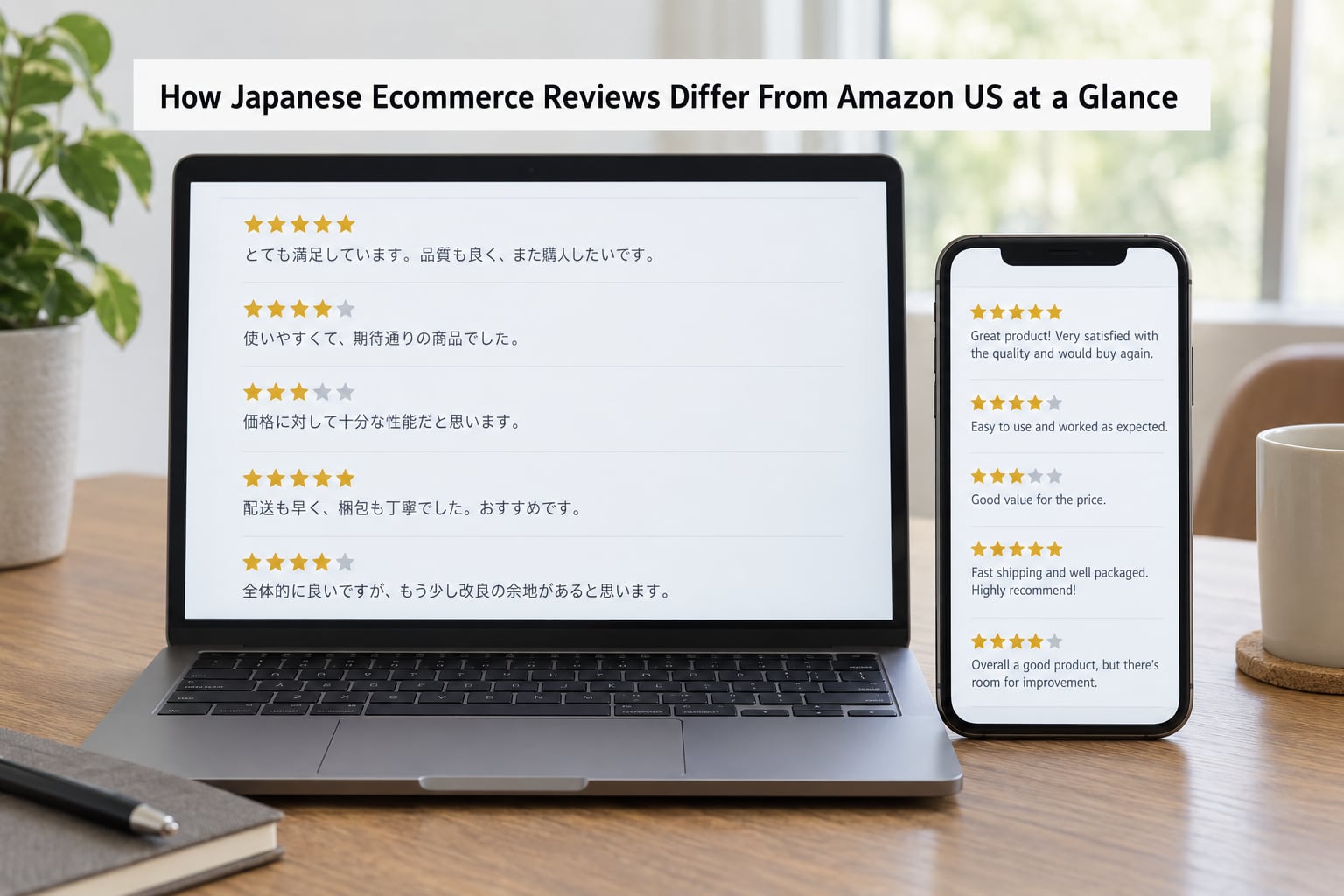
- 1How Japanese Ecommerce Reviews Differ From Amazon US at a Glance
- 2Language and Translation Differences
- 3How to tell translated feedback from an original English one
- 4Reviewer Identity and Cultural Expectations
- 5Ratings, Formats, and Review Volume
- 6How Amazon JP Reviews Versus US Reviews Differ in Volume
- 7Incentives, Sampling, and Credibility
- 8What to Look for in Product Feedback
- 9Which Review System Should You Trust?
- 10Frequently Asked Questions
- 11Are Amazon.co.jp reviews real and trustworthy?
- 12Why are Japanese Amazon reviews so short?
- 13How can I tell if Amazon reviews are real or fake?
- 14Can Americans order from Japanese Amazon?
- 15Why is Amazon not accepting my review on a product?
- 16Are Rakuten and Yahoo! Shopping reviews better than Amazon Japan’s?
- 17Conclusion
How Japanese Ecommerce Reviews Differ From Amazon US at a Glance
| Criterion | Amazon.com | Amazon.co.jp | Rakuten Ichiba | Yahoo! Shopping |
|---|---|---|---|---|
| Star scale | 1 to 5 stars | 1 to 5 stars | 1 to 5 stars | 1 to 5 stars |
| Typical review length | Often a paragraph or more | Usually one short line | Short, often about the store | Short to medium |
| Language | Predominantly English | Almost entirely Japanese | Entirely Japanese | Entirely Japanese |
| Verified purchase | Badge on most organic reviews | Badge used; non-purchase reviews blocked since the 2016 policy revision | Purchase required to post | Purchase required to post |
| What gets praised | Performance, value, durability | Packaging, delivery speed, gift wrapping | Store service and shipping | Delivery and price competitiveness |
| Typical rating behaviour | Skewed positive, some harsh one-star reviews | Heavily skewed to five stars, including pre-use ratings | Skewed positive, tied to store reputation | Skewed positive |
| Review incentive | Request a Review button, Vine, occasional credits | Request a Review, Vine, point campaigns | Points back for posting a review | T-points for reviews |
| Moderation focus | Fake review detection, incentivised review enforcement | Same rules, plus tight seller performance grading | Store-level review management | Review reward programmes |
| Extra layers | Q and A, images and video reviews | Q and A, images, product Q and answer threads | Separate store reviews and product reviews | Store ratings plus product ratings |
Two rows carry most of the weight. Review length and what gets praised: a short line about packaging tells you far less about whether a product works than a US review describing a failure after six months.
Language and Translation Differences
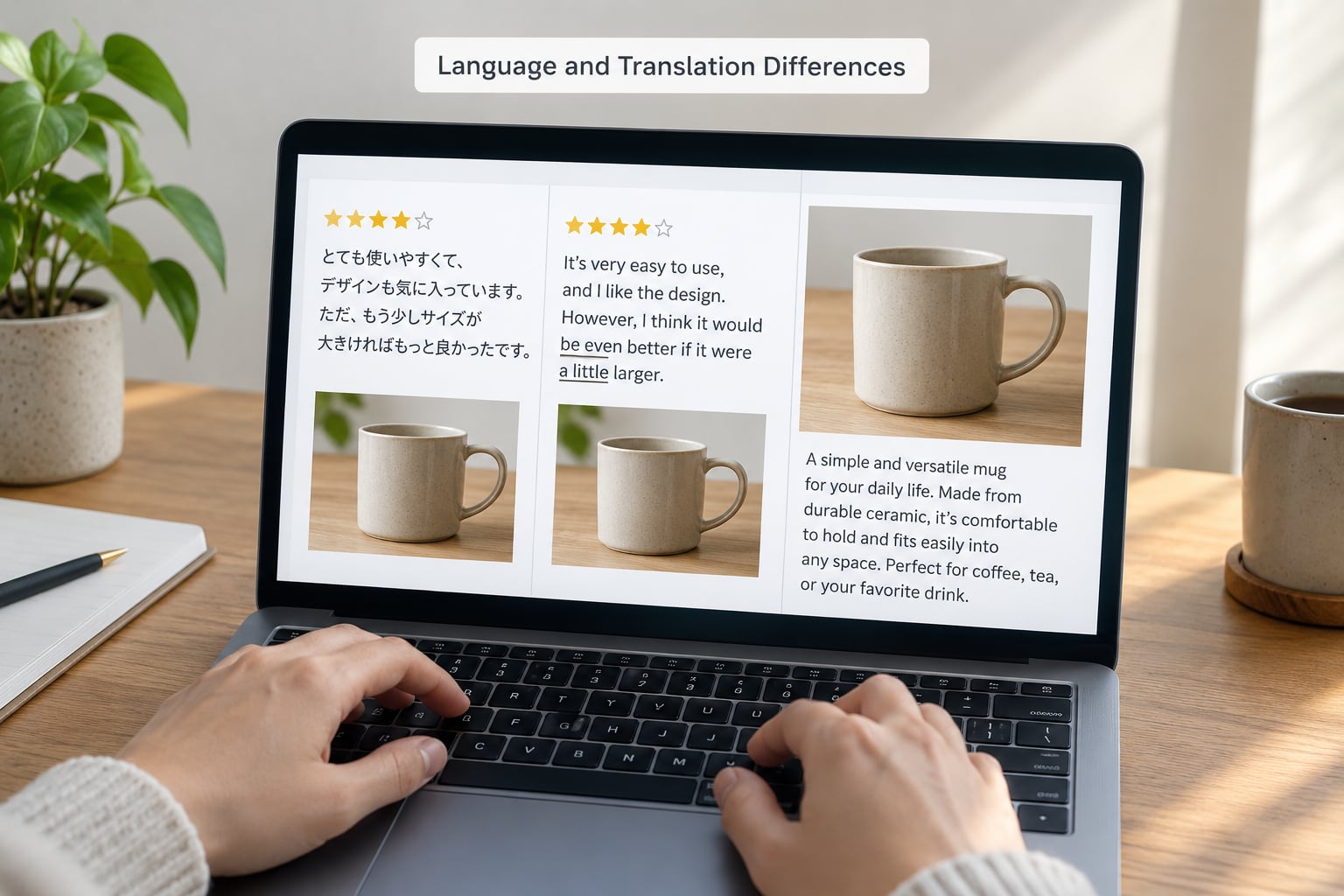
Most Amazon.co.jp reviews are written entirely in Japanese, and browser translation flattens a lot of what matters. The same words cover very different levels of disappointment.
A few phrases show up constantly. 発送が早い means shipping was fast, and says nothing about the item. 梱包が丁寧でした means the packaging was careful, which is often the highest praise a review contains. 残念ですが, literally unfortunate but, is a soft way of saying something disappointing. 普通でした, it was ordinary, is the polite form of it was fine but nothing special.
How to tell translated feedback from an original English one
Machine translation turns hedging into fact. A sentence that reads I would have liked it a bit lighter in the original might be softening a genuine complaint, and the rendered English hides that. When a review matters to your decision, paste it into a translation tool and compare it against how blunt the English looks. If the English sounds like a complaint and the Japanese looks neutral, trust the Japanese.
The reverse also happens. A US review full of superlatives is often a five-star default rather than a considered judgment, so a polite Japanese sentence can carry more information than an enthusiastic American one.
Reviewer Identity and Cultural Expectations
Reviewers on Japanese platforms are mostly pseudonymous handles and product-level nicknames rather than full public profiles, which makes individual accountability harder in both markets. The bigger difference is social expectation around writing anything negative.
Japanese buyers are used to near-perfect delivery and to a service culture where a complaint feels like it creates obligation for the other party. Several threads on r/japanresidents make this concrete. Users describe the pattern of five stars left before an item has been used because the packaging looked good, and one mentioned five-star reviews on winter tyres written before the tyres had ever touched snow. The same thread notes how rare harsh one-star reviews are.
That restraint cuts both ways. Negative reviews that do appear on Amazon.co.jp tend to be specific and worth reading carefully, because a buyer took a social risk to post one. On Amazon US you get far more one- and two-star reviews, and you have to filter for the useful ones yourself.
Packaging carries unusual weight in Japan as a gifting culture, so reviewers comment on boxes, wrapping and presentation more than US reviewers do. A compliment about presentation is not a disguised complaint. It is a compliment about presentation.
Ratings, Formats, and Review Volume
Both Amazon stores use the same one-to-five-star scale, so the difference has to be read in the distribution rather than the format. Japanese review distributions pile up at five stars. A product with an average of 4.6 on Amazon.co.jp may have a large share of five-star ratings from people who never opened the box.
Written feedback on Amazon.co.jp is usually a fragment. You will see a rating with one clause attached, or a rating with no text at all. Amazon US skews the opposite way: reviewers are more accustomed to the review section being a place to describe an experience, so text volume per verified purchase is higher and more varied in quality.
How Amazon JP Reviews Versus US Reviews Differ in Volume
Review volume on Japanese listings is lower for a given level of sales. Any comparison of amazon jp reviews versus us reviews has to account for that, or the same product looks like it has weaker demand in Japan when it simply has quieter reviewers. Written reviews are not the social act they are in the US, and points-back campaigns on Rakuten and T-point rewards on Yahoo! Shopping draw volume toward those platforms. A thin review count on Amazon.co.jp does not mean a product is unpopular. It often means buyers simply did not bother writing.
Helpful votes also carry less visible weight in Japanese layouts. If you are sorting for signal, sorting by the most recent reviews with text beats sorting by helpfulness here.
Incentives, Sampling, and Credibility
Neither marketplace is automatically more trustworthy, and the incentives differ more than most shoppers assume.
Amazon.co.jp applies the same community guidelines as Amazon.com, and the 2016 policy revision tightened them considerably. Reviews without a purchase are now effectively blocked on the Japanese store, so a verified purchase badge on Amazon.co.jp is a stronger filter than it once was. Vendors can also enrol products in Amazon Vine, which distributes free products to reviewers in exchange for honest feedback. Vine exists in both markets with broadly similar mechanics.
Rakuten Ichiba requires a completed purchase to review, and the store itself is rated separately from the product, so a shopper can see whether a seller has good service independent of the item. Rakuten also runs points-back campaigns for posting reviews. Yahoo! Shopping attaches T-points to reviews, which produces a genuinely high volume of short ratings.
That incentive layer is worth naming plainly. Both Rakuten and Yahoo! Shopping pay for the act of reviewing, which lifts volume but lowers the average length and depth of each entry. Amazon Japan, with fewer direct rewards, produces fewer reviews per sale but more of them say something about the product.
There is one more moderator that has no US equivalent in practice. Sellers on Amazon.co.jp are graded hard on order defect rate and on-time shipment, and falling below threshold affects account health. Sellers describe a long-running discipline of answering questions and responding to negative reviews before they accumulate. Community guidelines and seller account health together make the Japanese store tighter than the US one in practice, not necessarily in written policy.
What to Look for in Product Feedback
Here is how to read a Japanese listing without being misled by a five-star average. These are the differences that matter most when you compare how japanese ecommerce reviews differ from amazon us on the same product.
- Sort by newest reviews with text first, not by helpfulness or by top reviews. A wall of five-star no-text ratings tells you nothing.
- Check whether the reviewer has used the item. Reviews posted within days of delivery are usually first impressions. Look for descriptions of actual use, not appearance.
- Look for photos. An image of the real product in a real setting carries more weight than any amount of packaging praise.
- Read the variation specifically. Capacity, size, colour and model variants get separate reviews. A rating for a different variation does not transfer.
- Treat delivery comments as a separate category. 発送が早い appears in a huge share of Japanese reviews and says nothing about quality.
- Search for 残念 and 期待以下 inside the review section. Those surface the critical remarks that polite wording might otherwise hide.
- Compare against Rakuten and Yahoo! Shopping. The same product often has store-level and competitor feedback that adds a second, independent view.
One warning about volume. Market research on the two Amazon stores has found the relationship between review count and relative sales to be stronger in Japan than in the US, which means review presence moves Japanese sales more. That cuts both ways: good reviews are more valuable there, and manipulated reviews have more room to do damage.
Which Review System Should You Trust?
If you read Japanese, Amazon.co.jp is usually the richest source. The product reviews are specific, the verified purchase filter is strict, and the sellers are graded tightly. Use Rakuten when you care about store reliability and after-sales handling, and Yahoo! Shopping when you want to see whether other stores list the same item at all.
If you do not read Japanese, rely less on the star average and more on photo reviews, on the number of reviews with text, and on cross-checking the same product on Amazon US. For anything imported or grey-market, look for mentions of authenticity in the negative reviews, since counterfeits and mislabelled goods are a repeated concern in r/japanlife and a reason review scrutiny runs higher in Japan than in the US.
For sellers, the practical difference is that a US review strategy cannot be pasted into a Japanese store and ignored. Japanese listings need native copy, and reviews tend to accumulate around delivery, packaging and gift presentation as much as around the product itself, so those are the details that get commented on.
One thing worth putting to rest: Amazon.co.jp is a legitimate site operated by Amazon, and Rakuten is a major Japanese marketplace, not a grey operation. In shopping-habits threads on r/japanlife, Amazon Japan is the platform most often named as a buyer’s main one, with Amazon US a distant second and Rakuten and the smaller stores filling the rest.
Frequently Asked Questions
Are Amazon.co.jp reviews real and trustworthy?
Amazon.co.jp reviews are legitimate and, since the 2016 policy revision, reviews without a purchase are effectively blocked, so the verified purchase badge is a strong filter. The bigger caution is not authenticity but content: many reviews are very short, praise packaging rather than performance, or award five stars before the item is used.
Why are Japanese Amazon reviews so short?
Short reviews are normal in Japan. Buyers often post a rating plus one clause, and direct criticism of a product or seller carries social cost that many people avoid. Delivery comments such as fast shipping and careful packaging are so common that some reviews contain no product feedback at all. Read the reviews with text and the recent ones, not the headline average.
How can I tell if Amazon reviews are real or fake?
On Amazon.co.jp, check whether reviews are clustered in time, whether they repeat identical phrasing, whether several describe the same specific detail, and whether they include images. Reviews that arrive in a burst after launch, or that praise only packaging in the same sentence structure, are worth discounting. Verified purchase status helps, but a real buyer can still write nothing useful.
Can Americans order from Japanese Amazon?
Yes. Non-Japanese customers can place orders on Amazon.co.jp, though you need an international delivery address and a payment method Amazon accepts for cross-border purchases. Language is the real barrier: reviews are almost entirely in Japanese, so translation is needed to read them. Amazon US carries many Japanese products with English reviews, which is often easier for an English-speaking buyer.
Why is Amazon not accepting my review on a product?
The usual reasons are that your account has not received the order, the review falls outside the eligibility window after delivery, you have already reviewed the product, or your account has had previous reviews removed for policy breaches. Amazon.co.jp applies the same rules but with tighter verification after its 2016 policy change, so a legitimate purchase can still fail if the order and the reviewing account do not match cleanly.
Are Rakuten and Yahoo! Shopping reviews better than Amazon Japan’s?
It depends on what you need. Rakuten rates stores separately from products, so it is better evidence of seller reliability, and it pays points back for reviews, which lifts volume but shortens each entry. Yahoo! Shopping attaches T-points to reviews, producing high volume of brief ratings. Amazon Japan gives the fewest reviews but the most product-specific ones. Use more than one.
Conclusion
Start with the most recent reviews that contain text, check the exact variation, and discount anything about packaging or delivery. That is the practical answer to how japanese ecommerce reviews differ from amazon us: a five-star average on Amazon.co.jp tells you the product arrived intact and looked good on the way in, which matters. It does not tell you how the product performs after two months, and reading it that way is the mistake behind every bad cross-border purchase.