
A Japanese online forum is a bulletin board, or keijiban (掲示板), built from four stacked layers: a category (カテゴリ, kategori) grouping roughly forty topic areas, a board (板, ita) holding one forum, a thread (スレッド, sure) holding one conversation, and a response (レス, resu) holding one post. Understanding that stack explains why Japanese discussions move so fast, why nobody signs their name, and why threads simply vanish when they get too long.
The same four layers show up on anonymous textboards, question-and-answer services and hobby communities, even when the labels differ. What changes is who moderates it, whether you log in, and which language the room runs in.
Table of Contents
- 1How Japanese Online Forums Are Organized
- 2The Japanese words you will meet immediately
- 3What Are the Main Types of Japanese Online Forums?
- 4General communities and anonymous textboards
- 5Topic-specific boards
- 6Question-and-answer spaces
- 7Hobby, interest and location groups
- 8Professional and industry communities
- 9Platform snapshot
- 10How Do Categories, Boards, and Threads Differ?
- 11Board names are short, and the URL is the name
- 12Threads float to the top by default
- 13How a thread dies
- 14How Are Japanese Forum Communities Usually Structured?
- 15How Does Moderation Shape a Japanese Forum?
- 16What Language and Identity Conventions Appear in Japanese Forums?
- 17Anonymous posting is the default, not an edge case
- 18ID, trip and cap
- 19Formality is a setting, not a rule
- 20How Do You Participate Without Making a Common Mistake?
- 21Frequently Asked Questions
- 22What is the best Japanese chatting platform?
- 23What forums do Japanese people use?
- 24Does Japan have a Reddit equivalent?
- 25Why are Japanese forum posts anonymous?
- 26How do Japanese forums moderate content?
- 27Is 5ch still active?
- 28Conclusion
How Japanese Online Forums Are Organized
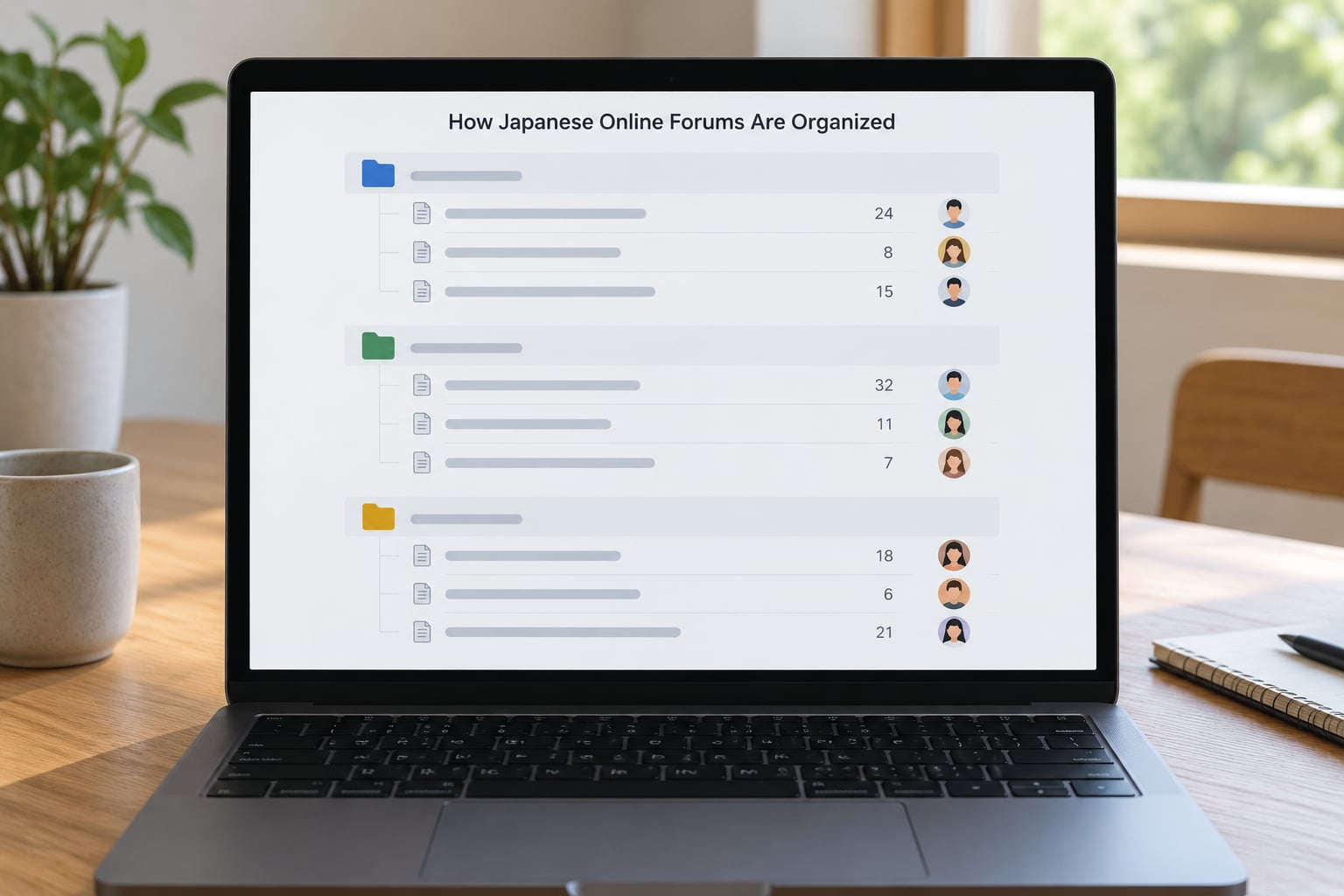
The whole system fits in one sentence: categories hold boards, boards hold threads, threads hold responses. Everything else on the page is a way of deciding which of those four you are looking at.
- Category (カテゴリ, kategori) — a top-level grouping of roughly forty topic super-groups. Nothing posts here; it is pure filing.
- Board (板, ita) — the actual forum. A board covers one subject: news, a game, a prefecture, a hobby. Boards are what you actually subscribe to or open.
- Thread (スレッド, sure) — one topic inside a board, started by whoever wants to start it. The thread title carries the whole subject.
- Response (レス, resu) — a single post inside a thread. Replies stack flat and in time order rather than branching into sub-replies.
So how japanese online forums are organized comes down to this: choose a category, find the right board, open the thread on your subject, and read or write a response. The site is not organised by person, popularity or karma, which is exactly what separates it from Reddit-style discussion.
The Japanese words you will meet immediately
| Japanese | Romaji | What it means | Where you see it |
|---|---|---|---|
| 掲示板 | keijiban | Bulletin board | The generic word for any forum |
| カテゴリ | kategori | Category | Top-level folder listing |
| 板 | ita | Board | The forum itself, and in its URL |
| スレッド | sure | Thread | Abbreviated スレ in titles |
| レス | resu | Response or post | Numbered replies inside a thread |
| 名無し | name-nashi | Nameless poster | The default anonymous handle |
| sage | sage (下げ) | Post without bumping the thread | Typed in the email or form field |
| 過去ログ | kako rogu | Past logs, a dead thread’s archive | Called dat ochi when it drops off the board |
| まとめサイト | matome saito | Summary site, a third-party digest | External sites that copy threads |
| 転載禁止 | tensai kinshi | Reprinting prohibited | Marked on threads that ban copying |
What Are the Main Types of Japanese Online Forums?
Five formats cover almost everything you will run into, and they differ mainly in who can post, whether you sign your name, and how long a conversation lasts.
General communities and anonymous textboards
The classic model, built around many small boards rather than one big feed. Anyone can post without an account, which is why these rooms are fast, blunt and unafraid of consequences.
Topic-specific boards
One subject, deeply covered. A console, a fighting game, a craft, a prefecture. Because the board is narrow, the vocabulary inside it becomes shorthand that newcomers read dozens of times before they understand it.
Question-and-answer spaces
A registration-required service where you post one question and wait. Answers are ranked and the thread stays open for months, which makes it the opposite of a textboard in almost every way: slower, signed, searchable and durable.
Hobby, interest and location groups
Clubs organised around a region or an activity, often running their own site, their own chat, or both. Travel advice for a specific area usually lives here rather than in a national board.
Professional and industry communities
Trade groups, alumni networks, vendor user communities and industry Slack or Discord servers. These are the least anonymous category, and the most likely to be gated by job or membership.
Platform snapshot
| Platform | How it is organized | Identity | Best for |
|---|---|---|---|
| 5ch (5ch.io) | Categories, boards, threads; responses float by newest post | Anonymous by default, ID and trip optional | News, games, politics, live reaction |
| 2ch.sc | Same board-and-thread model, separate community | Anonymous, similar tools | General chatter alongside 5ch |
| open 2ch (おーぷん2ちゃんねる) | Same hierarchy, volunteer-run and non-commercial | Anonymous, staff-run boards | Users who left after the domain change |
| Yahoo! Chiebukuro (知恵袋) | One question per page, ranked answers, searchable archive | Registered account required | Specific factual questions with a real answer |
| Yahoo! Bulletin Boards (留言板) | Topic lists with numbered threads, often regional | Registered account required | Local notices, hobbies, meetups |
| X | Flat timeline with hashtags and quote posts | Named account, optional anonymity | Live reaction, breaking news, communities |
| Discord | Servers, then text channels and voice rooms | Named account, join usually gated | Small private groups, language exchange |
| LINE | Friends, groups and open rooms | Phone-linked account | Everyday conversation with people you know |
| Expat subreddits (r/JapanTravel, r/LearnJapanese) | Subreddits with pinned daily and weekly megathreads | Named account, karma and flair | Travellers and learners asking in English |
One thing to know about the anonymous family in 2026: 5ch.net was suspended by its registrar on 5 March 2026 and the community moved to 5ch.io. Parts of the old user base went to open 2ch, to smaller volunteer boards, and to hosted chat rooms instead.
How Do Categories, Boards, and Threads Differ?
The three levels get confused constantly, mostly because a board and a thread both have titles and both get read. The difference is scope: a board is a permanent room, a thread is a temporary conversation inside it.
Board names are short, and the URL is the name
Boards are conventionally referred to by the end of their web address, often a few letters or a single word. You will see boards cited by their short path in ordinary conversation rather than by a formal name, which makes them easy to recognise and hard to search if you do not know the path.
Threads float to the top by default
This is the structural difference that surprises people most. A new response pushes its thread back to the top of the board list, so active conversations dominate the page and quiet ones sink. Typing sage in the form field posts without bumping, which is how a careful poster avoids reviving an argument at midnight.
Because replies are flat rather than nested, you scroll through hundreds of numbered posts in chronological order. Losing the argument structure is the trade you make for speed.
How a thread dies
Threads have hard limits. A textboard thread typically closes at around 1,000 responses or roughly 500KB of text, whichever comes first, and a separate rule governs how soon an older thread may be linked again. Once closed it drops out of the board index into an archive, referred to as dat ochi or kako rogu. The practical effect is that fresh content always wins, and old answers quietly become harder to find.
Judging a thread’s age and reliability before you reply is normal practice. Check the timestamp, scan the last few responses for tone, and look for whether the original question has already been answered further down.
How Are Japanese Forum Communities Usually Structured?
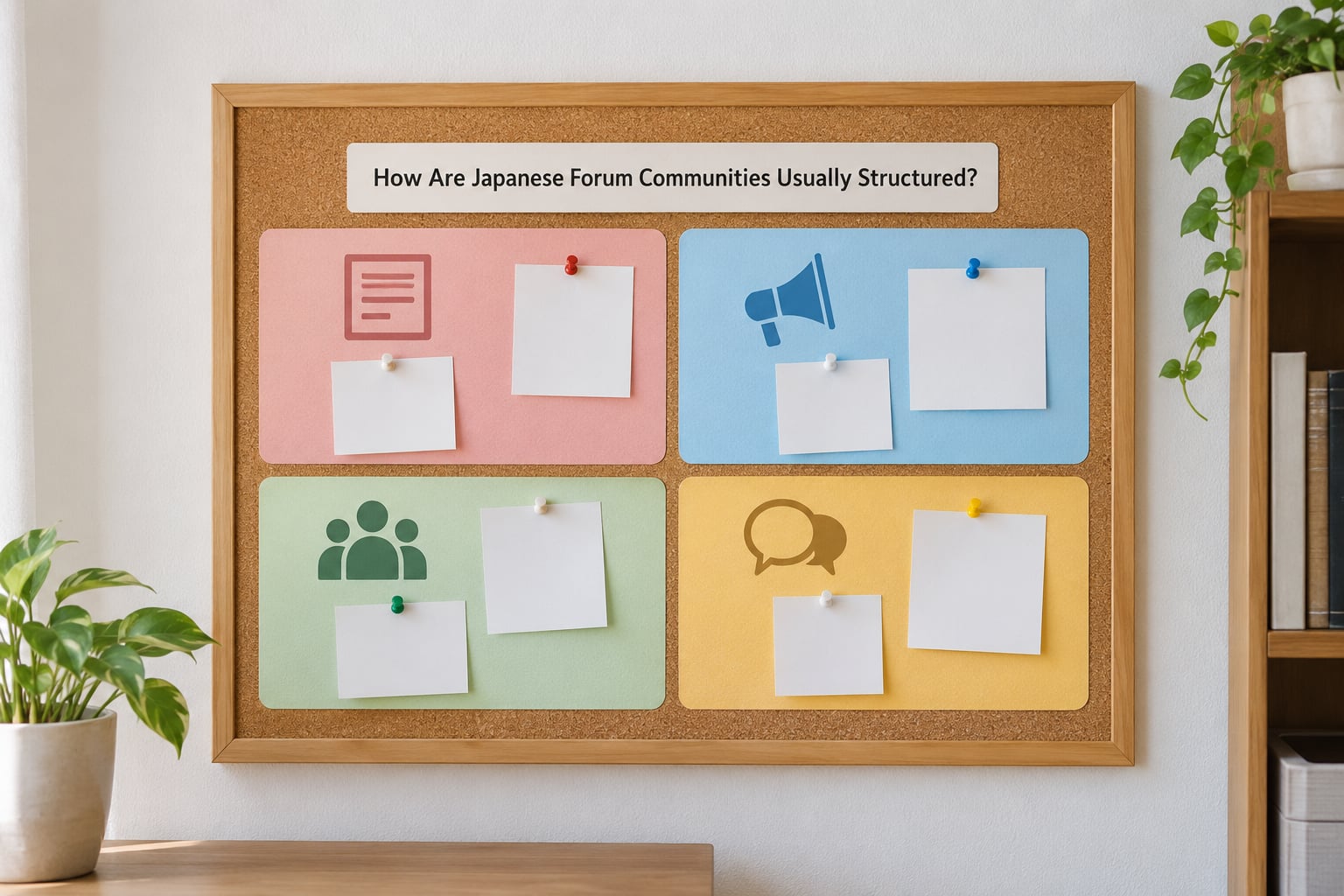
Communities layer a second structure on top of the four levels, and the layers are usually recognisable even when the labels are not identical across platforms.
- Rules and notices — board rules, posting templates and account requirements, often pinned at the top.
- Announcements — news from whoever runs the board, including thread merges and deletions.
- Newcomer sections — introduction threads and beginner boards where weaker Japanese is tolerated.
- Topic areas — the main working boards, sometimes with regional sub-boards underneath.
- Member-generated discussions — everything a user can start, which is most of it.
Regulars take on unofficial roles simply by showing up: answering questions, linking sources, summarising what happened, and telling new posters what the board actually wants. Moderators formalise that with a cap and a star in the name, but a lot of norm-setting happens long before anyone gets a title.
Expat communities organise differently because they cannot run hundreds of language-specific boards. Instead they lean on pinned megathreads: one daily or weekly thread per subreddit or server where every small question gets asked and answered in the comments. r/JapanTravel runs a weekly discussion thread and a monthly meetup thread in exactly this way. It works, but it makes information harder to search later, which is the main complaint people raise about it.
Boards also get described by how busy they are. A board with far more replies than it can serve is a crowded board, and one that has gone quiet for months is a deserted board. Either way, the label tells you how much patience a question needs.
How Does Moderation Shape a Japanese Forum?
Moderation on Japanese forums is unusually light on staff and heavy on volunteers. A platform might employ a handful of administrators, while the day-to-day tidying is done by users who earned a cap.
- Volunteer caps — regular members given a decorated name so readers can tell who is speaking officially.
- Thread organisation — renaming, merging duplicate threads, splitting a thread that has drifted off topic, and pinning.
- Response-level action — deleting individual responses that break rules, which is far more common than closing a whole thread.
- Posting limits — restricting an account to a slow posting rate, or blocking it, when one member floods a board.
- Locking and deletion requests — closing a settled thread, and removing content when the operator receives a formal request.
That last one matters legally. Japanese law puts pressure on intermediary providers to respond to deletion requests, and the industry body that processes them channels complaints toward platform operators. The result is that visible removals on textboards are usually quiet and undocumented, which is why a thread can shrink without an explanation.
A second layer of order comes from members rather than moderators. Self-censorship is heavy: reprint bans, source-checking habits, and a general expectation that a poster who misbehaves will simply be ignored rather than formally punished.
What Language and Identity Conventions Appear in Japanese Forums?
Language is the first barrier and the least decisive one. Plenty of boards run in Japanese with English sections, translation tools handle most of the difficulty, and a surprising share of slang is borrowed from English anyway.
Anonymous posting is the default, not an edge case
On the big textboards you post as 名無し (name-nashi), rendered as Anonymous-san. It is not shy behaviour; it is the normal way anyone participates, including people who post several times a day.
ID, trip and cap
Three optional layers sit on top of anonymous posting. The ID function assigns each poster a consistent code within a thread so you can tell whether the same person keeps answering. The trip (torippu) is a keyword you choose, so anyone who copies it is visibly an impersonator. The cap marks the volunteer moderators. Read together, they let you weigh a post without knowing a name.
Formality is a setting, not a rule
Address ranges from blunt casual to polite business register, usually signalling the board’s culture rather than the writer’s mood. Matsuri-style playful banter and a straight factual answer can sit three responses apart in the same thread, which trips up newcomers who read terseness as hostility.
It usually is not. Short answers are a speed optimisation, not a mood.
How Do You Participate Without Making a Common Mistake?
The mistakes are repetitive across platforms, and almost all of them are avoidable with a minute of preparation.
- Posting in the wrong board. Check whether a board has a beginner or newcomer section first, and read its rules before the first post, not after a warning.
- Skipping search. Use the site’s own search, which on textboards is usually a separate search tool, before starting a thread. A duplicate is the fastest way to be ignored.
- Writing a vague title. The title is the index. Include the model name, the game, the city or the year so the thread can be found later.
- Answering a different question. Read to the end of the thread first. Often the answer arrived eleven responses down.
- Bumping a thread unnecessarily. Type sage if you are only adding a small detail, and avoid replying to a thread that died weeks ago.
- Promoting something unlabelled. If a product, service or channel is yours, say so plainly at the top. Disclosing affiliation costs you nothing and buys credibility for everything else you post.
- Pasting a screenshot of a conversation. Quote the text instead, or link the source, unless you own it.
- Reading bluntness as a verdict. Short replies mean speed, not hostility. Ask your question plainly and move on.
Three posting modes are worth separating. Asking for help means giving enough context to be answered: your setup, budget range, season, or exact error text. Sharing information means linking a source and letting people draw conclusions. Promoting means disclosing the affiliation and accepting that the thread may be closed.
On r/JapanTravel the give-back pattern is a good model for English-language participation too: come back after the trip and post what actually happened, with specifics like store names and payment methods. Members there repeatedly note that recent first-hand accounts beat general guides, partly because platforms like Reddit give advice rather than authority.
Frequently Asked Questions
What is the best Japanese chatting platform?
There is no single winner because the platforms split by purpose. For anonymous, fast, high-volume discussion, 5ch.io is the largest. For a question that needs one correct answer, Yahoo! Chiebukuro is better because it is searchable and answers get ranked. For small private groups, Discord and LINE are the usual picks. For people who want the advice of people actually doing the thing, English-language travel and study subreddits are the most practical option.
What forums do Japanese people use?
The core ones are 5ch (now at 5ch.io), 2ch.sc, open 2ch, Yahoo! Chiebukuro for questions, Yahoo! Bulletin Boards for local and hobby topics, and X for live reaction. Younger and smaller communities sit mostly on Discord, LINE and private chat groups rather than public boards. Traffic is spread thin across all of them, which is why there is no clear equivalent to one dominant forum.
Does Japan have a Reddit equivalent?
Not really. The closest match is 5ch, because it has the same community-owned board structure, but it is organised by topic board rather than by subreddit, posts are anonymous by default, and karma and voting play almost no role. There is no single vote-ranked, personalised feed equivalent to Reddit in Japan, which is why regulars tend to follow several boards instead.
Why are Japanese forum posts anonymous?
Anonymity has been the default since the first large Japanese textboards, and it cuts both ways. It lowers the cost of asking an obvious question, stops arguments from turning into personal feuds, and lets a beginner post without embarrassment. The trade-off is low accountability, so regulars lean on ID codes, trip keys and reputation carried from thread to thread to judge who is worth listening to.
How do Japanese forums moderate content?
Mostly with volunteers. Regular members earn a decorated name, or cap, and handle thread renaming, merging duplicates, pinning and deleting individual responses. Administrators handle account-level problems and respond to formal deletion requests, which Japanese law requires intermediary providers to process. Beyond that, order is maintained informally: reprint bans, source-checking and reader enforcement through ignoring anyone who misbehaves.
Is 5ch still active?
Yes, though the address changed. The 5ch.net domain was suspended by its registrar on 5 March 2026 and the community moved to 5ch.io. Some users left for open 2ch, volunteer-run boards and private chat rooms, and the debate about the site’s direction pushed some of the older user base away for good. It remains the largest anonymous textboard, but it is no longer the only serious one.
Conclusion
Japanese online forums are organised by topic, not by person: a category holds boards, a board holds threads, a thread holds flat numbered responses, and the newest activity floats to the top. That single design choice, combined with anonymous posting by default, produces the fast, blunt, low-stakes style most newcomers meet first.
Before your first post in 2026, run this checklist:
- Identify what kind of forum it is — anonymous textboard, question-and-answer service, or chat platform.
- Read the rules and any newcomer section before writing anything.
- Search the site for an existing thread on your topic.
- Pick the board that matches your subject, and write a title specific enough to be found later.
- Write one plain post: enough context to answer, sage if it is a small addition, and an explicit disclosure if anything in it is yours.
Reading comes before posting, and it stays that way. A week of reading a board teaches you its shorthand faster than any guide.