Japanese games use so much text because text is the cheapest way to ship a deep story at scale, because Japanese packs far more meaning into far fewer characters than English, and because the country’s core genres were built around text boxes long before real-time 3D existed. Nothing about it is a quirk of translation. It is a design tradition with a budget attached to it.
I have played through enough JRPGs and visual novels to be able to tell you which of those reasons matters most for a given game, and it is almost never the one the internet argues about. The cultural explanation is the fun one. The character-count and voice-acting economics are the ones that actually decide how many words end up on your screen.
Table of Contents
- 1Why Do Japanese Games Use So Much Text?
- 2Japanese Game Design Traditions and Heavy Storytelling
- 3Reading Is Part of the Experience
- 4Visual Novels and Text-First Game Categories
- 5Mobile and Handheld Constraints
- 6Localization and Translation Challenges
- 7How Much Text Is Normal in Japanese Games?
- 8Frequently Asked Questions
- 9Are visual novels niche in Japan?
- 10Do Japanese players think JRPG dialogue is bad?
- 11Is Japanese text more compact than English?
- 12Why do Japanese games use text instead of voice acting?
- 13Why do Japanese games seem to explain everything twice?
- 14How can I get through games with a lot of text?
- 15Conclusion
Why Do Japanese Games Use So Much Text?
Six things drive it, and they stack on top of each other:
- Text is cheaper than voice. Fully voicing a long script means paying actors, recording it, and localizing it into every language at once. A text box costs nothing to add more of.
- Japanese fits more into the same space. A kana-heavy line conveys the same idea in fewer characters than the English equivalent, so a fixed-size box holds more information before it needs to scroll.
- The storytelling came from manga and kabuki. Both traditions explain and internalize. Games that grow up in that lineage inherit the habit.
- Visual novels and JRPGs made text the native format. These genres were designed around dialogue windows and 2D character art, and they are still the formats Japan sells most.
- Smartphones made text the default interface. Portrait screens, tap-to-advance, and episodic gacha releases have made text boxes the cheapest way to ship content on a small screen.
- Japanese players read fast and expect to. They grew up with text in games, and the standard skip and backlog features exist precisely because reading is treated as an activity, not a delay.
That last one matters more than it sounds. Reading is not something Japanese games tolerate. It is something they are built around.
Japanese Game Design Traditions and Heavy Storytelling
The heaviest text in Japanese games sits on top of a storytelling tradition that predates the medium. Manga panels are a delivery system for internal monologue, and kabuki uses staged mime and codified gesture to carry meaning that a bare stage cannot. A player in that culture arrives already fluent in the grammar: a character’s face changing, an emblem flashing, a line of narration standing in for a whole memory.
Then there is kishotenketsu, the four-part Japanese narrative shape. It runs: set the scene, elaborate on it, trigger an event, resolve it. There is no single central conflict driving everything forward, and that is exactly why it produces so much text. Each small problem needs setting up, reacting to, and closing out.
Compare that to a Western story structure, which spends its budget on one escalating conflict. Kishotenketsu spends its budget on many small ones. A single afternoon in an RPG town can involve a lost delivery, a strained conversation with a shopkeeper, a festival, and a rumor that pays off three hours later. Each beat wants its own text box.
The Game Developer essay on Japanese narrative mechanics is the best English-language treatment of this, and it goes further than the cultural story alone. It argues that Japanese developers treat text, sound, speech register, and perspective as separate narrative mechanics, each shaped by player interaction, rather than as one blended cutscene. That framing is useful because it stops the “Japan is just different” conversation dead.
Reading Is Part of the Experience
Ask a Japanese player whether a game has too much text and they will often ask a different question: how fast can they read it. Those are not the same conversation.
Japanese readers are trained from childhood on dense material, and games lean into that. A text box in a Persona or a Fire Emblem title is not filler between fights. It carries the character motivation, the world rule, and the joke, and a player who skips it will hit a mechanical surprise twenty minutes later with no idea why.
Genre conventions reinforce this. Visual novels are explicitly sold on route structure, and a route is a body of text. RPGs lean on a log or backlog feature that lets you scroll back through everything already said, which only makes sense in a game that assumes you will want to re-read rather than never read.
One detail from a visual novel translator explains why replays feel like a wall of repeated words. Multiple-heroine visual novels typically share around 80 percent of the same scenes between routes, with Fate/stay night being unusually different at roughly 15 to 20 percent overlap. The shared material is a trunk of world-building and character introductions; the route is the branch. Script engines differ in whether that shared text is indexed once or duplicated in the file, so raw script size is a misleading number, but either way you are reading the same trunk on your second playthrough.
And players do not resent it. They fast-forward through what they have already seen. That is not a workaround for bad design, it is the intended path through the text.
Visual Novels and Text-First Game Categories
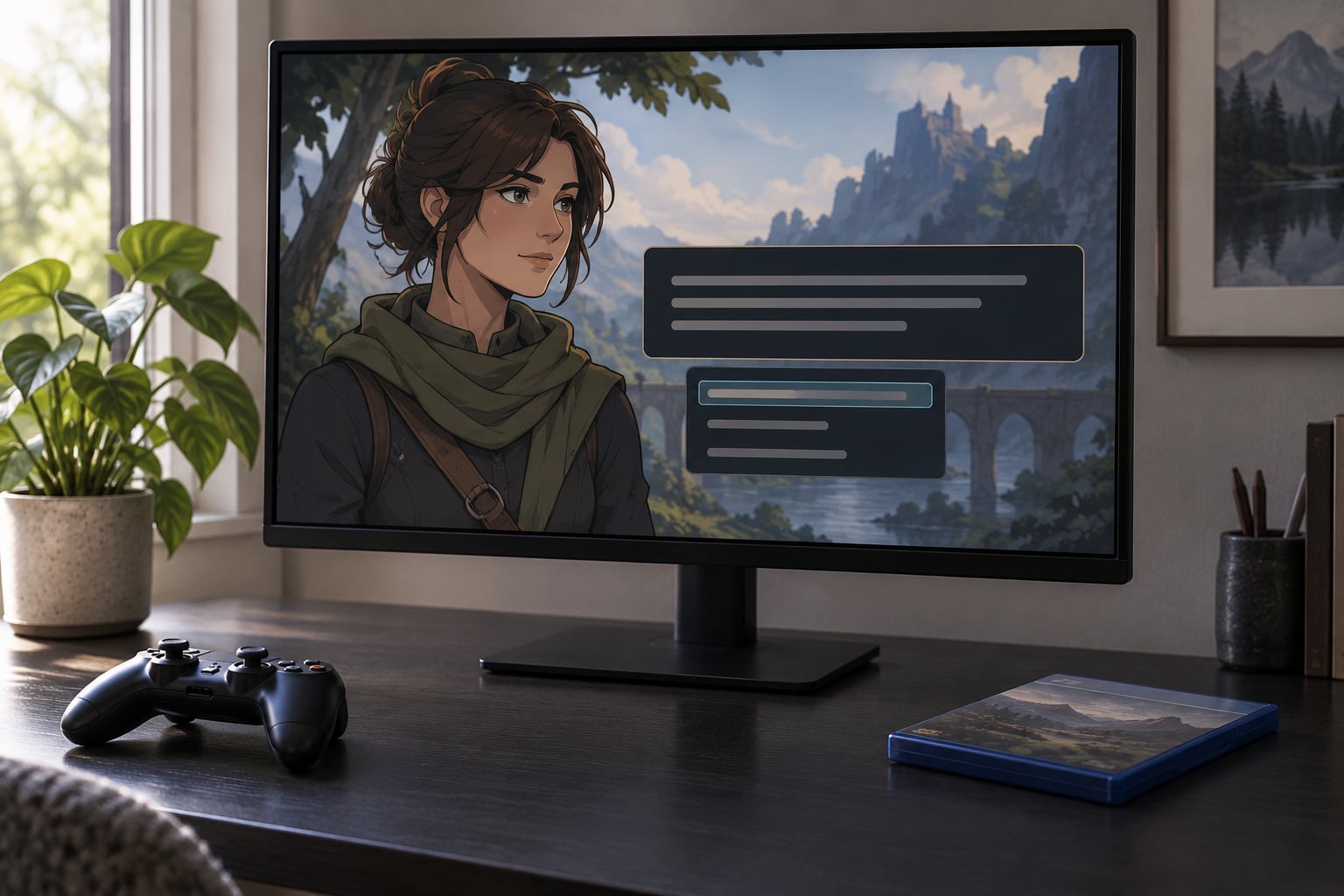
Visual novels are the clearest case, because in that genre the text box is not decoration. It is the game. A static character sprite, a background, a line of dialogue, and a choice. When Yu No: A Word Obtained in Autumn or Steins;Gate adapt that structure to other forms, the text stays because the text is doing the work.
Two other structural choices keep text in place. First, 2D busts instead of 3D cutscenes: a 2D character portrait with expression swaps is a fraction of the cost of an animated 3D scene, and the character can hold a pose while the words do the acting. Second, deliberate perspective: Japanese RPG narration is often third-person and external, describing what a character feels or what is really going on, rather than putting you in their head.
This is also why visual novels are not a niche category in Japan, despite the stereotype that they are. They are a mainstream product with dedicated console releases, huge budgets, and adaptations into anime and film. The stereotype is mostly a matter of which titles got licensed for the West.
Sound gets the same treatment, just through a different channel. Instead of a voice actor explaining the emotion, the music shifts, an emblem flashes, or a character portrait hard-cuts to a different expression. Each of those cues replaces words that a fully voiced scene would have carried out loud.
Mobile and Handheld Constraints
This is the reason nobody covers well, and it is the largest single source of text volume in Japanese releases right now.
A smartphone held in portrait gives you a narrow column and a thumb. There is no room for a 3D model, limited battery for a pre-rendered movie, and no local console budget. A text box, a character portrait, and tap-to-advance fills that screen perfectly, and it ships to millions of phones for a fraction of what a console voice production costs.
Episodic structure makes this worse in a useful way. A gacha title is a delivery schedule, not a single product. Each update needs enough new material to justify a log-in streak, and text is the fastest content to write, translate, and ship in small pieces. A new chapter of story is a few thousand characters and a patch. Fully voiced 3D cutscenes are none of those things.
Auto-advance design also feeds the habit. Many mobile games move text forward on a timer or with a tap, which trains players to read at speed and dismiss quickly. Bring that muscle memory to a console JRPG and it turns into the familiar experience of holding down a skip button.
Handhelds add a version of the same constraint. A small screen with variable performance and limited storage makes compressed, art-heavy, cinematic content expensive and text cheap, and the same logic held up when the platform was a 2010-era handheld rather than a phone.
Localization and Translation Challenges
Here is where a lot of the “Japanese games are wordy” argument actually comes from, and it is worth separating design from translation before you decide which one is bothering you.
Japanese writing carries a lot in register that English flattens. Speech levels differ by respect and social distance, and gender affects how characters speak. Male and female characters, polite and rough speech, senior and junior: these are distinctions a translator has to rebuild, usually by inventing a different English convention. A great deal of what reads as flat in an English release was carrying real information in Japanese.
Compounding that, the literal translation of exposition is often worse than the original. A translator working in a fixed text box has to fit English text into a box sized for Japanese characters, and English needs more room. The result is the familiar complaint that a scene explains the same thing three times: once in the original, once to make it land in English, and once because the localization team had room to expand it.
Some of the excess is a platform and regulation artifact too. Censorships in some markets have historically forced text boxes and other devices to carry a scene’s meaning, since changing a line is a different kind of problem from changing a model. And the deliberate decision to leave untranslated English loanwords in Japanese games, a habit noted by translator Clyde Mandelin, adds a small layer of text without adding translation work.
None of that is a defense of the writing. It just means the English version is a different document, sometimes a worse one, and a translation artifact can look exactly like a design choice.
How Much Text Is Normal in Japanese Games?
There is no single normal. The amount of text in a Japanese game tracks the genre almost exactly, and the genre is usually the answer to the question you were actually asking.
| Genre | Text density | Why |
|---|---|---|
| Visual novel | Very high | Text is the core mechanic; the rest is staging |
| Story-heavy JRPG | High | Long campaigns, per-character routes, world lore to seed |
| Tactical RPG | Moderate to high | Support conversations plus pre- and post-battle banter |
| Action RPG | Low to moderate | Story delivered in short scenes between combat |
| Mobile gacha | High, in small chunks | Episodic story updates ship as pure text |
| Fighting game | Low | Story limited to a handful of cinematics |
| Puzzle game | Very low | Text serves instruction, not narrative |
Two practical tells help you tell design from filler. If the text is skippable and readable in a backlog with a jump-ahead marker, it is doing real work. If a line explains something the previous line already established, that is the exposition pattern players rightly complain about, and it exists in Japanese, English, and every language in between.
Every major release ships with a skip-read button, an auto-advance toggle, adjustable text speed, and a backlog. If a game has all four, the developers assume you will read carefully at some point and want to skim at others. That is a design position, not an apology.
Frequently Asked Questions
Are visual novels niche in Japan?
No. Visual novels are a mainstream format in Japan, with dedicated console releases, large budgets, and regular anime and film adaptations. The niche reputation comes from which titles get licensed and released in the West, not from their standing at home. In Japan they are treated as a normal commercial genre, and text-heavy design is part of that norm rather than a quirk.
Do Japanese players think JRPG dialogue is bad?
The criticism exists in Japan too, not only among English speakers. Recurring complaints are the same: characters explaining things they already know, plot delivered by narration instead of action, and heavy-handed symbolism. What differs is the reading context. Japanese players grew up with the convention, and a large share treat long dialogue sections as the point of a story game rather than a delay before the action starts.
Is Japanese text more compact than English?
Yes, and it is the mechanical reason behind a lot of the word-count difference. Japanese mixes kanji and kana, and kanji pack meaning on their own, so a sentence conveying a given idea often needs fewer characters than its English equivalent. A text box sized for Japanese characters therefore fits more information, which makes writing more of it a reasonable design choice rather than padding. The gap narrows once the English translation expands to explain context.
Why do Japanese games use text instead of voice acting?
Three reasons, and they reinforce each other. Full voice acting is expensive, so studios budget it for key scenes and fall back to text for everything else. Players are used to reading, so the fallback does not hurt them. And 2D character art over 3D cutscenes keeps production costs and porting work down, which leaves more budget for story volume overall. Text-heavy design is what makes a big script affordable, not a substitute for wanting one.
Why do Japanese games seem to explain everything twice?
Two separate causes, and they are worth telling apart. The original design can repeat information because Japanese storytelling traditions favour explicit explanation over implication, and because kishotenketsu structures give each small beat its own setup and resolution. Separately, localization expands lines to fit English text boxes and to rebuild speech register that Japanese carries through formality and gender. Reading the Japanese original is often the fastest way to see which one you are dealing with.
How can I get through games with a lot of text?
Turn on skip read and raise the auto-advance speed in the options menu; both are standard in Japanese releases and most major Western ones. Use the backlog or log feature to re-read anything you missed instead of replaying a scene. If you are learning Japanese, a text-heavy game is a genuine reading practice tool, and reviewers regularly point to the Trails series as an enjoyable way to build reading speed.
Conclusion
So, why do Japanese games use so much text? Because the whole pipeline is built for it: cheap scripts, a compact writing system, a storytelling tradition that prefers explanation, genres designed around text boxes, phone screens that reward it, and a player base that reads quickly and expects to.
Start by identifying the genre, because that tells you most of what you are looking at. A visual novel with many routes is supposed to be long. Then check whether the text is mandatory or optional, and turn on skip read and faster auto-advance in the options menu. Everything else in this article exists to explain why those two buttons were built in the first place.