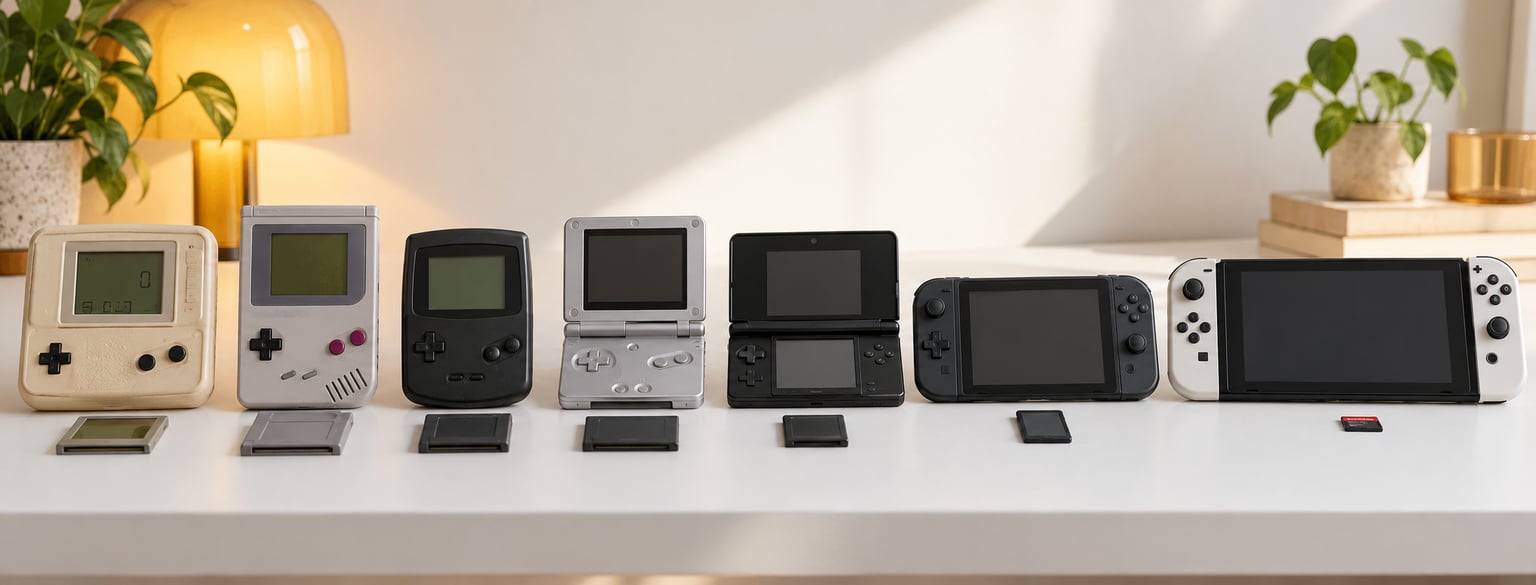
The Japanese gaming handhelds history runs from single-game LCD keychains in 1980 to a console that plugs into a television today. A handheld game console is a self-contained portable device with a built-in screen, controls and speaker. Nintendo’s Game & Watch in 1980 is usually credited as the first, and Epoch’s Game Pocket Computer in 1984 was the first one built in Japan and never sold anywhere else.
That arc matters because portable gaming was never a side project for Japanese companies. It became its own category, and for most of the last four decades Nintendo, Sony, Sega, Bandai and SNK have been the only names that mattered on it.
Table of Contents
- 1What the Japanese Gaming Handhelds History Includes
- 2How Did Japan’s Portable Gaming Industry Begin?
- 3How each era of the Japanese gaming handhelds history changed portable play
- 4How Did the Major Handheld Eras Shape Portable Gaming?
- 5The 8-bit rivals, side by side
- 6The 16-bit Japan wave
- 7How Nintendo Made Handheld Gaming a Mass-Market Product
- 8Why the monochrome screen won
- 9Dual screens, touch and 3D
- 10What Made Sony’s PSP and PlayStation Vita Important?
- 11What Role Did WonderSwan, Neo Geo Pocket, and Other Japan-Only Systems Play?
- 12Which Technologies First Appeared on Japanese Handheld Consoles?
- 13Why Did Some Japanese Handhelds Succeed While Others Disappeared?
- 14How Does the Switch Change the Story of Portable Gaming?
- 15What Legacy Did Japanese Handheld Consoles Leave?
- 16Frequently Asked Questions
- 17What was the first successful Japanese handheld game console?
- 18Were WonderSwan and Neo Geo Pocket only available in Japan?
- 19Why did Sony stop making PlayStation Vita handhelds?
- 20Are retired Japanese handheld game systems worth collecting?
- 21Is the Nintendo Switch a handheld game console?
- 22What to Remember First
What the Japanese Gaming Handhelds History Includes
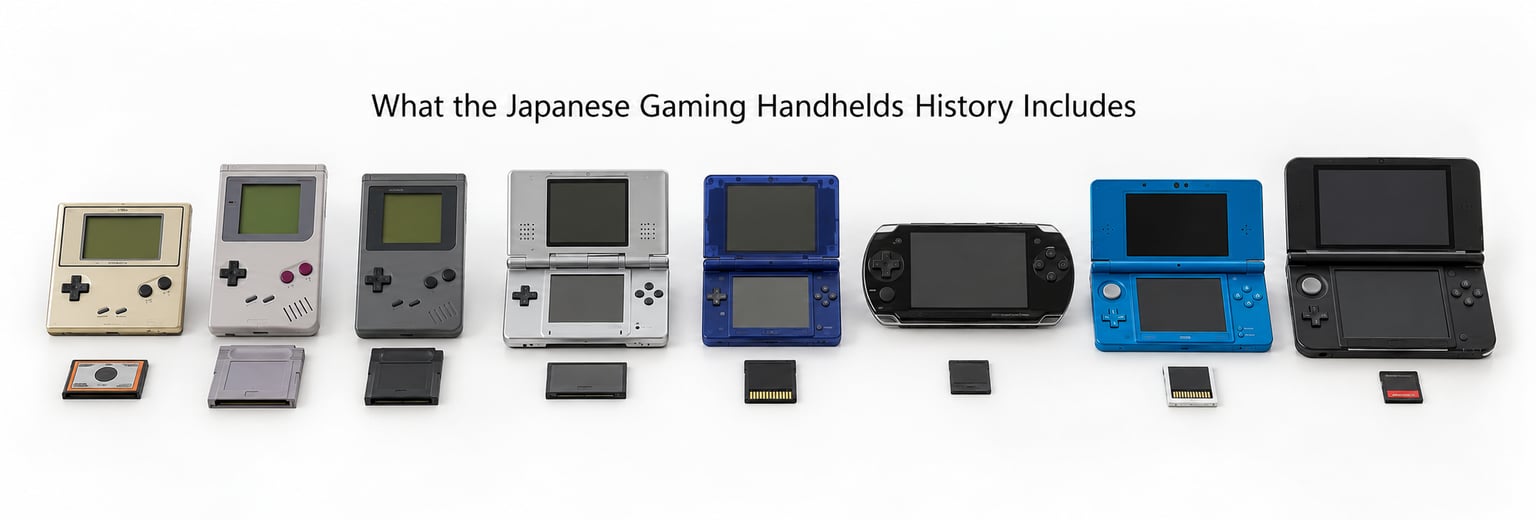
Japanese gaming handhelds history covers portable consoles designed by companies headquartered in Japan, including ones that only ever shipped inside the country. It also includes Japan’s contribution to devices that sold worldwide, because Nintendo and Sony defined the format for everyone else.
Two different things get mixed up constantly, so it is worth separating them. A Japan-first handheld was designed in Japan and released there first, sometimes worldwide later, such as the Game Boy Color or the PSP. A Japan-only handheld was never officially sold outside Japan, such as Epoch’s Game Pocket Computer, the WonderSwan and the Neo Geo Pocket line.
Some hardware from Western companies also matters to the story, mostly as contrast. Milton Bradley’s Microvision arrived in 1979 with the first modern D-pad, and Atari’s Lynx reached Japan in 1990 with a backlit colour screen years before Sega’s Game Gear. Neither survived long. The Japanese gaming handhelds history is largely the story of the machines that did.
How Did Japan’s Portable Gaming Industry Begin?
Japan already had a working parts supply chain, a strong toy market and a domestic arcade boom by the late 1970s. That combination is why the first credible handheld experiments came from Japanese factories rather than American ones.
Nintendo moved first with the Game & Watch in April 1980. Each unit was a single game on a segment display with no screen-off state, sold from kiosks rather than game shops, and designed by Gunpei Yokoi, who is credited with inventing the plus-shaped D-pad in the process. The whole line eventually passed 100 million lifetime sales, which is a remarkable run for machines most buyers used as keychains.
Epoch’s Game Pocket Computer arrived in 1984 and is the clean answer to the question of which Japan-only handheld came first. It used interchangeable cartridges on a 75 by 64 pixel LCD, and it never left Japan. It sold in modest numbers, but the design did something the Game & Watch could not: it proved that a pocketable console with swappable software was commercially viable.
How each era of the Japanese gaming handhelds history changed portable play
Three constraints drove every design decision for the next forty years: power, screens and controls. Each era solved them differently, and the failures usually come down to solving one of them badly.
Power ruled the 1980s and early 1990s. Unlit reflective LCDs drew so little current that the Game Boy ran for dozens of hours on four AA cells, while the Game Gear’s backlit colour screen drained six cells in a morning. Screen technology decided the same era’s shape, with colour arriving first on machines that were far too power-hungry. Controls went through the opposite arc, from one-thumb D-pad play to touchscreens to analog sticks on both sides of a device.
How Did the Major Handheld Eras Shape Portable Gaming?
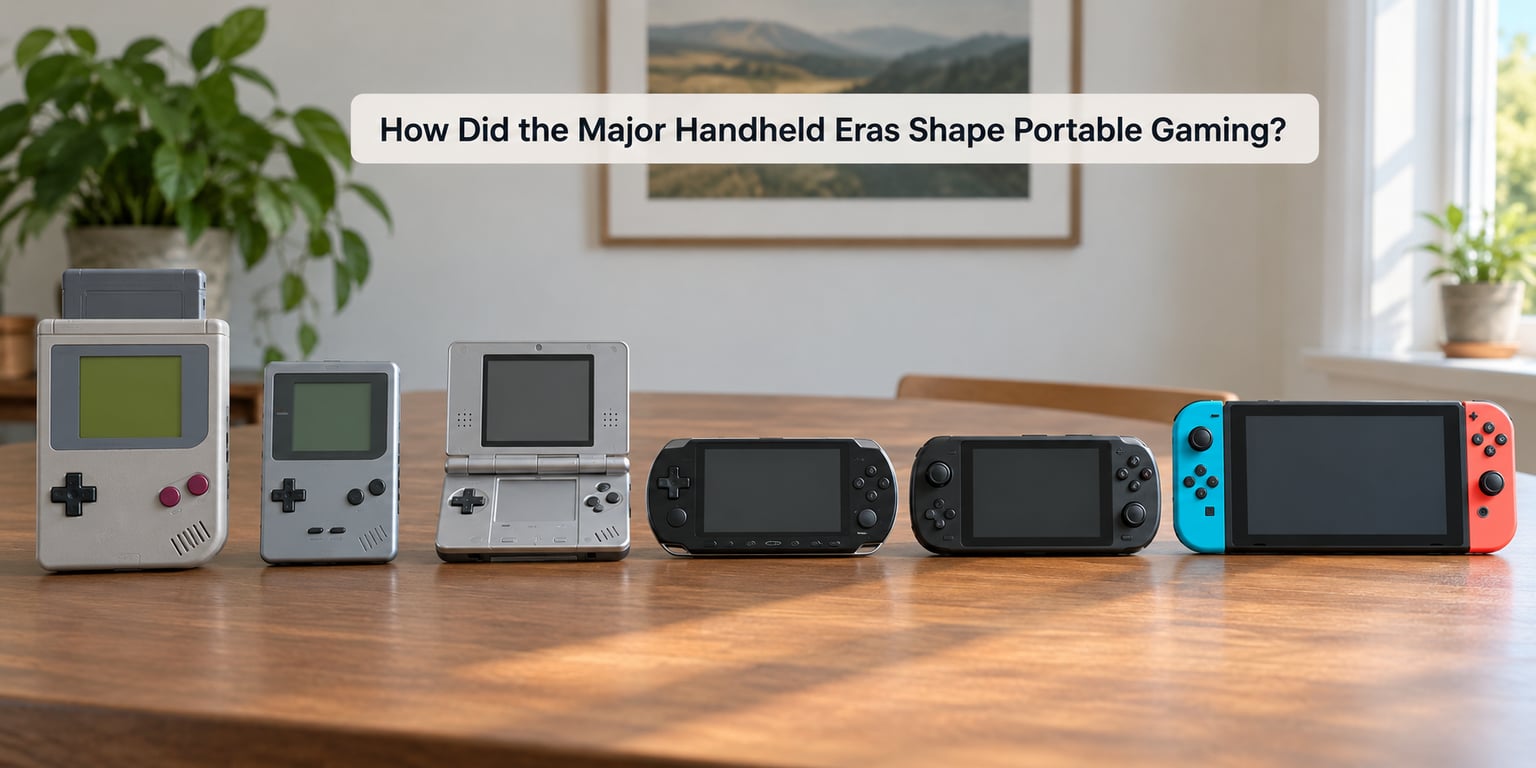
This table is the fastest way to see the whole Japanese gaming handhelds history. Sales figures are the best available published totals from manufacturer data.
| Device | Maker | Japan release | Key innovation | Fate |
|---|---|---|---|---|
| Game & Watch | Nintendo | 1980 | Single-game LCD plus D-pad | Over 100M lifetime sales |
| Game Pocket Computer | Epoch | 1984 | Cartridge-based LCD handheld | Japan only, low volume |
| Game Boy | Nintendo | 1989 | Swappable cartridges, weeks of battery | 118M+ sold |
| PC Engine GT | NEC | 1990 | HuCard media in a portable | Too early, Japan focused |
| Game Gear | Sega | 1990 | Backlit colour screen | Failed in Japan, cult favourite later |
| Neo Geo Pocket | SNK | 1998 | Genuinely pocket-sized, SNK arcade ports | About 10M, Japan led sales |
| WonderSwan | Bandai | 1999 | 224 by 224 reflective TFT, ultra-low power | 12M+, Japan and parts of Asia |
| Game Boy Color | Nintendo | 1999 | Colour plus Game Boy cartridge backwards compatibility | 86M+ sold |
| Game Boy Advance | Nintendo | 2001 | 32-bit performance, full GB and GBC compatibility | 81M+ sold |
| PSP | Sony | 2004 | UMD optical discs, Wi-Fi, multimedia | 77M+ sold |
| Nintendo DS | Nintendo | 2004 | Dual screens, resistive touch | 154M+ sold |
| Nintendo 3DS | Nintendo | 2011 | Autostereoscopic 3D without special glasses | 76M+ sold |
| PlayStation Vita | Sony | 2011 | Front and rear touch, OLED, twin analog sticks | Sony stopped reporting sales |
| Nintendo Switch | Nintendo | 2017 | One device that docks and detaches | 155M+ and rising |
| Steam Deck | Valve | 2022 | PC game library in a handheld chassis | Software led, not spec led |
The 8-bit rivals, side by side
The Game Boy, Game Gear and Lynx all launched within two years of each other, and they solved the same problem in completely different ways.
| Spec | Game Boy (1989) | Game Gear (1990) | Atari Lynx (1989, reached Japan 1990) |
|---|---|---|---|
| Screen | 160 by 144 unlit reflective LCD, no backlight | Backlit colour LCD | Backlit colour LCD |
| Battery | Four AA cells, days of play | Six AA cells, hours of play | Six AA cells |
| Colour | Four shades of green | Thousands of colours | Thousands of colours |
| Japan result | Dominated from launch | Beaten in every region | Never gained a hold |
Three colour rivals lost to a monochrome machine for one reason: the colour screen drained the batteries. A console that dies in the morning is a worse buy than one with four shades of green that survives a long train ride, and Japanese commuters used handhelds on trains.
The 16-bit Japan wave
At the end of the 1990s Japan’s domestic manufacturers tried to break the Game Boy hold from both directions. Bandai’s WonderSwan was the technical experiment, trading graphics for battery life and a screen wider than it was tall. SNK’s Neo Geo Pocket was the content play, banking on arcade ports from a company people already knew.
Both sold better in Japan than anywhere else, both are inexpensive today, and both are the reason collectors argue about which is the better first purchase.
How Nintendo Made Handheld Gaming a Mass-Market Product
Nintendo’s method was not to win on hardware specifications. It was to own the device in a pocket for a decade and keep the software library healthy the whole time.
The Game Boy launched in Japan in April 1989 and stayed on shelves in essentially the same form for nine years. That long life let publishers amortise a game across a big installed base, and Nintendo protected it with the kind of third-party support rivals could not match once the licensing relationship settled.
Then came the upgrades that mattered more than new consoles. The Game Boy Color in 1999 played every Game Boy cartridge. The Game Boy Advance in 2001 kept both formats working and jumped to 32-bit performance, which let existing owners buy into a new library without buying a new device. Backwards compatibility turned an upgrade into an addition rather than a reset.
Why the monochrome screen won
The reflective STN LCD on the Game Boy needed no backlight, so it drew almost nothing when idle and ran for dozens of hours on four alkaline cells. It looked washed out in direct sun, which players accepted, and it cost almost nothing to manufacture. The Game Gear’s backlit colour screen was a far better display in a dim room and a punishing one everywhere else.
Dual screens, touch and 3D
The Nintendo DS in 2004 went in the opposite direction, adding a second screen below a resistive touchscreen and taking inputs from a stylus. It sold over 154 million, which made it the second-best-selling game machine Nintendo ever put out, behind only the Switch. The 3DS in 2011 layered autostereoscopic 3D on top, with a slider letting players turn the effect off.
One misstep sits in the middle. The Virtual Boy launched in Japan in 1995 and disappeared within months; it is still regularly described as Nintendo’s biggest hardware failure, and it cost the company roughly its own worst-case assumptions in a single generation.
What Made Sony’s PSP and PlayStation Vita Important?
Sony’s approach was to sell a portable multimedia device that happened to play games, which was a deliberate break from Nintendo’s game-only framing.
The PSP launched in Japan in December 2004 with a 4.3 inch screen, built-in Wi-Fi and UMD optical discs large enough for full-size video. It had more raw power than anything portable before it, and Sony leaned into movies, music and TV as much as games. It eventually passed 77 million sold, including the later slimmer revision.
The PlayStation Vita arrived in December 2011 with a 5 inch OLED display, a touchscreen on both the front and the back, and two analog sticks. On paper it was the best handheld Sony ever built. It landed while phones were absorbing the low end of portable gaming and the 3DS had the volume, and Sony discontinued the hardware line and stopped publishing Vita sales figures rather than keep pushing a dedicated portable.
The Sony era also carried wider consequences. Sony’s PlayStation success had already displaced Sega’s hardware leadership, and Sony’s decision to keep investing in dedicated handhelds while restructuring its Japanese studios produced years of coverage about what that meant for the company. The PSP and Vita are the reason handheld fans still argue about whether portable gaming should be a media device or a pure game machine.
What Role Did WonderSwan, Neo Geo Pocket, and Other Japan-Only Systems Play?
These machines matter less for their sales than for the engineering and business questions they answered while almost nobody outside Japan was watching.
Bandai’s WonderSwan launched in Japan in February 1999 with a 224 by 224 reflective TFT screen, a tall body wider than a standard Game Boy cart, and a battery life that ran in days. Bandai used it for its own properties alongside Final Fantasy and other Square titles, and it reached roughly 12 million sales across Japan and parts of Asia. It never launched in Europe or North America. Collectors regularly describe it as the overlooked system they regret not buying sooner.
SNK’s Neo Geo Pocket launched in April 1998 as the most genuinely pocketable handheld of its era, and the colour revision arrived the following year. Its library leaned on SNK’s own arcade catalogue, which gave it a clear identity, and it also carried a strong third-party line in Japan.
PC Engine GT, NEC’s 1990 portable, showed what happens when a company ships a media format too early: it used HuCards, the same format as the home console, and there was no software ecosystem to fill it. Epoch’s SwanCrystal, a colour revision of the Game Boy, is the clearest example of a licensed Nintendo handheld living only in Japan.
The pattern across all of them is consistent. Japan had buyers who wanted a second, cheaper device for games their home console could not run, and that market supported hardware the rest of the world never saw. Owners in the west still buy these machines today, and the buying advice is straightforward: check for battery corrosion and screen damage first, and confirm the language on the cartridge before committing.
Which Technologies First Appeared on Japanese Handheld Consoles?
Most of what we now expect from portable devices arrived on Japanese hardware first, usually a generation before the feature became normal elsewhere.
Rechargeable internal batteries were an early example. Fixed batteries in the Game Boy and Game Gear meant constantly carrying spares, and it took later Japanese handhelds to make a sealed rechargeable pack the default expectation. Colour screens appeared on the Game Gear and Lynx before the Game Boy Color caught up. Touch input moved from the PlayStation Portable’s optional film-style panel to the Nintendo DS’s full resistive digitiser, and touch controls then spread to phones. Autostereoscopic 3D, the 3DS technique that used parallax rather than glasses, and the Switch’s detached-controller concept both reached the wider market from Japan.
Media choices followed a similar line. Handhelds went from cartridges to HuCards to optical discs to proprietary memory cards to internal storage and downloads, and the Switch pushed the format further by blurring handheld and home media into one device.
Why Did Some Japanese Handhelds Succeed While Others Disappeared?
Look at the machines that failed and the reasons repeat with uncomfortable consistency.
Software is the first variable. The Game Gear had colour and a good screen and lost, because it did not have the game library to matter in Japan while the Game Boy did. Sony shipped high-quality hardware and lost on the Vita because the software pipeline and the market timing were both wrong.
Battery life is the second, and it is less obvious than it looks. A device that dies mid-commute fails harder than one with dull colours. Japanese rail commutes made short battery life a genuine defect rather than an inconvenience.
Third is distribution. WonderSwan and Neo Geo Pocket sold well at home but had no international marketing behind them, and Japan’s domestic market alone was never going to fund continued hardware development. Fourth is timing: hardware that arrives before the software, or after phones have absorbed the category, gets squeezed from both sides.
Finally, a device has to solve a distinct problem. The Game Boy solved long battery life and cheap software. The DS solved two-screen touch. The Switch solved playing the same games at home and on a train. Machines that only copied the leader generally had no answer to give.
How Does the Switch Change the Story of Portable Gaming?
The Switch ends the division of labour that every previous Japanese handheld had accepted. It has a screen and battery, and it also docks into a television and becomes a home console with the same games.
Detachable controllers made that possible. Tabletop mode, handheld mode and docked mode run the same software, so the hardware decision stopped being a choice between portable and home. It also let Nintendo keep a single software library across both, which is exactly the economics that built the company’s earlier dominance.
The result has changed the shape of the whole category. Once the best-selling console is also the best-selling handheld, the separate portable market effectively ends, and the successor generation continues that logic with hybrid and open PC-style devices such as the Steam Deck. Collectors are now scattered across categories: cartridge-based retro boxes such as Evercade, FPGA-based hardware that renders original systems rather than running emulators such as the Analogue Pocket, and PC handhelds that run whole storefronts.
What Legacy Did Japanese Handheld Consoles Leave?
Four things carry forward. The first is the idea that the best portable device is the one with the biggest library, which is why publishers still treat handheld attach rates as a serious commercial signal.
The second is industrial design. Pocket proportions, flat undersides, centred D-pads, front-facing speakers and the clamshell book format all trace back to Japanese handheld work, and phone makers still copy them.
The third is shared play. Local wireless and later online portable play turned handhelds into social devices, and the same assumption that one person owns the hardware and others borrow it still shapes how multiplayer gets designed.
The fourth is the revival now running through retro hardware, with FPGA consoles and re-releases pulling people back to systems released before the smartphones arrived.
Frequently Asked Questions
What was the first successful Japanese handheld game console?
Nintendo’s Game u0026amp; Watch from 1980 is the usual answer, because it sold in huge numbers and introduced the D-pad. If you mean a handheld with swappable games, Epoch’s Game Pocket Computer from 1984 qualifies but stayed Japan-only. For a handheld with a real software library, the 1989 Game Boy is the consensus pick.
Were WonderSwan and Neo Geo Pocket only available in Japan?
Mostly. The WonderSwan launched in Japan in 1999 and reached Hong Kong and parts of Asia, but it was never officially released in Europe or North America. The Neo Geo Pocket was closer to a Japan-only system, with limited distribution elsewhere. Expect Japanese-language carts, Japanese-region packaging and no official English support on either machine.
Why did Sony stop making PlayStation Vita handhelds?
Sony retired the dedicated portable line while the wider handheld category was shrinking toward hybrid and PC devices, and it stopped publishing Vita sales figures rather than keeping a dedicated portable alive against that pressure. The hardware was well regarded, but the software pipeline and the timing of the smartphone era worked against it.
Are retired Japanese handheld game systems worth collecting?
Often yes, at modest cost. Japan-only machines such as the WonderSwan, SwanCrystal and Neo Geo Pocket are inexpensive, and complete-in-box examples with Japanese inserts now attract real attention. Check battery compartments for corrosion, screens for backlight failure, and confirm the cartridge language before buying, since region-locked software limits what most buyers can actually play.
Is the Nintendo Switch a handheld game console?
Both, which is the point. The Switch has a built-in screen and battery and runs standalone as a portable system, then docks into a television and plays the same games through detachable controllers. That dual identity is why its sales figures sit alongside historic handhelds rather than in the home console category on its own.
What to Remember First
Japanese companies did not follow one path through portable gaming. They solved a series of specific problems, and each solution shaped the next: power and screen trade-offs in the 1980s, colour and backwards compatibility in the 1990s, touch and multimedia in the 2000s, and the merging of handheld and home hardware after 2017.
The useful mental model is to ask, for each machine, which constraint it was built around. Once you know that, the sales figures and the odd hardware decisions make sense on their own.