How VTuber agencies work comes down to a fairly simple exchange: a company finds creators, builds their avatar, puts a team behind their streams, and promotes them, then takes a cut of everything earned in exchange. The creator gets paid on time, so the channel exists. Everything that matters afterwards, from the revenue split to who owns the character, comes down to one document: the contract.
The pattern grew out of Japan, where Cover Corp runs Hololive and ANYCOLOR runs Nijisanji. Western agencies like VShojo borrowed the structure with a lighter touch, and a large indie scene now runs alongside both. This guide covers the whole pipeline, from application to departure, so you can read an offer with your eyes open.
Table of Contents
- 1What Is a VTuber Agency?
- 2How VTuber Agencies Find and Support Talent
- 3Who works inside the agency
- 4A concrete first month
- 5How VTuber Agencies Make Money
- 6How Revenue Sharing Usually Works
- 7VTuber Agency Contracts and Rights
- 8What Independent VTubers Should Compare
- 9Frequently Asked Questions
- 10How do I get into a VTuber agency?
- 11Do VTuber agencies own your avatar and character?
- 12Are VTubers employees or contractors?
- 13Can you stream on Twitch if you have an agency contract?
- 14What happens when a VTuber graduates or leaves an agency?
- 15Conclusion
What Is a VTuber Agency?

A VTuber agency is a company that signs virtual creators to a management contract and handles the work that is hard to do alone: designing the avatar, rigging it so it tracks a face, funding the debut, running events, pitching brand deals and keeping the channel visible.
It is worth separating that from four neighbouring things, because the terms get used loosely.
- A talent agency in the conventional sense books live appearances, negotiates endorsements and manages a roster. A VTuber agency does some of this, but its centre of gravity is digital production rather than a physical schedule.
- A production studio builds avatars, animates and renders. An agency usually contracts that kind of studio rather than being one, though some large groups keep illustrators and riggers in-house.
- A label releases music and manages rights. Several VTuber groups function partly as labels, and music revenue is a big line item for the top performers.
- An independent VTuber owns the channel outright, keeps 100% of the income and handles every task alone. That is a real operating model, not a lesser version of the agency one.
In practice the agency is the party that signs you, pays your production bills up front and takes the largest slice when the money arrives. If nobody signed a contract, there is no agency, just a group of people sharing a manager.
How VTuber Agencies Find and Support Talent
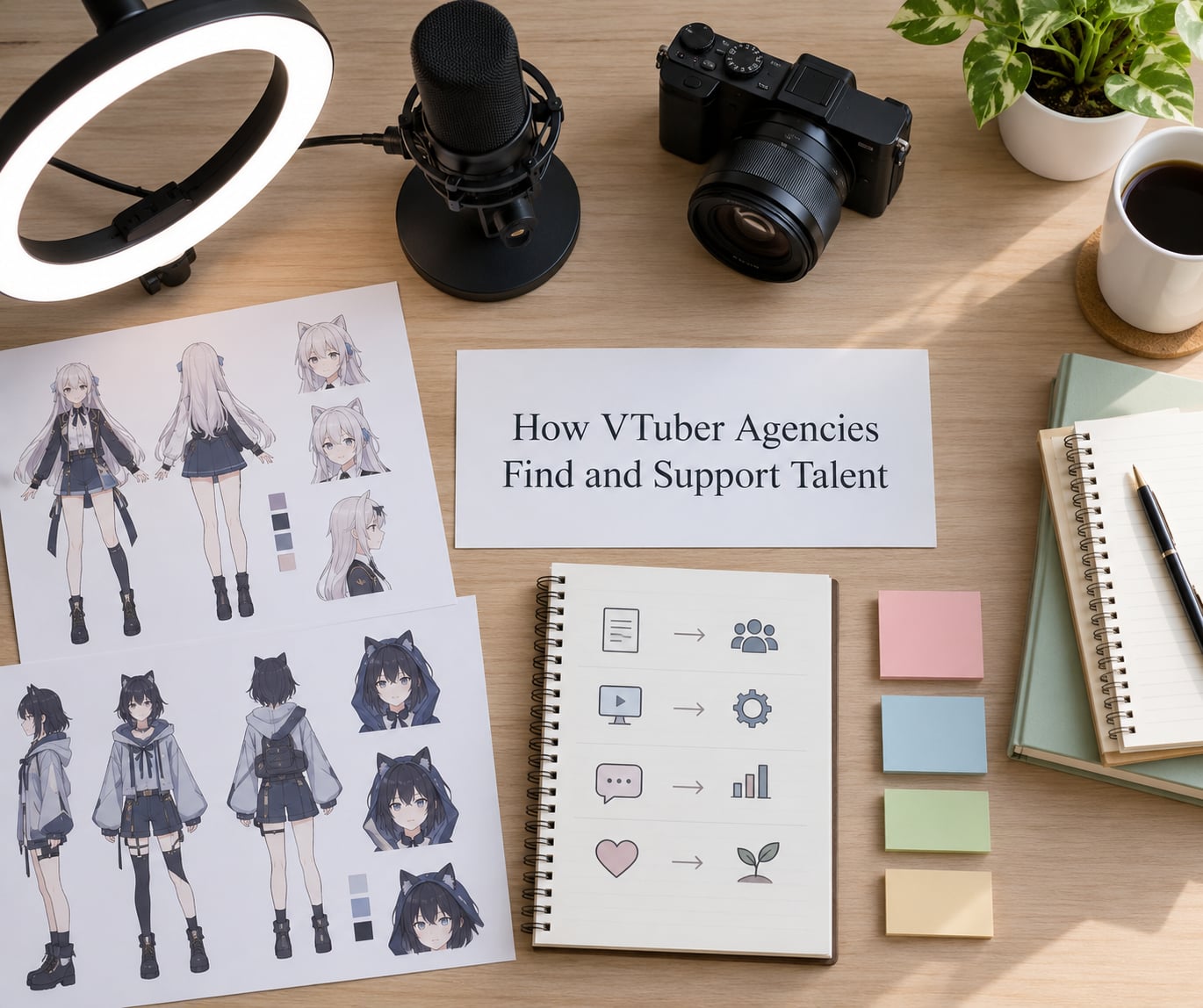
Every agency advertises open auditions, but the practical route is a pipeline, and the order of the steps is remarkably consistent across companies.
- Scouting and application. Some agencies take open submissions through a form. Others watch clips of creators already streaming independently and approach them directly. Large Japanese groups run scheduled audition windows and receive thousands of applications per round.
- Screening. Staff filter on presentation, consistency and fit. Many also collect a real name and identity documents at this stage, which surprises applicants who expected anonymity.
- Audition rounds. Usually a first conversation and then a second, where an agency producer or manager explains the business side. Applicants on community forums repeatedly describe the second round as the anxious one, because the expectations are less obvious there.
- Offer and contract. Terms cover the revenue share, exclusivity, intellectual property and length of the agreement. This is the point where an offer becomes binding.
- Character design and production. A designer creates the character, a rigger builds the skeleton and parameter set that make a 2D model move, or a 3D team models and sets up motion capture. This is the long pole: it routinely runs several months.
- Debrief, rehearsal and debut. Talent records a test stream, reviews it with staff, then debuts inside a group announcement or a solo channel reveal.
After debut the support changes shape. Weekly production meetings, scheduling help, editing and thumbnail guidance, event planning and sponsorship pitching replace the hands-on onboarding help.
Who works inside the agency
The staffing question comes up constantly in VTuber communities, usually about writers and narrative directors. In a large group the roles look roughly like this.
| Role | What the job actually involves |
|---|---|
| Producer | Owns the schedule, approves the content direction and is the decision maker the talent answers to. |
| Talent manager | Handles the business side: brand deals, event logistics, schedules and communications with other teams. |
| Illustrator / character designer | Creates the avatar art, costume variants and promotional key art. |
| Rigger | Builds the Live2D rig or sets up the 3D model so facial and body tracking works live. |
| Writer / narrative director | Develops backstory, running jokes, song lyrics and long-running story arcs, and keeps them consistent across members. |
| Music and video staff | Produce original songs, animated shorts and music videos for the group. |
| Marketing and events | Run the social accounts, organise live events, exhibitions and anniversary projects. |
Smaller agencies compress all of this into two or three people. A five-person roster might mean one producer handling management and scheduling, one contractor doing rigging, and a designer who appears at the start of the project and then leaves.
A concrete first month
Take a new talent accepted by a mid-sized group. In week one they give a hardware and software list, sign a contract, and record a test stream on their own avatar. Weeks two and three are character design revisions, with the designer sending drafts and the producer steering the silhouette toward something that reads well at thumbnail size.
By week four rigging begins and the talent runs mock streams so the rigger can check tracking quality on a real face and a real setup. Month two is rehearsal, a first song recording and a collab slot in someone else’s stream. Debut lands somewhere in month three, with a short reveal video and a date pushed in the group’s channel.
Nobody works this schedule for years without a break. Scheduled rest days are part of the contract at the better-organised agencies.
How VTuber Agencies Make Money
An agency earns on both sides of the arrangement. On the talent side, the income it manages comes from several streams that usually overlap.
- Streaming-platform income: ad revenue share and channel memberships through YouTube, plus platform-specific programmes and Super Chat-style live donations on Twitch.
- Sponsorships and brand deals: handled by staff, negotiated against the group’s reach, often with a category exclusivity clause attached.
- Merchandise: apparel, acrylic stands and accessories produced in batches, with revenue split per item sold.
- Memberships and fan subscriptions: recurring monthly income with perks attached.
- Live appearances and events: convention stages, music festivals and agency-run live shows, including ticket revenue.
- Licensing and collaborations: character licensing, brand character collaborations and crossovers with other properties.
- Music and digital products: albums, film and merchandise lines built around popular members.
On the agency side, the company keeps its cut of talent income, books cross-promotional events where its own members benefit, runs shops and event production, and sells advertising on its channels and events. The two large Japanese operators are public companies, which means their filings show how central revenue from creators and fans is to the whole model. Western agencies are private, so the same detail is much harder to find.
How Revenue Sharing Usually Works
Revenue sharing usually works by taking a percentage of what the talent earns after the platform has already taken its own fee. Two definitions decide what that percentage applies to, and this is where most disputes start.
Gross means everything the channel received. Net means what remains after platform fees, taxes, refunds, chargebacks and sometimes third-party service costs. A contract that says 30% without specifying which one can mean very different amounts at the end of the year.
| Arrangement | Broad band | What usually funds production |
|---|---|---|
| Independent | Creator keeps 100% | Creator pays every cost up front |
| Smaller or newer agency | About 70/30 in favour of the talent | Agency usually covers the avatar |
| Large established group | About 50/50, or lower for the talent at the top | Agency covers avatar, music, events and marketing |
To illustrate the arithmetic, take a channel with 10,000 units of gross income in a month. On a 70/30 split at the talent level, the agency takes 30% of the gross figure and the talent keeps 70%. Apply the same split to a net figure after platform fees and the talent’s share of the original total is smaller. The headline percentage is identical, so the contract wording matters more than the number.
Settlement usually runs monthly or quarterly, with the agency reporting income per channel and paying out on a fixed date. Stronger contracts add audit rights, which let the talent request source records if a payout looks wrong. The absence of a written report and a firm payment date is a bad sign, and people in VTuber communities treat it as one.
The practical rule is simple: a 30% cut is ordinary when the agency is paying for your avatar, rigging, music and events, and poor value when you are funding all of that yourself and getting scheduling help in return.
VTuber Agency Contracts and Rights
This is where most readers lose the thread, so here are the clauses that actually matter, in plain terms.
- Exclusivity. Usually platform exclusivity, meaning you stream only on the named platform. Multi-streaming rules, if permitted, generally exclude other VTuber channels on the same stream.
- Term and renewal. A fixed initial period, often one or two years, then renewal by agreement. Auto-renewal on the agency’s side with no notice requirement is worth negotiating.
- Content ownership. Who owns the character design, the name, the lore and the model data. The common structure is that the talent keeps the right to perform the character and the agency owns or co-owns the underlying IP.
- Image rights. Whether the agency may use the avatar in advertising, merchandise and licensing after the contract ends. Perpetual and irrevocable usage rights are a standard red flag.
- Revenue definition. Gross or net, what counts as agency revenue, which third-party costs can be deducted, and the reporting obligation.
- Audit rights. How often you can inspect income records, and at whose cost.
- Termination and graduation. Notice periods for both sides, what happens to the channel on departure, and how the transition is announced.
- Confidentiality and dispute resolution. How disputes are handled, often through arbitration or a named jurisdiction, plus any restriction on speaking publicly about the arrangement.
The legal relationship underneath matters too. Japanese agencies commonly use employment, quasi-delegation, where the creator is treated as an independent contractor but the company controls the working conditions, or a contract-for-work. Each carries different obligations around pay, leave and termination. Other countries lean more on contractor status or employment, and the difference shows up in what happens when you want to stop.
Eight things to check before signing:
- A vague or missing definition of revenue.
- Auto-renewal with no notice window.
- Perpetual image rights that survive the contract.
- Blanket platform exclusivity with no multi-streaming allowance.
- Unlimited deduction rights for unspecified service costs.
- No audit rights and no written reporting obligation.
- One-sided termination clauses with no notice period.
- A non-disparagement clause that prevents you describing your own experience afterwards.
Age eligibility deserves its own note. Most agencies set a minimum age of 16 or 18 and require parental consent for anyone signing as a minor. The rules on collecting identity documents at application stage vary widely and are rarely spelled out before you hand them over.
What Independent VTubers Should Compare
Independence is not automatically better. It is a different set of trade-offs, and the right one depends on whether your bottleneck is production capacity or creative control.
| Factor | With an agency | Independent |
|---|---|---|
| Upfront cost | Usually covered by the agency | Paid in full by the creator, before any income |
| Revenue kept | Roughly 50-70% of net income | Close to 100% |
| Creative control | Subject to approval, brand safety and schedule | Effectively total |
| Promotion | Cross-promotion, events, press | Whatever you can arrange yourself |
| Platform choice | Often limited by exclusivity | Yours to pick |
| Admin and marketing | Staff handle it | Yours, on top of streaming |
| Character IP | Frequently retained or co-owned by the agency | Yours outright |
If you cannot afford a rig, have no marketing time and want a debut inside a group, the agency route does the heavy lifting. If you already have a validated audience, a distinctive format you would rather not negotiate on, and a channel earning enough to fund the next improvement yourself, the split becomes expensive overhead.
There is a third path worth naming: operate independently, then hire individual contractors for rigging, editing or music. That captures most of the support an agency provides without giving up channel ownership or a share of income.
Whatever route you are considering, do the same arithmetic. Estimate your realistic monthly income for six months, write down the production and admin costs either option carries, then compare what reaches you under each. Numbers settle the indie-versus-agency argument faster than any opinion thread.
Frequently Asked Questions
How do I get into a VTuber agency?
Apply during an open audition window or get noticed while streaming independently. Expect screening on presentation and consistency, then one or two conversation rounds with a producer or manager. You will need a character concept, demonstration material and, in many cases, a real name and identity documents. The audition stage is where agencies judge fit, not just skill, so showing consistent output matters as much as raw singing or streaming quality.
Do VTuber agencies own your avatar and character?
It depends on the contract, and this is the single most important clause to read. A common structure is that the agency owns or co-owns the character design, name and lore, while the talent keeps the right to perform as that character during the contract term. Contracts that assign full ownership with perpetual image rights to the agency are a recognised red flag. Read the ownership and usage-rights sections together, because they interact.
Are VTubers employees or contractors?
Most VTubers are contractors rather than employees, and Japanese agencies typically use employment, quasi-delegation or contract-for-work structures. Quasi-delegation leaves the creator as an independent contractor while the company sets working conditions, and it sits between the other two. The distinction matters during disputes, because it changes notice periods, leave rights and how termination works. Ask which category the contract uses before you sign anything.
Can you stream on Twitch if you have an agency contract?
Only if your contract allows it. Most Japanese agency contracts carry platform exclusivity tied to YouTube, and streaming elsewhere can be treated as a breach. Some groups permit limited multi-streaming but exclude other VTuber channels on the same feed. Western agencies are frequently looser about this. Check the exclusivity clause specifically rather than asking staff in passing, and get the answer in writing before you set up a second channel.
What happens when a VTuber graduates or leaves an agency?
Graduation is usually a planned, mutual exit announced publicly, and the channel and archive typically stay with the agency. The departing talent may be allowed to keep streaming as themselves under a new name or as a different character, depending on the contract. Unilateral termination is different: it generally carries a notice period and leaves the agency holding the channel and IP. Ask about both exit routes, including channel ownership, before you sign.
Conclusion
An agency supplies money, staff, technical production and reach, and in return takes a share of revenue and usually some form of control over the character. That trade works well when you need a team and money upfront, and it works badly when you already have both.
So here is the first step, and it costs nothing: get the full contract in writing before you compare anything else. Read the revenue definition, the ownership clause, the exclusivity terms and the exit provisions side by side, then write down what you would keep after the split. If the numbers and the rights both look reasonable, the rest is preference.