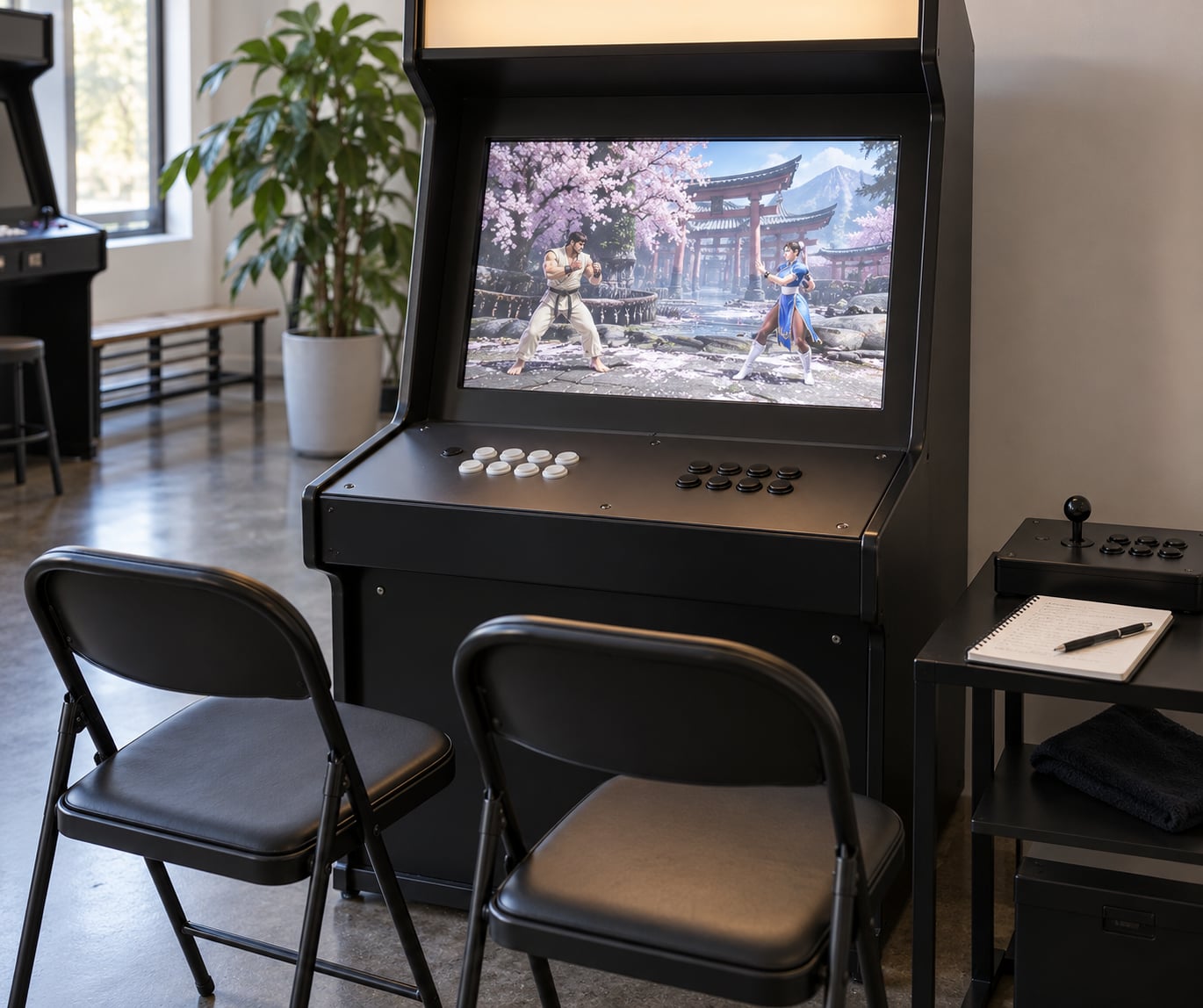
If you have ever wondered how Japanese fighting game communities train players, the answer is a community system rather than a secret technique. You queue for a shared arcade cabinet, play a fixed number of games against people at or above your level, review what happened, then return the following week and repeat it. Layered on top of that sit structured drilling, matchup notes, and a loose senior-junior ladder. A normal week in Japan can produce more improvement than most players get from solo hours.
The habits below show up in almost every strong local scene:
- Cabinet time as practice, not play. A game center is treated as a training room where the coin cost is just a token for the machine.
- Queues and winner-stays-on. Players form an orderly line for a cabinet and play a set number of games, often to the winner.
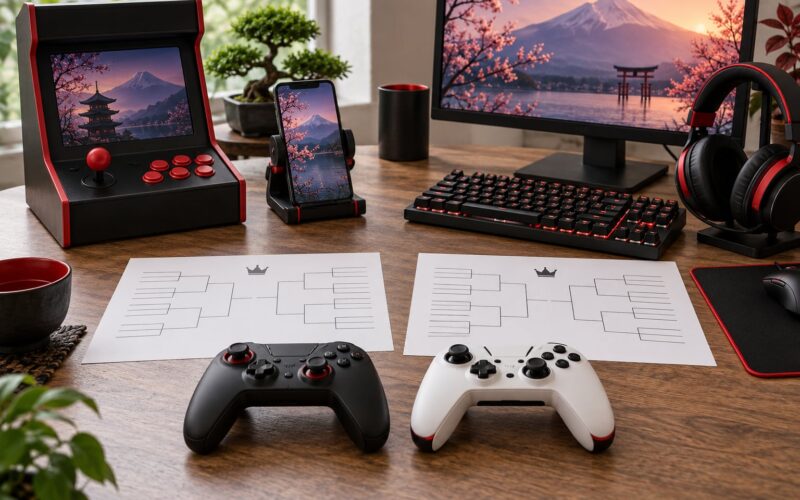
- A weekly ranbat. A ranbat is a recurring local tournament held on a fixed night, so the same opponents show up every week.
- Senpai and kohai mentorship. A senior player takes a newcomer under their wing, teaches specific habits, and introduces them around.
- Matchup notes and frame data used selectively. Data is written down for the handful of situations it actually decides, not memorised for its own sake.
- Review after every session. Players replay their recorded games, find the repeated mistake, and carry one fix into the next week.
Table of Contents
- 1What You Need
- 2Step-by-Step: Build a Japanese-Style Fighting Game Practice Routine
- 3Step 1: Choose a Dojo, Arcade, or Local Scene
- 4Step 2: Learn How Japanese Fighting Game Communities Train Fundamentals
- 5Step 3: Run Focused Solo Drills
- 6Step 4: Get Feedback and Practice Meaningful Sparring
- 7Step 5: Review Matches and Study the Meta
- 8Step 6: Enter Local Brackets and Study the Scene
- 9Step 7: Review Progress Every Month
- 10Common Mistakes
- 11Training Tips for Faster Improvement
- 12Frequently Asked Questions
- 13Do I need to visit Japan to learn from its fighting game community?
- 14How many hours a week should I train to improve at a fighting game?
- 15Should beginner players learn one character or several?
- 16What is the most useful way to review fighting game matches?
- 17How can international players find Japanese-style dojos and communities?
- 18Is tournament experience necessary to improve competitively?
- 19Conclusion
What You Need
You need four things before a structured routine makes sense: the game and version your scene plays, a training setup that can record and replay, access to regular human opponents, and a way to keep records. Physical conditioning matters more than most beginners expect, because fighting games are played standing up for hours.
Start with the game version your local scene runs. In Japan, arcade and home versions can differ, so confirm which one the group is playing before you buy anything or download anything.
For equipment, an arcade stick with a leverless layout is the common choice for new players because it lowers the input burden. Hitboxes and standard levers both work, and experienced players often own more than one. Whatever you use, the practical requirement is that it lets you reach every button reliably and quickly, because inputs you cannot hit are inputs you cannot drill.
Training features matter more than hardware once you have a stick. You want training mode that records dummy behaviour, replays inputs, shows frame data and hitboxes, and saves your positions so you can re-test a situation in seconds. Most modern titles ship with all of it.
Community access is the hard requirement. Ask a regular what a month of training there actually looks like, and compare it against the pattern above: a fixed night, the same opponents, and someone reviewing your games with you afterwards. Look for a weekly local event rather than a monthly tournament, because improvement in this genre comes from frequency of contact with opponents, not volume of solo play.
Keep three records: a match log with the date, opponent and result, a short note on what you are currently working on, and a monthly snapshot of your win rate against the opponents you meet most often. Notes on paper or in a phone file work fine.
Step-by-Step: Build a Japanese-Style Fighting Game Practice Routine
A workable routine moves in one direction. You fix fundamentals, drill them in isolation, test them against people, review what went wrong, compete, and repeat on a schedule. Skipping a stage does not save time; it just moves the failure somewhere you cannot see it.
Step 1: Choose a Dojo, Arcade, or Local Scene
Find a scene that meets on a fixed schedule and confirm it plays your game before you travel. In Japan that usually means a game center hosting a weekly ranbat; outside Japan, look for a local league, a university club, or a dedicated arcade that runs the same title every week.
Introduce yourself in person and say which character you play and roughly how long you have been at it. That one sentence tells the regulars how to pair you, which is the only thing that matters in the first month.
Watch before you join. Note when the queue forms, whether people announce sets, how long a set runs before rotation, and how someone bows out when they need to leave. Reading the room takes twenty minutes and saves you an awkward first hour. It is also the fastest way to see how Japanese fighting game communities train newcomers in practice, since the onboarding is built into the queue rather than explained to you separately.
You will know the step worked when someone invites you into a set without being asked twice. That is the point at which the scene starts investing in you.
Step 2: Learn How Japanese Fighting Game Communities Train Fundamentals
Japanese communities drill a small set of fundamentals relentlessly before anything game-specific: footsies and spacing, timing around frame advantage, resource management, and the punish game. Memorised combos come later, and they come from these basics rather than replacing them.
Footsies means using your fastest, longest-reaching normals to control space. Spacing is the discipline of staying at the edge of your opponent’s best range. Timing is knowing which moves you can act on recovery and which you cannot. Resource management covers meter, drive or burst gauges, throws, and the option to walk out of pressure. The punish game is knowing, move by move, what your opponent does on block and on hit that you can take advantage of.
The reason fundamentals come first is that they transfer. A combo route for one character dies the moment the patch changes. Spacing knowledge survives a patch, a new opponent, and a new tournament.
Check the step by playing ten games against a stronger player and naming the same problem in at least half of them. If you cannot name it, that is the first thing to fix.
Step 3: Run Focused Solo Drills
Solo practice works when every session has one objective and a pass condition. Vague half-hours of button mashing produce nothing you can point to later.
A repeatable drill looks like this: pick one situation, such as escaping pressure after a blocked heavy attack, set the dummy to record, repeat it thirty times, and pass when you succeed twenty-eight times without a gap. Move on the next day, not after five more failures.
A practical week looks like this. Two sessions of thirty minutes on execution drills, one session of forty-five minutes on matchup practice against the character you face most, and one short session reviewing notes. Total time is around two and a half hours, and it is more productive than four hours of unstructured play.
Record the pass or fail outcome each session. That log is what makes step 7 possible and it tells you whether you are improving or just getting comfortable.
Step 4: Get Feedback and Practice Meaningful Sparring
Feedback only helps when the question is specific. Vague requests such as “any tips?” get you nothing, while “which of my jump-ins do you find hardest to punish?” gets you information you can act on. That one habit is where how Japanese fighting game communities train diverges most from a private practice room.
Rotate sparring partners rather than playing the same person every session. The regulars are comfortable and helpful, but a different opponent exposes a different set of gaps. Ask two people to watch the same match and note where their answers differ.
Treat each set as a problem rather than a scoreboard. Win or lose is weak information; getting caught in the same corner position three times in a row is useful information. Write the position down before you play the rematch.
Notice whether people actually give you room to learn. A healthy scene lets a newcomer take a set slowly, and it lets a stronger player ask for a rematch instead of quietly leaving. If nobody ever asks you back, the scene is not training you.
Step 5: Review Matches and Study the Meta
Review is where theory becomes usable. Record your sets, watch them back at slow speed, and mark every moment you lost because of a decision you have seen yourself make before.
Three categories are worth tagging: repeated mechanical failures, such as dropping a combo you can do in training mode, situational failures, such as pressing block in a known gap, and blind spots, which are situations you did not know were dangerous. The third category pays the most.
Study the meta by watching tournament footage of the characters you play, but read it as evidence, not instruction. Ask what the player is punishing and which resource they spent to get it. Copying a top player’s sequence without understanding its condition is how you end up unusable in your own bracket.
Your review queue at the end of a session should be two items, no more. A longer list never gets done.
Step 6: Enter Local Brackets and Study the Scene
Competing is a measurement tool. Local brackets tell you what your training has actually produced, and the people you meet there are the people who will be in front of you next month.
Start with casual formats and small brackets. Watch the whole event, not just your own matches, and note the players who keep making the same mistake you do. Sit down with someone at your level afterwards and compare notes; this post-event conversation is often more useful than the bracket result itself.
Enter larger Japanese tournaments or their major events once you are losing in the round before, not the round after. You want a bracket that stresses your current level rather than one that removes you in pool play.
Feed the result back into training. Losing to one character repeatedly in the first two rounds means a matchup note, not a new character.
Step 7: Review Progress Every Month
Monthly review is what keeps a routine from drifting into comfort. Score five areas from one to five, and do it on the same day each month so the comparison is fair.
- Execution: combo routes and punishes you land consistently under pressure.
- Decisions: how often you chose a safe option instead of guessing.
- Adaptation: how quickly you stopped losing the same matchup after noting it.
- Attendance: sessions attended and sparring partners met.
- Recovery: whether your hands, joints and sleep held up under the load.
Keep what scored well, change what scored low, and pick one priority for the coming month. One priority. Three priorities means none of them get real practice time.
If your win rate against your most frequent opponent has not moved in two months, the honest conclusion is that your training is not addressing it. That is a programme problem, not a talent problem.
Common Mistakes
The failures below are shared across scenes, and each has a straightforward correction.
Overtraining without recording. Hours without a log, a recorded set or a pass condition produce a feeling of progress. Record one set per session and watch it back.
Learning several characters at once. Depth in one character beats shallow knowledge of three. Pick one until the fundamentals are automatic, then widen.
Chasing combos before fundamentals. If you cannot space or block, extra combo routes will not appear in matches. Fix the defensive basics first.
Asking vague questions. Ask what a specific move did to you, not how you played. One pointed question per set is plenty.
Copying pro play without conditions. A professional route depends on meter, position and opponent behaviour that you may not have. Learn the reason, not the input order.
Ignoring matchup records. The opponent you lose to most is your curriculum. Keep a note on each of those matchups and drill them deliberately.
Skipping the warm-up. Standing, wrist and shoulder preparation before a session prevents the injuries that end careers quietly. Five minutes is enough.
Comparing yourself to the wrong benchmark. Progress is measured against your own log from a month ago. Rank is a side effect of that, not the target.
Training Tips for Faster Improvement
Set one weekly training target you can name, such as landing a punish twenty times in a row, rather than a vague goal. Schedule deliberate rest days, because fatigue is the main reason a session stops producing information.
Ask better questions, vary your sparring partners, and record results before and after a change so you know whether the change worked. Most of all, keep relationships with stronger players friendly; in a small scene, the person who invites you back next week matters more than the person who corrects you today.
Frequently Asked Questions
Do I need to visit Japan to learn from its fighting game community?
No. The structure is reproducible anywhere: a fixed weekly night, a queueing system for whoever is available, a habit of reviewing recorded games, and a senior player who takes newcomers under their wing. Venues and cabinet quality differ, but the training loop does not. Many scenes outside Japan run this exact format for free, and the terms translate directly.
How many hours a week should I train to improve at a fighting game?
Around five to eight focused hours a week is a realistic range for steady competitive progress. Two or three of those hours are more valuable spent on live opponents than in solo training. If you can only manage three hours, put two of them into sparring and keep the rest for drills. Consistency across months matters far more than any single long session.
Should beginner players learn one character or several?
One character, for long enough that its movement, ranges and punish game feel automatic. Most strong players picked their main after around thirty matches rather than by studying a tier list. Once you can block, space and punish reliably with that character, adding a second is quick. Switching early usually means restarting fundamentals repeatedly instead of deepening them.
What is the most useful way to review fighting game matches?
Record your own sets and watch them back slowly, tagging the same three categories every time: mechanical drops, situational errors such as blocking in a known gap, and blind spots you did not know existed. Watch tournament footage second, and only to understand what a player punishes and what it costs them. Review works when it ends with a two-item list you will actually drill.
How can international players find Japanese-style dojos and communities?
Look for a venue that runs one title on a fixed weekly schedule, since a dedicated scene matters more than the size of the town. Local arcade leagues, university clubs and online communities that host scheduled fight nights all reproduce the same training loop. Introduce yourself in person, name your character and experience level, and ask when the next regular session is.
Is tournament experience necessary to improve competitively?
Not strictly, but bracket play is the cleanest measurement of whether your training is working, because it removes the comfort of your usual sparring partners. Enter small local events early rather than waiting until you feel ready. What matters most is showing up regularly, watching the whole event, and comparing notes with other players afterwards.
Conclusion
Begin with three commitments: one character, one fundamental, and one weekly sparring slot you protect every week. Everything else, the drills, the review queue, the monthly scorecard, adds itself to that base once the habit exists.
The reason how Japanese fighting game communities train works is not any single drill. It is that the schedule, the queue and the review conversation are all built around showing up in the same room with people who will remember you next week.