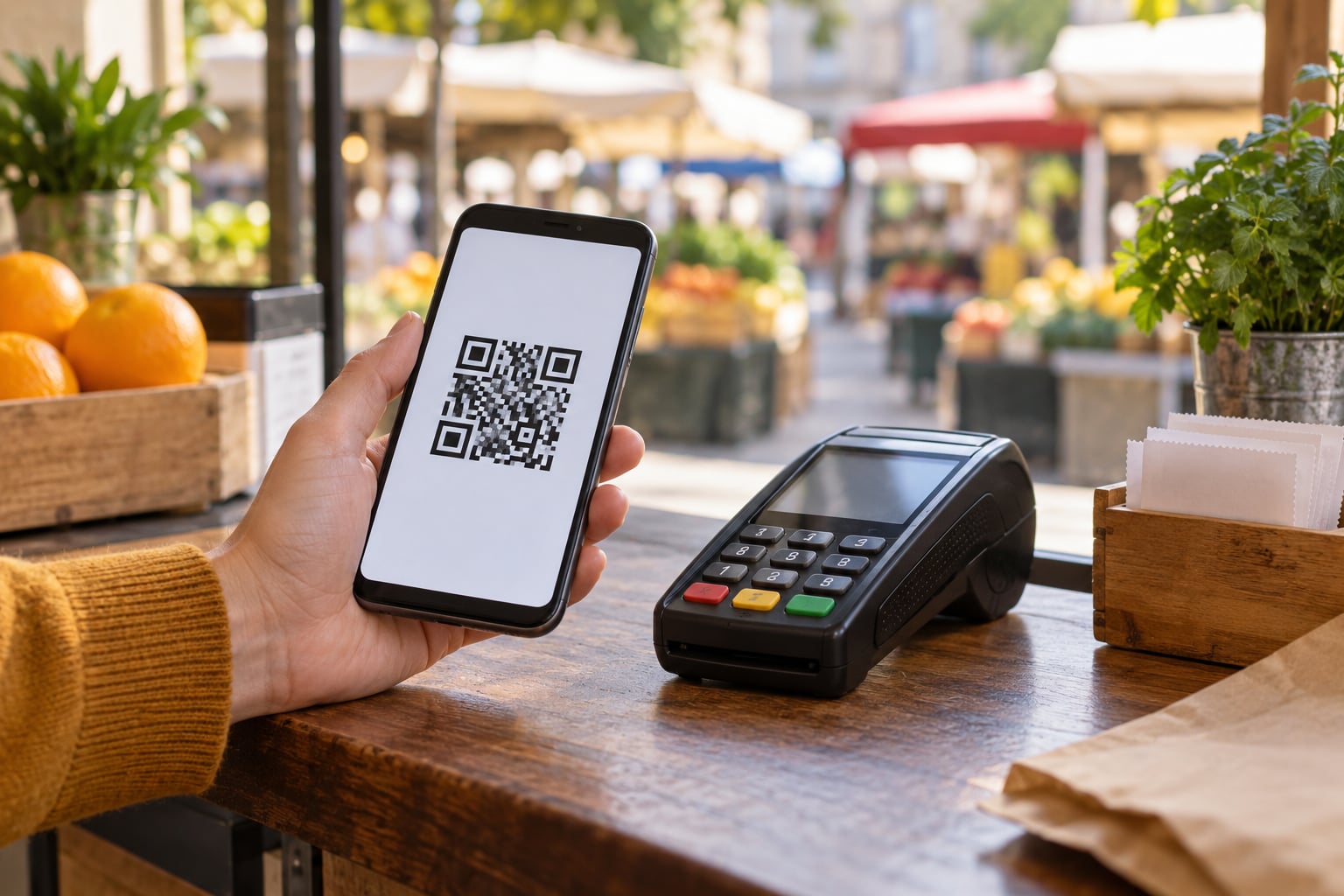
QR code payments spread quickly across much of Asia because merchants could accept digital payments with nothing more than a printed code, consumers already had the app in their pocket, and the money moved instantly between accounts. No card terminal, no new hardware, no change-making. Add heavily promoted national schemes and super apps that pay for everything from noodles to buses, and adoption stopped being a payment story and became everyday infrastructure.
The honest caveat is that “Asia” is not one market. China built a merchant-presented super-app economy, South Korea rolled out consumer codes early, Singapore and Hong Kong went merchant-first, and Japan still leans on cash. What follows is the shared pattern, then where each market diverged.
Table of Contents
- 1Why QR Code Payments Spread Quickly in Asia
- 2What Are QR Code Payments?
- 3How QR Code Payments Became Easy to Use
- 4Why QR Code Payments Spread Quickly in Asia: The Main Drivers
- 5Smartphones and Reliable Digital Infrastructure
- 6Digital Wallets and Trusted Local Platforms
- 7Low Fees for Small Transactions
- 8Merchants, Apps, and Everyday Use Cases
- 9How Different Asian Markets Took Different Paths
- 10What Helped QR Payments in China and South Korea
- 11What Changed the QR Payments Story Elsewhere in Asia
- 12Why QR Payment Adoption Was Not Uniform
- 13What Could Slow QR Payments Next?
- 14Frequently Asked Questions
- 15Why did Asia adopt QR payments faster than many other regions?
- 16Did every Asian country experience rapid QR payment adoption?
- 17Are QR code payments more secure than credit and debit cards?
- 18Why did QR payments spread faster among merchants in some countries?
- 19Can tourists use QR payments in Asia without a local bank account?
- 20Will QR payments eventually replace cash and cards in Asia?
- 21Conclusion
Why QR Code Payments Spread Quickly in Asia
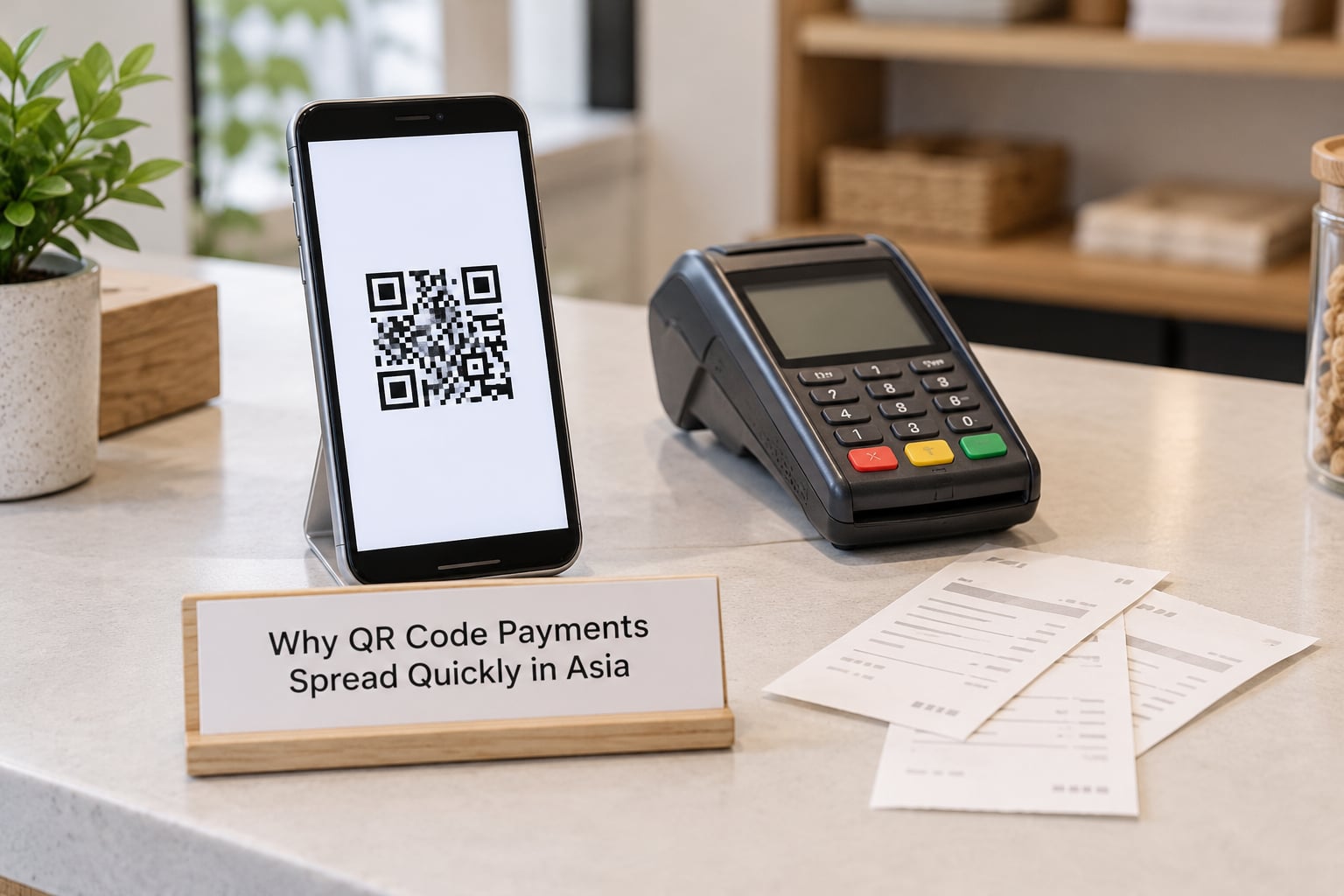
Six things reinforced each other, and no single one of them would have been enough. Cheap acceptance on the merchant side. Near-universal smartphone ownership. Wallets that consumers already used for other things. Instant account-to-account rails behind the code. Subsidised fees and reward programmes. And use cases that reached into transit, parking and street food.
Juniper Research put Asia-Pacific QR payment value at roughly 290 billion dollars in 2025, growing toward 1.2 trillion dollars by 2029 — about 300 percent, and at roughly twice the rate of Europe and North America. Grand View Research separately forecast Asia-Pacific QR code payment revenue near 18.9 billion dollars by 2033.
Growth has been fastest in Vietnam, Indonesia and the Philippines, according to Juniper. Those are also the markets where the transaction itself is small, which matters more than any later section explains.
What Are QR Code Payments?
QR code payments are scan-to-pay transactions. No card touches a terminal. A customer either scans a code the merchant displays or presents a code from their own phone, then confirms the amount.
The static version is a single printed code tied to one merchant account. It never changes, which suits a market stall or a hawker cart. The dynamic version is generated per transaction and can carry an amount, an order number or a loyalty identifier, which is what most modern checkout flows use.
Merchant-presented means the shop shows the code. Customer-presented means the payer shows it, useful for queues where one cashier scans several phones quickly. Both use the same EMV-compatible standards.
Here is the part people miss: the QR code is only the interface. The money moves on instant payment rails behind it, account to account, settling in seconds around the clock. Swap a printed code for a different interface and very little else changes.
How QR Code Payments Became Easy to Use
Account-based wallets did the heavy lifting. Once a bank account sits behind the app, a physical card stops being the product — the login is. That removed three separate barriers at once.
- No card to issue. Merchants who wanted digital acceptance did not need to think about card stock, embossing or replacement.
- No terminal to buy. A printed sheet of stickers cost a fraction of a point-of-sale unit and can be updated in an afternoon.
- No integration project. Small shops could join by printing a code from a banking app, not by signing a contract with an acquirer.
That last point is why the payment reached places card rails never did. A market vendor does not run an IT department, and never needed one.
Why QR Code Payments Spread Quickly in Asia: The Main Drivers
Here is the argument in one table. Rank them by how often they turn out to be the binding constraint rather than by any universal Asian ranking.
| Driver | What it changed | Relative weight |
|---|---|---|
| Merchant cost | Acceptance for near-zero hardware cost and low merchant discount rates | Highest in markets with tiny ticket sizes |
| Wallet adoption | Payments moved inside apps people already opened daily | Very high in China, South Korea, Singapore |
| Instant rails | Account-to-account transfers settled in seconds, 24/7 | High — the code is useless without it |
| Interoperability | One code accepted every participating wallet and bank | High where regulators pushed it, uneven elsewhere |
| User experience | Open app, scan, confirm — no behaviour change required | High, and cheap to copy |
| Platform integration | Wallets embedded in ride-hailing, delivery and retail apps | High in Southeast Asia |
| Policy and market conditions | Central bank promotion, cash-handling costs, thin card penetration | Varied sharply by country |
Read across the rows and one thing stands out: the last driver is the only one that cannot be copied by an app company working alone.
Smartphones and Reliable Digital Infrastructure
A QR payment needs two things before anything else: a device with a camera and a wallet app, and a network path to move the money. Much of Asia cleared both bars earlier and more widely than other regions.
By the mid-2010s, affordable Android handsets had pushed smartphone ownership past the point where a phone was a normal purchase rather than a status item. Native camera apps began treating QR codes as a target rather than a picture, so scanning stopped feeling like a separate skill.
On the infrastructure side, several Asian markets had limited legacy card penetration and thin ATM coverage outside city centres. Building acceptance on phones and account transfers filled a gap that cash had been filling by default.
Plenty of Asian e-payment systems grew out of transit-card infrastructure rather than the other way round. That history shows up in the UX: stored-value habits, tap-and-go thinking and top-up norms that predate QR entirely.
Digital Wallets and Trusted Local Platforms
Most payment methods need a decision. QR adoption in Asia often avoided that decision, because the app was not new.
When Alipay and WeChat Pay became super apps in China, they brought users, merchants, banks, loyalty programmes, bill payment and transport into one familiar screen. A QR transaction inside that app required no new habit. The same pattern shows up across Southeast Asia, where ride-hailing and delivery platforms became payment distribution channels and drivers carried wallets to places traditional banking never reached.
Trust follows concentration. Users trust instant rails when the fee is transparent and low, and fee-free domestic transfers are the single strongest trust signal in the region. When one widely used wallet sits between a person and their money, people stop comparing options.
People also notice when something works under pressure. Reliability during market queues, lunch rushes and delivery peaks builds habit faster than any reward programme.
Low Fees for Small Transactions
Card economics are brutal on a small purchase. Interchange, scheme fees, terminal cost and a per-transaction minimum all have to come out of an amount that might be one or two dollars.
Account-to-account transfers dodge most of that. There is no card scheme in the chain, no terminal to amortise, and settlement happens in real time rather than at the end of a batch cycle. The result is a merchant discount rate that a stall owner can actually live with.
Merchant fee sensitivity is the real competitive battleground here, not a footnote. Where card processing runs into the low single digits of turnover, QR looks almost free by comparison — which is why the method spread fastest exactly where cards were weakest.
Savings varied by country, provider and transaction type, and per-transaction caps still bite in places. But the direction was consistent enough to redirect enormous volumes of small-ticket commerce.
Merchants, Apps, and Everyday Use Cases
Adoption compounds when the same code serves a queue, a kitchen and a car park. Here is where QR payments stopped being a payment method and became background plumbing.
- Street food and markets. A hawker prints a sheet of stickers, takes any transfer instantly and skips the cash float, the change-making and the run to the bank.
- Transport and tolls. Scanning at gates removes cash handling from stations that would otherwise need staff and safe boxes.
- Parking. License-plate-linked codes turn a barrier and a lost ticket into a single scan.
- Bill splitting. One app handles a restaurant bill among friends without anyone calculating who owes what.
- Remittances and utilities. Transfers work where branches do not, so the same tool serves family support and bill payment.
- In-app checkout. Delivery, ride-hailing and marketplace payments ride inside apps, where the wallet was already open.
Take a typical weekday in Bangkok or Jakarta. Coffee, a bus ride, a bowl of noodles, a top-up for a motorbike ride, a grocery run — same app, same code, five times before lunch.
That frequency is the mechanism. Each use is a small time saving, but stacked across a day it changes how someone thinks about paying. Asia did not ban cash to get here. Convenience did the work, which is also why the change proved so hard to reverse.
How Different Asian Markets Took Different Paths
The same technology produced very different systems. Naming the schemes matters, because “Southeast Asia” hides more than it explains.
| Market | Scheme | Direction | What shaped it |
|---|---|---|---|
| China | Alipay, WeChat Pay, Alipay+ | Merchant-presented | Super apps absorbed payments into everyday apps |
| South Korea | KakaoPay, Samsung Pay, local banks | Consumer-presented | Early consumer rollout of personal codes |
| Singapore | PayNow (NETS) | Both | Central bank coordination and a small, dense market |
| Thailand | PromptPay (Bank of Thailand) | Both | Bank of Thailand promotion across provinces |
| Indonesia | QRIS (Bank Indonesia) | Both | Mandated national standard across banks and fintechs |
| Malaysia | DuitNow QR | Both | Interoperable rails covering banks and e-wallets |
| Philippines | QR Ph (BSP) plus InstaPay | Both | Instant rails paired with merchant push and incentives |
| Vietnam | VietQR via NAPAS, plus MoMo, ZaloPay | Both | Rapid wallet growth, roughly 90 million VietQR accounts |
| Hong Kong | FPS with code scanning | Both | Wallet-led, subsidy-supported adoption |
| India | UPI | Both | Bank-led real-time rails, free for most users |
| Japan | PayPay, various regional schemes | Merchant-presented | Late rollout, cash still dominant, many competing codes |
Two cross-border linkages show how far this went. PromptPay and PayNow are connected, with per-transaction limits of roughly 700 Singapore dollars in place to keep the corridor from becoming a value-transfer channel. China and Indonesia linked their payment systems for travellers, and Alipay+ extended that reach further.
What Helped QR Payments in China and South Korea
China started with the merchant. A static code pasted to a counter turns any shop into a payee, and two enormous apps pushed that outward until QR became the default for anyone holding a phone. The merchant orientation meant acceptance spread through businesses first.
South Korea flipped the direction. Consumers adopted personal QR codes early and presented them in shops and between friends, so habit formed on the payer side before acceptance caught up. Vietnam, Thailand and Indonesia later chose interoperability — every participating bank and wallet able to read the same code — because fragmented wallets were fragmenting the market.
What Changed the QR Payments Story Elsewhere in Asia
Japan is the counter-case worth dwelling on. It invented the QR code at Denso Wave in 1994, developed by Masahiro Hara, and still leans on cash more than any of its neighbours. Card and cash habits were already deeply embedded, terminals were cheaper there than in much of the region, and multiple competing merchant codes eventually diluted the network effect. The technology came from Japan; the payment revolution largely did not.
Singapore and Hong Kong went the other way. Small, dense, with a coordinating central bank in Singapore’s case and heavy wallet subsidy support in Hong Kong’s, both pushed merchants rather than consumers.
India took a different route again, building UPI on bank-led real-time rails that stayed free for most users. It became the dominant way to pay day to day, with cards left in a niche role. Southeast Asian growth markets such as Vietnam and the Philippines layered instant rails, wallet competition and merchant incentives on top of the same QR interface.
Why QR Payment Adoption Was Not Uniform
The “cashless Asia” story is too tidy. Several things slowed or bent adoption.
Merchant fee resistance. Fees matter when margins are thin, and a vendor weighing a small percentage against immediate cash will sometimes pick cash.
Habitual refusal. On Hacker News, users in multiple markets describe vendors citing “no signal” or “app not working” as a standing excuse to decline a code, long after connectivity improved. Trust does not update as fast as infrastructure.
Cash preference for privacy and tax reasons. A persistent minority wants a payment that leaves less of a trail. That is a rational preference, and any account of Asia that ignores it is describing half the region.
Fragmented systems. Where several incompatible codes compete, every merchant joins a different network and consumers cannot rely on their own app.
Limits and low ticket sizes. Per-transaction caps still constrain some transfers, and where the average purchase is tiny, per-payment friction matters more than fee percentage.
Cash held the value. In some markets cash remained dominant by value even as QR dominated by transaction count. A long-term resident of Vietnam reported in 2023 that cash was still the most common payment method, with regular bank transfers the leading digital option. That gap between count and value is still visible across the region.
What Could Slow QR Payments Next?
Adoption is a solved problem in the markets that moved fastest. The remaining constraints are harder.
Interoperability outside borders. Domestic linkage is largely done. Cross-border QR still runs on bilateral agreements and limits rather than a single global standard, and travellers hit it immediately.
Security. The consumer warnings that circulate about QR codes — including guidance from US law enforcement about fake codes pasted over real ones and payment-screen manipulation — target the one vulnerability a static sticker has. If confidence slips, habit slips with it.
Recurring payments. Merchant-presented QR works well for one-off purchases and poorly for subscriptions. Card and direct debit keep that ground.
Wallet competition. Where several wallets coexist without a national standard, merchant effort multiplies and users hesitate.
Contactless and account tapping. Where terminal infrastructure is dense and cheap, NFC keeps an edge on speed. In much of Asia the infrastructure argument still favours QR, but that gap narrows as handsets get better at bank-card-free payments.
Phone migration. Change device, lose the registered app, lose access. It sounds minor until it is your money.
Frequently Asked Questions
Why did Asia adopt QR payments faster than many other regions?
Mostly because the economics worked at the smallest ticket sizes. Account-to-account transfers carry lower processing costs than card rails, so a stall owner or noodle shop could accept digital payments without buying a terminal. Consumers already had smartphones and wallets, and central banks pushed interoperable national schemes so one code worked across banks and apps.
Did every Asian country experience rapid QR payment adoption?
No. China, South Korea, Singapore, Thailand, Indonesia, Vietnam and the Philippines moved quickly, each on a different model. Japan remains notably cash-heavy despite inventing the QR code, and adoption elsewhere has been uneven by region and by ticket size. Where cash still dominates by value, counting transactions gives a misleading picture.
Are QR code payments more secure than credit and debit cards?
It depends on where the risk sits. A transfer cannot be reversed by a cloned card, and dynamic codes expire. But a static code printed on a counter can be swapped for a fraudulent one, and payment screens can be manipulated. Security guidance from US law enforcement warns about exactly this. Check the merchant name and amount on your screen before confirming.
Why did QR payments spread faster among merchants in some countries?
Because acceptance was nearly free. Merchants needed a printed code, not hardware, and the fee on a small transaction came out far lower than card processing. Coordinated national schemes mattered just as much: when one code worked across every participating bank and wallet, adopting it meant no integration project and no new supplier relationship.
Can tourists use QR payments in Asia without a local bank account?
Increasingly yes, but not everywhere. Cross-border linkages such as PromptPay and PayNow, and the China-Indonesia corridor, let visitors pay from wallets they already have. Several domestic schemes still assume a locally registered account, so check before you travel. Binding a foreign card to a local wallet is the practical workaround where it is offered.
Will QR payments eventually replace cash and cards in Asia?
Cash will not disappear, because a minority of users still want payments that leave less of a trace and some transactions need cash at hand. Cards keep the recurring-payment and credit segments. What is likely is a quieter outcome: QR stops being noticed as a separate method and becomes one option inside a wallet that already handles everything else.
Conclusion
QR code payments spread across Asia because five things held together: wallets people already used, infrastructure that moved money instantly, transfers cheap enough for a two-dollar purchase, merchant acceptance that cost nothing to add, and everyday use cases that repeated dozens of times a day. Remove any one of them and the pace drops sharply.
The first thing to check in any market is narrow and practical. Is there one trusted wallet that both consumers and local merchants can reach without a local bank account or new hardware? If there is not, none of the other advantages matter, and that explains a good deal of why adoption elsewhere has been slower.