Japanese loyalty point ecosystems are networks of point programs owned by large business groups, where the points you earn at a convenience store, drugstore, phone plan or online shop can often be spent somewhere else in the same group. Unlike a Western airline-style tiered program, there are usually no status levels to climb. What you manage instead is an earn rate, a redemption value and an expiry date.
Most people in Japan already hold several of these programs without thinking about them, because the biggest ones attach themselves to a mobile phone plan. Below is how the system actually works, who owns each piece, and where the value quietly leaks out.
Table of Contents
- 1What Are Japanese Loyalty Point Ecosystems?
- 2Why Japanese consumers run into so many programs
- 3How Do Japanese Loyalty Point Ecosystems Work?
- 4Step 1: Enrol in the program that matches your spending
- 5Step 2: Earn points at the normal rate, then the campaign rate
- 6Step 3: Identify who actually issued the points
- 7Step 4: Transfer or pool points where the network allows
- 8Step 5: Redeem
- 9Step 6: Watch the expiry, because it is the real deadline
- 10Japanese loyalty point programs compared
- 11Why Do Japanese Businesses Join These Systems?
- 12Which Types of Points Can Readers Use?
- 13Retailer and convenience store points
- 14App-based and walking points (ポイ活)
- 15Payment-linked and carrier points
- 16Transport, airline and civic points
- 17How Do Points Expire, and What Restrictions Apply?
- 18What changed recently in Japan’s point programs
- 19How Japanese points differ from Western loyalty programs
- 20Can foreigners and tourists enrol in Japanese loyalty programs?
- 21Are Japanese Loyalty Points Safe and Worth Using?
- 22Frequently Asked Questions
- 23Can foreigners use Japanese loyalty points?
- 24Are Japanese loyalty points interchangeable?
- 25Do Japanese loyalty points expire?
- 26Can I transfer points between Japanese apps?
- 27What is the minimum value for redeeming Japanese loyalty points?
- 28Do Japanese loyalty programs require a Japanese phone number?
- 29Conclusion
What Are Japanese Loyalty Point Ecosystems?
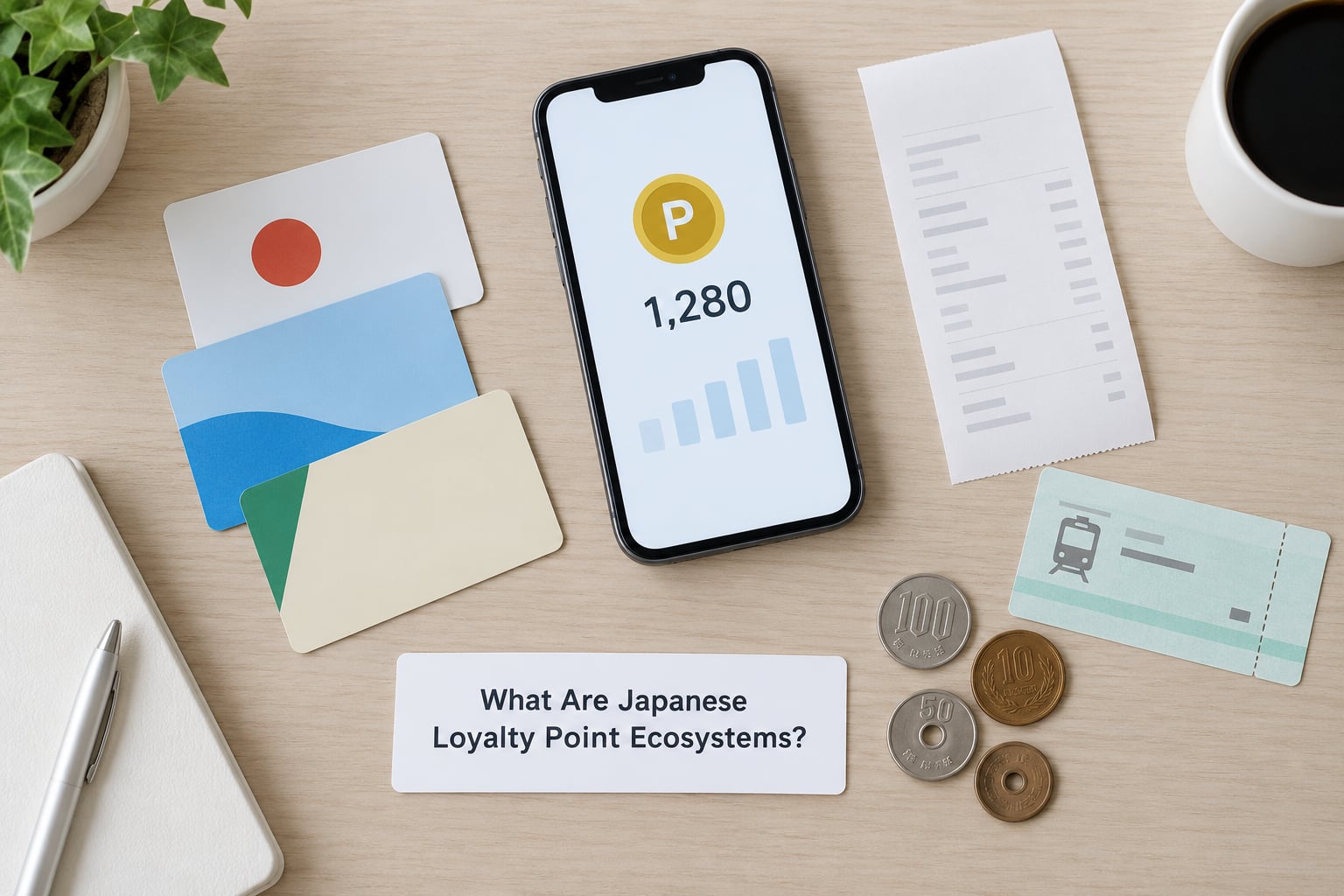
A loyalty point ecosystem is a set of point programs that share an owner, share a payment rail, or have a conversion path between them. One program alone is just a rewards card. An ecosystem means a single balance can move through several businesses.
Japan splits point cards into two families. Original point cards (店舗独自ポイント) are private to a single chain and cannot leave it. Common point cards (共通ポイント) belong to a group with many partners, so the same balance works across hundreds of stores and online services.
The distinction matters more than anything else in this article. A drugstore’s private points die in that drugstore. A major group program usually does not.
Why Japanese consumers run into so many programs
Convenience stores are the reason. The konbini network is so dense that a single trip can involve three or four different owners, each with its own app. Add a phone bill, a train card and an online shop, and six or seven active programs is normal for a heavy shopper.
For founders and marketers, this is the structural insight: Japan has no dominant single program the way a national supermarket chain dominates elsewhere. It has six or seven large ones, each walled off but leaking into neighbours through conversions.
How Do Japanese Loyalty Point Ecosystems Work?
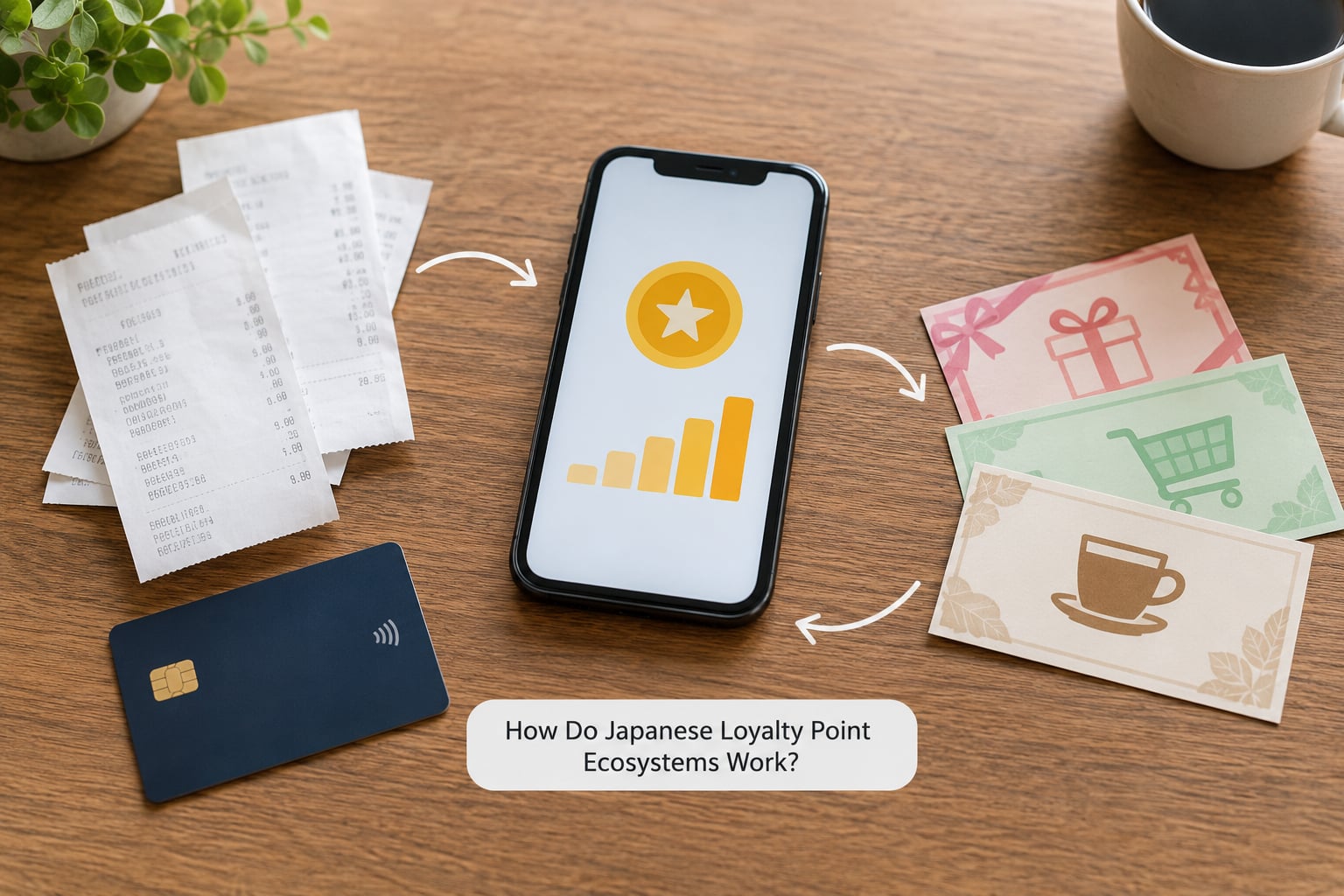
How Japanese loyalty point ecosystems work is straightforward once you separate three levers: how many points a purchase earns, what one point is worth when redeemed, and when the balance dies. Every program in Japan runs on those three numbers, and almost every confusion comes from ignoring the third one.
The mechanics run in six steps.
Step 1: Enrol in the program that matches your spending
Most people start with their mobile carrier. A phone plan generates a recurring monthly transaction, which makes it the easiest place to accumulate a balance that does not expire as fast as a one-off shop. SoftwareBank and NTT Docomo customers, for example, sit inside entirely different point groups.
Step 2: Earn points at the normal rate, then the campaign rate
Base rates are modest. Japanese programs typically credit one point per 100 yen at a convenience store, and often one point per 200 yen at supermarkets and drugstores. Campaign rates change that: 倍 (bai) means multiplier, and a 倍 campaign turns the base rate into double or triple.
Campaigns are scheduled, not random. Rakuten-style programs run point-up days on specific weekdays, often days ending in 5 or 0, and larger shopping marathons stack multiple rates on one date. Checking the campaign calendar before a large purchase is the single highest-return habit in this system.
Step 3: Identify who actually issued the points
This is where beginners lose value. A balance sitting in one app cannot be spent in another app’s network unless a conversion path exists. Read the program’s owner before assuming your points travel.
Step 4: Transfer or pool points where the network allows
Common point programs can often convert a balance into another program inside the same group, sometimes at a reduced rate. Points earned for activities that never touch a receipt (walking apps, surveys, referral campaigns) are often issued as limited-use points, which usually cannot be converted further.
Step 5: Redeem
Redemption options usually include discounts at partner stores, electronic gift cards, prepaid electronic money, mobile bill credits paid with points (ポイント払いで), and in some programs airline mileage.
Step 6: Watch the expiry, because it is the real deadline
Unused points expire on a schedule fixed by the program, not by you. This is the difference between a Japan point system and a Western one, and it is discussed in detail further down.
Japanese loyalty point programs compared
Here is the whole system on one page. The parent company column is the one most English guides leave out, and it explains most of the surprising behaviours.
| Program | Parent group | Typical base earn | Where points work | Airline mileage path |
|---|---|---|---|---|
| Rakuten points (楽天ポイント) | Rakuten Group | 1 point per 100 yen on group services | E-commerce, travel, mobile, streaming, partner shops | Yes, to ANA and JAL mileage |
| PayPay points | SoftBank group | Payment- and app-linked, rate varies by usage | PayPay app, SoftBank services, online shops | Yes, to ANA and JAL mileage |
| dポイント | NTT Docomo | Varies by service and partner | Docomo services, partner shops, gift cards | Yes, commonly 1,000 d-points to 500 miles |
| Ponta points | Loyalty Marketing / Lawson | 1 point per 200 yen typical | Lawson stores, FamilyMart, shared partner network | Yes, often 2 points to 1 JAL mile via JMB x Ponta |
| V points / nanaco | Seven & i group | 1 point per 200 yen typical | 7-Eleven, grocery, restaurants within the group | No direct mileage path |
| WAON points | AEON group | Varies by service | AEON stores, drugstores, group services | No direct mileage path |
| JRE POINT | JR East | Earned through travel and linked services | JR East travel, retail, partner services | No direct mileage path |
Two housekeeping notes on the table. Rates change with campaigns, so treat the earn column as a baseline rather than a promise. And the mileage column is where programs differ most, with only some offering a real conversion.
Why Do Japanese Businesses Join These Systems?
Because a merchant joining a common point program is buying traffic, not giving away margin. The group owner pays for the reward, and the merchant gets a reason for a customer to come back next week with the app open.
The business case runs on a few repeatable mechanics. Repeat visits come first, since a stored-value balance and a saved payment method both shorten the path back. Customer acquisition comes next, because a shared program lets a small chain reach an audience that already trusts a bigger brand’s points.
App distribution matters more here than almost anywhere else. Cash is still common at smaller merchants, so the app is frequently the only digital channel a chain has. Owning a popular points app gets that channel for free.
Cross-promotion is the quiet win. When a point program owns a shopping app, an airline and a streaming service, a discount on one becomes advertising for the others, funded by the discount itself. Rakuten is the clearest case, with the same balance usable across telecom, e-commerce, travel and media.
Data partnerships are the part readers ask about least and marketers most. Membership data reveals what a household buys, how often and through which channel. In practice that data stays with the group operator and is used for targeting and partner negotiation.
The difference between a genuine network and a merchant’s private program is simple to test: ask whether the points can leave. If the answer is no, it is a marketing line item, not an ecosystem.
Which Types of Points Can Readers Use?
Points fall into a handful of types, and the type decides what you can do with them. Retailer and group programs reward shopping. App-based programs reward behaviour. Payment-linked and carrier programs reward the bill. Transport and airline programs reward travel.
Retailer and convenience store points
These are the most visible in daily life. Each major convenience store chain sits inside a different group, which is why a wallet of konbini points is not one balance but several.
| Store type | Program to look for |
|---|---|
| 7-Eleven | V points |
| Lawson | Ponta points |
| FamilyMart | Ponta points |
| Supermarket and drugstore chains | Group programs such as WAON, or a shared network point |
Confirm the program before you shop. Lawson and FamilyMart share an owner, so their points are interchangeable in a way 7-Eleven points are not.
App-based and walking points (ポイ活)
ポイ活 (poikatsu) is the practice of collecting points through apps: step counters, check-ins, surveys, quizzes, restaurant check-ins and LINE friend campaigns. Users routinely run three or four in parallel to top up a slow balance.
The catch is the type of point. Rewards from these apps frequently arrive as 期間限定ポイント, limited-use points with a short life and a restricted set of eligible stores. They are excellent for a free drink and poor for airline miles.
Payment-linked and carrier points
Spending through a linked wallet or phone bill is the easiest recurring stream. Mobile carrier programs anchor most Japanese ecosystems because the bill repeats every month and the customer already has the account.
Transport, airline and civic points
Transport programs tie to travel and often to a stored-value card that doubles as transit payment. Airline programs run separately and sit on the far end of the ecosystem, because converting retail points into miles is a one-way, lossy move done through a partner, not a shared wallet.
How Do Points Expire, and What Restrictions Apply?
Japanese points expire on a fixed schedule, and the schedules differ in ways that catch people out. Retail programs commonly run a two-year validity window with an accumulation cycle that begins in April and ends the following March. That April-to-March cycle means points earned in late March can have far less usable life than points earned in early April.
The second restriction is the point type. Regular points (通常ポイント) can usually be converted to airline mileage and redeemed broadly. Limited-use points (期間限定・用途限定ポイント) expire faster, are locked to a small set of stores or products, and normally cannot be converted to miles at all. Walking app rewards, sign-up bonuses and most campaign credits land in this second bucket.
The third restriction is redemption mechanics. Voucher redemption usually needs a minimum order value, a minimum point threshold or a limited redemption window. A large balance is not automatically worth more than a small one, because a voucher you cannot use in time is worth nothing.
The fourth is inactivity. Some programs quietly taper or expire balances on accounts that show no activity, and notifications are often Japanese-language email that gets filtered. Checking a balance once a quarter is cheap insurance.
What changed recently in Japan’s point programs
Japan’s loyalty landscape has shifted, and older English guides still describe the old setup. In April 2024 the T-point programme moved to V points, replacing a long-running arrangement in the Seven & i group. SoftBank’s retail points also moved to PayPay points, which changed which app many shoppers open at checkout. If a guide you are reading still treats T-points as the current default, it is out of date.
Both moves point the same way: fewer standalone programs, more points sitting inside payment apps that already have the customer.
How Japanese points differ from Western loyalty programs
The biggest gap is tiers. Most Japanese retail programs have no spend-based status ladder. You do not reach platinum and unlock better redemption. What you get instead is a persistent expiry date and periodic campaigns.
Second gap: redemption breadth. Japanese points convert to a narrow set of things within their own group, whereas airline and hotel programmes are built around one redeemable inventory.
Third: the mobile bill. Paying down a phone charge with points is ordinary in Japan and unusual almost everywhere else. For a reader who does not travel, that redemption path is often worth more than a mile.
Can foreigners and tourists enrol in Japanese loyalty programs?
Expat communities and travel forums agree on the practical version: Rakuten, dポイント, Ponta and PayPay are the four most recommended programs, and the rest are niche. That consensus has held up in recent advice threads.
The friction is real too. Several major programs ask for a Japanese mobile number at sign-up, and a physical card usually requires a domestic address. App-only registration avoids the plastic card but not always the phone number check.
If you are visiting rather than living here, the realistic short-term play is different. Register what you can, use the points before you leave, and treat convenience store and drugstore campaigns as the return since flights home are not bookable through most retail programs.
Are Japanese Loyalty Points Safe and Worth Using?
They are worth using, with the caveat that value depends entirely on whether you redeem before expiry. A point you use on a purchase you were making anyway is close to free money. A point you forget is a small loss, and the system is designed to produce a lot of them.
Safety here is mostly about data and account handling, not fraud. Enrolment is free and rarely requires a credit check for the basic points account, but you are handing over your name, phone number, address and purchase history to a commercial group. Read the privacy policy for the app layer you use most, since ポイ活 apps often link health and step data alongside payment data.
Transferring points between programs is normal and usually safe when done inside the official app or the owner’s website. Be cautious with third-party sites offering above-market conversions. They typically work by harvesting credentials, and no legitimate program needs your password to move your own balance.
One habit covers most of it: know who issued the points, know when they expire, and know what they can be spent on. Everything else is detail.
Frequently Asked Questions
Can foreigners use Japanese loyalty points?
Yes, tourists can usually enrol in the major programs and spend points during a trip, but enrolment is often blocked by a Japanese mobile number requirement. Residents with a domestic address and a Japanese-issued card have far more options. The reliable path is app registration, then using points at convenience stores and drugstores before departure, since most retail programs cannot book travel.
Are Japanese loyalty points interchangeable?
Only within limits. Points from the same parent group can often be converted, and Lawson and FamilyMart share one program. Across unrelated groups, conversion usually runs through a partner at a reduced rate, so the value drops. Always check the owning group before assuming a balance will work somewhere else.
Do Japanese loyalty points expire?
Yes, and most retail programs run a two-year validity window with an accumulation cycle that begins in April and ends the following March. Points earned inside a limited-use campaign expire far sooner, often within months. Expiry is the main reason Japan’s system pushes people to spend on a schedule.
Can I transfer points between Japanese apps?
Sometimes, and the route depends on the owner. Common point programs built around group members allow conversion inside the same group, sometimes at a reduced rate. Mobile carrier programs offer mileage conversion to airline programmes. Limited-use points from walking and survey apps usually cannot be transferred at all.
What is the minimum value for redeeming Japanese loyalty points?
It varies by redemption method. Voucher and gift card redemptions often impose a minimum point threshold or a minimum order value, while point payments against a mobile bill can be used in smaller amounts. Check the redemption screen before accumulating a large balance, because a voucher above the threshold you need has no extra value.
Do Japanese loyalty programs require a Japanese phone number?
Most major programs ask for one during app registration, and this is the most common blocker for tourists and new residents. Physical cards also usually require a domestic address. Some overseas mobile numbers are accepted, and prepaid options change over time, so check the current registration page rather than relying on older advice online.
Conclusion
Japan’s point system runs on three numbers: earn rate, redemption value and expiry. There are no tiers to climb, and value leaks away quietly when a balance sits past its deadline.
Start with three things. Identify which program issued the points, check when the balance expires, and compare what a point is actually worth in your normal spending before you convert it to anything else. Get those right and the rest is scheduling.