
How digital transformation is going in Japanese companies: adoption is broad, results are thin. According to the Nikkei BP Research Institute, roughly 76.8% of Japanese companies now say they promote DX, but only about one in three report notable business results. The gap between those two numbers is the story worth understanding in 2026.
Last updated October 2026. Japan is not failing at digital transformation, and it is not quietly winning either. Large manufacturers, banks and consumer platforms have done genuinely hard work on cloud, data and factory automation. What most of them have not done, in many cases, is change how decisions get made or how work actually flows through the company.
That is why the two loudest stories about Japanese DX both sound right. Analysts writing in CIO in October 2025 describe a system “in crisis,” pointing to roughly 30% of Japanese firms reporting DX success against about 80% of US and German firms in the same IPA survey. Market researchers, meanwhile, put the Japan digital transformation market at 86.4 billion US dollars in 2026 and rising. Both read the same underlying activity. High spend, high activity, low measured outcome.
What follows is an evidence-led read of the current state: what has genuinely moved, what is still stuck, and which sectors are furthest ahead.
Table of Contents
- 1What Is the Current State of Digital Transformation in Japan?
- 2How Digital Transformation Is Going in Japanese Companies: Progress at a Glance
- 3How Is Digital Transformation Going in Japanese Companies?
- 4How Is Cloud Adoption Changing Japanese Business Operations?
- 5How Is AI Adoption Affecting Japanese Companies?
- 6How Does Progress Differ Between Large Enterprises and SMEs?
- 7Which Japanese Industries Are Leading the Transition?
- 8What Results Are Japanese Companies Achieving?
- 9Why Is Digital Transformation Still Uneven?
- 10What Should Companies Do Next?
- 11Frequently Asked Questions
- 12Is digital transformation actually working in Japan?
- 13How far behind are Japanese companies compared with the US and Europe?
- 14Is digital transformation in Japan now just about AI?
- 15Why do small and mid-sized Japanese companies lag behind?
- 16Which Japanese industries are changing fastest?
- 17How should executives measure whether DX is working?
- 18Conclusion
What Is the Current State of Digital Transformation in Japan?
The short version: Japanese companies have largely finished digitizing their old processes and have only started redesigning their operations around digital capability. Paper workflows became electronic ones, email replaced fax, and basic systems were moved onto cloud infrastructure. The harder half, changing the business itself, is where the numbers stall.
The distinction matters because it explains the gap between spending and return. Digitizing an existing process makes that process cheaper and slightly faster. Transforming means questioning who does the work, what data the decision needs, and whether the step exists at all.
Four forces are pushing the work forward. The labor shortage is the most obvious, since fewer people are available to run the same operations. Legacy cost is the second, after METI’s 2018 DX Report warned that aging mainframe and core systems could cost Japan up to 12 trillion yen a year by what it called the 2025 cliff. Productivity pressure and the sheer cost of modernization budgets drive the other two.
None of this proves transformation is working. It proves it is no longer optional.
How Digital Transformation Is Going in Japanese Companies: Progress at a Glance
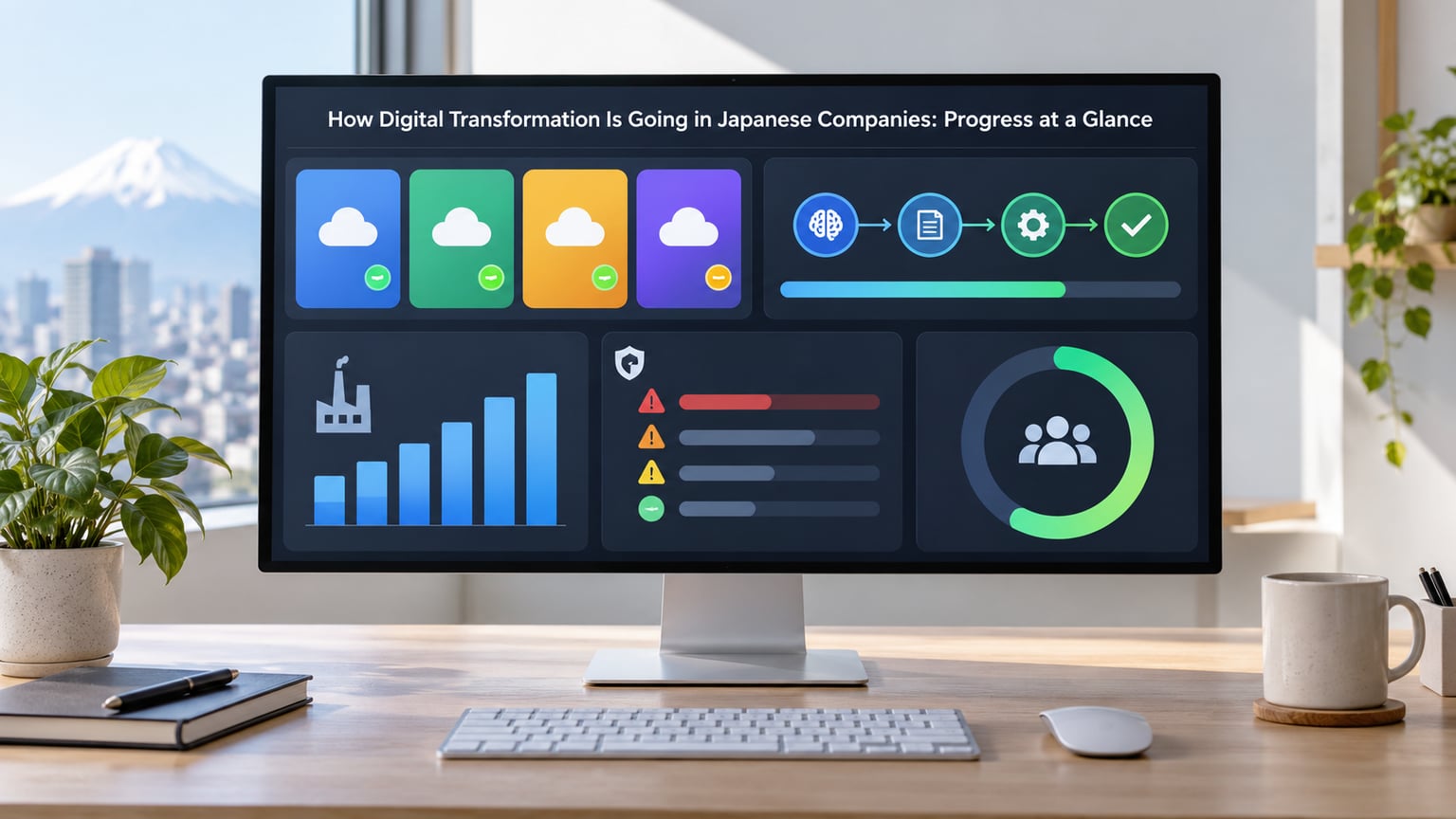
Read this as a maturity assessment rather than a league table. “Scaled” means the capability shows up in normal business operations rather than in a project plan, and each row separates the two things companies most often conflate: whether they have adopted something, and whether it changed a number anyone tracks.
| Area | Adoption status | Scaled business value | What separates the leaders |
|---|---|---|---|
| Cloud migration | Advanced in large enterprises, mixed in mid-market | Partial | New product development and cross-company data sharing run on cloud-native patterns rather than lifted workloads |
| Generative AI | Broad in pilots and internal tooling | Early | Governance and data readiness decided before deployment, so use cases reach production |
| Data platforms and governance | Common in large firms, rare in SMEs | Uneven | Master data ownership is assigned, not left to a committee |
| E-commerce and customer-facing systems | Advanced | Advanced | Japan’s own consumer market, cashless payments and app habits are unusually mature |
| Manufacturing automation | Advanced at export-grade factories | Advanced domestically, uneven across the supplier base | Quality inspection and predictive maintenance tied to kaizen routines rather than separate projects |
| Cybersecurity | Improving steadily | Mixed | Supply-chain security treated as an operating requirement after a series of ransomware incidents |
| Workforce skills and reskilling | Broadly acknowledged, unevenly funded | Early | Programs tied to real role changes rather than generic digital-literacy training |
| Legacy core modernization | Slow, expensive, unavoidable | Low | About 60% of Japan’s IT systems were expected to be more than 20 years old by 2025, per an EU-Japan Centre report, and the backlog has not cleared |
The clearest signal in this table is how often adoption is high and value is low. Cloud and generative AI both sit in that pattern, which is exactly what Forrester described in December 2025 when it argued Japan’s next phase is AI transformation, or AX, rather than DX as it was defined.
How Is Digital Transformation Going in Japanese Companies?
Five dimensions tell the story better than any single adoption number: which technology is in use, whether the organization changed, whether results are measurable, how experience differs by company size, and how the definition of the work itself is shifting.
How Is Cloud Adoption Changing Japanese Business Operations?
Cloud platforms now support product development cycles that Japanese firms could not previously run, because shared environments let engineers and designers work from different sites on the same codebase. That matters more in Japan than in many markets, where the headquarters and the factory have often sat in the same building for decades.
The complication is that most cloud migration in Japan has been a relocation, not a redesign. Workloads moved off aging mainframes, but the surrounding process, the approval chain and the custom ERP logic came along unchanged. CIO’s coverage of the 2025 cliff describes the same problem with an image worth borrowing: firms have historically made systems “fit the kimono,” stretching the technology around the organization, rather than reshaping the organization around the technology.
Hybrid infrastructure is the normal state, not a transitional phase. Core banking and production lines stay on-premise, and cloud handles experiments, analytics and anything customer-facing. Security controls and the Personal Information Protection Act sit on top of both, which adds real work to every migration decision.
Where the gap shows is business impact. Moving a workload is measurable in months. Redesigning a process around cloud capabilities usually takes years and requires someone senior to own it.
How Is AI Adoption Affecting Japanese Companies?
Generative AI has become the main new driver because it offers a way to demonstrate value in weeks rather than the multi-year horizon of core modernization. Document processing, internal search across years of reports, code assistance and first-line customer support are the most common starting points in Japanese companies.
Forrester’s December 2025 argument is that Japan approaches AI differently from the West, where the dominant fear is job displacement. With acute labor scarcity, the framing in Japan is closer to relief: the technology is needed, not feared. That difference of starting position has a practical effect, because organizations willing to use AI to augment scarce staff get to production sooner than organizations that first have to win a labor negotiation.
The gap is between pilots and deployed systems. Analysts have described proof-of-concept purgatory as the standard failure mode: many small experiments, few production deployments, and no mechanism to decide which ones deserve investment. Data readiness is usually the culprit, since master data ownership is unresolved, and governance is often written after deployment rather than before it.
Infrastructure is the other variable. NTT’s IOWN optical network, which claims 125 times the transmission capacity of conventional electronics with 200 times lower latency, originally targeted 2030 and has since slipped to 2032. That slip matters less for this article than the fact it represents, which is that Japan’s infrastructure bets are long-cycle while its AI deployment is short-cycle, and the two rarely get planned together.
How Does Progress Differ Between Large Enterprises and SMEs?
Large Japanese companies are not uniformly ahead either, but they have something most mid-sized firms do not, which is a balance sheet that can absorb a failed modernization. The mid-market, often called chuko, is where the digital divide is widest.
Large firms also work inside a constraint smaller companies avoid: group structure. Subsidiaries, a main bank relationship and long supplier chains all add coordination cost before a single line of code is written. A mid-sized manufacturer with 200 employees may be technically more flexible and still have less digital capacity than a sprawling group.
For smaller companies, the honest answer from practitioners on r/JapanDev is that the market is polarized. A commenter described it as a situation where the market is not too bad now thanks to AI companies hiring aggressively, while outside the AI segment it does seem to be slow. The named beneficiaries tend to be a recognizable set, including Mercari, PayPay, Money Forward, Woven and SmartNews, where compensation in the twelve million yen range and above is common. Most other Japanese employers are not part of that market.
So there are two speeds inside the country, not a leader and a laggard. A small group of AI-native and IT-leveraging firms is moving quickly. The broad base of Japanese enterprises, including many very large ones, is moving slowly for reasons that have little to do with their technology.
Which Japanese Industries Are Leading the Transition?
Sector is a better predictor of progress than company size. Industries that sell physical products internationally have had to modernize for export competitiveness, while domestically focused service industries have had less pressure and fewer comparable benchmarks.
| Industry | Main priorities | Maturity signal | Constraint |
|---|---|---|---|
| Manufacturing | Smart factories, quality inspection, predictive maintenance, supply chain visibility | Advanced at major exporters, uneven further down the supplier chain | Long tiered supply chains make standards and data sharing hard to enforce |
| Retail and e-commerce | Omnichannel, demand forecasting, inventory and fulfillment | Advanced, driven by a mature domestic consumer market | Legacy store estates and fragmented logistics networks |
| Finance | Core banking modernization, digital channels, fraud detection, AI-assisted service | Advanced on customer channels, slow on core systems | Regulated change control and mainframe replacement cost |
| Logistics | Route and capacity optimization, warehouse automation, labor substitution | Mixed | Driver shortages and an aging workforce make automation attractive but capital-intensive |
| Healthcare | Telemedicine, electronic records, back-office administration, drug discovery support | Behind other sectors | Regulatory caution, staffing pressure and fragmented data between care and administration |
| Public services | My Number, one-stop online services, the Digital Agency’s consolidation push | Improving but contested | Local government capacity varies widely and legacy systems are old |
Japan’s government framing for all of this is Society 5.0, a national vision that fuses physical and digital spaces, delivered through the Digital Agency established in 2021 and the Digital Garden City Nation initiative. For companies, that framing matters mainly as signal about where subsidy and procurement programs will point.
What Results Are Japanese Companies Achieving?
The honest answer is that results reporting in Japan is weak, and any company claiming a clean transformation number deserves a follow-up question about the baseline. The measures that do hold up are operational rather than strategic.
| Measure | The business question it answers | How to measure it |
|---|---|---|
| Process cycle time | Did the workflow actually get faster? | Timestamp comparison before and after, on one named process |
| Defect and rework rate | Did quality improve where the work happens? | Defects per thousand units at the line, not company-wide |
| Release frequency | Is development faster and less risky? | Deployments per month and change failure rate |
| Forecast accuracy | Is demand planning better? | Error rate against actuals for a named product group |
| Conversion and retention | Did customer-facing changes pay off? | Same store or same cohort, before and after release |
| Cost per transaction | Did headcount or effort drop? | Back-office cost per unit of volume, tracked over quarters |
Kazukazu Sekiguchi of MM Research Institute, interviewed by CIO in October 2025, named the three causes of failure with unusual clarity: no strategy, no KPIs set, and no people. Read that list as a measurement warning, since two of the three are about deciding what success means before work starts.
Pilot count is not a result. A company can run forty AI experiments in a year and change nothing measurable, and in Japan that is close to the default outcome.
Why Is Digital Transformation Still Uneven?
The barriers are mostly organizational, and they compound.
- Aged core systems. A large share of Japan’s IT estate was already more than 20 years old by 2025, and core banking and production platforms carry decades of customization that nobody fully understands.
- Consensus decision-making. Approval chains assume a shared plan, which is efficient when plans are stable and slow when they are not.
- Silos and subsidiary structures. Group companies duplicate systems and negotiate data access from scratch.
- Seniority-based careers. Rewarding specialists and failed experiments sits badly with promotion systems built on tenure and group loyalty.
- Skills shortage. There are not enough engineers, data specialists or product managers with the combination of business and technical judgment these programs need.
- Supplier chains. Progress at the top of a tiered supply chain stops where a subcontractor cannot fund the change.
- Risk aversion after high-profile incidents. Leaks and outages have made security teams cautious about moving anything, including internal AI tools.
- Pilot purgatory. No agreed process for deciding which experiments get production investment, so most quietly stop.
Smaller companies cannot solve items one through seven by spending more. What they can do is narrow the scope: pick one expensive, measurable workflow, modernize only what that workflow touches, and accept that some systems will stay old for years. A mid-sized firm that fixes order-to-cash end to end will get more out of that than one that buys a cloud platform it cannot afford to operate.
What Should Companies Do Next?
A sequence that works in Japanese organizational conditions looks like this. It is deliberately unglamorous.
- Pick a costly, measurable workflow. Order management, invoice processing, quality inspection or customer service triage. If nobody can name the current hours or defect rate, it is the wrong candidate.
- Map how the work actually happens. Not the process diagram in the manual. Sit with the people doing it, because in Japanese firms the real work sits in spreadsheets and chat messages that no system records.
- Settle governance before deployment. Decide who owns master data, what the Personal Information Protection Act requires, and what an acceptable AI error looks like. Writing this later is the most common cause of stalled rollouts.
- Assign executive sponsorship with time, not a title. A chief digital officer whose remit is advisory only will lose the first real fight over a process change.
- Measure the baseline first. You cannot show a result without the number you started from.
- Scale only what survived contact with the operation. One workflow running in production beats forty pilots in a slide deck.
Two Japanese realities deserve explicit planning. Group structure means the business case has to survive a parent company’s approval process, so expect the timeline to extend. Supplier chains mean you should ask what your tier-1 suppliers can absorb, because a transformation that dies at the second tier is the most common failure point in manufacturing.
Frequently Asked Questions
Is digital transformation actually working in Japan?
Partly. Roughly 76.8% of Japanese companies say they promote DX, and about one in three report notable results, per the Nikkei BP Research Institute. Cloud, manufacturing automation and consumer-facing systems show real returns. Core banking, back office and mid-sized firms lag. The pattern is consistent: high adoption, thin measured value, with results concentrated where technology was tied to an existing operational discipline rather than treated as a standalone program.
How far behind are Japanese companies compared with the US and Europe?
It depends what you measure. On perceived DX success, an IPA survey puts Japan at roughly 30% against about 80% for US and German firms. On consumer technology, Japan leads, with payments, apps and hardware in genuinely mature territory, and Japan ranked as low as 32nd in the World Digital Competitiveness Ranking in 2023. The gap is therefore in enterprise software adoption and organizational change, not in technical capability.
Is digital transformation in Japan now just about AI?
Mostly funded by it, no. Generative AI has become the easiest way to show progress quickly, which is why it dominates current budgets. Underneath it sits slower work that AI depends on: data governance, master data ownership, cloud migration and core system replacement. Two Japanese-specific distinctions are worth keeping straight, between digitizing existing processes and redesigning them, and between DX and ITization, where the organization changes rather than the paperwork.
Why do small and mid-sized Japanese companies lag behind?
The most common constraints are money and people, not appetite. A mid-sized firm usually cannot absorb a failed core modernization, and there is a genuine shortage of people who combine business knowledge with technical skill. Groups add another layer, since subsidiaries negotiate systems and data access separately. The workable response is to pick one expensive measurable workflow and modernize only what it touches, rather than buying a platform the company cannot operate.
Which Japanese industries are changing fastest?
Manufacturing leads, driven by export competitiveness rather than internal pressure. Major factories run smart quality inspection, predictive maintenance and connected supply chains, though the gains thin out down the supplier tiers. Retail and e-commerce follow, with an unusually mature domestic consumer market and advanced payments. Finance is split, with modern customer channels over slow core systems. Healthcare and public services trail on regulatory caution and data fragmentation.
How should executives measure whether DX is working?
Measure operations, not activity. Useful indicators are process cycle time, defect rate, release frequency, forecast accuracy, customer conversion and cost per transaction, each compared against a named baseline. Two things reliably mislead: counting pilots, which says nothing about outcomes, and using headcount reduction as the headline, which hides whether the remaining work got done. An analyst at MM Research Institute named the three failure causes as no strategy, no KPIs and no people.
Conclusion
Japanese companies are making real progress in digital transformation, and the strongest evidence sits in cloud services, manufacturing, payments and consumer-facing systems where the technology attaches to work that already had a discipline behind it. The 2025 cliff did not arrive as catastrophe, and it will not be resolved by 2026 either. About one in three companies still turns broad adoption into results anyone can measure.
The lesson from the companies doing this properly is not about technology choice. It is sequencing. Start with a workflow that is expensive today and measurable tomorrow, map how the work really happens, set governance before deployment, and scale only what survived contact with the operation. Everything else, including a platform purchase, comes after that.