Why cash on delivery is still common in Japan comes down to three things that reinforce each other: shoppers want to see the goods before money changes hands, the courier networks that collect cash are already built and reliable, and a meaningful slice of customers either prefer cash or cannot use the domestic apps. That is the short answer. The trend runs the other way — cards, electronic money and QR payments keep taking share — but collection at the door is not disappearing. It is becoming one option among several rather than the default.
I have watched this shift in both directions while covering Japanese retail. Big chains took cards and taps years ago. The little neighborhood shop, the izakaya, the marketplace seller, and the ryokan guest ordering a jacket left behind all still run on notes and coins. Last updated for 2026.
Table of Contents
- 1Why Cash on Delivery Is Still Common in Japan
- 2What Is Cash on Delivery in Japan?
- 3How Japanese Shoppers Traditionally Paid Online
- 4Why COD persists as a practical fallback, not a favorite
- 5The Main Reasons Cash on Delivery Persists
- 61. Paying after seeing the goods
- 72. Not sharing financial details with an unknown seller
- 83. Trust in the handover, not in the platform
- 94. Households and visitors without usable digital payment
- 105. Older shoppers who did not adopt the apps
- 116. Fewer moving parts at checkout
- 127. Free or cheap returns soften the risk
- 138. The courier network is already paid for
- 14How Trust, Convenience, and Logistics Interact
- 15Where Cash on Delivery Is Most Common
- 16What Barriers Make COD Less Convenient for Businesses
- 17Is Cash on Delivery Declining in Japan?
- 18How the Customer Experience Differs by Payment Method
- 19Frequently Asked Questions
- 20Is cash on delivery still used in Japan?
- 21Why do some Japanese shoppers prefer paying the courier?
- 22Can foreigners use cash on delivery for Japanese online orders?
- 23Is cash on delivery more expensive for a Japanese business?
- 24What payment methods are replacing cash on delivery?
- 25Does cash on delivery let the customer inspect an item before paying?
- 26Conclusion
Why Cash on Delivery Is Still Common in Japan
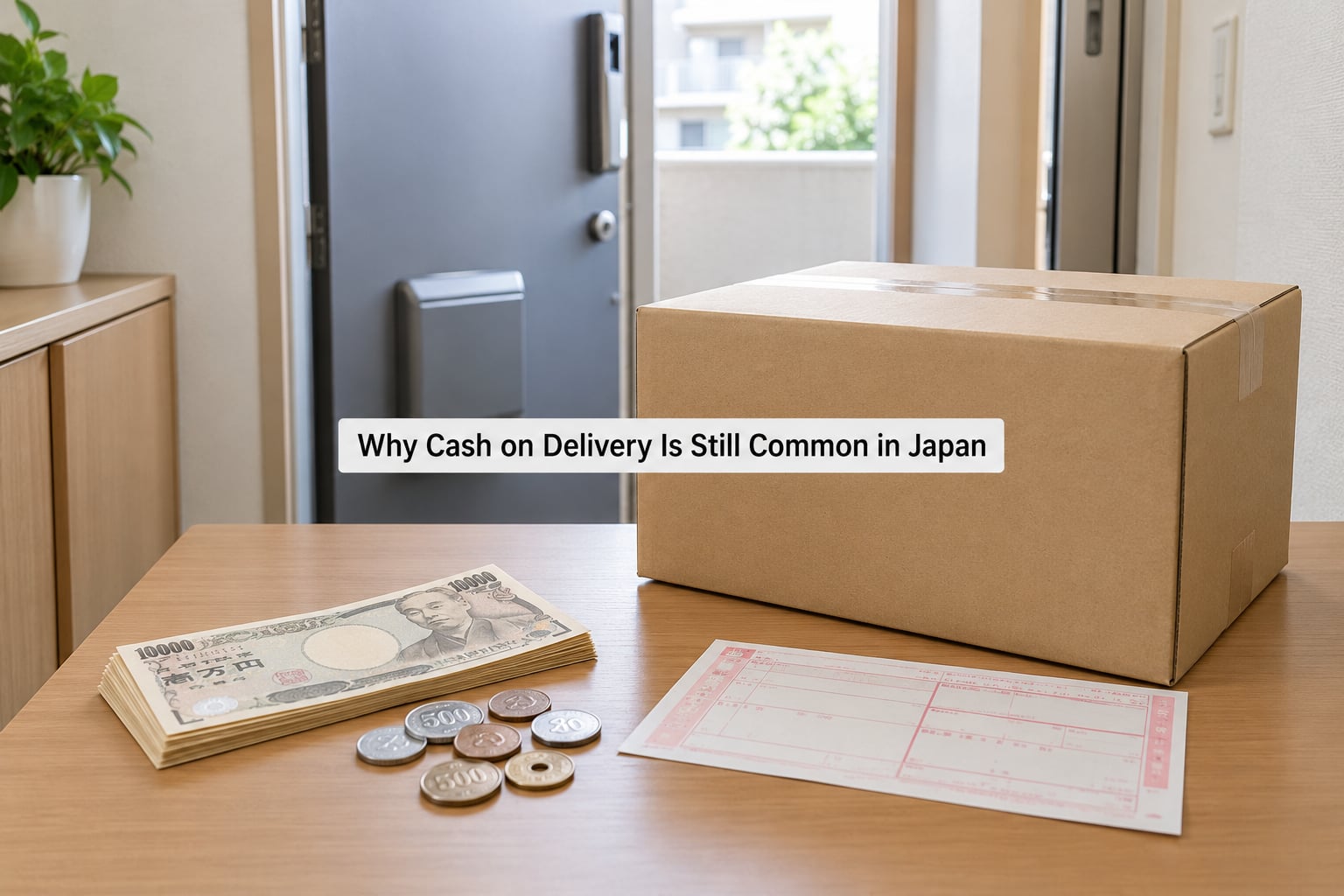
Cash on delivery remains common in Japan because visible payment checks reduce buyer risk, mature courier networks already collect money at the door, and a real share of shoppers — older customers, marketplace buyers, foreign visitors — either prefer cash or cannot use domestic payment apps. DHL put the share of Japanese online buyers using collect on delivery at roughly 20% in its market guidance, and it links that figure directly to perceived security and anonymity.
What has changed is the balance. Cash on delivery used to be the normal way an unfamiliar online merchant got paid. Now it sits beside cards, bank transfer, electronic money and konbini payment as one tab among several at checkout. Which is exactly why it survives: no single payment method has to win everywhere.
What Is Cash on Delivery in Japan?
In Japan, cash on delivery means the buyer hands cash to the courier at the moment the parcel arrives. Nothing is charged when the order is placed. If the recipient refuses the parcel, no payment is collected and the courier takes it back.
Two Japanese terms cover most of this, and the difference trips up a lot of English-language readers. Chakubarai (着払い) literally means “pay on arrival” and is the everyday term for collect on delivery. Daibiki (代引き) is the more formal merchant-side term for the same handover, and you will see it on shipping or payment terms pages.
The other terms you meet on Japanese checkout pages mean something different:
| Term | Meaning | Who pays the courier |
|---|---|---|
| 着払い (chakubarai) | Collect on delivery | Recipient, at the door |
| 代引き (daibiki) | Formal collect-on-delivery handover | Recipient, at the door |
| 先払い (seniharai) | Shipping prepaid at checkout | Buyer, before dispatch |
| 後払い (atokehiharai) | Billing after delivery | Buyer, later |
| 振り込み (furikomi) | Bank transfer in advance | Buyer, before dispatch |
| コンビニ (konbini) payment | Pay at a convenience store counter on pickup | Buyer, at the counter |
Konbini payment is often mistaken for cash on delivery. It is a separate channel: the parcel waits at one of Japan’s roughly 55,000 convenience stores and the buyer pays there in cash or by code. No courier knocks at all, which is the point for anyone who does not want a doorbell or a signature.
Typical everyday uses include marketplace orders, small retailer parcels, food delivery, catalogue and mail-order purchases, and some service bookings. Not every merchant offers it. Larger chains have quietly removed the option from most checkout flows, and the major card-accepting platforms default to prepayment.
How Japanese Shoppers Traditionally Paid Online
Japan’s online payment habits moved in layers rather than all at once, and each layer is still visible in how people choose to pay today.
Mail order and cash in advance. Early catalogue shopping ran on furikomi — you posted a transfer or a payment slip with your order and waited for the goods. That habit of paying first and trusting the seller by mail never fully went away, and it is still the default for many repeat buyers.
Convenience store arrival. As konbini expanded through the 2000s, online order-at-store pickup became normal. The buyer paid cash or code at the counter and collected the parcel in person. It looked like cashlessness was over. What actually happened is that cash moved from the register to the pickup counter.
Cards and electronic money. Contactless IC cards such as Suica and PASMO turned trains, konbini and vending machines into card terminals, and credit cards became ordinary on major e-commerce platforms. QR code apps followed, and PayPay became the default code payment many people reach for first.
The measured shift. One industry source put Japan’s cashless ratio at about 39.3% in 2024, and a September 2025 report discussed on r/japannews cited roughly 58% of consumer spending as cashless. QR payment users grew from about 3.55 million in 2018 to more than 75 million by 2023. Those are real numbers, but read them carefully: a cashless ratio measures value settled digitally, not whether cash still works everywhere. Both things are true.
Why COD persists as a practical fallback, not a favorite
Here is the distinction most coverage gets wrong. Cash on delivery is not popular in Japan the way it is in parts of Southeast Asia or the Middle East, where a large share of e-commerce settles at the door by preference. In Japan it persists as infrastructure plus reassurance. The courier network is already there, so collecting cash costs the merchant almost nothing extra in practice, and for a buyer who does not know the seller, deferring payment until the goods are visible removes the biggest objection to ordering from an unfamiliar shop.
That makes COD a fallback that works for everyone, not a preference a growing share of shoppers share. It matters most where confidence is lowest: an unfamiliar marketplace seller, a used item, a garment whose fit cannot be guessed.
The Main Reasons Cash on Delivery Persists
The drivers below are ranked roughly by how often they decide the choice. Which one matters most depends entirely on the order.
1. Paying after seeing the goods
For clothing, sizing is a genuine problem solved by trying the item. For used goods, condition is the entire purchase. Handing money over after the box is open removes the dispute before it starts. Forum reports from r/japanlife describe exactly this pattern — a chakubarai order placed so nothing was paid upfront, with the item checked in person first.
2. Not sharing financial details with an unknown seller
Card checkout asks for a number, an expiry date and often a one-time code. A buyer who is ordering from a small seller or a peer-to-peer listing has no relationship with that merchant. Cash at the door shares nothing.
3. Trust in the handover, not in the platform
Japan’s low-fraud reputation cuts both ways. A buyer who trusts the courier to bring an order safely trusts the seller to have sent it. Sellers on r/japanlife describe a national reputation for honesty and self-control as the reason buyers do not feel the same anxiety they would elsewhere.
4. Households and visitors without usable digital payment
PayPay needs a Japanese phone number. LINE Pay shut down in March 2025. A foreign visitor or resident without either is effectively locked out of the domestic code-payment ecosystem, which leaves cash, konbini counters, and cash on delivery as the practical routes. A September 2025 report put cash use at 94.5% of foreign visitors’ trips, with only 11.4% using a QR payment app.
5. Older shoppers who did not adopt the apps
Plenty of older customers hold a card but never installed a payment app. For them, collect on delivery is not nostalgia, it is the only online payment they know works. This group is shrinking, but it is still large enough to keep the option alive.
6. Fewer moving parts at checkout
For a buyer ordering a 1,500 yen item, entering a card number is more effort than paying a courier. Low-value orders are where the convenience argument wins outright.
7. Free or cheap returns soften the risk
A chakubarai buyer can open the box, decide against it, and refuse without paying. Multiple r/japanlife users report that when a seller arranged collect on delivery for a return, the return shipping was on the seller. That reframes COD as low risk for the buyer rather than risky.
8. The courier network is already paid for
Yamato Transport, Sagawa Express and Japan Post already visit every address in the country. Adding a collection step costs them a few seconds per stop. That is why the option survived in places where card infrastructure had to be built from nothing.
How much weight each reason carries shifts by merchant, customer age, product and order value. COD dominates for used goods and unfamiliar sellers, and rarely appears at all in a large chain’s checkout.
How Trust, Convenience, and Logistics Interact
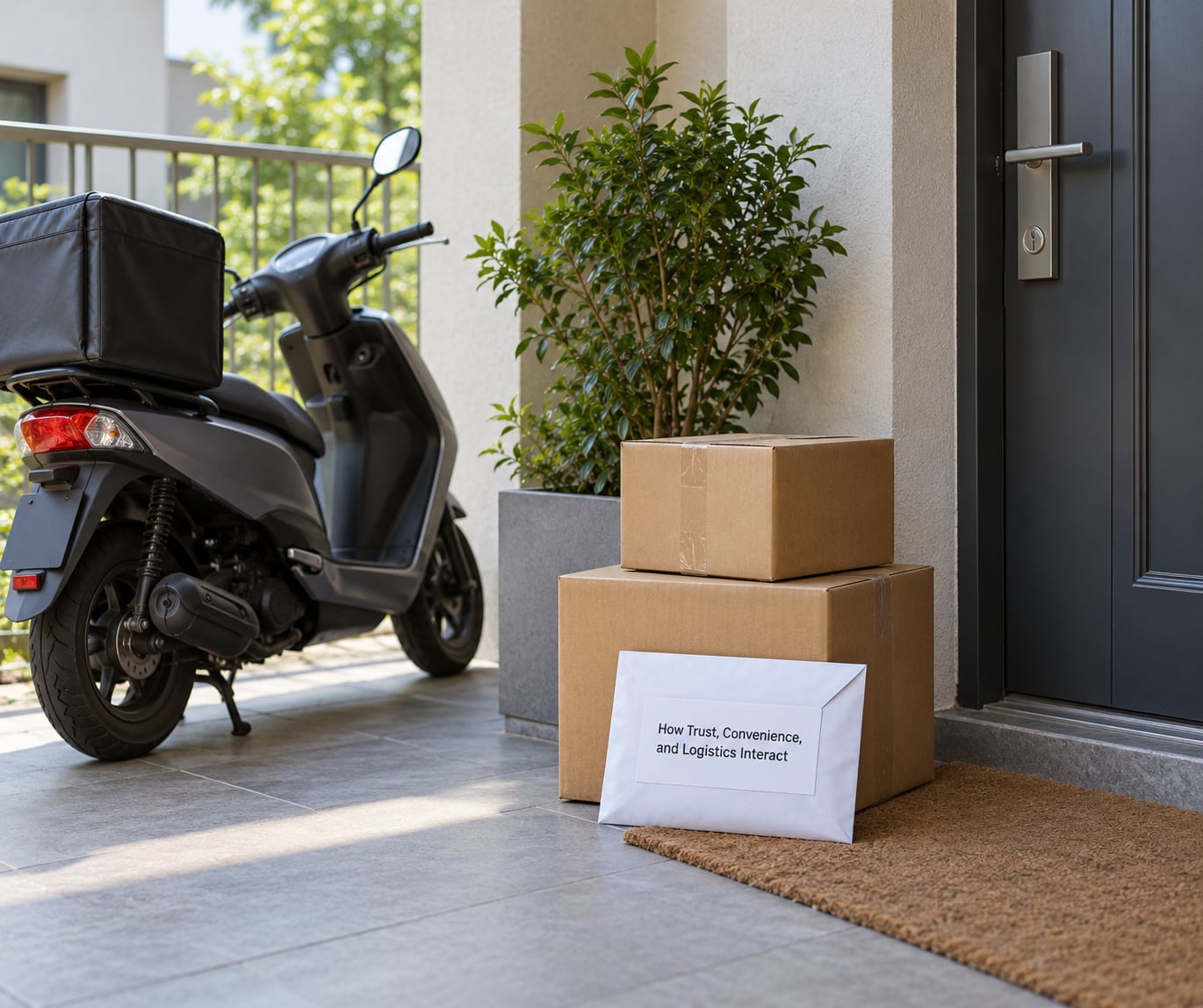
Pull the three factors apart and none of them explains much. Together they form a loop: buyers trust a handover that requires no account, couriers already visit every address, so accepting cash costs little, and merchants inherit a payment option that converts hesitant shoppers. Each link makes the next one cheaper to keep.
Comparing the payment routes makes the trade-off concrete:
| Method | Trust for buyer | Settlement for merchant | Fits best |
|---|---|---|---|
| Cash on delivery | Highest — goods in hand before paying | Slowest — cash after handover | Used goods, unfamiliar sellers, apparel |
| Credit card | Low at purchase, strong dispute rights | Fast, minus a transaction fee | Repeat purchases and larger orders |
| Bank transfer (furikomi) | Lowest — money moves before the goods | Fast, low cost | Wholesale, deposits, known sellers |
| Electronic money or IC card | Low — stored value spent up front | Fast, small fee | Everyday low-value retail |
| Konbini pickup and payment | Medium — pay on pickup, no courier visit | Fast, fee applies | Buyers avoiding the door |
Note the split. Buyer trust and merchant settlement run in opposite directions across every row, which is why the same order gets paid differently depending on who is deciding.
Where Cash on Delivery Is Most Common
Context predicts the payment method better than demographics do.
Peer-to-peer and resale marketplaces. Listings on Mercari and similar sites often let the seller choose, and a buyer who does not know the seller picks collect on delivery. Facebook resale groups for Japan-based sellers treat chakubarai as a standing label.
Used and pre-owned goods. Condition is not describable in a listing photo, so payment after inspection is close to a requirement rather than a preference.
Fashion and apparel. Sizing uncertainty pushes buyers toward paying later. A forum user reported ordering a jacket left behind at a ryokan with chakubarai for the same reason.
Small merchants and local sellers. A shop that runs on an iPad and a courier pickup point has no reason to add a settlement system.
Food and prepared orders. Short delivery windows and cash handling at the door keep this common where the order is perishable and the customer is waiting.
Returns, too. An Amazon return through Yamato arranged as chakubarai means paying the shipping fee at the counter, not the refund. COD shows up in Japan’s return logistics as well as its sales ones.
Large standardized retail is the exception. Where a chain already takes cards, taps and code payments, the checkout is a single screen and adding a cash option mostly adds a fee and an argument.
What Barriers Make COD Less Convenient for Businesses
Seller-side, collect on delivery is the least attractive payment method a Japanese merchant can accept. The frustration shows up repeatedly in r/japanlife complaint threads.
Slow settlement. The merchant gets the money when the courier does, then waits again for it to reach the account. Card and code payments settle far sooner.
Cash handling. Counting, banking and reconciling notes is labor, and it is labor that small shops are short of.
Refused deliveries. A parcel the recipient will not pay for still consumes a courier stop. Repeat refusals get a merchant’s address flagged.
Disputes over condition. Once cash has changed hands, arguing is a face-to-face problem rather than a transaction record.
Refunds in cash. Returning money means another handover and another reconciliation entry.
The surcharge. The COD fee typically adds roughly 300 to 500 yen on top of the shipping charge, and the courier expects cash for shipping and goods together, which means the driver has to make change.
Risk carried entirely by the seller. One r/zenmarket user pointed out that when a seller arranges chakubarai, the marketplace platform ends up fronting the payment and absorbing the return risk.
That is the honest picture. Buyers like collect on delivery more than merchants do, which is a large part of why it is offered selectively rather than everywhere.
Is Cash on Delivery Declining in Japan?
Cash on delivery is not disappearing, but it is shrinking relative to everything around it. It is becoming one option inside a broader digital payment ecosystem rather than a default.
Several forces push it down. Contactless IC cards made tapping the normal way to pay for everyday errands. QR code apps absorbed the mid-value transaction. Policy has helped: the government’s Cashless Vision pushed rewards on digital spending, which pulled habit more effectively than any rule could. App consolidation has cut the number of things a shopper has to learn, and digital yen pilots keep the conversation moving.
Two forces hold it up. New digital methods keep closing gaps that COD used to cover — konbini counters taking codes, platforms adding wallet options at checkout — which slowly removes COD’s job. Meanwhile the pockets COD serves, older customers and visitors without a Japanese payment account, are exactly the slowest to adopt anything new.
My read is that COD settles into a long tail rather than vanishing. It will keep appearing where a buyer does not know the seller, where inspection matters, and where a merchant is small enough that the courier’s visit is the simplest payment system available.
How the Customer Experience Differs by Payment Method
The moment money changes hands is where these feel completely different.
Paying online before dispatch. You commit on a screen, then track. The benefit is speed and no cash risk. The cost is paying for something unseen, and for an unfamiliar merchant, handing over card details to complete a purchase.
Handing cash to a courier. You are standing in your doorway with an item in one hand and your wallet in the other. Nothing was charged earlier, so nothing needs chasing if the box disappoints. The courier waits, and change is part of the interaction.
Paying a driver on arrival. Common with prepared food. The handover is fast, and inspection is limited to what you can see in the doorway.
Collecting in person at a konbini counter. You pay when you pick up, so inspection is still possible, but nobody comes to your door. Buyers who dislike doorbells, signatures or showing ID use this route specifically.
Tapping a card or phone. Seconds long, and it is the option with the strongest dispute rights if something goes wrong. What it does not offer is the ability to look before you pay.
The practical difference for a buyer who cares most about checking an item before paying comes down to whether the payment moment comes after the box is open. With COD and konbini pickup it does. With everything digital, it does not.
Frequently Asked Questions
Is cash on delivery still used in Japan?
Yes. DHL has put the share of Japanese online buyers using cash on delivery at around 20%, citing perceived security and anonymity. It shows up most often on marketplace listings, small merchants and used goods, where the buyer does not know the seller. Large chains have mostly removed it from checkout. Konbini payment at a convenience store counter is a separate, similar option that also settles in cash.
Why do some Japanese shoppers prefer paying the courier?
Because the goods arrive before the money does. A buyer can open the box, check sizing on apparel or condition on a used item, and refuse without paying anything. It also means no card details or personal payment data go to an unfamiliar seller. Forum users on r/japanlife describe COD orders as a way to avoid paying upfront, with return shipping often arranged at the seller’s cost.
Can foreigners use cash on delivery for Japanese online orders?
Usually, because COD requires no Japanese account. It needs yen in hand and a delivery address someone can answer. The main complication is the payment apps foreigners cannot use: PayPay requires a Japanese phone number and LINE Pay shut down in March 2025. Konbini pickup and payment is often the easier route, since a convenience store counter accepts cash without an ID check or local app.
Is cash on delivery more expensive for a Japanese business?
Yes, for the merchant. The courier adds a COD surcharge of roughly 300 to 500 yen on top of shipping, and the driver must make change for shipping and goods together. Settlement arrives late, cash has to be counted and banked, and refused parcels still consume a delivery stop. r/japanlife threads show sellers openly resenting requests for chakubarai for exactly these reasons.
What payment methods are replacing cash on delivery?
Contactless IC cards such as Suica and PASMO, credit cards on major e-commerce platforms, and QR code apps led by PayPay. Convenience store counters now take code as well as cash, which absorbs much of what COD used to handle. Japan’s cashless ratio reached about 39.3% in 2024, with a September 2025 report citing roughly 58% of consumer spending as cashless.
Does cash on delivery let the customer inspect an item before paying?
That is the point of it. Nothing is charged when the order is placed, so the recipient opens the parcel, checks it, and hands over cash only if the item is acceptable. Refusing is free in the sense that no payment is collected at all, though shipping charges can still apply depending on the merchant. Buyers on r/japanlife report that sellers arranging chakubarai often cover the return shipping.
Conclusion
Cash on delivery survives in 2026 because three conditions hold at once: familiar payment behavior, control for the recipient, and delivery networks mature enough to collect money anywhere in the country. Take any one of them away and the option weakens. That is why it is shrinking in absolute terms while still working well wherever trust is the deciding factor.
Digital payment is reshaping the role, not ending it. Cards, IC cards and QR apps now handle most routine buying, and the payment moment is moving earlier. But the buyers who most want to open the box before paying have not gone anywhere.
Start with the checkout page of the specific merchant rather than assuming anything about Japan as a whole. Whether cash on delivery appears depends on the seller, the item and the order value — not on the country.