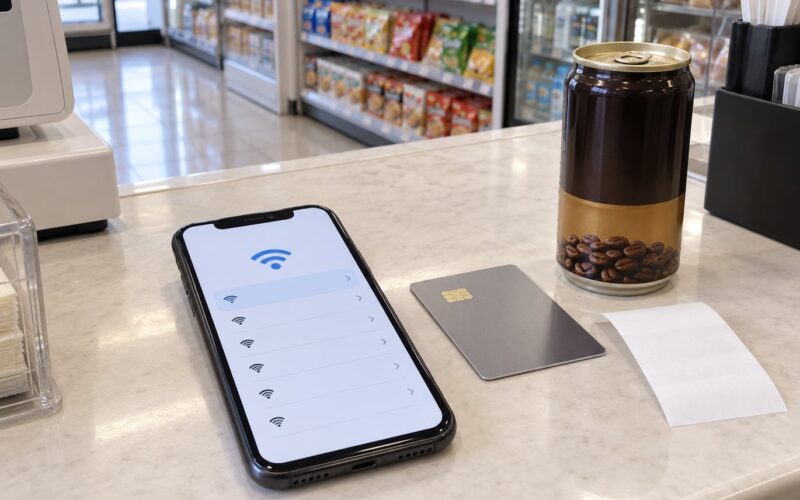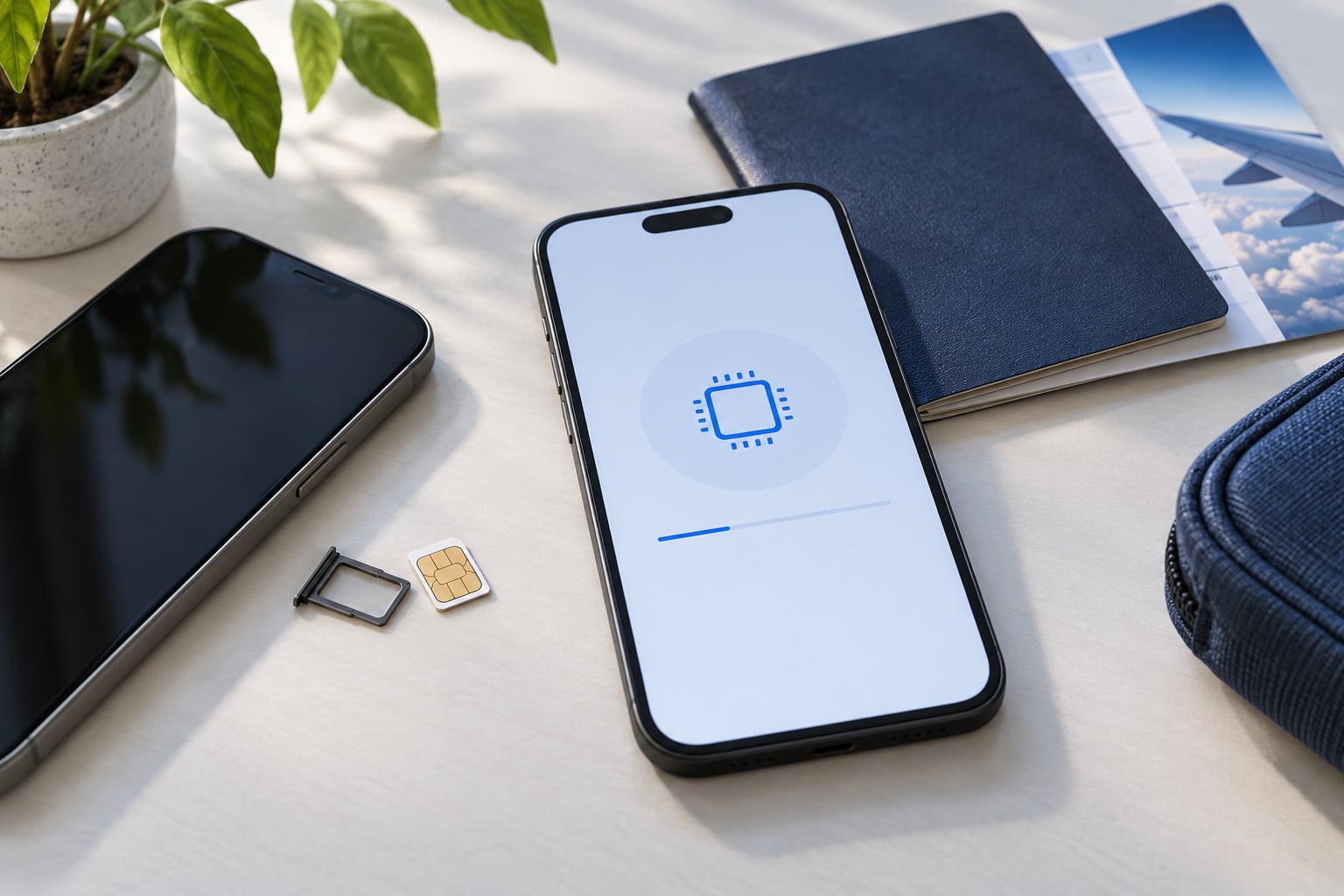
If your phone supports eSIM and you are buying in advance, an eSIM is the easier choice for Japan: you scan a QR code before you fly and have data the moment you land. A physical Japan SIM card still wins for older or carrier-locked phones, for people who want a card they can swap between devices, and for anyone who would rather hand over a plastic chip than manage a digital profile. In the Japan SIM card vs eSIM debate, the deciding factor is your device, not the network.
Both formats reach the same Japanese networks. What changes is how the plan reaches your phone, how quickly you can get it running, and what happens when something goes wrong in a taxi queue at Haneda. That is what this guide breaks down.
Table of Contents
- 1Japan SIM Card vs eSIM for Travelers at a Glance
- 2What Is the Difference Between a Japan SIM Card and an eSIM?
- 3How a Japan SIM Card and eSIM Activate
- 4Japan SIM Card vs eSIM: Device Compatibility
- 5How to check your Japan SIM card vs eSIM options before you buy
- 6Which Option Is Easier for Short and Long Trips?
- 7What About Coverage, Data Speeds, and Reliability?
- 8Which Is Better for Maps, Translation, Ride-Hailing, and Hotspot Use?
- 9How to Avoid an Expensive Connectivity Mistake
- 10Which Should You Choose?
- 11Frequently Asked Questions
- 12Can I use an eSIM in Japan if my phone is from another country?
- 13Is a physical SIM card better than an eSIM in Japan?
- 14Can travelers use a foreign travel eSIM in Japan?
- 15Do I need a Japanese SIM card for a short trip?
- 16Can I use a Japan SIM card for mobile data and phone calls?
- 17Conclusion: What to Do First
Japan SIM Card vs eSIM for Travelers at a Glance
The table below is the short version. Everything after it explains why each row looks the way it does.
| Factor | Physical Japan SIM card | eSIM |
|---|---|---|
| Device requirement | Any phone with a SIM tray, in the right card size | Only models sold with eSIM support |
| How you get it | Buy online and ship it, or collect it at an airport counter or city shop | Buy online, get a QR code by email or an app |
| When it activates | On insertion, then a restart or manual APN entry | After you install the profile, usually before departure |
| Switching plans or carriers | Swap the card, keep the old one | Add, switch or delete a profile in settings |
| Keeping your home number | Two physical trays, rare on modern phones | Home SIM plus a travel profile side by side |
| Data access | Plan allowance applies either way | Same allowance, same networks |
| Physical risk | Can be lost, bent or left in the wrong slot | Nothing to lose, but nothing to hand over either |
| Best for | Unsupported phones, shared devices, repeat trips, tangible comfort | Solo travelers who pre-plan and want it working on landing |
What Is the Difference Between a Japan SIM Card and an eSIM?
A physical SIM is a removable plastic chip that holds your subscriber identity. A Japan SIM card for tourists is supplied by an airport counter, a telecom shop in town, or a travel retailer who mails it to you, and it only works once it is seated in a phone and matched to the network.
An eSIM is the same subscriber identity stored on a chip soldered into the phone. The carrier profile is installed from a QR code or a carrier app, so nothing physical arrives. The connection itself then behaves the same way it would with a card: same towers, same speeds, same APN settings in most cases.
That last point is the one most marketing copy gets wrong. An eSIM is not a better network. It is a different way of telling the network who you are.
How a Japan SIM Card and eSIM Activate
Both take a few minutes once you have the hardware in hand, but they happen at different moments. The eSIM is faster because you can finish before you leave home.
Before you fly, with an eSIM:
- Confirm your exact phone model is eSIM-capable.
- Order the plan and receive a QR code by email or in the provider app.
- On iPhone, open Settings, Cellular, Add eSIM, then scan. On Android, most manufacturers put this under Connections or Network and Internet.
- Label the profile, for example “Japan”, so it is easy to switch later.
- Install it on Wi-Fi before you fly. Activation on cellular data often fails.
- Check that the plan has not already started its clock. Many run from the moment you install.
On arrival, with a physical SIM:
- Collect the card, either from a prepaid counter or a carrier shop.
- Check the size. You need nano-SIM for most modern phones, micro-SIM for some older handsets.
- Power off, eject the tray, insert the card gold contacts down, and close it.
- Restart the phone. Most Japanese prepaid cards also need the APN typed in by hand.
- Confirm data works before you walk away from the counter.
Airport counters sell convenience and queue time together. Budget ten minutes plus waiting, and have your passport and payment ready. If you are installing an eSIM mid-journey, do it on Wi-Fi, not on a shaky train connection.
Japan SIM Card vs eSIM: Device Compatibility
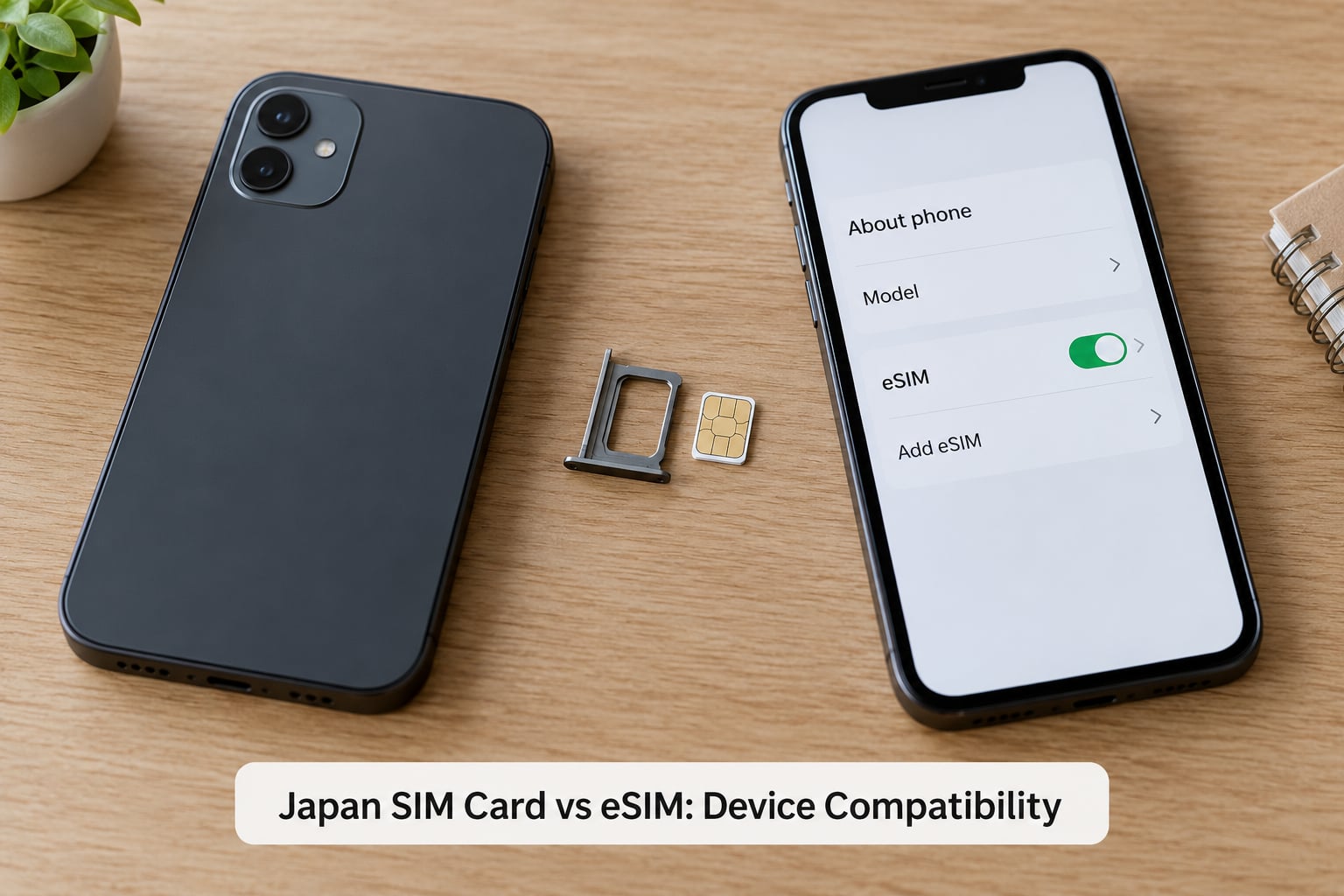
eSIM support depends on the exact model, the region it was sold in, and occasionally the software version. Roughly, iPhone XS and newer handsets support eSIM, most Google Pixel 3 and newer models do, and among Samsung phones it is the S20 generation and later. Some models sold in mainland China and in parts of Europe ship with eSIM disabled, and some Japanese-market and carrier-locked phones behave differently again.
A physical SIM is more forgiving, but not foolproof. A nano-SIM still needs a nano tray, and plenty of modern phones have no tray at all.
How to check your Japan SIM card vs eSIM options before you buy
- Find your exact model number, not just the marketing name. On iPhone this is Settings, General, About. On Android it is under Settings, About phone or About device.
- Search that model number with the word eSIM, or type eSIM into the phone’s settings search box. If a “Add eSIM” or “Add cellular plan” option exists, the phone is ready.
- Confirm the phone is carrier unlocked, especially if you bought it from a carrier on a payment plan.
- Check the country of purchase. If the phone was bought in a market that locks eSIM profiles, providers will refuse activation even though the hardware supports it.
- If any step fails, plan for a physical card instead of finding out at the airport.
Do this ten minutes before you pay for anything. It is the cheapest step in the whole trip.
Which Option Is Easier for Short and Long Trips?
For a trip of three to ten days, the eSIM wins on logistics. You install at home, land, turn the profile on, and you are moving. There is no queue, no language barrier, and no risk of the card arriving after you did.
For stays of a month or more, the picture changes. Long plans from local operators usually carry more data for less per gigabyte, and many local brands only sell directly to people who can show a Japanese address or a local payment method. A physical card from a telecom shop is easier to top up in person, and swapping it into a second phone when your main device needs servicing takes seconds.
Travelers crossing several Asian countries often prefer one multi-country eSIM profile rather than a stack of cards. Anyone repeating Japan trips may prefer a reusable physical card that survives the drawer between visits.
What About Coverage, Data Speeds, and Reliability?
Coverage depends on the carrier behind the plan, not on the card format. A travel eSIM running on a partner network will behave exactly like a local SIM on that same network. Read which network your plan actually uses, because a provider that resells a lesser network will feel slower in busy places even though the bars look full.
Rural areas are the honest test. Mountain roads in the Japanese Alps, parts of Hokkaido, and islands outside Okinawa have thinner coverage than Tokyo or Osaka, and travelers on Reddit’s Japan travel boards keep repeating that Docomo-based plans hold up best in those places. Ask which network the plan runs on before you buy, not after.
Also compare the data policy. A plan labelled unlimited often carries a fair usage threshold, after which speeds drop sharply or data is capped. Ask for the exact number in writing, and check whether tethering is included. Network bands are rarely a problem in Japan for modern phones, since domestic bands are widely supported.
Which Is Better for Maps, Translation, Ride-Hailing, and Hotspot Use?
Both formats handle everyday travel apps equally well once connected. Maps, translation, ride-hailing and music streaming care about data allowance and network quality, not about how the plan was delivered.
The format matters in two specific ways. First, hotspot and tethering: many travel eSIM plans include it, but some data-only plans block it or limit the shared amount, while a physical card from a Japanese operator is more likely to allow it without a fuss. If you are travelling as a group or bringing a laptop, read the tethering line before you buy.
Second, physical card readers. A Japan travel eSIM is data-only, so anything that expects a Japanese mobile number, including some local apps, payment services and delivery services, will not work on it. A physical SIM with a local number can do those things. If you plan to use your phone for local payments or need a domestic number for a service, that tilts the decision toward a physical card.
How to Avoid an Expensive Connectivity Mistake
Most ruined trips are ruined by one of nine small things. Check each of these before payment:
- Device compatibility, checked on the exact model.
- Plan validity length. A 15-day plan with 20 GB is not the same as a 15-day unlimited plan.
- Data allowance and whether unused data rolls over.
- Activation deadline. If the profile has a window to install it, install early.
- Hotspot allowance, if you plan to tether.
- Network coverage for the places you are actually going, not just the cities.
- Refund rules for a plan that never connects.
- Account or app requirements. Some Japanese carriers require an app, an account, or in-app purchase.
- Whether the travel eSIM you already hold still works in Japan, or whether your provider has quietly retired it.
A phone call home on a data-only travel plan is a common surprise. Most travellers use Wi-Fi calling or an app instead, but decide that before you land, not at 1 a.m.
Which Should You Choose?
Here is the short version of Japan SIM card vs eSIM for travelers: pick the format your hardware supports and the way you like to buy things.
Choose an eSIM if: your exact model supports it, the phone is unlocked, you are buying before departure, and you want connectivity working the second you land. This is the case for most solo travellers.
Choose a physical Japan SIM card if: your phone is older, locked, bought in a restricted market, or has no tray. It is also the better choice if you want a local phone number, if you plan to tether often, or if you prefer to hand someone a card rather than manage a profile.
Consider a local plan if: your stay is a month or longer, or you are travelling with a group or a laptop. Local operators give more data per unit of money, and a physical card from a telecom shop also has real people behind it when something breaks.
Frequently Asked Questions
Can I use an eSIM in Japan if my phone is from another country?
Yes, in most cases. What matters is the model, not where you bought it. iPhone XS and later, Pixel 3 and later, and Samsung S20 and later generally support eSIM, including when bought overseas. The exceptions are phones carrier locked, phones bought in markets such as mainland China where eSIM profiles are restricted, and models where the carrier has disabled eSIM. Confirm on the phone itself before you buy anything.
Is a physical SIM card better than an eSIM in Japan?
Only if your device or your plans need it. A physical card wins for phones without eSIM support, for people who want a local Japanese number, and for travellers who prefer a reusable card or need the carrier to troubleshoot in person. An eSIM wins on speed of setup, on keeping your home number active alongside a travel profile, and on having nothing to lose in a crowded train. Both run on the same networks.
Can travelers use a foreign travel eSIM in Japan?
Yes, and most regional travel eSIMs list Japan as a covered destination. The checks that matter are whether your provider still sells and supports that profile, whether the plan covers Japan specifically rather than Asia as a whole, and whether your phone model is allowed. Some providers restrict older phones even when the hardware supports eSIM. If the plan is region-wide, verify the data allowance applies in Japan and check for any network restrictions.
Do I need a Japanese SIM card for a short trip?
You need some kind of data connection, but not necessarily a Japanese-issued card. Free Wi-Fi at stations and cafes covers quick checks, not map browsing for an afternoon in Kyoto. For a short trip, a travel eSIM bought before you fly is the least effort option if your phone supports it. If it does not, buy a prepaid card in advance for shipping or pick one up at the airport counter on arrival.
Can I use a Japan SIM card for mobile data and phone calls?
It depends on the card. Physical SIMs sold by Japanese telecom shops can include a domestic number that handles calls and SMS, while most travel eSIMs and prepaid tourist cards are data-only. Data-only plans work fine for apps, maps and translation, but you will need Wi-Fi calling, an internet calling app, or another number for voice calls. Check whether the plan you are buying includes a Japanese number before you assume it does.
Conclusion: What to Do First
Check whether your exact phone model supports eSIM. If it does and you are buying before you fly, install the profile at home on Wi-Fi and you will never think about this again. If it does not, order a physical card in advance or plan on ten minutes at the airport counter.
After that, compare the plans on the four things that actually matter: which Japanese network they run on, how much data you get for the length of your stay, whether tethering is included, and what happens if it never connects. Format comes second. Your device comes first.