Japanese game consoles are region locked because manufacturers sell hardware at lower domestic prices and need to stop that cheap stock being exported to markets where it would undercut them. The lock is a pricing and distribution decision, not a technical requirement, and on current PlayStation and Nintendo hardware it applies mainly to software, not the console itself.
That last sentence is where most confusion starts. Ask ten people whether a Japanese PlayStation 5 or Switch is locked and you will get five answers, all of them certain.
So here is what actually happens, layer by layer, and what it means if you are picking up a console while you are in Japan.
Table of Contents
- 1Why Japanese Game Consoles Are Region Locked
- 2Who actually decides
- 3What Does a Console Region Lock Actually Restrict?
- 4Why Japan Uses Region Codes on Game Discs
- 5How Regional Locking Protects Ratings and Distribution Rights
- 6Why Region-Free Consoles Still Matter in Japan
- 7Can You Change a Japanese Console’s Region Setting?
- 8What Language and TV-Separate Differences Can Cause Problems
- 9What Should You Check Before Buying a Japanese Console?
- 10Model number and region capability
- 11Physical media support
- 12Language options
- 13Account region and payment
- 14Television and video standard
- 15Power supply
- 16Controller and accessories
- 17Warranty and return rights
- 18Total cost, not sticker price
- 19Frequently Asked Questions
- 20Are all Japanese game consoles region locked?
- 21Can a Japanese PlayStation 5 play games from other regions?
- 22Does changing the console language make a game region compatible?
- 23Are Japanese Nintendo Switch games region locked?
- 24Is a Japanese console warranty valid for an overseas buyer?
- 25Conclusion
Why Japanese Game Consoles Are Region Locked
The short version: a console sold in Japan is a domestic product with a domestic price point, and the manufacturer protects that price by separating markets. Hardware, games, downloadable content, saves and store accounts are each sold into a region, and the regions are not allowed to mix freely.
Who actually decides
Sony, Nintendo and Microsoft decide. No Japanese law requires a console sold here to be restricted, and no international standard requires one either. The clearest proof is that the same companies ship unlocked hardware in other markets.
When Xbox One first went on sale in China in 2014, reporting at the time attributed the lock on the mainland models to the local partner and to Microsoft’s own commercial interest, not to any government rule. Review units of the PlayStation 4 in that market were reported as a global product with no regional lock, and other imported electronics such as televisions and Blu-ray players went through inspection without carrying any regional restriction. Region locking is a console-industry choice, which means it can be changed whenever the business case changes.
And it has changed. The PlayStation 3 was region locked. The PlayStation 4 launched with a region lock that was later lifted. The PlayStation 5 hardware has no region lock at all. Nintendo went from locking the Wii U to shipping region-free Switch hardware. The direction of travel over two decades is consistently toward less locking on the box and more locking on the account and the content.
What Does a Console Region Lock Actually Restrict?
People use region lock to mean several different things at once, and that is where the argument goes wrong. A lock on the disc drive is not the same thing as a lock on your PlayStation Network account, and neither of them is the same as a Japanese-only system menu.
Here is the layer-by-layer version.
| Layer | Restricted by region? | What it means in practice |
|---|---|---|
| Console hardware | Not on PS5, Switch, Switch 2 or current Xbox | A Japanese unit boots and runs anywhere. The model number still matters for power, warranty and accessories. |
| Physical game discs | Depends on the console generation | Current PlayStation and Nintendo discs from Japan generally play on overseas hardware. Older optical-disc consoles check codes. |
| Game cards and keycards | Region-free on Switch and Switch 2 | Physical and digital versions use the same region rules, which is a change from earlier Nintendo handheld generations. |
| Downloadable content | Yes, usually | DLC is tied to the region of the game. Buying DLC for a Japanese release generally needs a Japanese store account. |
| Save data | Yes, in many cases | Some titles will refuse to load a save created under a different account region. Check the specific game before you import. |
| Online store account | Yes | The Japanese PlayStation Store and Japanese Nintendo eShop are separate storefronts with their own currency, payment methods and language. |
| Payment method | Yes | Users on the PlayStation forums report that the payment method has to match the region of the account being used to buy from the store. |
| Warranty and repairs | Yes | Japanese service centres are set up for Japanese-market units and generally do not cover an imported device. |
| Mains power and television | Not a region lock at all | Separate practical issues with real consequences: 100V in Japan and 60Hz video timing differences. |
One more distinction worth making. A console’s operating region, the setting you choose on first boot, is a software property that tells the system how to format itself for the local television standard. It is not the same thing as a disc region code, and it does not decide which games will run.
Why Japan Uses Region Codes on Game Discs
Region codes started life in television, moved into optical media, and were inherited wholesale by game consoles. Understanding that history explains why the mechanism exists at all.
Japan’s broadcast standard is NTSC-J. North America and parts of Asia use NTSC-U, which shares the frame rate but has different colour subcarrier and encoding. Europe and Australia used PAL, and France and parts of the Middle East used SECAM. PAL and SECAM ran at 50Hz, NTSC at 60Hz, which is why early console output had to be configured to match the television it would be plugged into.
When DVD arrived, the format standard itself carried region codes, one to six, covering which discs would play in which territory. Console makers building DVD-ROM drives inherited the mechanism because the drives could not do anything else. The same thing happened again with Blu-ray, which has its own smaller set of region groupings.
| Region code | Where it comes from | Where you still meet it |
|---|---|---|
| NTSC-J | Japanese television standard | Discs and hardware from the PlayStation 2 and GameCube era, and Japanese DVD and Blu-ray releases |
| NTSC-U | North American television standard | North American DVD and Blu-ray releases, and discs for older consoles sold in the US and Canada |
| PAL | European, Australian and much of Asian television | European and Australian discs, and most second-hand retro consoles outside Japan |
| SECAM | French and Middle Eastern television | Older European hardware, mostly of historical interest now |
| DVD regions 1 to 6 | DVD format specification | DVD movies. Rarely a factor for modern console software |
| Blu-ray regions A, B and C | Blu-ray specification | Blu-ray movies, and some console-era optical media |
What changed is the medium. Once games moved from optical discs to direct download, the physical check had nothing left to read, so the manufacturers quietly retired it on the hardware. A current PlayStation 5 or Switch has no disc region behaviour to speak of, and treating an imported Japanese unit as though it were a 2004 component is a category error.
The trap is assuming every generation behaves the same way. GameCube, PlayStation 2, Wii, Nintendo DS and 3DS all had genuine hardware-level region checks. Current consoles mostly do not. Check the specific model rather than the brand.
How Regional Locking Protects Ratings and Distribution Rights
Pricing is the motive people talk about, but it is not the only one. Every major market runs its own content rating system, and a console sold into that market has to respect it.
Japan uses CERO, which grades software and also flags things like violence, alcohol and gambling in ways the letter grades do not convey on their own. North America uses ESRB, Europe uses PEGI, and Australia uses its own classification. A game shipped to each market has already been adjusted, marked and packaged for that market’s regulator, and in some cases content is cut entirely.
Beyond ratings, there is age verification. Storefronts gate purchases behind account age checks that differ by region, and the rules about what has to be verified before a purchase are set locally. Local distributors and licence agreements matter too: the company that has the rights to sell a title in Japan may not have those rights elsewhere, which makes the store region a legal question rather than a technical one.
Release timing is a related issue. Japanese and Western releases of the same game often land months apart, and a global digital storefront in one region can undercut the licensed local distributor in another. Separating storefronts is one of the tidiest ways to avoid that.
Why Region-Free Consoles Still Matter in Japan
Region-free hardware has been standard on Nintendo since the Switch, and the term gets stretched in conversation until it means three different things. Keep them apart.
Region-free hardware means the console itself imposes no regional restriction. Region-free games means a particular title runs on any console regardless of where it was bought. Globally compatible software means a digital purchase is available and licensed in every market, which is a separate question again and increasingly the norm for major titles.
Even with unlocked hardware, the account layer still matters. This is the single most common surprise for importers: the console plays the game, and then the first piece of downloadable content will not.
On the PlayStation side, players report that DLC is generally region locked, so matching a Japanese disc means matching a Japanese account for the add-ons. A VPN does not solve this, as forum users in the modding community point out, because it changes what your network looks like from the outside rather than the region of the console or the account you are signed into.
For buying, the practical point is to check the exact model number rather than trusting a shelf label. Retail staff in Japan frequently describe hardware as region free in conversation because for the current generation they are right, and the phrase gets stretched backwards onto older stock and onto software. Two machines with the same name on the box can differ in power supply, bundled accessories and warranty channel.
Can You Change a Japanese Console’s Region Setting?
Partly, and it depends on what you mean by region setting.
The operating region is chosen once, during first setup, and formats the console’s video output to match the television standard you selected. It is not a switch you flip later, and it has nothing to do with which games the console will accept.
Game region behaviour is governed by firmware and, on locked generations, by hardware inside the disc drive. On current PlayStation and Nintendo hardware there is nothing to unlock because the console never locked it. On older consoles the checks live in the drive itself, so they cannot be turned off through a menu, and the only way around them historically has been modified hardware.
Modifying a console carries real consequences. It can void a warranty, it can break online access to the console’s own store, and depending on where you live it may fall under anti-circumvention rules. On a modern console it also buys you nothing, because there is no lock to remove.
What you can safely check on any imported unit, before you commit: confirm the model number on the base plate, read the input voltage and current from the rating label, check which language options the system menu offers, confirm the account region you plan to sign in with, and verify the controller that ships in the box. Those five checks catch almost every real problem, and none of them requires opening anything.
What Language and TV-Separate Differences Can Cause Problems
Some of the friction people attribute to region locking has nothing to do with regions at all.
Japanese-language packaging on a domestic model is the obvious one. The box, the quick-start guide and the safety instructions may be Japanese only, which matters more than it sounds if you need to read the warnings before wiring something up.
The system menu is a related issue, though less severe than it used to be. Current PlayStation and Nintendo consoles ship with multiple system languages, so an English system menu is usually available on a Japanese unit. Game support is a separate layer again: a Japanese-language release of a game may carry Japanese and English, and titles that support English will let you switch at boot. The packaging is Japanese far more often than the game itself is, which is a distinction buyers regularly get wrong.
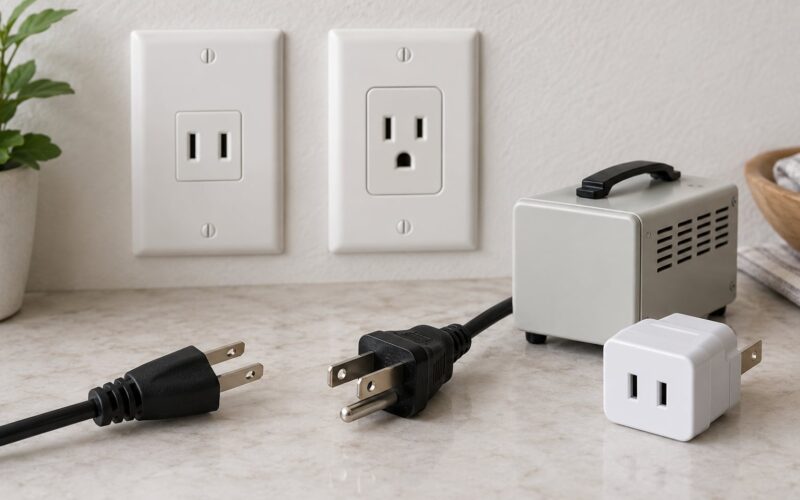
Power is the one worth taking seriously. Japan runs at 100V, while North America runs at 120V and much of Europe at 230V. Plugging a Japanese console into a 120V supply without a proper step-down transformer is a real hardware risk, not a theoretical one. Check the rating label, and use a converter with enough headroom for a console and a television on the same circuit.
Video output and controller pairing sit alongside these. Sets from the PAL era and some early hardware will produce a signal your television cannot display, or run at a frame rate that looks wrong. Controllers sold in Japan are the domestic variant, and while current PlayStation and Switch controllers pair with any regional console, older and accessory-specific peripherals may not.
Warranty is the last one, and in practice it is the biggest cost. Japanese service centres are set up for Japanese-market hardware with Japanese-market documentation, and an imported unit is usually outside that scope even though the hardware is identical.
What Should You Check Before Buying a Japanese Console?
Run through this before you pay, whether you are at a shop counter in Tokyo or buying from someone shipping to you.
Model number and region capability
Read the model number on the base or the back panel and look up what that exact number supports. Do not rely on the box, the shelf ticket or the seller’s description of it as region free.
Physical media support
Confirm the drive or card slot exists at all. Digital-only and disc editions of the same console behave differently once you get home, and the cheaper version is often the digital one.
Language options
Check the system menu languages and, more importantly, whether the games you want support English. Japanese packaging says very little about the language inside the software.
Account region and payment
Decide which storefront you will use before you sign in. Once an account is created it is bound to a region, and changing that later means starting over. Payment methods generally have to match the region of the account, so bring a card that works with the Japanese store if you intend to buy anything there.
Television and video standard
Make sure the console’s output matches your television and that any converter you need has enough capacity for both the console and the display on the same circuit.
Power supply
Read the voltage and frequency on the rating label. This is the single most important safety check on the list, and the one people skip because the store already confirmed the console works in Japan.
Controller and accessories
Check which controller is bundled and whether it pairs with the console outside Japan. Note what is not in the box, since regional bundles differ.
Warranty and return rights
Assume there is no Japanese warranty on an exported unit, and confirm what the seller’s return policy actually covers. Sellers of imported hardware frequently describe units as new and sell them with no manufacturer support behind them at all.
Total cost, not sticker price
Add the converter, any cable or adapter, the shipping, and the games themselves before deciding whether the saving is real. Import duty and freight often erase a headline price difference entirely, which is the whole reason the manufacturers restricted exports in the first place.
Frequently Asked Questions
Are all Japanese game consoles region locked?
No. PlayStation 5, Switch, Switch 2 and current Xbox hardware are not region locked at the console level, so a Japanese unit works normally overseas. The restrictions sit in the software layer: downloadable content, save data, online store accounts and payment methods. Older consoles such as GameCube, PlayStation 2, Wii, Nintendo DS and 3DS do have genuine hardware region checks.
Can a Japanese PlayStation 5 play games from other regions?
Yes. The hardware has no region lock and physical discs from other regions run on it without trouble. The part that catches people is downloadable content, which is region locked to the game, so Japanese DLC generally needs a Japanese PlayStation Network account. Save data is another layer to check for the specific title. Power voltage and warranty are separate practical concerns.
Does changing the console language make a game region compatible?
No. The console’s language setting only changes the system menu and on-screen text. It does not change how the drive, the disc or the store behaves, and it will not unlock DLC or save data. Japanese-language packaging on a box also does not mean the game inside is Japanese-only, which is why checking the language list for individual titles is more useful than reading the packaging.
Are Japanese Nintendo Switch games region locked?
Switch and Switch 2 hardware is region free, so a Japanese console plays games bought anywhere and physical and digital versions follow the same rules. What stays separate is the account and store side: the Japanese Nintendo eShop is its own storefront, and content, currency and payment methods belong to that region. Older Nintendo handhelds and the Wii U were region locked, which is where most of the confusion comes from.
Is a Japanese console warranty valid for an overseas buyer?
Rarely. Japanese service centres are set up for Japanese-market hardware with domestic documentation, and an imported unit usually falls outside that scope even when the hardware is otherwise identical. This is the most common complaint among people who bought a console in Japan and took it home. Treat the purchase as having no manufacturer support and check the seller’s own return policy carefully instead.
Conclusion
Japanese game consoles are region locked to keep cheaper domestic hardware out of markets where it was sold to earn more, and to keep ratings, licensing and store rules orderly. That is a market decision rather than a technical one, and it is not applied evenly: current hardware is largely unlocked, older consoles are not, and the layers that still bite are downloads, saves, accounts and warranty.
Before you buy, write down the exact model number, check the voltage label, and decide which storefront you will use. Those three answers settle almost everything else.