Japan built contactless payment technology two decades before ordinary shoppers wanted it. Suica and FeliCa arrived in 2001, Edy in 2004, and NTT DoCoMo’s iD in 2005, yet cash still dominated the counter well into the 2020s. The lag came from weak consumer demand, cash-centred habits, incompatible services, thin merchant incentives, and no clear value in swapping methods.
That gap is the whole story, and it is a strange one. Most countries had to invent contactless payments from scratch. Japan already owned the hardware and had the world’s most-used transit tap system going, so the technology argument is the wrong place to look for the explanation.
Here is how the delay actually happened.
Table of Contents
- 1Why mobile payments took longer to catch on in Japan
- 2Japan had contactless payment technology before the smartphone era
- 3The core issue: why mobile payments took longer to catch on in Japan
- 4How Suica, i-mode, and FeliCa shaped early expectations
- 5Why cash remained convenient and trusted
- 6How service fragmentation slowed the shift to smartphones
- 7Why merchants did not prioritize contactless payment
- 8What changed when Apple Pay and modern QR payments arrived
- 9How COVID-19 changed the pace of digital payments in Japan
- 10A timeline of Japan’s mobile-payment adoption
- 11What Japan’s slow adoption teaches the payments industry
- 12Frequently Asked Questions
- 13Why did Japan take longer to adopt contactless payments?
- 14Is Japan still a cash-only country?
- 15How did Suica and FeliCa influence mobile payments in Japan?
- 16Why did Apple Pay arrive in Japan later than in some other markets?
- 17Why are QR payments becoming more common in Japan?
- 18Conclusion
Why mobile payments took longer to catch on in Japan
Japan developed contactless payment infrastructure early, but weak demand, cash-centred behaviour, incompatible services, limited merchant incentives, and unclear consumer value kept everyday use from becoming widespread. The result is an inversion of the usual pattern: a country that led the technology lagged the behaviour.
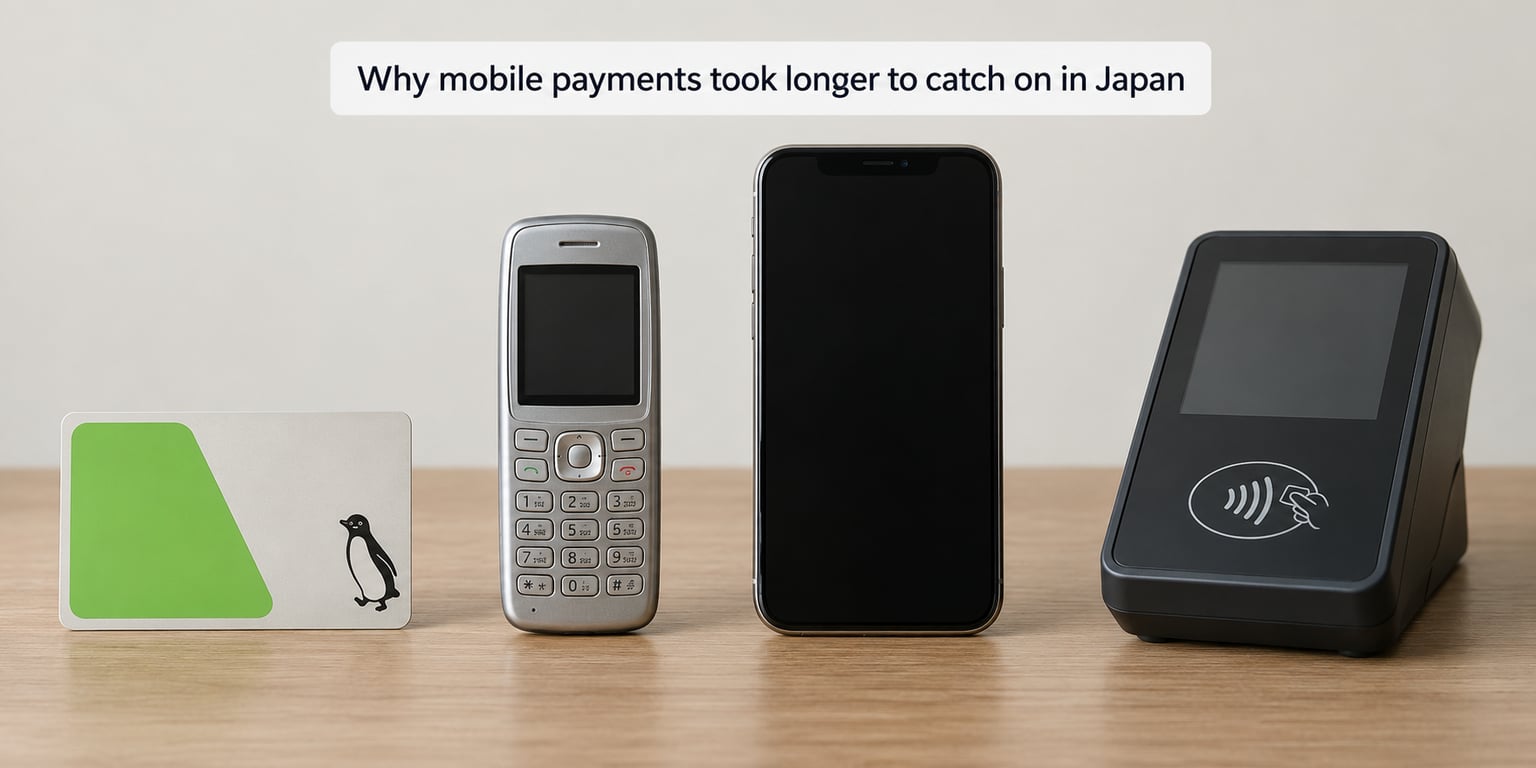
Eight forces explain most of it.
- No urgency to switch. Cash worked in every shop, every vending machine and every taxi, with no signup and no fee, so nothing forced a change of habit.
- Thin merchant economics. Terminal hardware, monthly fees and slow settlement made a payment method unattractive at a shop selling a 400-yen bowl of noodles.
- Fragmented standards. FeliCa, Edy and iD were separate closed ecosystems, so a user who loaded one wallet could not spend it everywhere the others worked.
- Operator control instead of user choice. Early mobile wallets lived inside the mobile carrier, so the phone company decided the terms rather than the shopper.
- Feature phones, not smartphones. Osaifu-Keitai money lived on handsets that could not do much else, and it read as a transit top-up tool rather than a way to shop.
- Bank inertia. Core banking systems that were hard and expensive to change meant banks were slow to expose cards to mobile wallets at all.
- Credit avoidance and an ageing population. Debt carried social stigma, and older shoppers had both less digital comfort and more cash habits to protect.
- No rewards on the counter. Without points or a reason to leave cash behind, a new payment rail was simply another button nobody pressed.
Notice what is missing from that list. None of it is a failure of engineering.
Japan had contactless payment technology before the smartphone era
By the mid-2000s Japan had contactless chips, radio-frequency tags, tap-to-pay phones, and roughly 510,000 installed terminals, with around 16 million Osaifu-Keitai handsets in circulation. That was a functioning payment network, built a decade before most Western shoppers touched a tap.
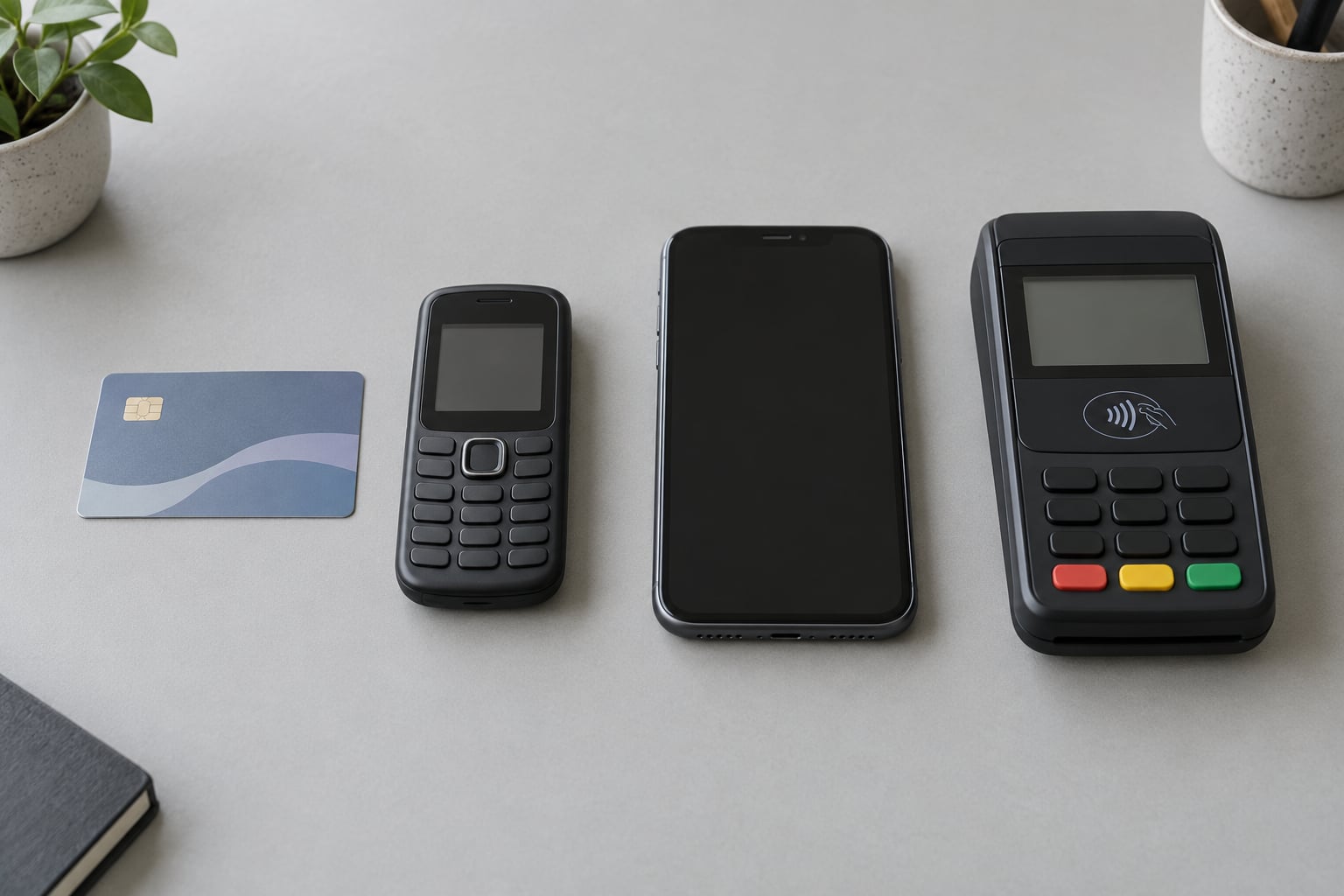
The distinction that matters is between tapping a thing and paying from a wallet. FeliCa is the contactless chip standard underneath Suica and the other railway cards. Osaifu-Keitai is the phone-based wallet that stores electronic money and can carry train fares, shop payments and small purchases.
Both existed. Neither solved the retail problem. Osaifu-Keitai was brilliant at the gate and mediocre in a shopping street, which is where the real shift to contactless had to happen.
The core issue: why mobile payments took longer to catch on in Japan
The mismatch is simple. Technical capability ran ahead of consumer demand, and demand never arrived because the case for changing was weak.
Loading a wallet meant tapping through several steps on a handset that also had to be charged, carried and topped up. The balance could usually only be spent where that specific service was accepted, and a failed tap meant standing in a queue. Cash, by contrast, needed no account, no battery and no network.
Fragmented support made it worse. Edy, iD and Pay-e were separate brands with separate top-up points and separate merchant lists. A shopper who picked one was locked into it, which is exactly the opposite of what makes a payment network valuable.
And at ordinary shops there was no reason at all. Swapping a banknote for a tap meant giving up a method everyone understood for one that only some counters accepted.
How Suica, i-mode, and FeliCa shaped early expectations
Suica, launched by JR East in November 2001, gave Japan something almost no other country had: a contactless card that tens of millions of people used every single day for trains and buses. Transit built the muscle memory.
The i-mode ecosystem extended that habit onto feature phones. DoCoMo’s mobile internet service bundled everything a commuter needed, and money on the phone grew out of that world rather than out of the retail world. By the time wallets were touching shop counters, users already thought of them as train passes with a small shop function attached.
That is a narrow expectation to build a national payment habit on. A transit card succeeds because it removes a queue at a gate. A shop payment needs a different argument: that it is faster, cheaper or more rewarding at a counter, and for years none of those claims held strongly enough.
Suica still fills convenience store shelves, vending machines and konbini counters today, and it is genuinely useful there. What it did not become in the 2000s was the default way to pay for groceries, restaurants or anything at an ordinary till.
Why cash remained convenient and trusted
Cash was not a nostalgic preference in Japan. It was the low-friction option, and every alternative charged something for the privilege.
Credit cards carried a stigma that dates back to a money-lender industry that filled the gap left by conservative banks. Borrowing and paying later on small purchases still reads as a sign of poor judgement to many shoppers, and paying with cash keeps a purchase private and unitemised.
Users on Japanese forums describe paying cash as a form of control, because a note leaves no transaction record behind. Regulars describe withdrawing a fixed monthly amount at a 7-Eleven ATM and paying in cash as normal rather than exceptional.
It would be wrong to paint this as one uniform national habit. Generational differences are large, and city convenience stores, chain restaurants and convenience store counters in metropolitan areas accept code payments widely. A cash-only counter still shows up at a small temple, a local eatery, a rural bus or an independent taxi.
What varies is not really cash versus digital. It is how much choice a given shop offers, and that maps neatly onto shop size and location.
How service fragmentation slowed the shift to smartphones
The move from feature phones to smartphones should have simplified things, and it did eventually, but it took long enough that two different problems ran in parallel. The first was device support, the second was who controlled the wallet.
Suica stayed locked to feature phones and Apple’s phones for years, which meant a phone switch could cost you your transit money. Android support finally arrived in 2016. By then the phone in a shopper’s pocket had changed twice, and so had their wallet.
The structural differences between the eras explain a lot of the delay.
| Era | Device support | Who controlled the wallet | Interoperability | Merchant coverage |
|---|---|---|---|---|
| FeliCa and Suica on cards (2001 onward) | Physical cards, later iPhone | Rail operators and card issuers | Strong inside transit, weak in retail | Excellent at gates, uneven at tills |
| Feature-phone wallets: Osaifu-Keitai, Edy, iD, Pay-e (2004-2015) | Selected carrier handsets | The mobile operator or the issuing consortium | Weak, separate closed loops | Patchy outside convenience stores and transit |
| Smartphone code payments: PayPay, Rakuten Pay, d払い and others (2016 onward) | Almost any recent smartphone | The user, through an app and a QR code | Improving, many codes still separate | Broad and growing in chains and convenience stores |
| International wallets: Apple Pay and card tap-to-pay (2017 onward) | iPhone and recent Android | The user’s bank or card issuer | High, follows the EMV standard | Growing fastest among mid-size shops |
The table shows the pattern: interoperability improved every time control moved away from the operator and toward the user. Until that happened, each phone purchase risked a wallet migration.
Bank-side inertia reinforced the same outcome from the other direction. Several Japanese banks ran on third-party legacy core systems where even a small interface change needed heavy investment, which is a large part of why card tap-to-pay on phones took years to spread beyond the largest chains.
Why merchants did not prioritize contactless payment
From a shop owner’s side, accepting a new payment method is a cost decision before it is a technology decision. A terminal has to be bought, connected, supported and reconciled, and most of those costs land on a shop with thin margins and low average transaction values.
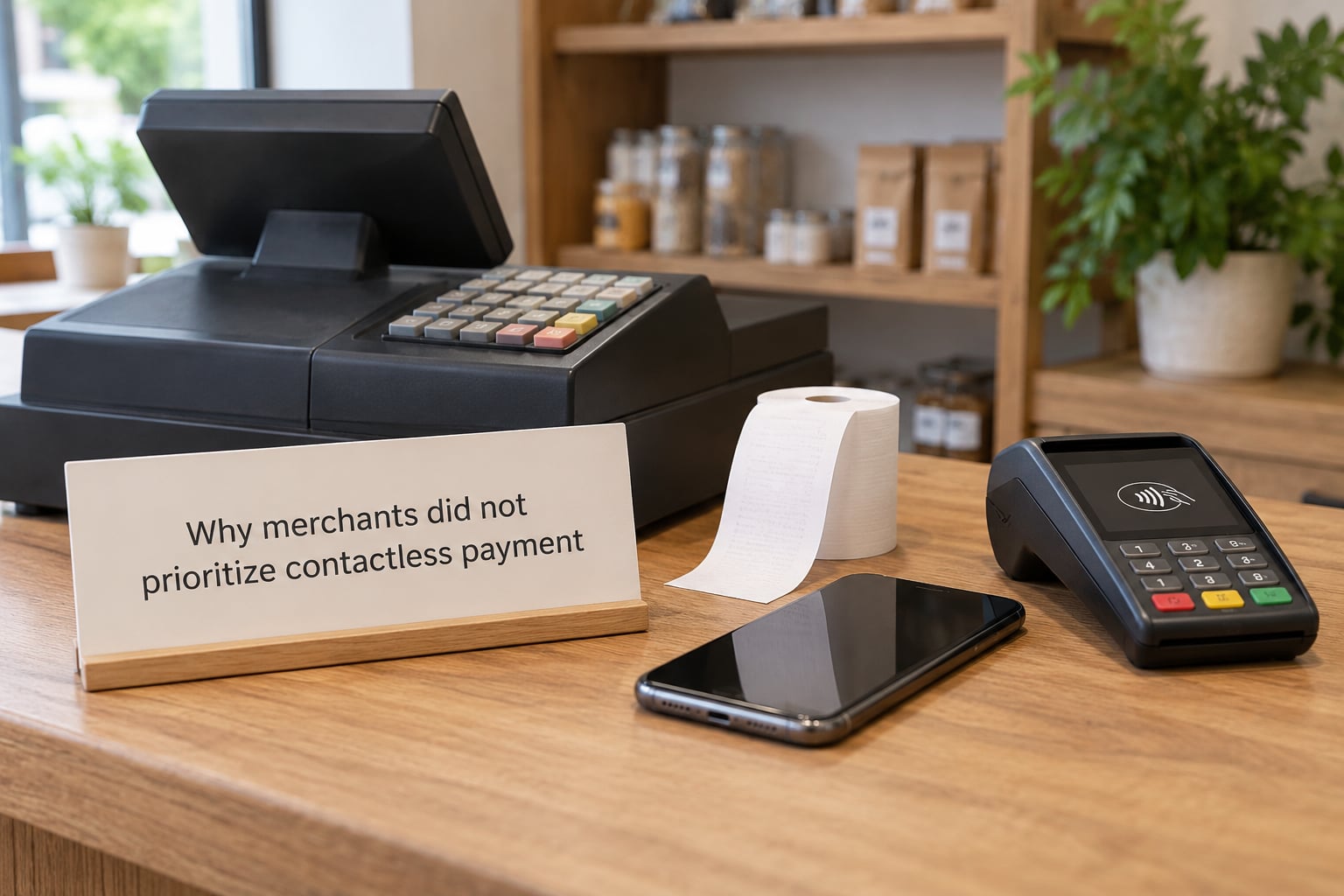
Settlement timing is the part that gets missed. Card sales traditionally paid out roughly a month after the transaction, which for a small business means funding the float yourself. Sumitomo Mitsui Card shortened that to about five days, which removed a real objection for many merchants.
Add to that a low average ticket, a customer base skewing older, and the absence of an immediate reward for trying it. A shopper who taps instead of handing over a coin saves nobody any money at the counter, so the merchant sees no return on the hardware.
Low perceived demand completes the loop. Shopkeepers look at their own customers, see mostly older people paying in notes, and conclude that a contactless terminal would sit unused. That is a reasonable read of the evidence in front of them, and it is exactly why adoption stalled at small shops while chains moved ahead.
Large operators changed the math. 7-Eleven enabled contactless payment across its whole store network in June 2020, and chains built the volume that made terminals pay for themselves. Small independents still trail.
What changed when Apple Pay and modern QR payments arrived
Two developments in the late 2010s loosened the grip of the old system. The first was Apple’s decision to support FeliCa rather than push its own closed loop, which put Suica on iPhone and gave millions of users a transit card they already trusted.
The second was the arrival of code payments. Display a QR code, the customer scans it in an app, and the money moves. It sidestepped terminal hardware entirely, so a single-purpose shop could accept payments with a printed sign instead of a device.
Contactless limits also moved. Earlier systems capped tap payments at low amounts to stay inside stored-value rules, which blocked their use for anything but small purchases. Raising those ceilings let a tap handle an ordinary shop transaction.
Tourists supplied their own pressure. Alipay and WeChat Pay entered Japanese stores first because visitors demanded them, and merchants installed acceptance for foreign wallets sooner than some of their own competitors. Japanese apps spread more slowly than Chinese ones, which people on Japanese forums frequently note with some embarrassment.
How COVID-19 changed the pace of digital payments in Japan
The pandemic pushed on the same weak spots at the same time. Concerns about touching shared surfaces made a tap at the counter feel safer, staff shortages made unattended payment attractive, and a surge in delivery demand pushed ordering and payment into apps.
Trials that had stalled suddenly had a reason. A shop that had judged contactless dead in 2019 had a practical case for it in 2020, and plenty of small businesses tested a code payment simply to keep queues moving.
What did not happen was a permanent reversal. Contactless payment offered a way to avoid touching shared surfaces rather than a way to earn rewards, so it lacked the pull that transformed other markets. Usage rose, then settled into a higher plateau once the immediate reason disappeared, and plenty of shoppers went back to the note in their hand.
A timeline of Japan’s mobile-payment adoption
Dates matter here, because the gap between introduction and ordinary use is the entire answer to the question. A technology launched on time does not mean a behaviour changed on time.
| Year | Milestone | What it changed |
|---|---|---|
| 2001 | Suica launches with the FeliCa standard from JR East | Contactless payment became a daily habit for tens of millions of commuters |
| 2004 | Edy launches as an interoperable electronic money service | A serious consumer wallet existed outside the railway system |
| 2005 | DoCoMo takes a stake in Sumitomo Mitsui Card and backs iD | A carrier and a card issuer resolved the usual telco-bank standoff |
| 2007 | Pay-e joins the electronic money market | More choice, but another closed loop rather than an open standard |
| 2010s | Cash dominates retail; many shops still decline cards | Infrastructure matured while everyday use stayed flat |
| 2016 | Suica support arrives on Android | Transit money is no longer stranded on feature phones |
| 2017 | Apple Pay launches in Japan with FeliCa support | Interoperability arrives through the global standard |
| 2018 | PayPay launches after a large SoftBank-backed promotion | Code payment becomes a mainstream consumer habit |
| 2019 | Cash still accounts for roughly three quarters of payment volume | The turning point has not arrived yet |
| 2020 | 7-Eleven enables contactless across its store network | Contactless becomes default at a major convenience store chain |
| 2022-2024 | METI pushes the 40% cashless target; banks roll out card tap-to-pay | Policy pressure and bank competition attack the last barriers |
| 2024-2025 | Point-of-sale rebates tied to consumption tax encourage cashless payment | A direct financial incentive finally reaches the consumer at the till |
Those cashless figures need care, because you will see several different numbers quoted as if they contradict each other. They usually measure different things. A figure near 18% tends to count private consumption only. The roughly 39.3% figure for 2023, covering about 126.7 trillion yen, counts consumer spending by value. A figure near 58% comes from a broader definition that includes business and person-to-person transfers, and one recent thread also put foreign visitors’ spending at 94.5% still being cash-based.
So the honest summary is that cashless payment in Japan is well past the early experiment stage and still nowhere near universal. Chain stores, convenience stores and transport are close to done. Small shops, temples, taxis and ticket machines are where cash persists.
What Japan’s slow adoption teaches the payments industry
The first lesson is that infrastructure is not demand. Japan had chips, readers, wallets and a daily-use transit card roughly fifteen years before most of its shoppers wanted to tap for groceries, and none of that hardware created a habit.
The second is that interoperability matters more than loyalty. Every closed wallet in the early era shrank the addressable network and taught shoppers that the safest choice was the one that already worked everywhere, which was cash.
The third is that the merchant decides. A rail operator cannot refuse a passenger who taps a gate, but a noodle shop with three customers in the morning has no reason to accept risk it cannot price. Improvements on the merchant side, faster settlement, cheaper hardware and a real reward at the till, changed more than any new app did.
The fourth is that incentives move behaviour faster than novelty. When a rebate attaches to the payment method at the moment of purchase, the ambiguity disappears. That is why the 2024-2025 rebate programme matters as a test case, not just as a headline.
If you are evaluating this for your own work, start by counting checkout friction rather than reading app rankings. Watch what payment methods the places you actually use accept, how long settlement takes for a small seller, and what the shopper gets for tapping. Those three answers will predict adoption faster than any forecast.
Frequently Asked Questions
Why did Japan take longer to adopt contactless payments?
Japan had contactless technology early, including FeliCa and Suica in 2001, but the reasons for slow everyday use were practical rather than technical. Cash worked everywhere with no setup or fee, small shops faced terminal costs and slow settlement, wallets were fragmented into separate closed ecosystems, and banks ran legacy core systems that made changes expensive. With no reward at the counter, there was little reason for anyone to switch.
Is Japan still a cash-only country?
No, but cash remains more important than almost anywhere else in the industrialised world. Chain convenience stores, supermarkets, pharmacies and transport largely take code payments and contactless cards. Cash still dominates at small independent shops, local restaurants, temples and shrines, some taxis, ticket machines and rural buses. Published cashless rates also differ sharply depending on whether they count private spending, all consumer spending or person-to-person transfers, so check the definition before quoting a number.
How did Suica and FeliCa influence mobile payments in Japan?
Suica, launched by JR East in 2001 on the FeliCa contactless standard, gave Japan a payment method that commuters used every day at train gates. That built nationwide familiarity with tapping and made electronic money unremarkable. It also shaped expectations in a limiting way: people learned to think of contactless payment as a transit tool rather than a way to shop, so extending it to ordinary retail took much longer than extending the rail network.
Why did Apple Pay arrive in Japan later than in some other markets?
Apple launched Apple Pay in Japan in 2017, years after the United States, and the delay came down to standards. Apple needed a local contactless system that carriers, banks and merchants would all accept, and Japan had FeliCa rather than the EMV standard used elsewhere. Rather than build a competing system, Apple supported FeliCa, which meant waiting for operators, banks and shops to line up behind it. The delay was coordination, not technical inability.
Why are QR payments becoming more common in Japan?
Code payments suit Japan’s small-shop problem. A merchant needs a printed sign or a phone screen rather than a wired terminal, so a single-purpose shop can accept payment cheaply and quickly. Backed by large promotion and familiar point programs, services like PayPay and Rakuten Pay became ordinary habits during the pandemic era. Recent consumption tax rebates tied to cashless payment add a direct financial reason to tap or scan.
Conclusion
Japan was a pioneer of payments technology whose infrastructure arrived decades before its everyday retail behaviour did. FeliCa, Suica and Osaifu-Keitai built the rails early, and then cash habits, closed wallets, slow bank systems and weak merchant incentives kept the trains empty.
If you are judging payment adoption for yourself, do it the way the shops do. Count the methods your regular places actually accept, check what a small seller would need to add one, and weigh the friction at the till against the note in your hand. That is the calculation that decided Japan’s last two decades.