A Japanese electronics model number is an alphanumeric code the manufacturer prints on the rating plate, and it usually reads in four parts: series letters, a generation or tier letter, a model number, and a suffix. That suffix typically flags region, voltage, colour system or revision.
That definition sounds tidy, but real labels never look like a clean template. A Sony receiver plate might say STR-DE585, a Panasonic television might say TH-42PX80A, and a tape deck bought in Japan might say something entirely different from the version sold in Europe. Each of those strings answers the same three questions once you know the grammar: what product line is this, which version of that line am I holding, and will it actually work where I live?
Japanese makers have used a broadly shared naming convention since the postwar electronics boom, which is why the method transfers once you know it. This guide gives you a repeatable six-step process, per-brand pattern tables for twelve manufacturers, a suffix cheat sheet, and five worked examples with the literal model strings visible. Where a pattern is a documented convention I say so. Where it is a typical habit rather than a published rule I say that too, because most hobbyist decoding knowledge was reverse-engineered by comparing sibling models and nobody wrote the results down.
Last reviewed: October 2026. Naming conventions shift over time, and some suffixes remain undocumented by the manufacturers themselves.
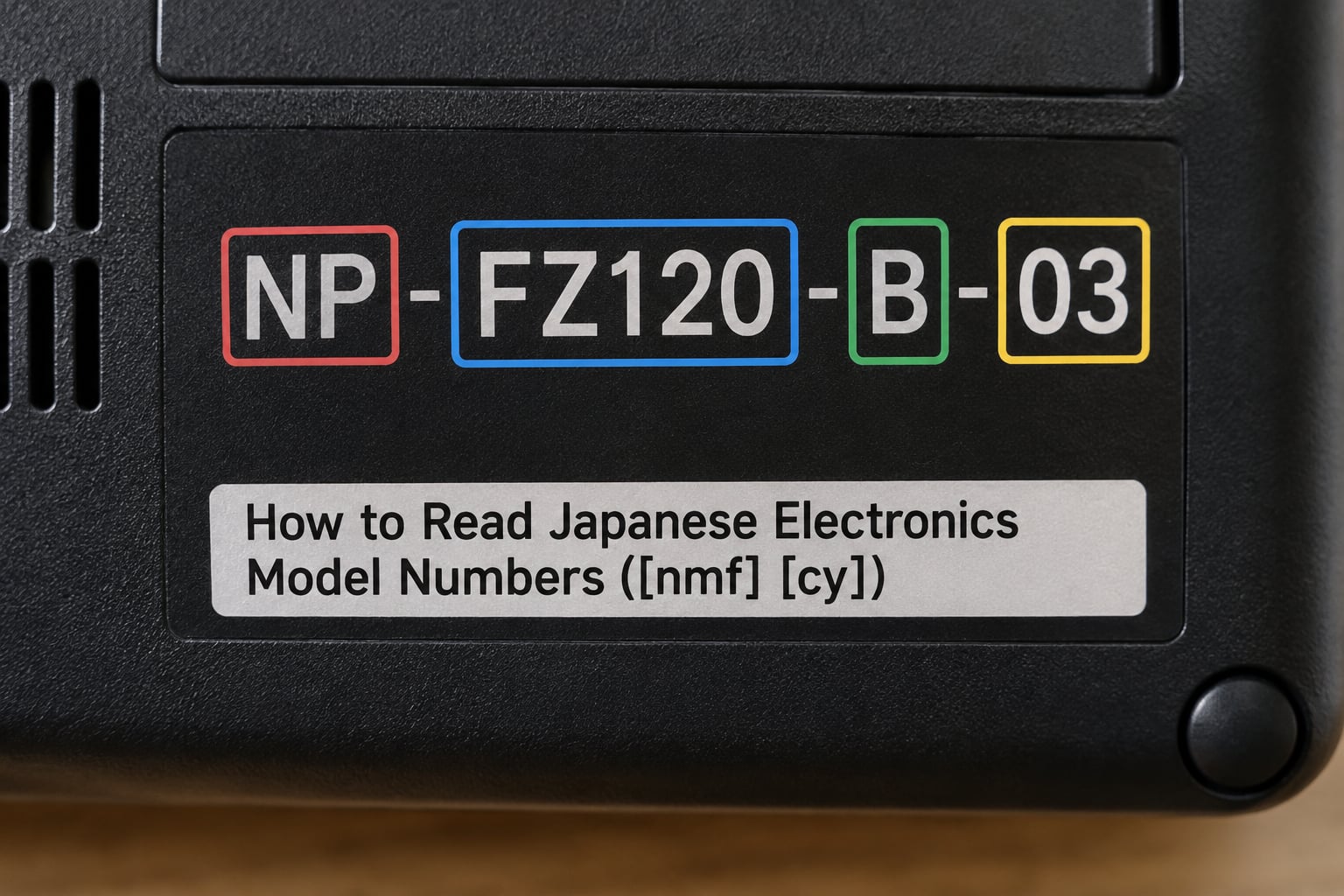
Table of Contents
- 1What You Need
- 2Model Number, Serial Number or Part Number?
- 3Step-by-Step: How to Read Japanese Electronics Model Numbers
- 41. Transcribe the Whole Code Exactly
- 52. Identify the Manufacturer or Brand
- 63. Split the Series From the Variant
- 74. Decode the Letters and Digits by Meaning
- 85. Check the Official Manufacturer Documentation
- 96. Check Compatibility Before You Buy
- 10A Worked Example, Character by Character
- 11How to Read Japanese Electronics Model Numbers by Brand
- 12Sony
- 13Panasonic, Technics and the National name
- 14JVC and the Victor domestic split
- 15Kenwood, Denon and Pioneer
- 16Sharp, Toshiba and Yamaha
- 17Vintage and specialist makers
- 18Suffix Cheat Sheet: What the Last Letters Usually Mean
- 19Where to Find the Model Number on Different Devices
- 20Common Mistakes
- 21Frequently Asked Questions
- 22Is the model number the same as the serial number?
- 23Can I tell what year my Japanese electronics was made from the model number?
- 24Why does my Japanese TV say no signal with US cables?
- 25What does 100V mean on a Japanese stereo, and is it Japan-only?
- 26Do all Japanese electronics brands use the same model number format?
- 27How do I get a service manual for a Japanese model number?
- 28Conclusion
What You Need
Four things, and none of them expensive. The first is the physical rating plate on the device, or the box if the device is a casualty. Japanese makers are legally required to carry the model designation on the product itself, so it is almost always there even when the manual is long gone.
The second is the manufacturer name in Japanese or English. You do not need to translate anything. Kanji brand names such as 松下, 日立, 東芝, -national or ソニー on an old plate simply tell you which brand to search; the model string underneath is usually Latin characters and digits.
The third is a clean transcription. Photograph the plate and retype the code into a plain notes app. Photographing alone is not enough, because a code you read from a photo is a code you will misread later when you are three search results deep and tired.
The fourth is access to the brand’s own documentation. Each manufacturer publishes a product archive and usually a support or service section, and those pages are the only authority that matters when a suffix turns out to mean something specific and counter-intuitive. If you read electronics in English, the English support site is usually enough.
Optional but helpful: a unit of Japanese currency in the bank for parts listings on Japanese marketplace sites, and a rough sense of the era the device came from, since makers often change their letter systems once or twice per decade.
Model Number, Serial Number or Part Number?
Before decoding anything, confirm you are holding the right string. This single distinction causes more wasted support calls and mismatched parts orders than any other mistake in this whole process.
| Identifier | What it identifies | Changes per unit? | Use it for |
|---|---|---|---|
| Model number | The product design, exactly as sold | No | Support calls, manuals, parts lookup, listings |
| Serial number | One individual manufactured unit | Yes | Warranty registration, theft claims, provenance |
| Manufacturer part number | A specific spare or assembly | No | Ordering replacement parts and boards |
A practical tell: model numbers are shared by every unit of that design, so they are not unique. Serial numbers are unique and often longer. Part numbers look nothing like the model number even when they describe the same product, because they were assigned by the parts division rather than the product division.
On Japanese plates the three are usually labelled in kanji, and the kanji tells you which string you have:
- 形名 (keimei) — the model number, the design designation
- 製造番号 or シリアルナンバー — the serial number of the individual unit
- 品番 (hinban) — the part number for service and spares use
When you contact a repair shop or support line, quote the model number first and the serial number only if they ask for it. Plenty of repair databases are keyed on the model number alone, and quoting the serial number instead returns nothing at all.
Step-by-Step: How to Read Japanese Electronics Model Numbers
1. Transcribe the Whole Code Exactly
Copy the complete string including every hyphen, and keep the capitalisation visible. Note whether the plate uses a capital O or a zero, and whether a suffix sits at the end or the start, because both vary by maker.
Photograph-based OCR is the main source of errors here. It routinely confuses 0 with O, 1 with I, S with 5, B with 8, and it drops hyphens. If you have any doubt, zoom in and read each character against its neighbours rather than trusting a single pass.
How you know it worked: typing the code into a search engine returns pages from the manufacturer’s own domain for that product family. If you get nothing sensible, the transcription is wrong, not the search.
2. Identify the Manufacturer or Brand
The brand usually comes from the logo, but it is worth checking the kanji on the plate, because the same company has shipped under several names. Matsushita sold as Panasonic internationally and National domestically, and Panasonic audio still carries the Technics badge on higher-end components. JVC sold as Victor inside Japan and JVC everywhere else. A model that looks like a foreign-market unit in a Japanese listing may be exactly the opposite.
A familiar-looking code can also belong to a different division. Denon, Pioneer and Kenwood are three separate companies with three separate naming systems, and none of them encodes the way the others do.
How you know it worked: the brand’s support site returns a product archive or a parts list that includes your exact code, not a near miss.
3. Split the Series From the Variant
Most Japanese model codes follow the same grammar, even when the letters differ. A typical pattern is a short letter group naming the series, an optional generation or tier letter, a numeric block identifying the model, and a trailing letter block naming the variant.
Look at STR-DE585 and the split is visible: STR is the series, D is a generation letter, E is a tier letter, 585 is the model number. Now look at KX-880 and the shape is different: KX is the series and 880 is the model number, with no generation letter present. The lesson is not to memorise one template but to test which parts of the string repeat across sibling models.
How to find the boundary: list two or three adjacent models from the same product line and see which segments change together. If the leading letters stay put while the digits climb, that is your series-versus-model split.
4. Decode the Letters and Digits by Meaning
Within that split, the digits are usually the model identifier and the letters carry the meaning. Typical recurring signals:
- Leading letters name the product family and often imply the price tier, with fewer letters generally meaning a bigger or better product.
- A letter standing alone between series and digits is usually a generation marker, and Sony is the most systematic example of this.
- Trailing letters are the variant block: colour, tuner region, voltage, colour system, revision, or a bundle.
- Digits inside a trailing block often mean something narrow, such as a channel count or a regional tuner code.
Treat all of this as a working hypothesis. The test is always whether sibling models behave the way your hypothesis predicts.
5. Check the Official Manufacturer Documentation
Go to the manufacturer’s support or service section and look for a product archive, a parts list, or a downloadable service manual. Service manuals are the strongest source available to an outsider, because they list the model designation, the service parts for it, and often the domestic and export designations side by side.
Warranty registration pages also confirm which variants were officially sold in which market, which is exactly the question an importer needs answered. A model that never appears on the US parts list is a model where replacement parts get expensive and slow.
How you know it worked: the manual or archive page names your exact code, and any suffix meaning it shows matches what the plate says.
6. Check Compatibility Before You Buy
The model number tells you what the device is. It does not tell you whether it will work for you. Run these checks every time, especially on anything bought second-hand in Japan:
- Voltage. Japanese domestic equipment is commonly built for 100V AC. That is half the supply of most of Europe and the UK and one third of North American mains, so a domestic unit can run slowly, run hot, or not start at all. Appliances, kettles and rice cookers are the strict ones.
- Plug type. A domestic unit will have a Type A plug, which will not fit a Type G or Type B socket without an adapter.
- Tuner region. Japanese television tuners are built for a broadcast standard and channel plan that will not receive North American or European over-the-air signals. Satellite and streaming models are a different story and often work fine.
- Colour system. Older video decks and monitors may be fixed to one video standard only.
- Language and menu. Domestic models frequently ship with Japanese-only menus and no language option, or with a region lock that has to be cleared with a service code.
- Accessories. Remote controls, batteries and chargers for domestic models are often region-specific and rarely interchangeable with the export version.
- Warranty and radio rules. A unit imported outside its official sales channel gets no local warranty, and anything with a radio transmitter faces local radio approval rules that are separate from any model number.
The PSE mark on the plate is worth understanding too. It is Japan’s electrical safety certification, and the domestic and export versions of the same product may carry different marks under different rules. A PSE mark tells you the product was assessed for Japan. It does not tell you it was cleared anywhere else.
A Worked Example, Character by Character
Take STR-DE585 as a type, with the caveat that the letters beyond the model number are the part readers most often get wrong:
| Segment | Likely meaning | Confidence |
|---|---|---|
| STR | Sony series prefix used across its audio-video and stereo receiver families | Consistent, documented pattern |
| D | Generation letter, showing family era rather than a specific feature | Typical pattern |
| E | Position within the generation, usually a step below the letter above it | Typical pattern |
| 585 | The model designation, shared by every unit of this design | Certain |
The useful conclusion is not the letter meanings. It is that this code identifies one specific receiver design, and that is the string you quote for the manual, the parts list and the service centre. The letter interpretation helps you date it relative to siblings.
How to Read Japanese Electronics Model Numbers by Brand
What follows are typical patterns, not published universal rules. Brands rewrite their nomenclature periodically, and a pattern that held for the 1990s may not hold for a current product. Use each table as a hypothesis generator, then confirm against official documentation.
Sony
Sony is the most documented of the group because its letters follow a fairly consistent internal order. The series prefix names the product category, a following letter marks the generation, a further letter marks the tier within that generation, and the digits identify the model.
| Part of the code | Typical role | Example shape |
|---|---|---|
| Three-letter prefix | Product family, and often the size class | STR, CMT, STR-DE family prefixes |
| First letter after prefix | Generation letter | A through N family progression, plus W and X in later eras |
| Second letter | Tier or feature set within the generation | A step up or down from the letter before it |
| Trailing letter | Region, colour or revision variant | Appended after the digits |
The generation letters A, B, C, D, E, F, G, H, J, K, N, W and X appear often enough that Sony collectors sort by them directly. The usual reading is chronological, with notable gaps where a letter was skipped, and with W and X standing apart because they belong to a different naming era rather than continuing the same ladder.
A Sony Bravia television string works differently. On sets, the leading TH or KD prefix denotes the category, digits denote the screen size in centimetres on some ranges and inches on others, and a trailing letter commonly distinguishes one of several very similar panel or tuner revisions.
Panasonic, Technics and the National name
Matsushita used three names, and the one on your label tells you which documentation set applies. Consumer electronics sold in Japan carried the National name, the same company exported as Panasonic, and its high-end audio line was badged Technics.
| Brand on label | What it means for decoding | Example shape |
|---|---|---|
| Panasonic | Export or global-market naming, often with region letters | TH-series televisions, SA and NS audio series |
| National | Domestic Japanese naming, frequently shorter codes | Domestic receiver and tape deck codes |
| Technics | The prestige component line, codes often ending in 0 | SU, SE and SL turntable and amplifier series |
Panasonic television codes break down into the category prefix, a screen-size block, a series letter for the feature tier, and a trailing digit for the revision. A common question is what the last letter means on a Panasonic TV. Typically it is the revision within that model year, and the practical difference between revisions is usually tuner or firmware rather than panel specification. That said, a trailing letter on a Panasonic camera or cordless phone often means something entirely different, such as a colour or a kit bundle, which is why the same letter cannot be read the same way across product categories.
JVC and the Victor domestic split
This is the trap that catches people buying in Japan. JVC is the export brand and Victor is the domestic brand, both belonging to the same company, and Japanese listings often use Victor codes for machines that were never sold under that name abroad.
| Part of the code | Typical role | Note |
|---|---|---|
| Two-letter series family | Video deck, video camera or audio family | MX and AV families for decks, RC-D style for other video kit |
| Digit block | Model designation | The part you quote for parts and manuals |
| Trailing letter or digits | Region, deck count, or revision | Widely debated and often undocumented |
Because the trailing character on JVC video decks has caused so much argument, treat any confident interpretation with suspicion. The reliable move is to confirm the code against the service manual for that exact designation.
Kenwood, Denon and Pioneer
These three are frequently lumped together and then decoded incorrectly, so separate them. Kenwood codes are usually a short letter prefix plus a model number, with letter count hinting at tier: KX across the receiver range, and longer prefixes for specialist equipment. Pioneer follows a similar shape across its SX and CT families. Denon is distinctive because many of its codes use letters plus a four-digit number that itself encodes the era.
| Brand | Typical shape | What the letters usually signal |
|---|---|---|
| Kenwood | Two or three letters, hyphen, digits | Series family; longer prefixes mean specialist or lower-tier kit |
| Denon | Letters then four digits, sometimes plus a letter | Series family; the digit block also shifts with the era |
| Pioneer | Two or three letters, hyphen, digits | Series family, with SX for receivers and CT for tape decks in classic usage |
Vintage receivers from all three follow the pattern where the digit count grows over time, and where a four-digit model number from one decade is not comparable to a three-digit one from the decade before. Comparing sibling models within a single range is always more reliable than comparing a number across decades.
Sharp, Toshiba and Yamaha
| Brand | Typical shape | Reading tip |
|---|---|---|
| Sharp | Letter prefix, hyphen, digits, often a trailing letter | Audio and video lines share a shape, so the product category matters |
| Toshiba | Letter prefix, hyphen, digits, sometimes a trailing letter | Television codes often lead with the screen size, which makes them unusually readable |
| Yamaha | Letters then digits, often with a hyphenated block | Product category prefixes are long and descriptive, which helps with identification |
Mitsubishi, Hitachi, Sanyo and Sharp share the same broad grammar, and Hitachi in particular tends to place a short category prefix before a model block that encodes size or tier directly.
Vintage and specialist makers
For pre-1980 Made in Japan equipment, Sansui, Pioneer and Kenwood used conventions that predate the modern systems. Sansui in particular used long letter-and-digit codes whose meaning shifts with the decade, and Kenwood’s early amplifiers and tuners use letter counts as a tier signal in a way later ranges abandoned.
Technics components from the late 1970s and 1980s usually end in 0, and that single character is one of the more reliable vintage signals in existence. It marks a domestic-market component, which tells you it was built for 100V and for the Japanese market only.
Suffix Cheat Sheet: What the Last Letters Usually Mean
Use this as a prompt for what to look up, not as a substitute for looking it up. Suffix meanings are the least consistent part of any brand’s system.
| Code or suffix | Typical signal | Seen on |
|---|---|---|
| A trailing single letter | Revision within the model year | Most brands, TVs especially |
| A trailing block such as /BS, /FS, /S, /K, /(E) | Tuner type, broadcast standard, or regional sales channel | Television and video brands |
| Trailing digits | Channel count, deck count, or regional tuner code | Video decks and multi-tuner sets |
| A leading digit rather than letters | Domestic rather than export variant on some ranges | Vintage audio, especially Technics |
| A trailing 0 | Domestic-market component on classic Technics gear | Technics and some Panasonic-era hi-fi |
| Region abbreviations | Intended market, which decides voltage and tuner | All brands with export variants |
One honest caveat, taken straight from repair forum practice: most suffix meanings in circulation were derived by hobbyists comparing sibling models, not from published manufacturer documentation. Where an interpretation cannot be checked against an official page, treat it as a hypothesis.
Where to Find the Model Number on Different Devices
Every Japanese-market device carries its model designation somewhere on the body. The location follows a pattern by category.
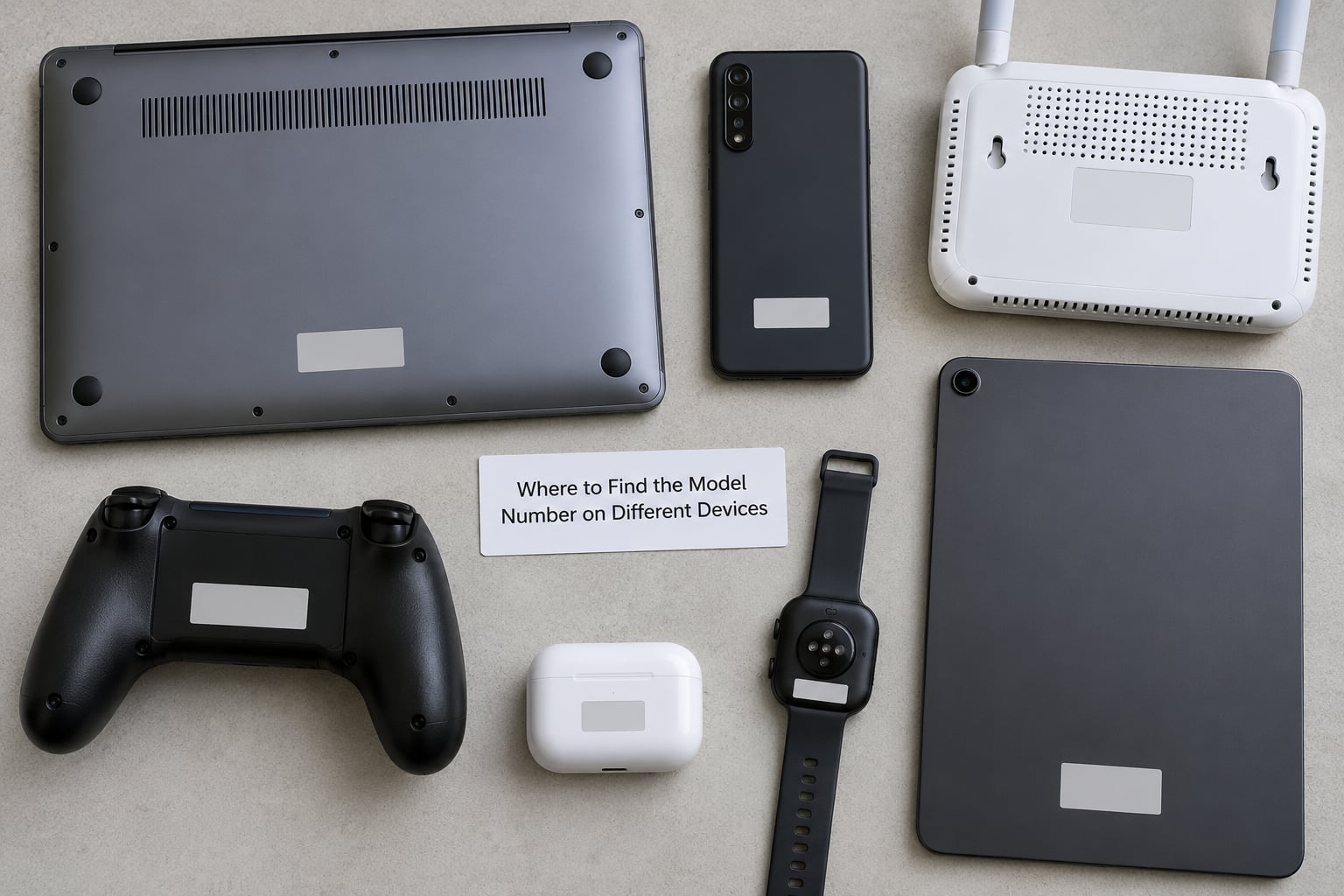
| Device type | Where to look | Watch out for |
|---|---|---|
| Television | Rear panel or stand recess, usually on a white rating label | Two codes on one label: model and serial |
| Audio receiver or amplifier | Rear panel beside the AC inlet, on a metal or paper plate | Voltage and current ratings printed next to it |
| Tape deck | Underside or rear, often on the chassis itself | Deck mechanism code differs from the product model |
| Camera or camcorder | Underside near the tripod mount, or inside the battery compartment | Region suffix is the important character for imports |
| Mobile phone | Under the battery, on the SIM tray area, or on the back cover | Network and carrier bands are not always in the model code |
| Car audio or navigation head unit | Faceplate or chassis label | Domestic-only chassis often lacks a release slot |
| Kitchen and small appliance | Base or underside rating plate | Voltage and frequency matter most here |
For phones specifically, the model designation is often a shorter internal code than the marketing name, and the region is sometimes encoded as a separate line rather than a suffix. Reading a phone code takes more work than reading an audio component code, which is another reason to check official documentation before ordering anything for one.
Common Mistakes
Treating every brand as if it uses one shared format. The grammar is shared, the letters are not. The fix is to work on one brand at a time and build the pattern from that brand’s own sibling models.
Reading a serial number as a model number. The serial number looks similar and produces no results in a parts database. The fix is to look for the kanji labels described earlier and quote the model designation.
Ignoring the domestic-versus-export split. Victor versus JVC, National versus Panasonic, and a leading-digit domestic code are all real traps in Japanese listings. The fix is to check whether the code appears anywhere in the export market’s documentation for that brand.
Assuming the trailing letter means the same thing across categories. A revision letter on a television may mean a colour or a bundle on a camera. The fix is to decode within a single product category only.
Misreading characters from a photograph. Zero against letter O, S against 5, and missing hyphens are the usual culprits. The fix is to zoom, compare neighbouring characters, and retype rather than copy-pasting an OCR result.
Skipping the voltage check. A 100V domestic unit will not simply work on 240V mains, and the failure mode can be a slow motor or a warm transformer rather than an obvious refusal. The fix is to read the rated voltage on the plate before anything else.
Buying from an unreliable seller who did not test the tuner. Region-locked tuners are the most common disappointment in an imported television. The fix is to ask for a photograph of the tuner region setting or a return path if it does not work.
Believing the model number proves the age of the unit. The code narrows the era but does not date the individual device, and a production line can run a model number for years. The fix is to use the serial number or manufacture plate for dating, and to treat model-number year ranges as approximate.
Treating an unofficial decoder as authoritative. Community tables are genuinely useful, but they disagree with each other constantly. The fix is to keep the best source you have: the service manual for that exact model.
One last practical tip. When you do find a decoder or a forum thread that gets it right, save the model number, the interpretation and the source together. The next time you see that brand’s naming pattern, you will not have to rebuild it from scratch, and the notes take about thirty seconds to write.
Frequently Asked Questions
Is the model number the same as the serial number?
No. The model number identifies the product design and is identical on every example of that design. The serial number identifies one individual device and is unique to it. When contacting a manufacturer or a repair shop, quote the model number first because parts databases and service manuals are indexed by it. On a Japanese rating plate, the model number is usually marked in kanji and the serial number sits beside it under a different label.
Can I tell what year my Japanese electronics was made from the model number?
Usually not with certainty. A model number narrows the era because a given code is only used for part of a product line’s life, and brands reuse letter patterns across decades. To date an individual unit, read the manufacture plate or use the serial number where the brand publishes a date code. Treat any year range decoded from the model number as approximate and confirm it against official documentation for that brand.
Why does my Japanese TV say no signal with US cables?
Japanese-market television tuners are built for a broadcast standard and channel plan used in Japan, so they will not tune North American over-the-air signals. This is a tuner issue, not a cable or input issue, and the model number often reveals it through a regional suffix. Satellite and streaming models from Japan generally work fine because they rely on internet services rather than an over-the-air tuner.
What does 100V mean on a Japanese stereo, and is it Japan-only?
It is the rated mains voltage of the device, and on many classic Japanese audio components it marks a domestic-market model built for Japan’s 100V supply rather than the 240V or 120V used elsewhere. Such units may underperform or overheat on a different supply voltage. Before powering one up, read the rated voltage and frequency on the plate, and use a step-down transformer if the device is designed for a lower voltage than your mains.
Do all Japanese electronics brands use the same model number format?
They share a common grammar, but not the same letters. Most Japanese makers build codes from a series prefix, an optional generation or tier letter, a numeric model block and a trailing variant. The letters assigned to each part differ completely between brands and change over time, so a pattern learned on one brand rarely transfers directly to another. Learn one brand at a time and confirm the rest against official documents.
How do I get a service manual for a Japanese model number?
Search the manufacturer’s own service or support section using the model designation, not the serial number. Most large Japanese makers publish product archives and parts lists, and service manuals for older equipment often come from the same page or from dedicated service documentation sites. If the manufacturer has no page for the code, check whether the model was domestic-only, because those were frequently documented under the domestic brand name instead.
Conclusion
Start with three actions. Write the complete model number down exactly, including hyphens and the trailing letters. Identify the manufacturer from the logo or the kanji on the plate, and check whether that company used a different domestic brand name. Then confirm the exact regional version in official documentation before you commit, because that is where voltage, tuner standard, language and warranty questions all get answered.
Everything after that is interpretation, and interpretation is the easy part once the string is correct and the brand is known. Treat the patterns in this guide as a starting hypothesis rather than a verdict, and let the service manual settle any argument.