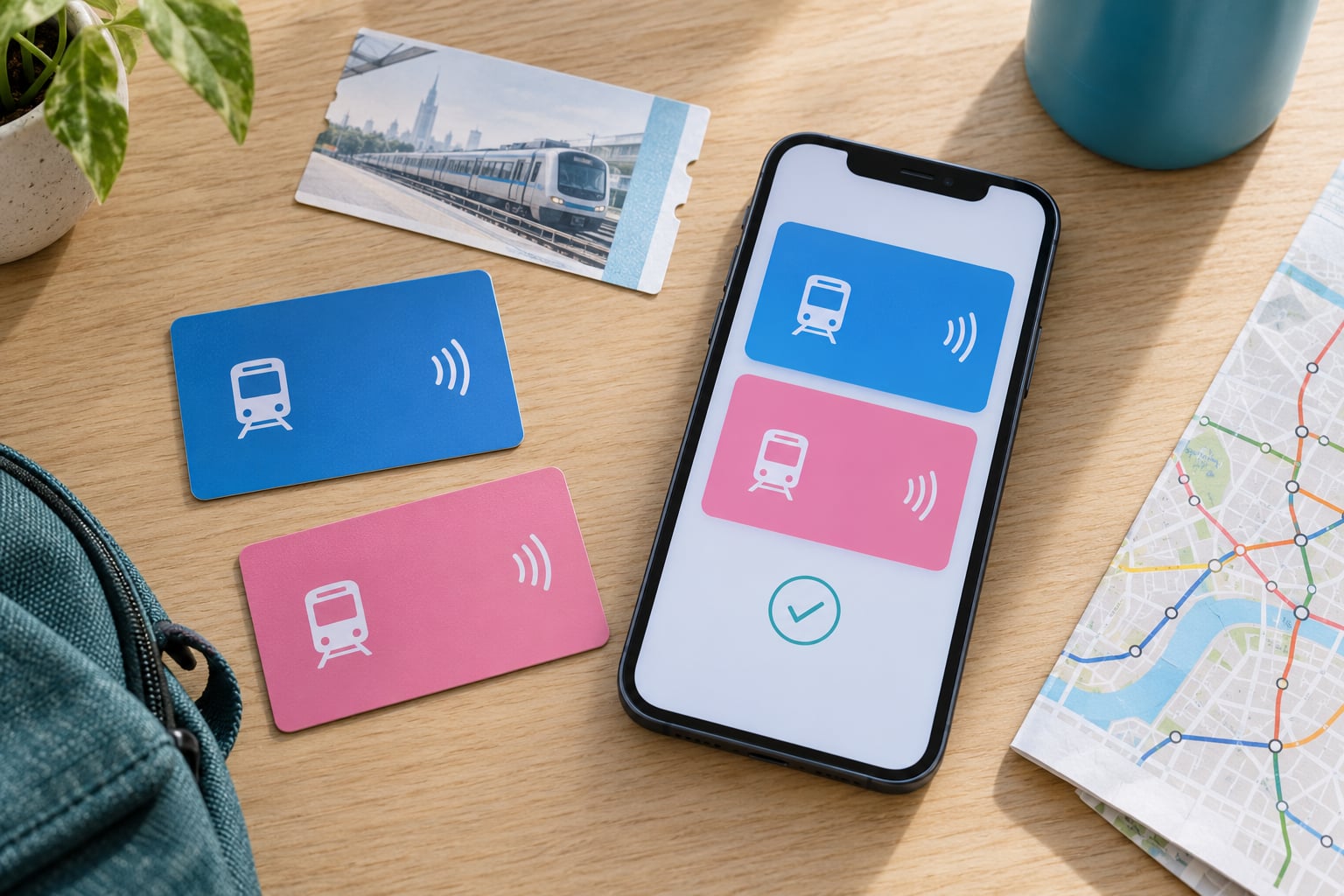
Suica and PASMO are functionally identical for visitors: the same gates, the same nationwide network, the same convenience store payments. The only real choice is tourist card, regular card, or mobile app, and that choice is decided by your phone type and how long you are staying.
That is the short version. The details that actually matter on the ground are where you can buy each card on arrival, how much value to load, and what happens to the balance when you fly home.
Table of Contents
- 1Suica vs PASMO for Visitors at a Glance
- 2Which Card Is Easier for Visitors to Buy?
- 3Where to buy on arrival, terminal by terminal
- 4Suica vs PASMO: Transport Coverage and Acceptance
- 5Suica vs PASMO: Fees, Top-ups, and Refunds
- 6How much to load for 7, 10 and 14 days
- 7Which Card Is Better for Everyday Travel?
- 8Suica vs PASMO: Problems Visitors May Encounter
- 9Which Should You Choose?
- 10Frequently Asked Questions
- 11Can tourists use PASMO in Japan?
- 12Should I buy PASMO or Suica?
- 13How much money should I put on my Suica card for 10 days?
- 14Do I need both Suica and PASMO?
- 15Can you use 1 Suica card for 2 people?
- 16Where can I buy a Suica card as a tourist?
Suica vs PASMO for Visitors at a Glance
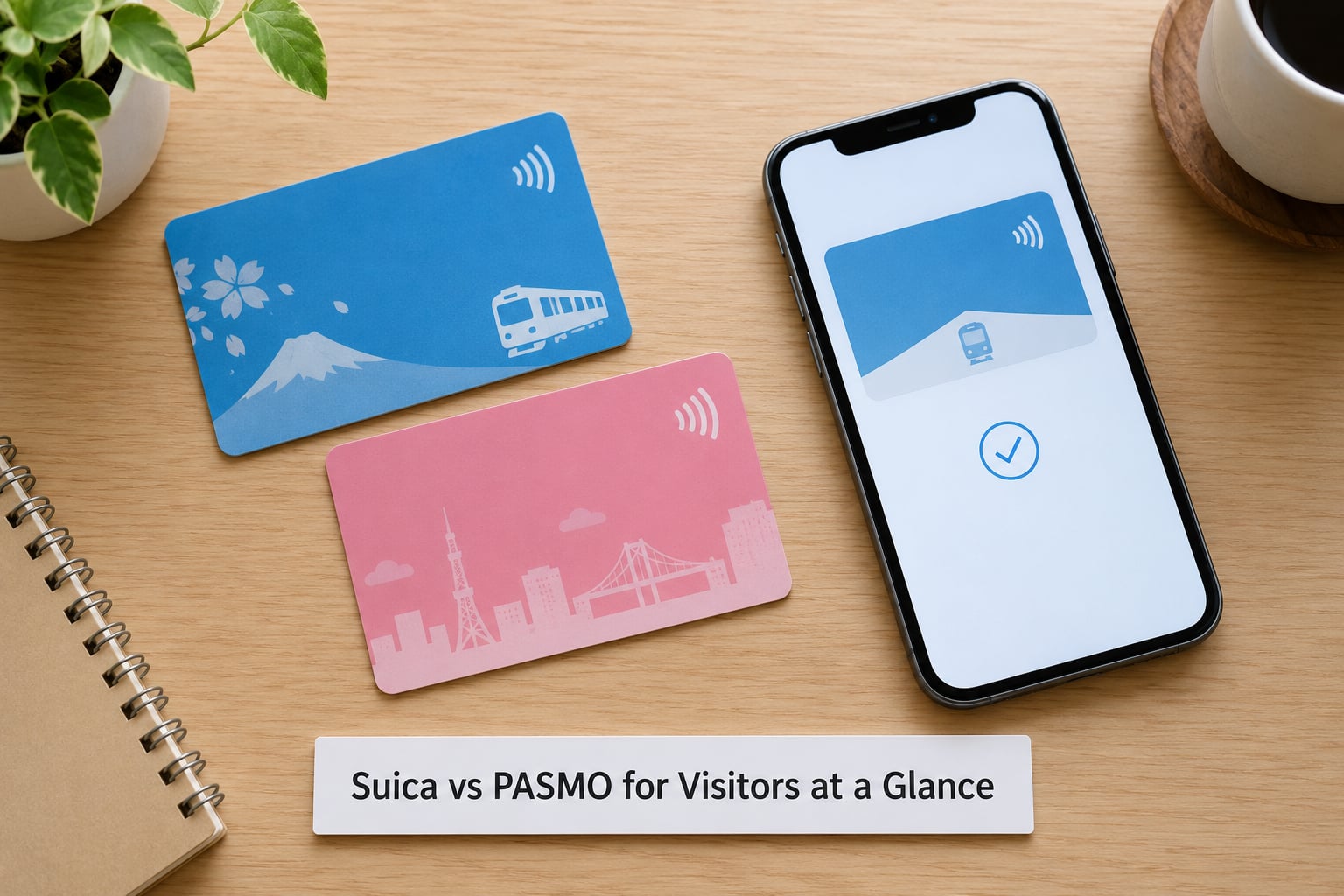
Suica is issued by JR East. PASMO comes from Tokyo’s private subway and bus operators. That issuing difference decides where you buy the card and who handles the refund, and almost nothing else.
| Card | Who it is for | Deposit | Validity | Deposit refundable |
|---|---|---|---|---|
| Welcome Suica (physical) | Tourists, trips under 28 days | None | 28 days | No deposit to refund; remaining balance is not refundable |
| Welcome Suica Mobile | iPhone users, launched 6 March 2025 | None | 180 days from issue | No |
| Tourist PASMO | Tourists, launched 20 May 2026 | None | 28 days | No |
| Regular Suica or PASMO | Residents, long stays, repeat visitors | ¥500 | 10 years from last use | Yes, at a JR East or PASMO counter, minus a handling fee of up to ¥220 |
One more number worth knowing before you buy anything: the balance on any of these cards is capped at ¥20,000.
Which Card Is Easier for Visitors to Buy?
The visitor versions are easier, and that is the whole reason they exist. Regular cards were pulled from sale during the chip shortage of 2023 and returned in March 2025, but buying one still means a counter visit with a Japanese address on file, and a passport alone will not do it.
That leaves three realistic options on arrival: Welcome Suica, Tourist PASMO, or Welcome Suica Mobile. The first two are physical, sold at airport counters and station machines, and need nothing but cash or a card. The third lives inside Apple Wallet.
Where to buy on arrival, terminal by terminal
At Narita, the JR EAST Travel Service Center is the reliable spot, and the Tourist PASMO and Welcome Suica vending machines sit in the arrivals area of each terminal. Reported counter hours run roughly 08:15 to 19:00. If you are taking Keisei or the Skyliner, the Keisei counters in Terminal 1 and Terminal 2 stock Tourist PASMO too. At Haneda, the JR EAST Travel Service Center is in Terminal 3, with the Keikyu Tourist Information Center nearby for Keikyu lines; reported hours there are about 06:45 to 20:00. Haneda Terminal 2 is the awkward one, so plan to walk to Terminal 3 or buy online before you land.
Mobile changes the arithmetic completely, but only for some people. Welcome Suica Mobile runs on iPhone 8 or later with iOS 17.2 or later, and stays valid for 180 days from issue. Android phones sold outside Japan generally lack the FeliCa chip these cards need, and Samsung is expected to add FeliCa support from 2027. If you are on an international Android, stop reading mobile guides and buy the physical card.
One stale piece of advice to ignore: the PASMO Passport, the old three-week tourist card, was discontinued in October 2024. Any guide still telling you to look for it is out of date.
Suica vs PASMO: Transport Coverage and Acceptance
Both cards sit on the same ten-card mutual-use network, alongside ICOCA in Osaka, TOICA in Nagoya, manaca in Fukuoka, Kitaca in Sapporo, SUGOCA, nimoca, hayakaken and PiTaPa. A card bought at Narita works in Tokyo, Kyoto, Osaka, Fukuoka, Sapporo, Hiroshima and Sendai without anyone asking which operator issued it.
Beyond the network, the practical difference between a Suica and a PASMO is close to nothing. Both open the same gates, both work on Tokyo’s subways and the JR Yamanote Line, and both tap at the same reader. The only coverage caveat most travellers hit is Kumamoto, which left the nationwide network in November 2024. In Kumamoto you now pay cash or buy a local one-day pass.
Shinkansen is where people get an unwanted surprise. An IC card covers your local train legs, and it will get you to a Shinkansen station, but it does not buy a reserved seat or cover a reserved carriage. For a Tokyo-only trip you will never touch it. For a run of long-distance legs, you still want a separate plan, and the JR Pass covers JR lines only, which is why most visitors carry an IC card alongside it rather than instead of it.
Beyond trains, both cards tap at convenience store counters, drink vending machines, station coin lockers and a long list of shops. Around 85% of vending machines take them, and across a typical tourist day that covers the majority of everyday spending.
Suica vs PASMO: Fees, Top-ups, and Refunds
The deposit is where regular and tourist cards part ways. A regular Suica or PASMO carries a ¥500 refundable deposit. Get the full deposit back at a JR East or PASMO counter and they may deduct a handling fee of up to ¥220. Tourist cards have no deposit at all, and the balance on them is not refundable either way. So the rule most visitors get wrong is the assumption that a no-deposit card means a refundable one. It does not.
Topping up a physical card happens three ways. The fastest is the counter of any convenience store, where you hand over the card and say Suica ni chāji onegaishimasu, charge o kudasai, which means I would like a top-up. Station machines take cash and, at many locations, a card. Seven Bank ATMs work for both, which matters when a machine refuses your card and you need cash in a hurry.
How much to load for 7, 10 and 14 days
Here is the calculation nobody on the SERP does properly. Travellers report topping up around ¥1,000 to ¥1,500 a day when you include trains, buses, konbini lunches and vending machine drinks, and forum regulars say a load lasts three to five days. Scale that to your trip and you have a defensible number:
- 7 days, light use in Tokyo: about ¥7,000 to ¥10,000
- 10 days, Tokyo plus one or two day trips: about ¥10,000 to ¥15,000
- 14 days with Kyoto and Osaka legs: about ¥15,000 to ¥20,000, right at the cap
Load in stages rather than one lump sum. If a top-up at a station machine declines, you are 200 metres from a convenience store that will take cash.
Mobile top-ups look cleaner until a foreign Visa card is declined at the payment step, which travelers on Reddit and in App Store reviews report often enough that JR East gives no guarantee. Mastercard and Amex come up more reliable. Keep cash in your pocket as the fallback, because the mobile app cannot help you if your card will not load it.
Which Card Is Better for Everyday Travel?
For day-to-day use, a physical card and a phone are not equally convenient. The physical card works with no battery, no screen, no network and no app update, which is exactly why it is the right answer on a long trip. The phone version wins on one specific thing: you can add it to Apple Wallet and leave it in your hand through the gate.
One card per person, always. A single card cannot be tapped in by two travellers; the second person at the gate blocks the queue. Each adult and each child needs their own card, and you tap in at the entrance gate and tap out at the exit, even on a flat fare.
Children need a child card, which requires showing a date of birth, either on a Japanese family register or a passport, and the age cut-off is the child’s twelfth birthday, with the fare category changing at the end of the month of that birthday. Under six rides free with no card at all. Buying an adult card for a child and forgetting to tap out can end with a penalty fare at the exit gate, so it is worth the small queue at the counter.
Beyond that, the choice is a coin toss. Longstanding consensus on r/JapanTravelTips and the Japan Station forums is that for a visitor both cards work the same way, so pick whichever one you can buy first.
Suica vs PASMO: Problems Visitors May Encounter
These are the friction points travellers actually report, collected from TripAdvisor’s Tokyo and Kyoto forums, r/JapanTravel and App Store reviews of Welcome Suica Mobile.
- Declined foreign cards on top-up. Visa issued outside Japan fails more often than Mastercard or Amex, on machines and in the app. Workaround: pay cash at a convenience store counter.
- Airport machines refusing cards. Narita Terminal 1 Welcome Suica machines have turned away foreign credit cards, forcing a walk to a Seven Bank ATM. Buy at a staffed counter instead.
- Duplicate charges in the mobile app. Travellers report a top-up appearing twice after a transaction showed as failed, and support tickets require a funded account, which is a neat catch-22.
- Queues at Shinjuku and Ikebukuro JR East counters. Thirty minutes or more during cherry blossom and autumn leaf season. Buying at the airport removes the problem entirely.
- Reader failures on Kyoto city buses. Some bus fareboxes reject tapping cards, and the fix is a new farebox or a paper day pass. It is an operator quirk, not a card fault.
- Losing the card. A physical card is a real loss, since regular card deposits are only refunded at a counter. On mobile, the balance stays reachable from another device after you sign in again.
- Stranded balance on departure. Tourist balances are not refundable, and no counter will hand back cash. Spend it before you fly.
Using up the remainder is easier than people expect. A convenience store will take almost any amount across the counter, and a drink vending machine will happily swallow a few hundred yen. Just remember that stores and machines rarely split a payment, so a ¥1,200 balance buys a ¥900 basket only if the balance can cover the whole basket.
Which Should You Choose?
Short Tokyo visit, iPhone in your pocket: buy Welcome Suica Mobile after you land and top it up once. It removes the queue, the counter and the cash problem in one move.
Any other phone, or anyone who wants zero app dependency: buy a physical Welcome Suica or Tourist PASMO at the airport. Between the two, pick whichever machine or counter has the shorter line.
Staying longer than 28 days, or coming back repeatedly: a regular Suica or PASMO is worth chasing, because the 10-year validity and the refundable deposit suit repeat use. You will need a Japanese address for the purchase.
Travelling with kids, or on a tight budget with heavy shopping: a physical card per person, loaded in stages, and keep cash for the days the card declines you. Nationwide itineraries with Shinkansen legs need a separate plan for the reserved seats; an IC card gets you to the platform and no further.
None of this is a judgement about which card is better. Suica wins on JR East counters, PASMO wins on the private subway side, and at the gate you will not be able to tell them apart.
Frequently Asked Questions
Can tourists use PASMO in Japan?
Yes. PASMO is a full IC card, not a residents-only product. Visitors can buy Tourist PASMO at airport counters and station machines, and the card works in Tokyo, Osaka, Kyoto, Fukuoka, Sapporo and across the ten-card mutual-use network. Tourist PASMO has no deposit and is valid for 28 days, and the balance on it cannot be refunded.
Should I buy PASMO or Suica?
Either one, and the difference will not affect your trip. Both open the same gates and are accepted across Japan’s IC card network. The real decision is tourist card versus regular card versus mobile app. Pick Welcome Suica or Tourist PASMO for a trip under 28 days, Welcome Suica Mobile if you have an iPhone 8 or later, and a regular card only if you have a Japanese address.
How much money should I put on my Suica card for 10 days?
For a 10-day trip with a couple of day trips from Tokyo, load roughly ¥10,000 to ¥15,000. Travellers typically spend ¥1,000 to ¥1,500 a day across trains, buses, konbini lunches and vending machine drinks. The balance cap is ¥20,000, so top up in stages rather than loading the maximum on day one, and keep cash because foreign credit cards get declined on machines.
Do I need both Suica and PASMO?
No. One card covers both, because Suica and PASMO sit on the same nationwide mutual-use network. What a single IC card does not cover is reserved Shinkansen seats and non-JR operators on a JR Pass. If your trip is mostly local travel, one card is enough, and buying a second one only doubles the leftover balance you cannot get back.
Can you use 1 Suica card for 2 people?
No. Each traveller taps their own card, including each child. Two people sharing one card means the second person is stuck behind a closed gate while the fare is already deducted. You tap in at the entrance gate and tap out at the exit gate, even when the fare is flat, and buying one card per person at the airport is far quicker than arguing with a gate.
Where can I buy a Suica card as a tourist?
Buy Welcome Suica or Tourist PASMO at airport counters and machines. At Narita, use the JR EAST Travel Service Center or the arrivals-area machines in each terminal, with reported hours of about 08:15 to 19:00, and the Keisei counters for Terminals 1 and 2. At Haneda, the JR EAST Travel Service Center and Keikyu Tourist Information Center are in Terminal 3, about 06:45 to 20:00.
Do one thing on arrival: buy one physical card per person at the airport, load roughly ¥1,500 per day of travel, and keep the rest of your money as cash until you see whether your card works at the machines you actually use. Update this guide for 2026 whenever airport counters or card rules change, because that is where most of the old advice goes stale.