A Japanese ATM does not decide to refuse your card because it is foreign. The machine reads your chip, sends an authorisation request through the card network, and your home bank either approves or declines it. Understanding why Japanese ATMs reject foreign cards means understanding that chain, and knowing which party in it blocked you.
Two separate organisations can stop a withdrawal: the ATM operator standing next to you, and the bank that issued the card in your wallet. When people treat it as one problem, they retry the same machine three times and give up. When they split it in two, the fix takes about five minutes.
This guide walks through the nine causes in the order they most often happen, what the machine does at each stage, and what actually works when the screen says no.
Table of Contents
- 1Why Japanese ATMs Reject Foreign Cards: The Nine Causes
- 2Who Actually Declines the Card: The Authorisation Chain
- 3Japanese ATM Acceptance: Quick Comparison
- 4Card Network and Issuer Compatibility
- 5Why a familiar network does not guarantee acceptance
- 6ATM Features That Can Cause a Decline
- 7Fees, Account Access, and Withdrawal Limits
- 8Decline the machine’s currency conversion offer
- 9PIN, Security, and Card Condition Problems
- 10Why the Same Card May Work in a Store but Not an ATM
- 11What to Do When a Japanese ATM Rejects Your Card
- 12Before You Fly: A Six-Point Checklist
- 13How Much Cash a Trip Actually Needs
- 14If Every Machine Refuses Your Card
- 15Frequently Asked Questions
- 16Which ATMs in Japan accept foreign cards?
- 17Does Japan accept US debit cards?
- 18Do 7-Eleven ATMs in Japan charge a fee?
- 19What is the daily withdrawal limit for ATMs in Japan?
- 20Should I accept the ATM’s currency conversion offer?
- 21Conclusion
Why Japanese ATMs Reject Foreign Cards: The Nine Causes
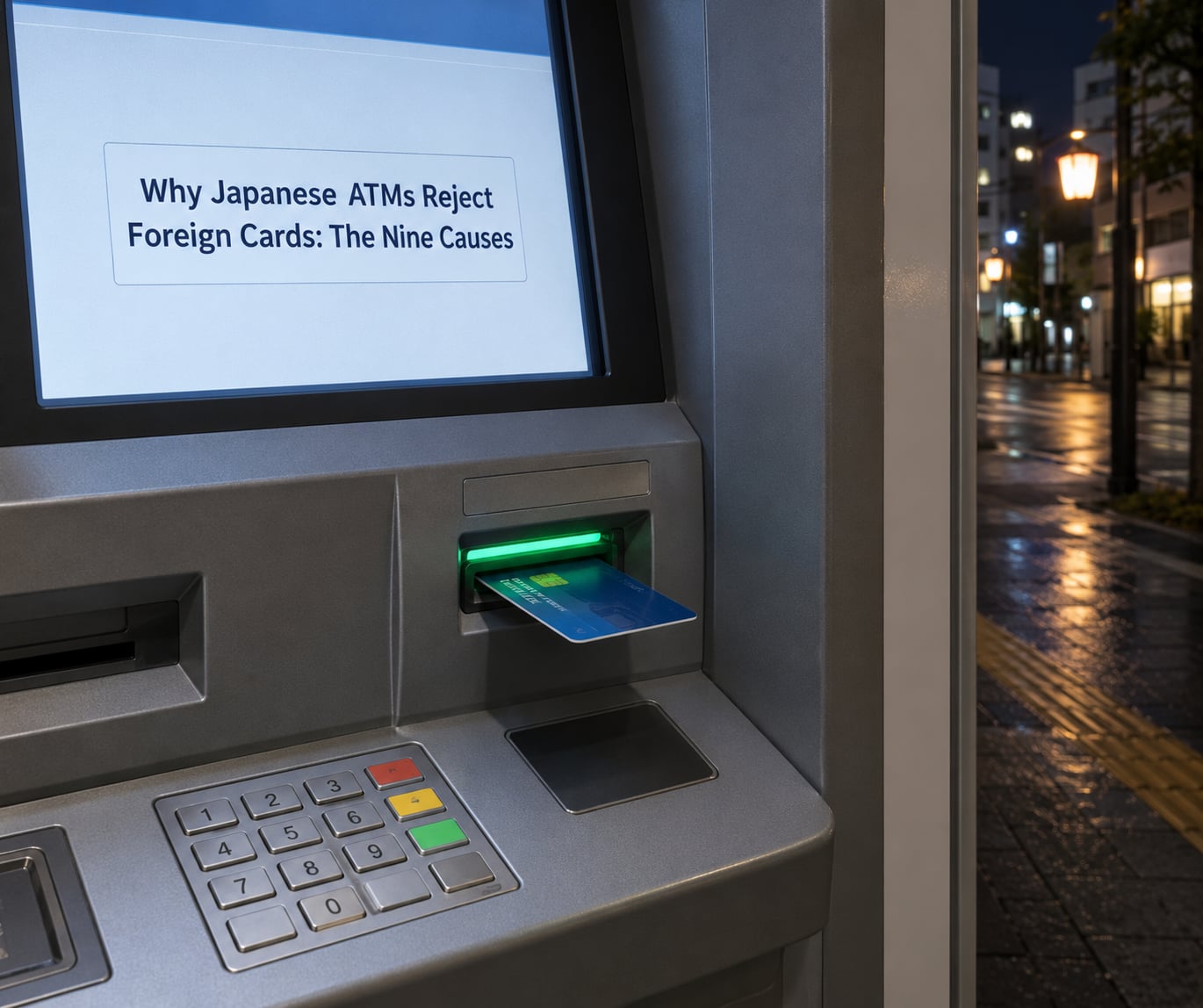
Here is the short version. If a Japanese ATM refuses your card, it is one of nine things, and the first four account for most cases.
- The operator does not accept foreign-issued cards on that machine. Bank branch ATMs frequently serve only their own customers, and a card from another country is not one of them.
- Your issuer declined it. The overseas-usage toggle in your banking app may be off, or a fraud system may have flagged a Japan transaction.
- You hit a limit. Per-transaction caps, daily caps and monthly caps on cash withdrawal are common, and all three are set by your own bank.
- You used a contactless-only or wallet-only card. Cash machines need a physical card with a chip and a PIN pad.
- The PIN is wrong, or the wrong format. Four to six digits is normal, but a PIN entry with a letter or an asterisk can fail silently.
- The chip, stripe or card body is damaged. A cracked card often still pays in shops and still fails at the ATM.
- The network or card brand is not supported by that machine. JCB dominates domestically, so some machines are built around a card type you are not holding.
- Your account cannot fund a cash advance. A credit card with a cash limit of zero, or a debit card linked to an account without overdraft, fails differently from a card that is simply blocked.
- A temporary bank or network problem. Scheduled maintenance, a compliance hold, or a switch outage can produce the same error as a decline.
That is why Japanese ATMs reject foreign cards far more often than the internet suggests. The overwhelming majority are not nationality judgements. They are limits, settings and machine types.
Who Actually Declines the Card: The Authorisation Chain
Most explanations stop at the machine, which leaves the useful part unexplained. Four parties are involved and each can end the request at a different moment.
- You insert the card, the machine reads the chip, and it asks for your PIN and amount.
- The ATM operator checks the card against its own configuration. Does this machine accept foreign-issued cards? Does it have enough notes? Is the amount within its ceiling? A failure here never reaches the network.
- The card network receives an authorisation request from the operator’s acquirer and routes it to the bank that issued your card. The network itself almost never declines; it is a pipe, not a decision-maker.
- Your issuer reads the request against its own rules — overseas usage setting, cash-advance permission, limits, fraud screening, card status — and returns approval or a decline code.
The decline code travels back the same route. The operator translates it into a Japanese message on screen, which is why the wording you read is rarely the actual reason. A code meaning insufficient funds and a code meaning prohibited by issuer policy can look similar once translated.
Two practical consequences follow. If the card is refused before the amount screen appears, the operator stopped it and your bank was never involved, so an app setting will not help. If the amount screen appears and the failure comes after the PIN, the request reached your bank and only your bank can fix it.
This split is also why the same card can behave differently in two Japanese cities on the same day. Operators differ in configuration, and the acquirer routing them can differ by region.
Japanese ATM Acceptance: Quick Comparison
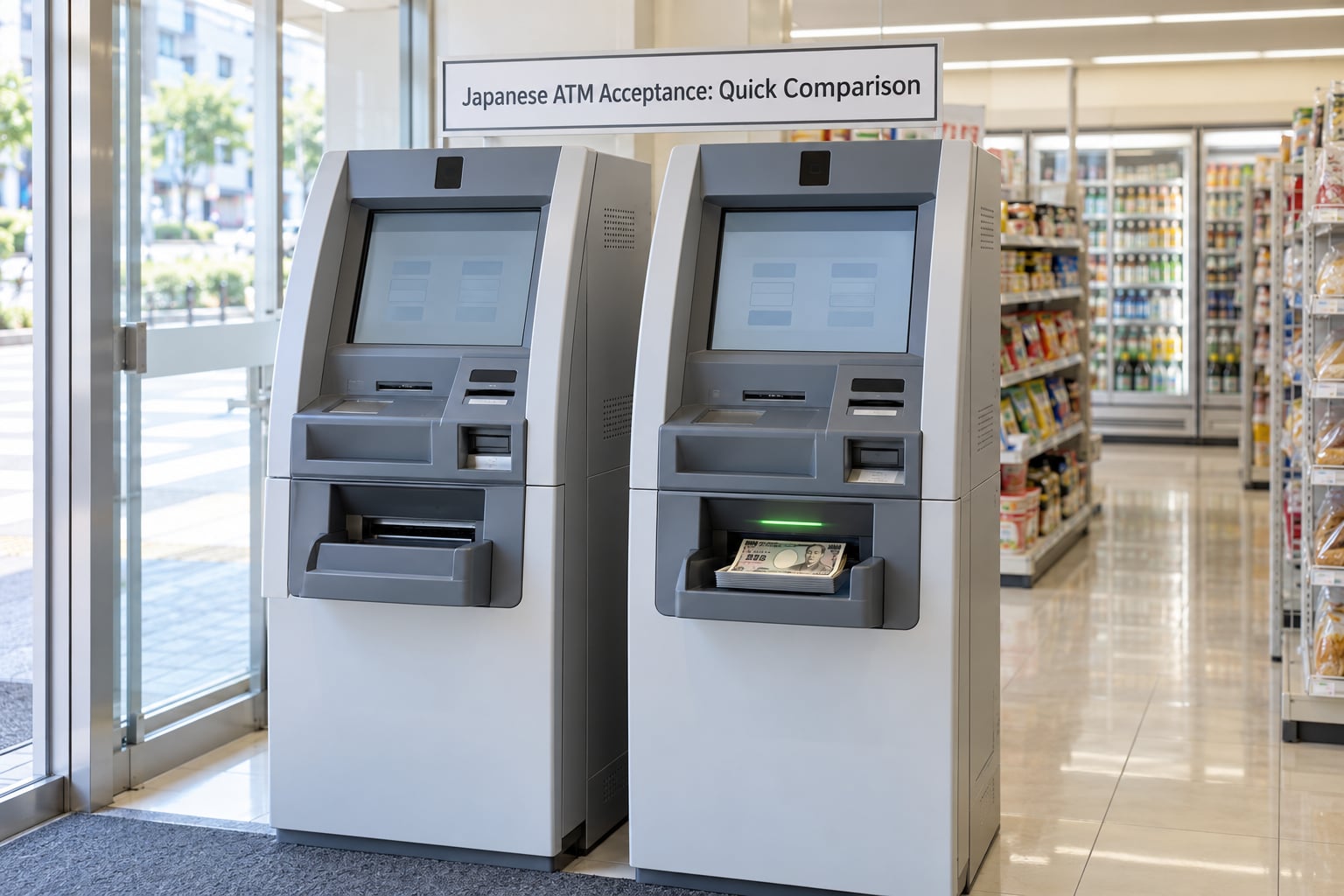
Operator acceptance varies more than card acceptance, and it is the variable most readers get wrong. A Visa card from a European bank is widely accepted. That same card in the ATM inside a big-name bank’s branch lobby may be refused, because the machine is configured for that bank’s own cards only. Foreign travellers report this pattern repeatedly on the Japan Forum, and it is the reason branch ATMs rank low on most lists of where to get cash.
Foreign card acceptance on convenience store machines is the default case rather than the exception, and the details shift with operator policy. Everything here was checked against operator pages in 2026 and changes periodically, so confirm anything critical before you fly.
| Operator and location | Foreign-issued card | Typical operating notes | What to verify |
|---|---|---|---|
| Seven Bank, inside 7-Eleven stores nationwide | Usually accepted | Largest convenience store network, English interface available, tiered charges that vary by operator and by time | Whether your issuer and card brand are on the operator’s supported list |
| Japan Post Bank and post office ATMs | Accepted on many machines, with conditions | Yen accounts and passbook features are for domestic customers; foreign-card machines are a subset | Confirm the machine shows a foreign-card option before inserting |
| E-Net and Lawson terminals | Commonly accepted | Loppi ticket terminals handle cash and top-ups; a terminal with no ATM slot cannot withdraw cash | That the terminal has a withdrawal function, not only ticketing |
| FamilyMart and FamiPort | Commonly accepted | Wider opening hours than many bank lobbies; interface language varies | Note denominations available before inserting |
| Bank branch ATMs | Often not accepted | Configured for that bank’s own cards, with domestic security controls | Only worth trying if you hold an account with that bank |
| Airport and major station ATMs | Usually accepted | Higher footfall and shorter queues, often inside banks with an international remit | Foreign transaction fees from your own issuer before arrival |
One more practical point from the table: it is the machine, not the building. A 7-Eleven in a small town may hold a terminal that only does top-ups. Look for an ATM slot and a cash dispenser before you queue.
Card Network and Issuer Compatibility
Network support is the layer people assume is settled, and it is the layer that surprises them. Visa, Mastercard and American Express issued outside Japan work at most convenience store ATMs. UnionPay works widely at bank-owned and airport machines and is less consistent at smaller convenience store terminals. JCB is the domestic default in Japan, so a machine built around JCB handling is unusually well tested for JCB and only adequately tested for everything else.
None of that should produce a decline on its own. Networks exist to route authorisations between banks they do not own. What does produce a decline is the routing arriving at an issuer that says no.
Why a familiar network does not guarantee acceptance
The network moves the message. Your bank decides the answer. A card can sit on the Visa network for twenty years and still be declined because your bank blocks overseas cash advances, caps them tightly, or has not issued that product for travel at all. This is the single most common source of confusion: people check the network logo on the card, see Visa, and conclude the machine should work.
Digital banks are a separate case worth naming. Cards and accounts from online-first institutions vary enormously in overseas ATM support, and support is often a setting in the app rather than a property of the card. Forum threads about international cards failing at 7-Eleven, Lawson and station ATMs in the same trip point at issuer settings far more often than at the machines.
There is a documented precedent for failures at the network layer rather than the bank layer. Travellers have reported cards issued outside Asia-Pacific failing temporarily at Japanese ATMs, pointing to regional terminal certification rather than anything you did wrong.
ATM Features That Can Cause a Decline
Japanese cash machines are mostly cash recyclers: deposit-and-withdraw units that count notes and dispense the same notes later. They are configured for domestic use, and several of those defaults produce refusals for visitors who have no way to see them.
Foreign-acceptance flags. Some operators configure terminal slots or terminal sessions for specific card types. If the machine does not recognise your card as supported at the moment of insertion, it will not proceed to the authorisation step at all. Nothing reaches your bank, so calling the issuer tells you nothing.
Cash denomination ceilings. Recyclers carry a limited supply of notes and often cap the amount dispensed per transaction, commonly around ¥50,000 at convenience store ATMs. Ask for a higher figure and the machine refuses the whole request. Two withdrawals of ¥30,000 succeed where one of ¥60,000 does not, at the cost of a second charge.
Available balance display. Foreign-card sessions frequently cannot show your home-currency balance. Machines then restrict the amount you can enter or skip a balance check the operator would normally run.
Cash-back and cash-plus functions. Some domestic machines support cash back or cash-plus withdrawals against a Japanese account. Those functions only work with Japanese issuing cards.
Contactless withdrawal. Tap to withdraw is not a thing at Japanese cash machines. If your card only lives in a phone wallet, or your bank issues tap-to-pay without a usable chip, you need a physical card.
Per-transaction caps in the other direction. Machines also have minimums and, in a few configurations, refuse amounts that are not multiples of the note denominations loaded. Splitting a request into smaller ones is the standard workaround.
Fees, Account Access, and Withdrawal Limits
Most fee problems do not stop a withdrawal, but limits and account eligibility do. Treat these as three separate checks.
Account eligibility. A credit card cash withdrawal is a cash advance. Many travel cards enable it by default, some block it entirely, and a card with no cash limit assigned fails at the ATM rather than at the till. Debit cards draw on an account, so the question there is whether that account can go negative and whether your bank allows overseas ATM use.
Limits. Three limits sit between you and the money. The per-transaction limit caps a single withdrawal, often to the machine’s own ceiling. The daily limit caps a rolling 24-hour total. The monthly or trip limit caps the whole period and is common on multi-currency accounts. Hit any of them and the machine declines with the same message as a fraud block, which is why reading the screen matters.
Fee stack. An overseas withdrawal can attract an operator charge from the ATM, an issuer charge from your bank, and a currency conversion spread. The operator and issuer charges are typically modest. The conversion rate is often the largest of the three, and it is the one you control.
Decline the machine’s currency conversion offer
If the ATM offers to convert your withdrawal into your home currency at the machine’s own rate, decline it. That is dynamic currency conversion, and it is almost always worse than letting your own bank convert at the network rate. Your bank’s rate is set by a published scheme with a capped spread. The machine’s rate has no such cap.
One Monzo user posting on r/monzo described no trouble at all withdrawing and paying across Osaka, Kyoto and Nara, using convenience store ATMs. Another traveller reported a different card refused at a 7-Eleven ATM, then at Lawson, then at a station ATM in Tokyo. Both reports are ordinary. The difference is which limit or setting was in play.
PIN, Security, and Card Condition Problems
PIN format. Japanese machines accept four, five and six digit PINs, which covers most Western cards. Problems appear when the PIN contains a letter, when the pad expects a different length than you enter, or when you re-enter it with different numbers the second time. Three wrong entries can lock the card at the issuer.
Chip versus stripe versus tap. The physical chip is what the machine reads. A magnetic stripe fallback exists but is increasingly absent from modern machines. Contactless does nothing here. Forum consensus is consistent on this: the physical card goes in, the PIN goes in.
Card condition. A bent card, a worn chip or a card demagnetised in a bag can still tap for small payments and still fail at the ATM, because the ATM reads the chip under pressure and at a fixed angle. Cards with printed or stamped details near the chip edge are more prone to this.
Fraud protection and blocks. Issuer fraud systems watch for cards suddenly used in a new country, for a card used in several countries within hours, and for withdrawals that break the account’s usual pattern. A block looks identical to a limit on screen. The difference is that your bank can lift one instantly and the other in seconds.
Why the Same Card May Work in a Store but Not an ATM
A shop payment and a cash withdrawal are two different transactions with two different approval paths. At a shop, the card is present, the amount is small, and the merchant’s terminal often settles on a short authorisation window. At an ATM, the card is present but the transaction is a cash advance with its own limits, its own fees and, at Japanese operators, its own compliance screening.
Add to that the fact that the card may be over its contactless limit in a shop, which prompts a PIN in a way the reader does not connect to an ATM failure. Retail success is weak evidence that cash access will work.
| Outcome | What the machine does | What it usually means | What you do |
|---|---|---|---|
| Declined | Returns the card to you, no cash | An authorisation was requested and refused, by your bank or by the operator | Retry once, then try a different machine, then call the issuer |
| Returned | Ejects the card before or early in the session | The machine could not complete the session, often a session timeout, a wrong PIN sequence or an unsupported card | Start again from the beginning and follow the on-screen order |
| Retained | Keeps the card and prints a notice | Usually a security or compliance action: repeated wrong PINs, or an alert raised during screening | Do not leave. Take the slip and contact the operator and your issuer immediately |
Retention is the one that upsets people most. A retained card is not a missing card in the ordinary sense: the operator holds a physical asset and a record. Your bank can often pause the replacement process until the operator confirms the card’s status, which adds days to getting a new one.
What to Do When a Japanese ATM Rejects Your Card
Work through these in order at the machine. Most problems resolve within a couple of attempts.
First, read the screen before doing anything else. These are the Japanese ATM error messages most visitors hit, and what they mean:
| Japanese message | Meaning | Usual next step |
|---|---|---|
| このカードはご利用できません | This card cannot be used | The operator or network will not run it. Change machines. |
| 残高が不足しています | Available balance is insufficient | Lower the amount, or the account cannot fund this. |
| 一回限度額を超過しました | Per-transaction limit exceeded | Split the amount across two withdrawals. |
| 日限度額を超過しました | Daily limit exceeded | Wait for the rolling window to reset, or contact your issuer. |
| 暗証番号が違います | Wrong PIN number | Re-enter carefully. Three errors may lock the card. |
| お取り扱いできません | Cannot be processed | Generic failure. Check the card type and try another machine. |
Retry once, cleanly. Take the card out fully, wait a few seconds, reinsert it chip-first and follow the prompt order exactly. Many failures are a session timeout after a pause at the PIN pad.
Change machines, not just screens. Move to a different 7-Eleven, a different operator, or a bank ATM at a station. If the failure was operator-side, a second attempt on the same machine repeats it.
Decline conversion. When the machine offers to convert to your home currency, decline and let your own bank handle it.
Call the number on the back of the card. Ask three questions: is overseas ATM use enabled, what is my per-transaction and daily limit, and is there a block on the card. A phone call clears issuer-side causes faster than any app setting.
Ask for a local network view. Your bank’s support line can tell you which networks and operators your card is routed through in Japan.
Fall back to a different payment method. Before you leave the machine, think about what happens next if nothing works: a colleague’s card for the immediate cash need, a bank counter, or cash carried in.
Three Japanese phrases help when you need a human at a branch or a staffed counter:
- このカードは使えますか — Can I use this card?
- 別のATMを試します — I will try another ATM
- 操作的方法を教えてください — Please tell me how to operate this machine
What you will sometimes hear back is 外国のカードはご利用いただけません, meaning foreign cards cannot be used here. That is a counter-side decision, not a network failure, and no amount of retrying the same machine changes it.
Before You Fly: A Six-Point Checklist
Every cause in this guide has a pre-travel fix, and all six take one phone call or one app session to rule out.
- Turn on overseas card use. Some banks ship cards with international withdrawals disabled by default, or disabled until you open the app at least once while abroad. This is the single most common cause and the easiest to fix.
- Ask for your actual limits. Per-transaction, daily and monthly. Then ask whether the per-transaction limit is lower than the machine’s own ceiling, because that is the number that will stop you.
- Ask whether cash advances are enabled. For credit cards, confirm the cash advance feature is on and find out whether it has its own separate cap. A travel card with cash advances disabled will not work at any Japanese ATM.
- Check the card itself. Unreadable PIN, an expiry date inside your trip, a missing chip, a card that only exists in your phone wallet. All of these are checkable at home in two minutes.
- Notify the bank of the dates and country. A travel note on your account removes the single most common false-positive fraud flag, and it tells the fraud team that Japan is expected.
- Bring a second card from a different network. Not a backup in theory. A different network means a different acquirer route, so it survives a problem that a same-issuer second card will not.
Also pack for the coin problem. Japanese machines dispense notes and dispense few coins, so a large note will not break into small change at an ATM. Carry some coins or a small note for the convenience stores that will not make change for you.
How Much Cash a Trip Actually Needs
Japan runs card and code payments in cities, but cash still covers ramen shops, market stalls, taxis, small restaurants, shrines, and the 500-yen and 100-yen coins many machines will not hand out. Convenience stores frequently will not break a note.
A workable pattern for most itineraries is to arrive with enough yen for the first two days, then withdraw near where you are staying rather than at the airport, where fees tend to be higher and queues longer. When you move between cities, withdraw at the station on arrival; the 7-Eleven inside most major stations is the least stressful option.
Split your withdrawals instead of maximising each one. Three smaller successful withdrawals cost the same per-transaction fee as one large one, and none of them get refused for exceeding a machine ceiling.
If Every Machine Refuses Your Card
Three rejections at three different operators means the cause sits on your side of the chain, because the operator has already changed. That points at your bank. Call the number on the back of the card, and if support cannot lift the block, ask for the card to be reissued for travel use.
While that runs, keep a backup rather than a hopeful one: cash already in hand, a colleague’s card for the immediate need, or a staffed bank counter where staff have more tools than an ATM does. Do not plan a large payment on a card that has already failed twice in one day.
Before flying, do three things. Turn on overseas card use in your banking app and ask what your daily ATM limit is. Ask the bank which networks and operators they support in Japan, because that answer is specific to your card. Carry enough yen to get through your first day or two, so one refusal late at night is an inconvenience rather than a crisis.
Frequently Asked Questions
Which ATMs in Japan accept foreign cards?
Convenience store ATMs are the reliable option. Seven Bank machines inside 7-Eleven stores accept most foreign-issued Visa, Mastercard and American Express cards, and E-Net and Lawson terminals handle many of the same cards. Japan Post and major station ATMs work too, with conditions. Bank branch ATMs are the weak point, because many are configured for that bank’s own customers only. If a machine refuses the card before the amount screen appears, that is an operator-side refusal and a different machine is the fix.
Does Japan accept US debit cards?
Usually, yes, at convenience store and station ATMs. A US debit card on Visa or Mastercard is treated as a foreign-issued card and is the most common type that works. Debit cards with a chip and a four digit PIN are the easiest case. The problems are almost never Japanese rules. They are your issuer’s overseas usage setting, your daily withdrawal cap, and whether the specific terminal supports foreign cards. Bring a second card from a different network as a backup.
Do 7-Eleven ATMs in Japan charge a fee?
They do, and the charge varies by operator and by the time and day of your withdrawal. Some tiers apply during evenings, weekends and public holidays, which is when you are most likely to need cash. Expect a separate charge from your own bank for international ATM use, plus a currency conversion spread. The operator charge is the smallest of the three, so decline any offer to convert the amount at the machine and let your own bank do the conversion.
What is the daily withdrawal limit for ATMs in Japan?
There is no single Japanese figure, because the limit comes from your bank, not from the machine. The per-transaction ceiling at convenience store ATMs commonly sits around ¥50,000, and the machine refuses anything higher. On top of that your issuer sets daily and monthly limits, and multi-currency accounts often cap monthly ATM withdrawals. When a withdrawal is refused for a limit, the error message names it: 一回限度額 or 日限度額. Call the number on the back of your card to find your own ceilings.
Should I accept the ATM’s currency conversion offer?
Decline it. The machine’s offer is dynamic currency conversion, which sets its own exchange rate and adds a hidden spread on top. Your own bank converts at the network rate under a published scheme with a capped spread, so the bank’s rate is normally better. Accepting at the machine also makes the amount on your statement harder to reconcile. If you already accepted once, it is not a disaster, just an expensive rate for that one withdrawal.
Conclusion
Japanese ATMs reject foreign cards for reasons your home bank controls far more often than for reasons Japan controls. Before you travel, confirm that overseas use is switched on, ask what your per-transaction and daily limits are, and find out which networks and operators your card routes through here.
At the machine, read the message, retry once, then move to a different operator rather than the same machine again. Decline the machine’s currency conversion. And carry enough yen to get through your first day, so one refusal at midnight is a nuisance rather than a stranded traveller.