Japanese voltage vs US voltage comes down to a single number most travelers get wrong: Japan runs on 100V and the United States runs on 120V, even though both countries use the same flat two-pin plug. That means your phone charger and laptop brick need nothing but a plug shape, while a hair dryer, kettle or rice cooker does need real help.
Here is the short version. Anything marked Input: 100-240V, 50/60Hz is dual-voltage and works in both countries with the right plug. Anything marked only 100V or only 120V is single-voltage, and that is where adapters and transformers come in.
Table of Contents
- 1Japanese Voltage vs US Voltage at a Glance
- 2What Is the Voltage and Frequency in Japan?
- 3Japanese Voltage vs US Voltage: What the Numbers Mean
- 4Why Japan Settled on 100V
- 5Are Japanese and US Plugs the Same?
- 6Can You Use US Electronics in Japan?
- 7The Wattage Math Behind Heating Appliances
- 8Can You Use Japanese Appliances in the US?
- 9How to Tell If a Device Is Dual-Voltage
- 10Do You Need a Voltage Transformer?
- 11Which Should You Choose?
- 12Frequently Asked Questions
- 13Can I use a US hair dryer in Japan?
- 14Is a plug adapter the same as a voltage converter?
- 15Does 50Hz or 60Hz electricity damage a Japanese appliance?
- 16Can I use a Japanese PlayStation or Nintendo console in the US?
- 17Can plugging in a 100V appliance damage a US electrical circuit?
- 18Conclusion
Japanese Voltage vs US Voltage at a Glance
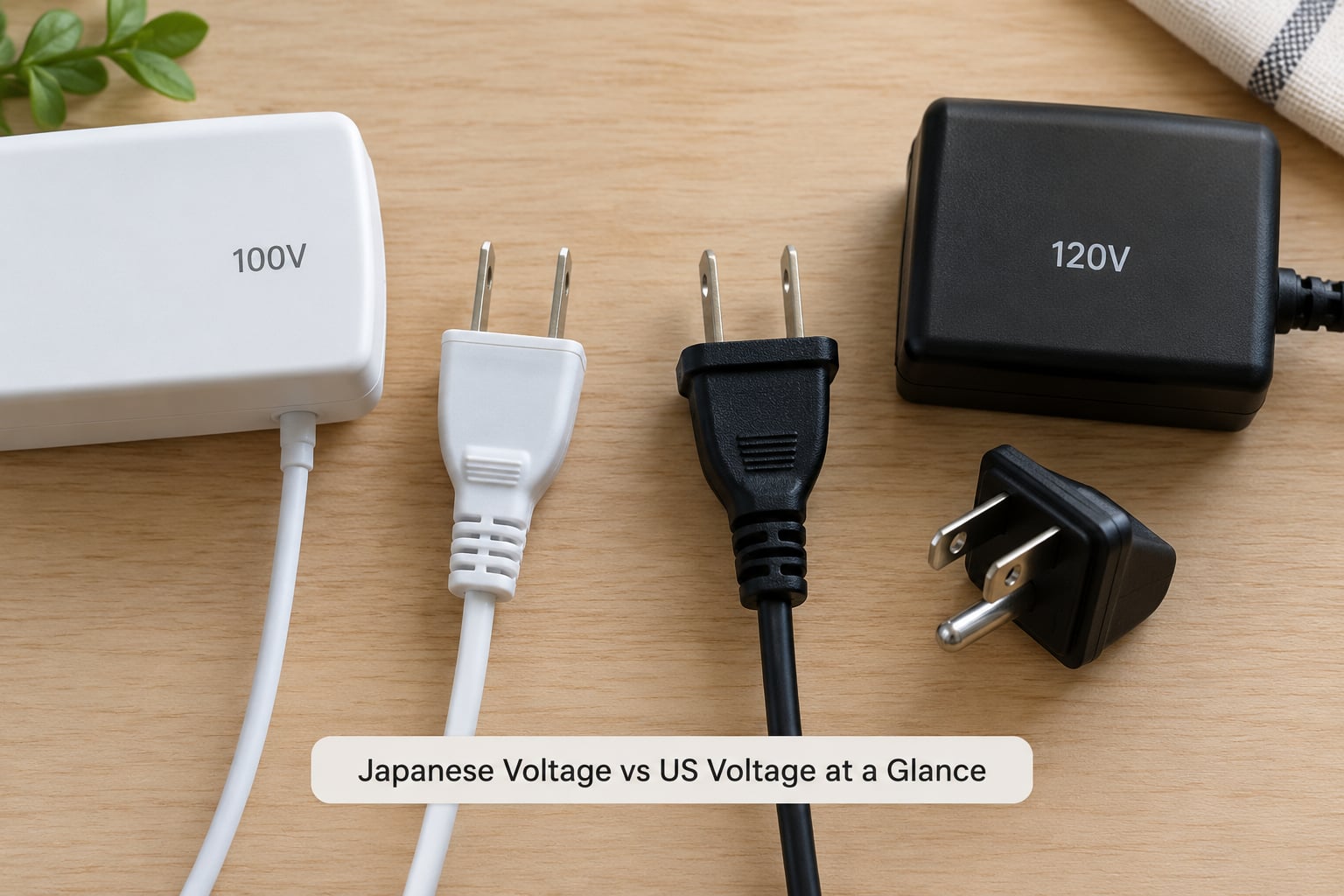
The table below covers the differences that actually matter at an outlet. Everything else is noise.
| Specification | Japan | United States |
|---|---|---|
| Nominal voltage | 100V | 120V |
| Frequency | 50Hz (east) / 60Hz (west) | 60Hz nationwide |
| Supply system | Single-phase AC | Split-phase AC |
| Plug standard | Type A (JIS C 8303) | Type A (NEMA 1-15) and Type B |
| Socket shape | Type A, ungrounded | Type A ungrounded, Type B grounded |
| Typical branch circuit | 15A, about 1,500W per outlet | 15A and 20A circuits, roughly 1,800W and 2,400W |
| Common device support | Most modern electronics are 100-240V | Most modern electronics are 100-240V |
The 20V gap sounds trivial until you remember that power on a resistive heating element scales with the square of voltage. That is the whole reason hair dryers cause trouble in Japan.
What Is the Voltage and Frequency in Japan?
Japan uses a 100V nominal supply. The interesting wrinkle is frequency: eastern Japan, including Tokyo, Yokohama, Tohoku and Hokkaido, runs at 50Hz, while western Japan, including Nagoya, Osaka, Kyoto, Hiroshima, Shikoku and Kyushu, runs at 60Hz. Okinawa sits on the 60Hz side of the split.
The US is simpler. Almost everything is 120V at 60Hz, and the split-phase system means your wall outlet carries half the voltage between two hot legs rather than the full 240V available on a US range or dryer outlet.
Do not let the 100V-versus-120V gap fool you into thinking Japanese appliances work fine in the US. They generally do not, and I explain why below.
Japanese Voltage vs US Voltage: What the Numbers Mean
Nominal voltage is the nameplate value, not an exact reading. Real supplies sit within a tolerance band around it, so 100V in Japan typically measures a little above 100V at the socket, and 120V in the US runs a little above 120V under load.
Frequency is a separate property entirely. A 50Hz motor and a 60Hz motor behave differently at the same voltage, which is why Japanese clock motors and some older induction-motor appliances feel slightly different depending on which side of the frequency boundary you live.
Here is the part people skip: plug compatibility proves nothing about electrical compatibility. A Type A plug fits in both countries and tells you zero about whether the device behind it can handle the voltage on the other side of the Pacific.
Why Japan Settled on 100V
Japan adopted its electrical standard during the Meiji era, when the country was importing Western technology and building in timber. 100V keeps shock current lower and reduces fire risk in wooden housing, which suited the moment. The US standardized on 120V and later moved to a split-phase grid that pushes 240V to large appliances.
The 50Hz and 60Hz split is a fossil of that same period, generally traced to imported generators from different engineering traditions on each side of the country. The odd part is not the split itself, it is that nobody has ever unified it, because replacing a national grid costs more than the inefficiency it would remove.
Are Japanese and US Plugs the Same?
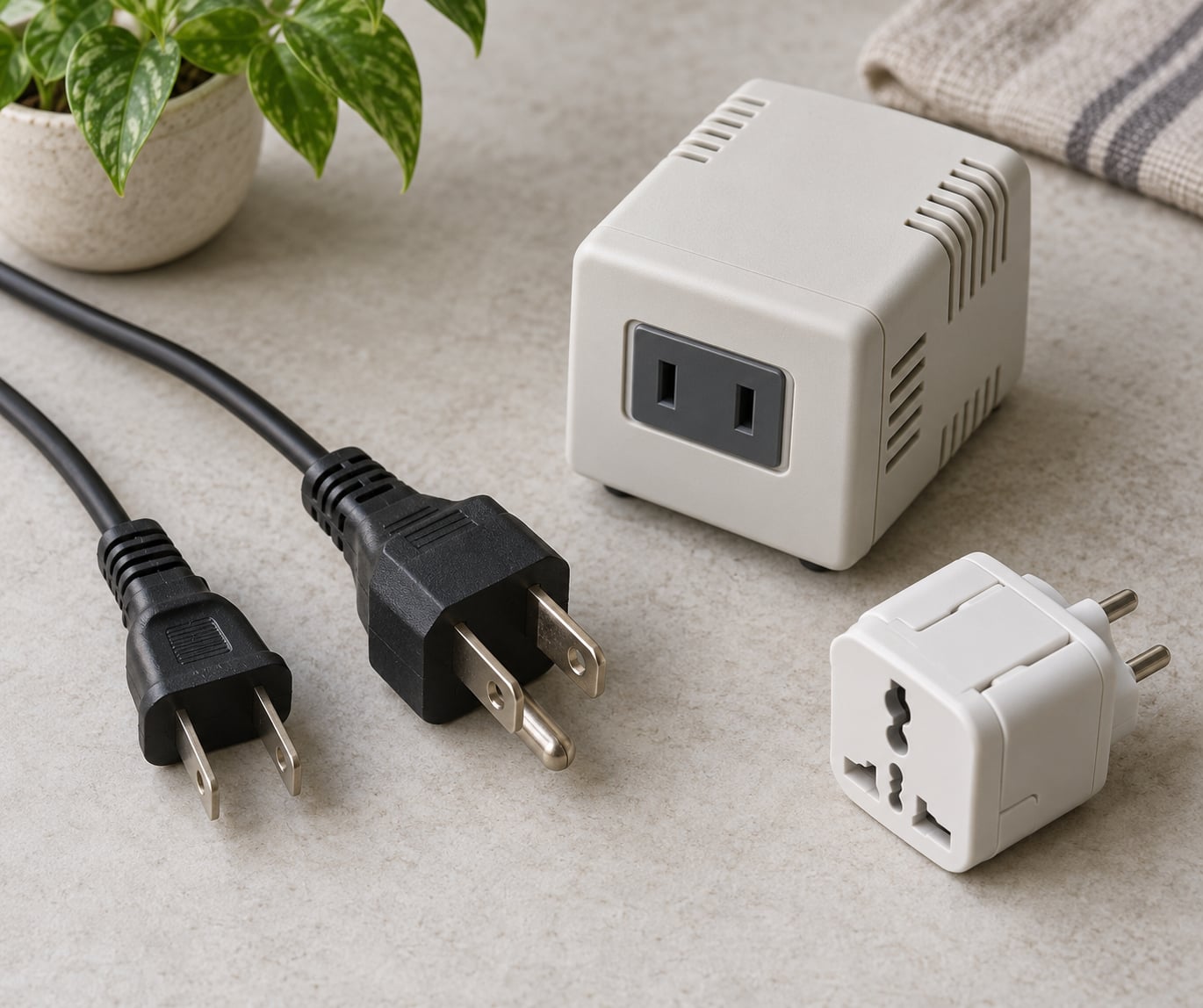
Mostly. Japan’s socket standard is JIS C 8303, which is a Type A socket with two flat parallel pins. The US Type A standard is NEMA 1-15, and the pins look identical in everyday use.
Two real differences are worth knowing. Japanese sockets are ungrounded, so a US Type B plug with its grounding pin will not physically enter a Japanese outlet at all. Many Japanese sockets are also recessed, and bulky universal travel adapters sometimes refuse to sit flat in older ryokan and business hotel rooms. Travelers report this fitting problem more often than the voltage question itself.
A three-to-two-prong ground-dropping adapter is the usual workaround, and it is worth being blunt about the tradeoff: it leaves a metal-cased laptop or monitor with no earth connection. Electricians are broadly skeptical of these adapters for that reason, and I would only use one where the adapter manufacturer permits it and for a short trip.
For a device with a US Type B plug heading to Japan, the cleanest answer is often to leave the brick at home and use a local USB-C charger. That is a decision more people should make.
Can You Use US Electronics in Japan?
Most modern electronics cross the border without any transformer at all. Here is the device-by-device verdict that travelers keep asking for.
| Device | Typical rating | Verdict in Japan |
|---|---|---|
| Phone charger (USB) | 100-240V, 50/60Hz | Works as-is |
| Power bank | USB low voltage | Works as-is |
| Laptop brick | 100-240V, 50/60Hz | Adapter only if grounded |
| Camera and lens chargers | 100-240V | Adapter only |
| Game console (power brick) | 100-240V on modern units | Adapter only; check the label |
| Three-prong monitor or desktop | 100-240V, grounded plug | Ground-dropping adapter |
| Hair dryer or curling iron | 120V only | Step-down converter or buy local |
| Kettle or rice cooker | 100V only | Buy a Japanese one |
That is why the most common traveler mistake is buying a heavy converter up front: most USB chargers already support 100V to 240V, so a two-prong plug adapter is enough. No converter for modern electronics.
Older advice that claims everyone in Japan needs a converter is simply out of date, and it still confuses a lot of people. Anything built with a switching power supply, which is nearly everything made after roughly 2010, accepts the full 100V to 240V range by design.
The Wattage Math Behind Heating Appliances
Here is the arithmetic that explains the whole problem. On a resistive element, power equals voltage squared divided by resistance. Take a kettle element rated for 1,000W at 100V: its resistance works out to 10 ohms. Run it on a 120V supply and power becomes 120 squared divided by 10, or 1,440W. The same element is now dissipating nearly half again as much heat.
On the other side of the equation, a 120V-only hair dryer on Japan’s 100V supply loses about 17% of its power. It still runs, it just runs cooler and slower, which is why some travelers think a converter is optional. It is not. The damage is cumulative and mostly shows up as a fried appliance weeks later rather than a visible failure on day one.
Motors behave differently again. A fan or pump is roughly a fixed load rather than a fixed resistance, so it draws the same current at both voltages and just spins slower on the lower one. That is why the frequency split is more relevant to motors than the voltage difference is.
The one ceiling to remember is 1,500W per Japanese outlet on a 15A circuit. A 1,800W US hair dryer draws more current than a Japanese socket is comfortable with, which is how you trip a breaker in a hotel room at midnight. Military and civilian staff posted in Japan generally find the housing power close enough to US standard that everyday gear just works, which matches the table above for anything with a switching power supply.
Can You Use Japanese Appliances in the US?
This is the direction almost nobody covers, and it is the top question people ask about this topic. The answer is that a 100V-only Japanese appliance is not directly compatible with a 120V US supply.
It receives 20% more voltage than it was rated for. For electronics with a regulated power supply, the outcome is often simply stress or an early failure. For a resistive heating element such as a kettle element or rice cooker plate, the physics is worse: power equals voltage squared over resistance, so 120V on a 100V element delivers about 44% more power, and the element runs hot enough to shorten its life or start a fire.
The correct tool is a step-up transformer that converts 120V up to 100V. Imported Japanese-market recorders and older game consoles are the usual candidates, and small step-down units handle them without trouble when the wattage rating has headroom.
One more thing to check when you import gear: Japanese products carry the PSE mark, US installations expect UL listing. A PSE-certified appliance imported to the US has never been evaluated to a US safety standard, which matters more for anything with a heating element or a motor.
How to Tell If a Device Is Dual-Voltage
Turn the device over and read the label on the power brick or the back of the unit. You are looking for the word INPUT, and you want a range, not a single number.
Good labels read INPUT: 100-240V, 50/60Hz, or INPUT: 100-240V~ 1.5A. If you see a single voltage such as INPUT: 100V or INPUT: 120V, that device is single-voltage and needs a transformer in the other country. When a printed label is smudged or reprinted, opening the power brick and reading the internal rating is a reasonable last resort.
USB chargers and power banks are a special case. They take low-voltage USB from your device rather than mains directly, so voltage concerns mostly disappear. What still has to fit is the plug on the charger block itself.
A quick safety checklist before you pack:
- Read the INPUT label, not the model number.
- Confirm 100-240V and 50/60Hz both appear.
- Check the plug shape: two flat pins, or three with a ground pin.
- Compare wattage against the destination outlet ceiling of about 1,500W in Japan.
- Inspect the cord and adapter for cracks, and follow the manufacturer’s own instructions when they exist.
Do You Need a Voltage Transformer?
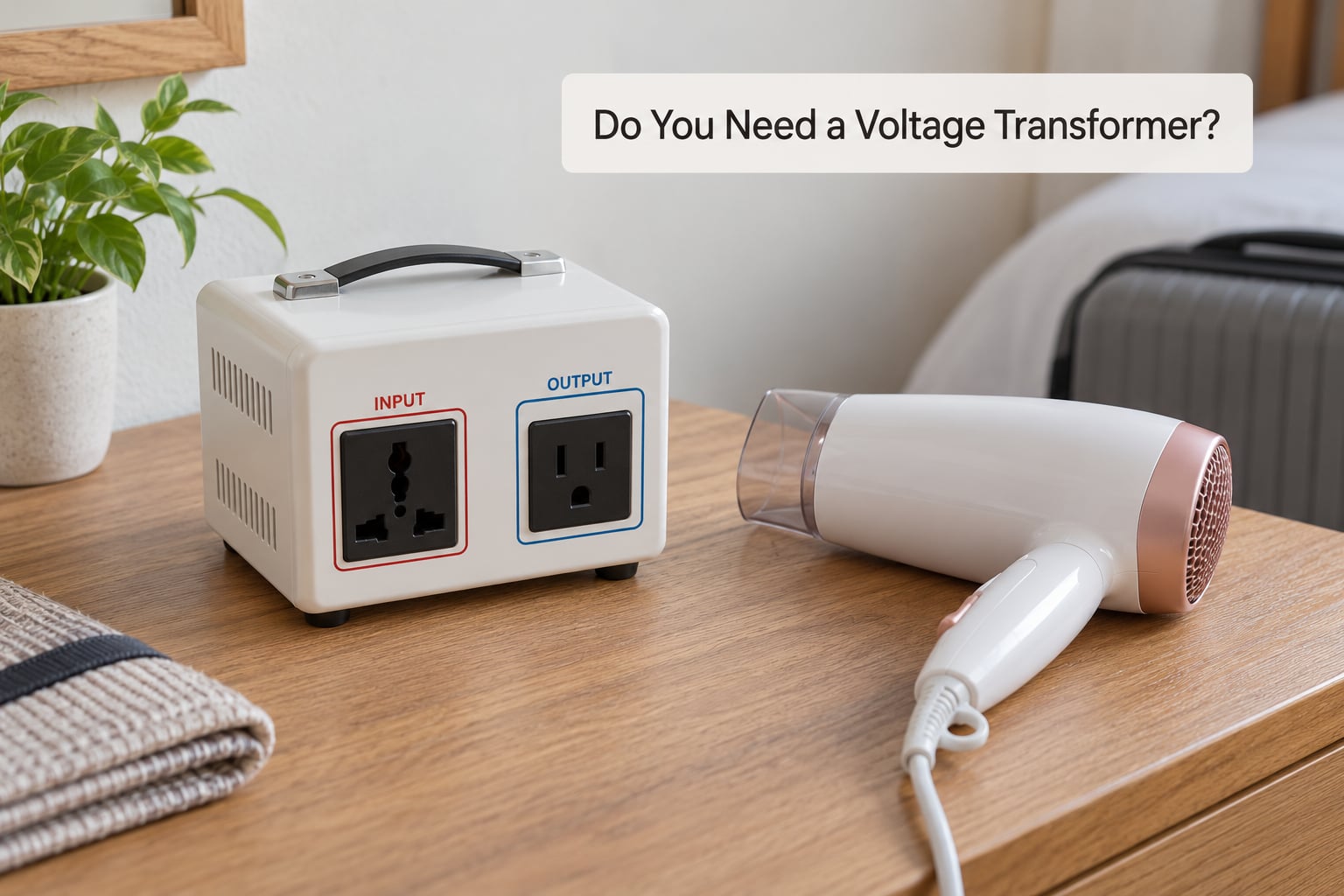
A plug adapter changes the shape of the pins so the plug fits. It does nothing to voltage. A transformer changes the voltage itself, either stepping 120V down to 100V for US gear in Japan or stepping 120V up so a Japanese 100V appliance can run on a US supply.
So you need a transformer only for single-voltage equipment. And for high-wattage things like hair tools, the better answer is usually to buy a local one. A Japanese hair dryer costs far less than a converter that can carry it.
If you do need a transformer, size it properly. Choose a continuous rating comfortably above what the device draws, about one and a half times for motor-driven appliances that surge on startup. Motors and compressors draw inrush current that a transformer rated right at the load will trip on. Expect large units to run hot and hum, which is exactly why people resist carrying them for a single appliance.
Cheap travel converters are built for small dual-voltage electronics only. They are not rated for a kettle, a heater or a hair dryer, and no amount of clever packing justifies one.
Before you buy anything, check the voltage, amperage and frequency printed on its housing. A unit that lists 120V to 240V on the input side and 100V or 120V on the output side is the one you want for Japanese gear in the US. Listings that describe a converter as 220V to 110V are often single-direction, so read carefully.
Which Should You Choose?
For confirmed dual-voltage electronics, a simple plug adapter does it. That covers phones, laptops, cameras, most console power bricks and nearly every USB charger you own.
For grounded devices, use a Type B-to-Japan adapter only if its manufacturer permits the ground-dropping arrangement, and understand what you give up. Otherwise, plan to run the device without its earth wire.
For a phone or tablet, skip the adapter debate entirely and carry a second USB charger that plugs straight into the Type A socket.
For supported single-voltage equipment, a properly rated transformer is the only correct answer, and buying a local replacement is usually cheaper, lighter and safer than carrying one across the world.
Whatever you pick, do not alter a plug, bend pins to make something fit, or feed a high-power appliance a supply it was never rated for. Damaged or improvised adapters are how a packing-list shortcut turns into a burn.
Frequently Asked Questions
Can I use a US hair dryer in Japan?
Only with a step-down transformer rated above the dryer’s wattage, and only within Japan’s 1,500W per-outlet ceiling. A 1,800W US dryer exceeds what a 15A Japanese socket is comfortable with, so the breaker may trip. The practical answer most travelers arrive at is to leave it at home and use the hair dryer most Japanese hotels already put in the room.
Is a plug adapter the same as a voltage converter?
No. A plug adapter only changes the pin shape so your plug fits a foreign socket; voltage passes through untouched. A voltage converter, usually a transformer, actually changes the mains voltage. If your device reads INPUT 100-240V, you need the adapter and nothing more. If it reads a single voltage, the adapter alone will not save it.
Does 50Hz or 60Hz electricity damage a Japanese appliance?
Rarely. The east-west frequency split mostly matters for clock motors, fans and other induction motors, which run slightly slower on 50Hz. Anything with a switching power supply or an electronic control board ignores frequency entirely, as long as the label says 50/60Hz. A device rated for only one frequency is the exception, so read the label before you pack.
Can I use a Japanese PlayStation or Nintendo console in the US?
Modern consoles ship with power bricks rated 100-240V, so they run on 120V with no transformer at all, and imported Japanese-market consoles generally handle the difference well. Older single-voltage units and region-locked hardware are a separate question. Check the INPUT label before you buy anything used, since Japanese-market models are often 100V only.
Can plugging in a 100V appliance damage a US electrical circuit?
The circuit itself is usually fine; the appliance is what gets hurt. A 100V-only appliance on a 120V outlet receives 20% more voltage than rated, and a resistive heating element then draws about 44% more power, which overheats it. Imported light fixtures are the classic case, since dimming and early burnout are common. A step-up transformer is the correct tool, or buy a 120V replacement.
Conclusion
Start with the label. Find the INPUT line on the power brick or the back of the device, note whether it lists 100-240V and 50/60Hz, then check the plug shape and the wattage against the destination outlet.
Japanese voltage vs US voltage only matters when a device is single-voltage. Confirmed dual-voltage gear needs only the correct plug arrangement. Anything rated 100V only generally cannot run directly on 120V US power without a step-up transformer, and anything rated 120V only belongs in a step-down converter or in a suitcase you leave at home.