Most US appliances do work in Japan, but not all of them, and the reason is rarely the plug shape. Japan runs on 100 volts while the US runs on 120, and Japan’s power runs at 50Hz in the east and 60Hz in the west. Anything labelled 100-240V plugs in with an adapter. Anything labelled 120V only, or built around a motor or a magnetron, needs more thought before you unpack it.
That is the short version. The rest of this guide goes device by device, because the honest answer changes depending on what is inside the case.
The three rules that settle almost every case: read the rating label first, remember that a plug adapter changes nothing electrical, and treat anything with a motor, a compressor or a heating element as a special case rather than a yes. The numbers below are Japan’s own mains specifications, so you can check them against your gear at home before it goes in a suitcase.
Table of Contents
- 1What Voltage and Frequency Does Japan Use?
- 2Can You Use US Appliances in Japan?
- 3Dual-voltage appliances marked 100-240V or 100-120V
- 4Single-voltage 120V appliances
- 5220-240V appliances and mains-only devices
- 6How to Check an Appliance Before Using It in Japan
- 7Step 1: find the input rating
- 8Step 2: check the frequency line
- 9Step 3: check the wattage against the outlet limit
- 10Step 4: read the manual, then look at the plug
- 11A grounding problem people ignore
- 12Do You Need a Voltage Transformer in Japan?
- 13The reverse direction
- 14What Plug Adapter Is Needed for Japan?
- 15Where to buy adapters and Japan-rated replacements in Japan
- 16Which US Appliances Are Most Likely to Work or Fail?
- 17Frequently Asked Questions
- 18Do I need a voltage converter in Japan from the US?
- 19Can you use 120V appliances in Japan?
- 20What is the voltage used for appliances in Japan?
- 21Are Japan power outlets the same as the USA?
- 22Can I use a 220V charger in Japan?
- 23Will my US microwave, fridge or washing machine work in Japan?
- 24Conclusion: Check the Label Before You Bring the Appliance
What Voltage and Frequency Does Japan Use?
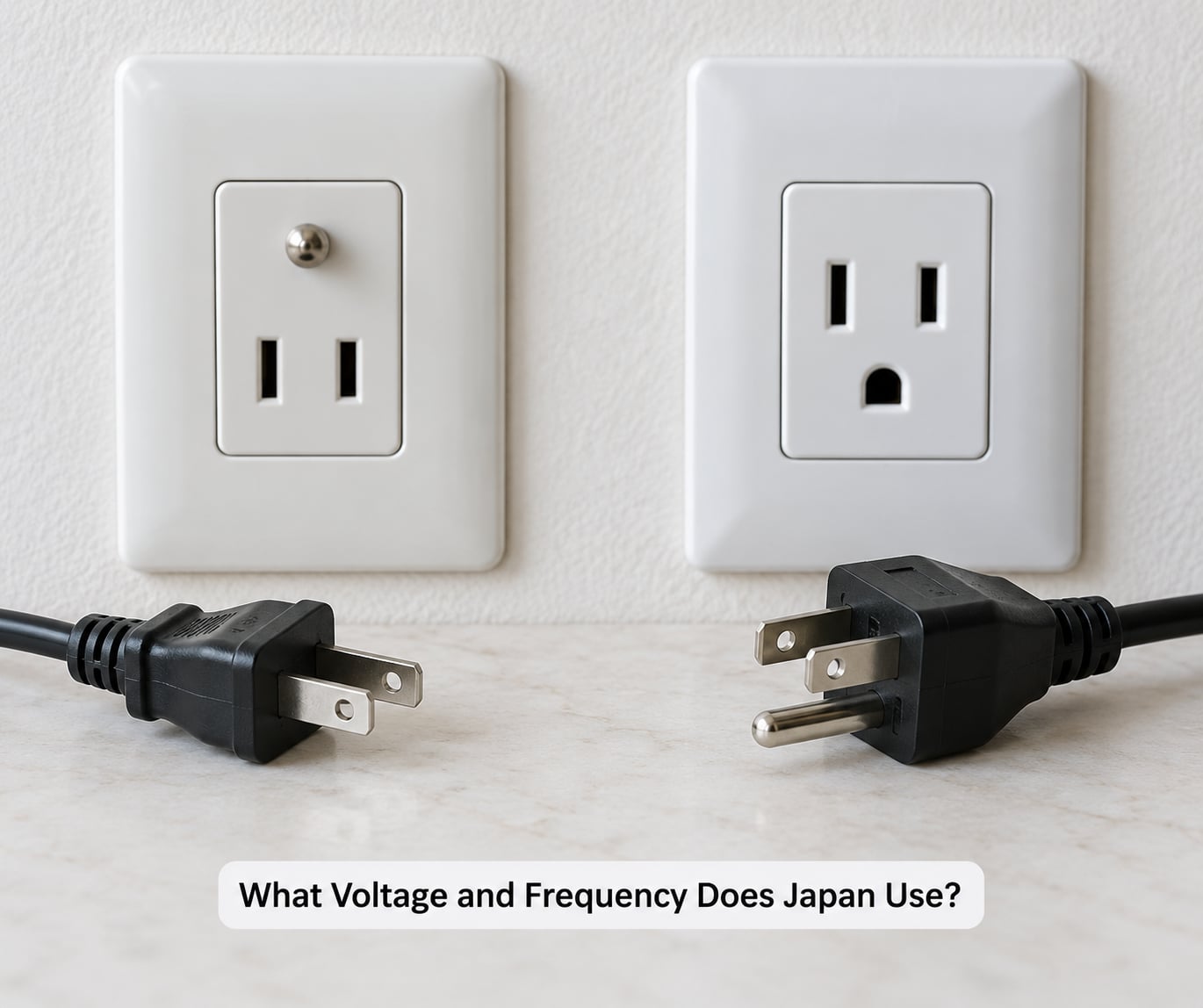
Japan’s household supply is 100V. Frequency is 50Hz east of a boundary that runs roughly through the middle of the country, and 60Hz to the west. The US supply is 120V at 60Hz everywhere, which is why a lot of American gear seems to work fine at first and then behaves oddly.
| Region | Voltage | Frequency | Plug type | Grounding |
|---|---|---|---|---|
| Japan (east: Tokyo, Yokohama, Sendai, Hokkaido) | 100V | 50Hz | Type A, Type B | Mostly ungrounded 2-pin |
| Japan (west: Osaka, Kyoto, Nagoya, Hiroshima, Fukuoka) | 100V | 60Hz | Type A, Type B | Mostly ungrounded 2-pin |
| United States | 120V | 60Hz | Type A, Type B | Grounded 3-pin standard |
| Canada | 120V | 60Hz | Type A, Type B | Grounded 3-pin standard |
| UK | 230V | 50Hz | Type G | Grounded 3-pin |
| Europe (EU) | 230V | 50Hz | Type C, Type E, Type F | Varies by country |
Two more Japanese numbers matter more than most people expect. A standard 100V wall outlet in a Japanese home is rated to about 1500W. Larger appliances such as air conditioners, electric ovens and some washing machines get a dedicated 200V circuit instead, and a US appliance will never touch that circuit through an adapter.
The 50Hz/60Hz line is worth memorising if you move. An American microwave that behaves perfectly in Tokyo is a common surprise in Osaka, and people moving west to east report microwaves and motors that start acting strange within a week.
Can You Use US Appliances in Japan?
Sort your appliances into three groups and the whole problem gets simple. The label on the case or on the AC adapter brick tells you which group something is in.
Dual-voltage appliances marked 100-240V or 100-120V
This is the easy group. Phone chargers, laptop bricks, camera battery chargers, electric shavers, most small kitchen gadgets and a lot of imported electronics are rated for a wide input range and work on 100V without complaint. You still need a plug adapter for a three-prong plug, but no transformer and no risk.
These devices also usually say 50/60Hz or 100-240V 50/60Hz, which means they are happy in either half of Japan. If you are buying an appliance in the US specifically to bring over, look for that dual rating before you pay for it.
Single-voltage 120V appliances
These will usually power on in Japan and that is exactly where people get into trouble. A 120V heating appliance fed 100V produces less heat, so a kettle or coffee maker takes noticeably longer, and a hair dryer runs cooler and weaker. Motors run slower and hotter on the wrong frequency, which shortens their life.
None of that is dramatic on its own. The problem is when a resistive heating element is involved: a toaster or coffee maker that never reaches temperature can sit in a long cycle indefinitely, and that sustained load is what stresses the element and the wiring.
220-240V appliances and mains-only devices
Anything built for Europe, the UK, Australia or China at 220-240V will not run on Japan’s 100V supply at all. It needs a step-down transformer (a hen-atsuki in Japanese) sized to the device. Old appliances with no AC adapter brick, where the mains cable plugs straight into the wall, are almost always in this group unless the label says otherwise.
Mains-powered hair dryers from Europe fall here, which surprises people. A US 120V hair dryer is a milder problem by comparison: it works, just less hot.
How to Check an Appliance Before Using It in Japan
Run every new device through this sequence. It takes about a minute and it removes almost all guesswork.
Step 1: find the input rating
Turn the appliance over and look for the small printed label or the molded plastic plate on the back or underneath. Look for an INPUT or RATED line. A range such as 100-240V or 100-120V means dual voltage. A single figure such as 120V 60Hz means single voltage, and you now know it needs a transformer or careful handling.
If the device uses an external power brick, read the brick’s INPUT line rather than the one on the device itself. The brick is where the mains actually enters, and almost every modern brick says 100-240V 1.5A or similar.
Step 2: check the frequency line
Next to the voltage you will find a frequency, either 50Hz, 60Hz or 50/60Hz. A single frequency means the device was built for one grid. Motors and compressors care about this far more than electronics do.
Step 3: check the wattage against the outlet limit
Find the power rating in watts or the current draw in amps. Multiply amps by 100 to get the wattage at Japanese mains. Anything above roughly 1500W exceeds what a standard Japanese room outlet is built to deliver, so it belongs on a 200V circuit or a dedicated outlet. Full-size US washing machines, large air fryers, dehumidifiers and space heaters usually land in that category.
Step 4: read the manual, then look at the plug
The manufacturer’s manual settles arguments. Then check whether the plug is a two-pin flat Type A (these often fit a Japanese outlet directly) or a three-prong grounded Type B, which needs a 3-to-2 adapter at minimum.
A few appliances deserve extra caution in Japan. Anything that touches water, including electric toothbrush chargers, kettles and humidifiers, should only be used on a properly grounded or low-draw connection. Microwaves, refrigerators, washing machines and dehumidifiers all have motors or magnetrons, so frequency matters and so does grounding. Power tools from the US often carry double insulation and run fine, but check the label because some jobsite tools are 120V single-frequency.
A grounding problem people ignore
A 3-to-2 adapter plugs a grounded American plug into an ungrounded Japanese outlet. For a phone charger, that is fine. For a 1500W microwave or a dehumidifier with a metal water tank, you have quietly removed the safety ground that would trip if a wire faulted. On high-draw appliances the safer path is a Japan-rated replacement or a properly grounded installation, not an adapter.
Do You Need a Voltage Transformer in Japan?
You need one when the appliance’s label calls for something other than 100-240V or 100-120V. That means 120V-only US devices and every 220-240V device. A plug adapter is not a substitute: it changes the physical plug shape and nothing else, which is the single most expensive misunderstanding in this whole topic.
Two limits on transformers catch people out. First, a basic step-down transformer does not change frequency, so a 50Hz-sensitive motor still has the wrong Hz even after conversion. Second, the transformer itself draws current, so you need headroom.
A practical sizing rule: pick a transformer rated at roughly twice the device’s wattage, and never above the 1500W ceiling of the outlet it plugs into. A 900W coffee maker wants a 1500W unit minimum, and if you want two high-draw devices on one circuit, stop. Buy the Japanese version of one of them instead.
The costs settle this quickly for anyone staying long. A converter that can handle a refrigerator, a washing machine and a dryer would cost more than replacing those appliances with 100V Japanese models, which come with local service and no conversion guesswork. For a traveler with a hair dryer and a laptop, one small converter in a suitcase is entirely reasonable.
The reverse direction
The same logic runs backward. A Japanese appliance rated 100V will not work on a 120V US supply either, and a Japanese microwave or rice cooker needs a step-up transformer in America. If you plan to move back and forth, buy 100-240V replacements rather than shipping equipment across the ocean twice.
What Plug Adapter Is Needed for Japan?
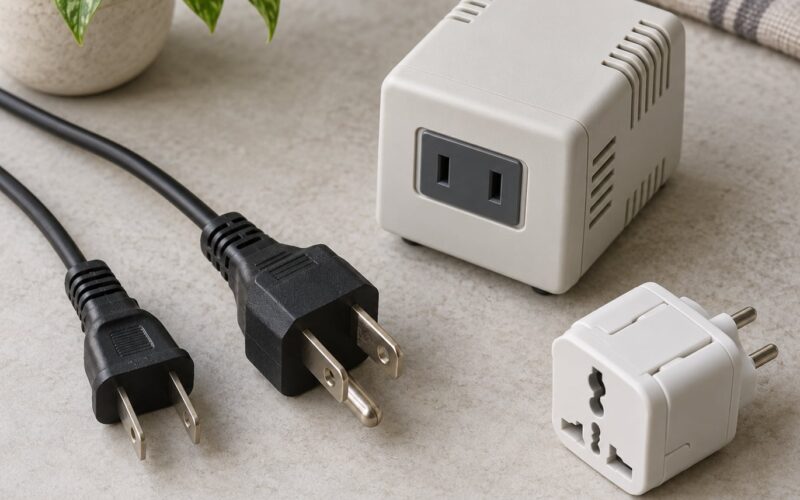
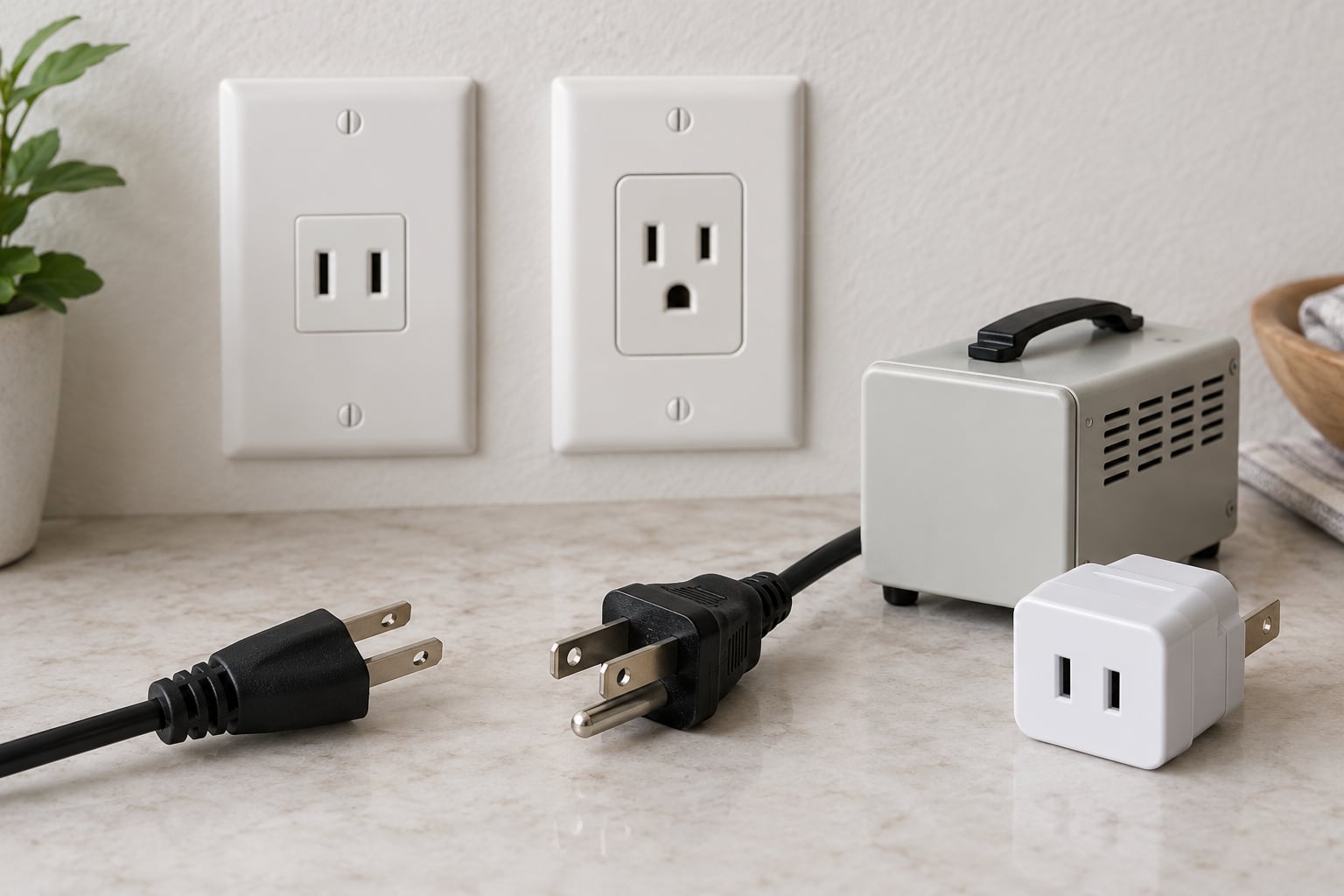
Japan uses Type A and Type B. Type A is two flat parallel pins and it is the same shape used in North America, so many American two-prong plugs slide straight into a Japanese outlet without any adapter at all. Type B adds a round grounding pin below the two flat pins.
Type B outlets exist in Japan but they are less common, especially in older apartment buildings where the standard is an ungrounded NEMA Type A 1-15 socket. That is the same socket found in much of North America, which is why so many travelers bring nothing at all and simply fail when they reach for a three-prong plug.
Your choices, in order of preference: nothing at all if the plug is two-pin Type A; a simple 3-to-2 adapter for low-wattage devices; a grounded Type B to Type A adapter for anything you genuinely need grounded; and Japan-rated replacement hardware for high-draw appliances. A universal travel adapter box works, but the bulky plug-style adapters tend to hold on to a loose Japanese socket better.
Choose an adapter based on what it plugs into, not on what it looks like. An adapter that lets a three-prong plug sit in a two-prong outlet hides the fact that the ground is gone, and on a 1200W appliance that is a genuine shock and fire risk rather than a technicality.
Where to buy adapters and Japan-rated replacements in Japan
BIC Camera and Yodobashi Camera both carry travel sections with plug adapters and converters. Hands and Loft stock household and travel accessories, Daiso has cheap two-pin adapters, and Don Quijote carries adapters and small appliances. Amazon Japan has a deep range of both adapters and Japan-rated replacement appliances. Japanese electronics stores rarely stock adapters for foreign plugs as a category, so the travel sections are the place to look first.
If you are flying in, buy a 3-to-2 adapter before departure. It costs the same in the US and removes one errand from the day you land.
Which US Appliances Are Most Likely to Work or Fail?
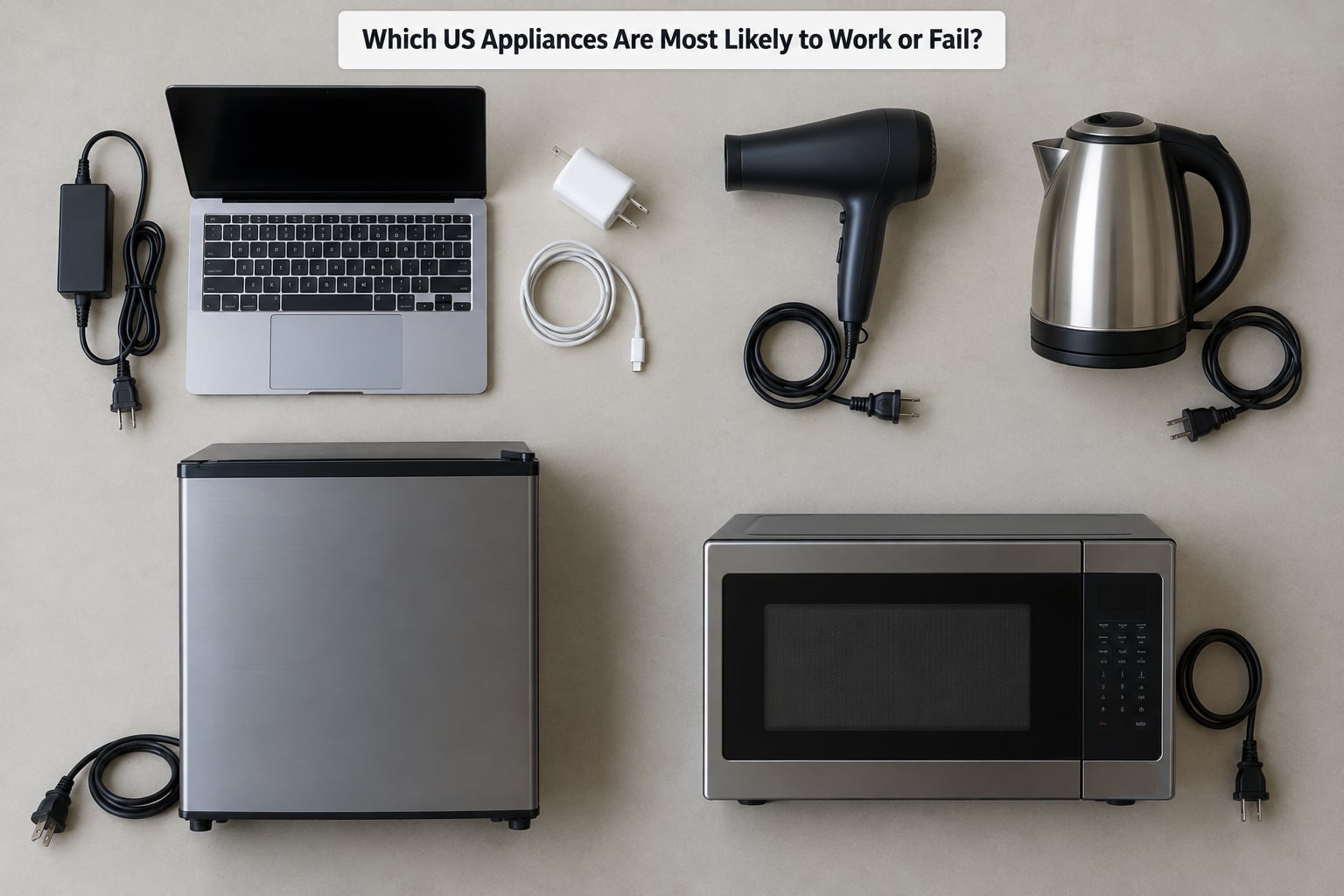
Here is the per-device verdict table. Plug-compatible means the plug fits and the voltage is fine. With care means it runs but performs below spec. Transformer means you need a properly sized step-down unit. Replace means buy the Japanese version.
| Appliance | Typical US rating | What you need in Japan | Verdict |
|---|---|---|---|
| Phone charger | 100-240V, 50/60Hz | Nothing or a 2-pin adapter | Plug-compatible |
| Laptop and laptop brick | 100-240V, 50/60Hz | Nothing or a 2-pin adapter | Plug-compatible |
| Camera and battery charger | 100-240V, 50/60Hz | 2-pin adapter if grounded | Plug-compatible |
| Electric shaver | 100-240V or 100-120V | Usually nothing | Plug-compatible |
| Game consoles and Nintendo handhelds | 100-120V, 60Hz | Adapter; region checks still apply | Plug-compatible |
| Television | 120V, 60Hz | Adapter plus a tuner; US broadcast format differs | With care |
| Hair dryer | 120V, 60Hz | Adapter; runs cooler and weaker | With care |
| Curling iron or straightener | 120V, 60Hz | Adapter; slower to reach temperature | With care |
| Electric kettle | 120V, 60Hz | Adapter; noticeably longer boil | With care |
| Toaster | 120V, 60Hz | Adapter or small transformer | With care |
| Coffee maker or espresso machine | 120V, 60Hz, often over 1000W | Adapter, or transformer above 1000W | With care |
| Air fryer | 120V, 60Hz, 1200-1800W | Adapter and check the 1500W ceiling | With care |
| Dehumidifier | 120V, 60Hz, high draw | Ground safely; consider a Japanese unit | Transformer or replace |
| Vacuum cleaner | 120V, 60Hz | Adapter; motor runs slower on 50Hz | With care |
| Microwave oven | 120V, 60Hz | Frequency-locked; unreliable in the wrong region | Replace |
| Refrigerator | 120V, 60Hz compressor | Step-down transformer, and match the region Hz | Transformer or replace |
| Washing machine | 120V, 60Hz | Usually over the 1500W outlet limit | Replace |
| Rice cooker | 120V only in Japan | US model needs a transformer | Transformer |
| 3D printer and heated bed | 100-240V on the heated variant | Check the bed heater rating specifically | Depends on the model |
Two table rows deserve extra explanation. Microwaves are frequency-locked: the magnetron and the turntable motor are tuned for one grid frequency, and on the wrong one the unit runs slow or simply stops heating. Refrigerators and washing machines also carry motors, so they run hotter and louder at the wrong Hz and lose life quickly.
And one row is not really about electricity at all. A US television can power up and still show nothing useful because the broadcast format and tuner differ. Region-locked game hardware fails the same way, for reasons no adapter can fix.
Frequently Asked Questions
Do I need a voltage converter in Japan from the US?
Usually not. If your device is labelled 100-240V or 100-120V, a plug adapter is enough. You need a step-down transformer only for 120V-only US appliances and all 220-240V ones. A plug adapter changes the plug shape and never the voltage, which is the most common mistake people make.
Can you use 120V appliances in Japan?
They will usually power on, because Japan’s 100V supply sits inside the tolerance most electronics accept. Heating appliances then run cooler and take longer, and motors run slower and hotter. For a kettle or hair dryer that is workable; for a microwave or refrigerator the frequency mismatch makes it unreliable. Check the label before you commit.
What is the voltage used for appliances in Japan?
Japanese homes run on 100V, split into 50Hz in the east, including Tokyo, Yokohama and Hokkaido, and 60Hz in the west, including Osaka, Kyoto, Nagoya and Hiroshima. The United States runs on 120V at 60Hz nationwide. Standard Japanese room outlets handle about 1500W, with separate 200V circuits for large appliances.
Are Japan power outlets the same as the USA?
The shapes overlap but are not identical. Japan uses Type A and Type B, the same family as North America, and many American two-prong plugs fit a Japanese socket with no adapter. Three-prong Type B plugs need an adapter because grounded Type B outlets are uncommon in Japan, especially in older buildings.
Can I use a 220V charger in Japan?
Not directly. A 220-240V charger or mains device needs a step-down transformer to bring Japan’s 100V up to what it expects. Transformers change voltage but usually not frequency, so a 50Hz-sensitive motor can still be a problem. Check the label, size the transformer at about twice the device wattage, and stay under the 1500W outlet limit.
Will my US microwave, fridge or washing machine work in Japan?
Rarely well. All three have motors or magnetrons tuned to 60Hz, and Japan runs 50Hz in the east and 60Hz in the west. Expect slower cooking, hotter running motors and shorter life, and washing machines often exceed the 1500W a standard room outlet delivers. Buying the Japanese version is normally cheaper and simpler than converting.
Conclusion: Check the Label Before You Bring the Appliance
Start with the label. If it reads 100-240V or 100-120V with 50/60Hz, plug it in with an adapter and move on. If it reads 120V only, think about whether a transformer is worth it, especially for a heating device you use occasionally. If it reads 220-240V, plan on a transformer sized at twice the wattage, and stay inside the 1500W outlet limit.
If the specifications are unreadable or the manual is missing, replace it. Electricity is not the place to guess, and a Japanese 100V version of any large appliance is both cheaper and safer than converting a machine you cannot verify.