Twitter stayed popular in Japan because it matched how Japanese users already talk: quickly, under a pseudonym, in public, and mostly from a phone. Add a culture of live television commentary, dense fandom networks and one of the highest per-user time-spend figures on the platform, and you get a market that never really left. Below are the eight reasons that explain it, followed by where X actually sits in 2026.
One thing to clear up early: almost nobody in Japan says X. The platform is still ツイッター (tsuite) in ordinary conversation, the act of posting is a ツイート (suu-to), and the noun for a poster is a twitta. That name never really went away in English-language coverage, which is part of why the outside view of Japanese Twitter is so often wrong.
Table of Contents
- 1Why Twitter Stayed Popular in Japan: Key Reasons at a Glance
- 2How Japan’s Mobile Internet Helped Twitter
- 3Twitter Fitted Japan’s Real-Time Communication Culture
- 4Why Local Networks and Influencers Mattered
- 5What the Platform’s Simplicity and Familiarity Added
- 6How Events, News, and Daily Life Kept Users Engaged
- 7What Changed When Instagram and Other Platforms Arrived?
- 8Why Twitter Stayed Popular in Japan: The Takeaway
- 9Frequently Asked Questions
- 10Was Twitter more popular in Japan than in other countries?
- 11Why did Japanese users adopt Twitter earlier than some other social networks?
- 12Did Japanese people use Twitter mainly for news?
- 13What made Twitter feel different from Facebook in Japan?
- 14Is Twitter still used in Japan today?
- 15How did Japanese companies and celebrities use Twitter?
Why Twitter Stayed Popular in Japan: Key Reasons at a Glance
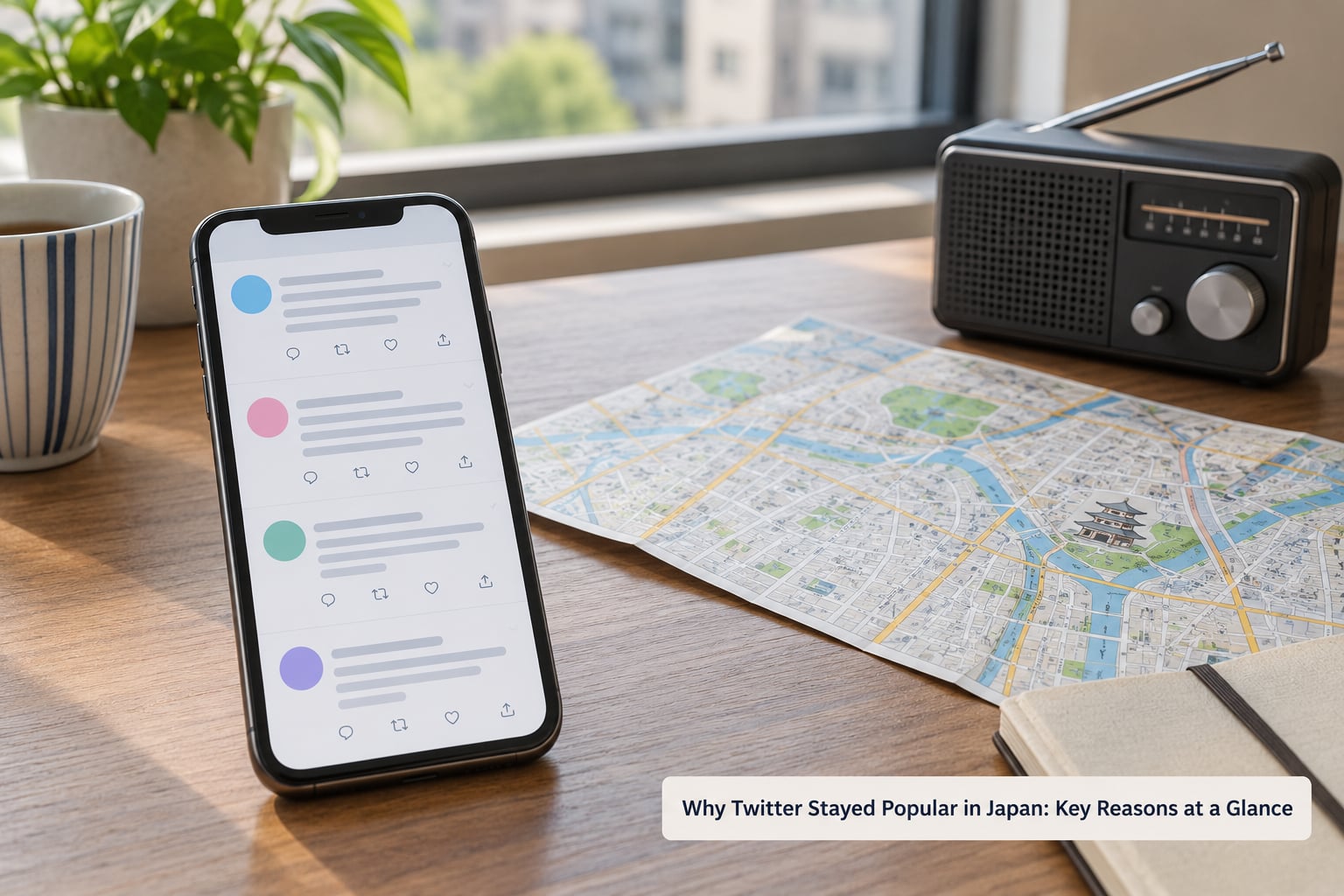
Short version: mobile-first design, pseudonymity, real-time conversation, local networks, simple mechanics and repeated daily triggers. Here is the same answer broken into the parts that actually matter.
- Phones came first. Japanese users met Twitter on feature phones and early smartphones, on commutes and while watching TV, so posting became a habit rather than a separate activity.
- Pseudonymous handles fit the culture. A handle let people say things their workplace, family or neighbours would not want attached to their name.
- The character limit became a writing style. Japanese posters turned the 140-character cap into slang, emoji and kaomoji density instead of terseness.
- It was a real-time layer over television. Research comparing Japanese and US tweets found Japanese posts reference TV far more often.
- News and disasters broke first there. Earthquake, tsunami and transport updates made the timeline feel like a service, not a diary.
- Follow without friending. You could build a feed around interests rather than existing relationships.
- Local networks were dense. Anime, game and idol communities, media outlets, officials and brands all posted in Japanese to the same hashtags.
- Weak domestic rivals. Facebook never took hold here, and LINE is a private messenger rather than a public square, leaving room for X to be the public one.
How Japan’s Mobile Internet Helped Twitter
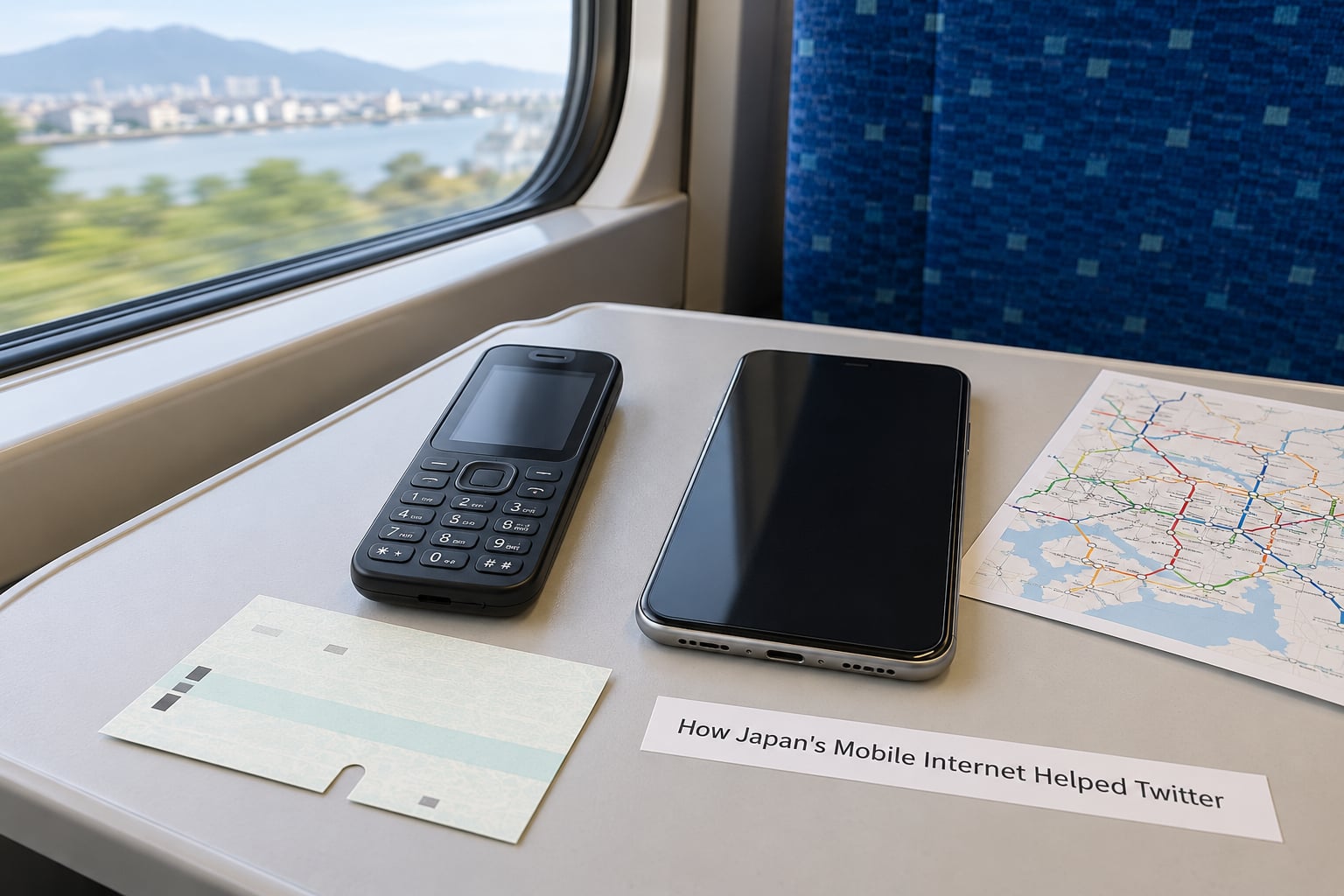
Japan was an early mobile market, and Twitter arrived in 2008 into a country where many people already had a phone in their hand all day. Feature phones shipped with Twitter clients, so posting required no computer and no desktop website visit. That is the opposite of how Facebook got its start in most countries, where the network implied a browser at a desk.
The commute made it worse in the best way. Long public transit journeys with no reliable mobile signal created a habit of opening the timeline, scrolling, and reacting in bursts. Academic work on Japanese Twitter users links the character limit to emoji-heavy, slang-heavy posting, which reads as a habit formed in short stolen windows rather than one formed in long seated sessions.
The short format also fit Japanese writing. Fitting an opinion into a small space encouraged a compressed, playful style that people enjoyed producing. As one Reddit thread about Japanese 140-character artistry put it, the constraint was treated as a craft rather than an annoyance.
Twitter Fitted Japan’s Real-Time Communication Culture
The single most Japanese thing about Twitter usage is that people used it to talk about what they were watching right now. A television programme starts, an audience of several hundred thousand posts about it within minutes, and the hashtags and trending topics reorganise around the broadcast. In the US, research shows the same platforms skew toward sports and news instead.
That behaviour turns the platform into a live commentary layer, sometimes called the second screen or isolation effect. Households often watch alone, on separate sofas, so the app becomes the social half of watching television. Reaction GIFs, spoilers and jokes about an ad break circulate faster on the timeline than anywhere else.
Crises proved the same muscle. The 2011 earthquake and tsunami pushed a huge volume of real-time information, eyewitness posts and service-status updates through the network, and transportation disruption reports became a routine local use. When something happens in Japan, the timeline is where the first wave of posts appears, so people keep an eye on it out of habit.
Why Local Networks and Influencers Mattered
Twitter’s value in Japan was not that it was global. It was that it was dense with the accounts people in Japan actually cared about, all posting in Japanese, all using the same tags, all reachable without an introduction.
Anime, manga and game communities were the network-effect engine. Fans of a series, an idol group or a game title built follow relationships around a hashtag, and the communities stayed lively because followers accumulated for years. Celebrities and idols post routinely on X, and a single post from a popular account can reach a very large Japanese audience in a matter of minutes. Media organisations, government departments and local municipalities keep official accounts there too, which pushes ordinary users to check the same feed for practical reasons.
Reuters reporting from 2018 made the commercial version of the same point: advertising executives in Tokyo attributed Japanese growth to the alias policy and the ease of anonymity in a reserved culture. Pseudonymity was not a loophole to exploit. It was the product.
What the Platform’s Simplicity and Familiarity Added
Rivals in Japan tended to be either visual-first or closed by design. X was a public text feed with a follow model, a character limit, hashtags, replies and reposts, and that narrowness was the appeal. You could understand the whole thing in a minute and then never think about the interface again.
Reposts and trending topics did the discovery work that a friend graph would do elsewhere. Follow without friending meant a 19-year-old in Osaka and a hobbyist in Sapporo could build parallel feeds about the same subject, with no relationship required and no obligation to interact with people you know.
The 2018 numbers showed how big that gap was. Reuters reported roughly three-quarters of Japanese 18-plus students on Twitter, against about one-quarter on Facebook. Facebook, which arrived with a friend-and-real-name model, never caught up in Japan for exactly the reasons the pseudonymity story predicts.
How Events, News, and Daily Life Kept Users Engaged
Popularity is easier to keep when there is always a reason to open the app. Japan has a dense calendar of them: technology events in Tokyo, product announcements and launch dates, live broadcast finales, sports seasons, shopping promotions and holiday travel periods. Each one produces a temporary spike in posting that pulls casual users back into the timeline.
For anyone following the tech scene, this is the most visible side of it. Device announcements, developer posts and event coverage accumulate into searchable threads that get linked, quoted and argued over long after the original post scrolls away. That archive effect is part of why X still functions as a working reference tool for Japanese technology news, separate from any platform where it is popular.
GetAFollower’s 2026 figures put numbers on the habit: Japanese users average around 42 minutes per day on X, the highest per-user figure globally. Whatever else is changing about the platform, attention from Japanese users has not.
What Changed When Instagram and Other Platforms Arrived?
Twitter did not vanish in Japan. It lost its default position. Instagram took lifestyle, food, travel and visual celebrity content. TikTok took short-form video discovery. LINE took private messaging and remained the default way most people talk to friends. mixi, once the home-grown network people reach for when the Facebook comparison comes up, serves a different, more closed community.
Musk’s 2022 acquisition changed the tone more than the numbers. X lost users globally and gained a persistent negative reputation for moderation and bot activity, while Japanese engagement held up comparatively well. The shift in growth markets is telling: global monthly active users sit around 611M, with expansion coming from India, Brazil and Indonesia while Japan is flat to declining.
| Platform | Typical role in Japan | Approximate user base | Direction of travel |
|---|---|---|---|
| X (Twitter) | Public real-time conversation, news, fandom, official accounts | Roughly 45M reported in 2018 | Flat to declining |
| LINE | Private messaging with friends, family and work groups | Largest platform in Japan by reach | Still growing slowly |
| Visual lifestyle, food, travel, fashion | Large and growing | Growing | |
| TikTok | Short video discovery and creators | Growing fast since launch in Japan | Growing fast |
| Small remnants of real-name social use | Minority in Japan | Flat to declining | |
| mixi | Closed Japanese communities and hobby boards | Niche but loyal | Stable |
The honest downside deserves a sentence. Japanese Twitter has also been a rough place: coordinated harassment, political hostility and bot accounts are documented problems, and long-running fandom conflicts have turned arguments into pile-ons. Whether the app is popular and whether it is pleasant are two different questions, and for a lot of Japanese users the answer to the second is no.
Why Twitter Stayed Popular in Japan: The Takeaway
So why twitter stayed popular in japan comes down to two things above the rest: pseudonymity in a name-sensitive society, and real-time public conversation. Those two created a space LINE’s private chat rooms and Facebook’s friend model could not occupy, and they filled with local accounts worth following.
Ranked, the advantages run: pseudonymity first, real-time commentary second, dense local networks third, mobile-first access fourth, and the character-limit style fifth. The last two have decayed the most. Mobile-first posting is no longer a differentiator anywhere, and weak domestic rivals stopped being true once Instagram, TikTok and a strong LINE arrived. The first two have not decayed, which is why Japanese time-spend still leads the world even after the global decline.
If you want to read Japanese Twitter culture rather than just count it, follow Japanese-language hashtags, ordinary posters rather than only verified accounts, and one live broadcast. The conversation underneath the celebrities is the part that explains the platform.
Frequently Asked Questions
Was Twitter more popular in Japan than in other countries?
Per user, yes. Reuters reported roughly 45M Japanese users in 2018, and 2026 figures put average Japanese time on X at about 42 minutes per day, the highest of any market. As a share of the population it looks smaller than in the US, but the depth of use per account is unusually high, which is why Japanese behaviour shows up so strongly in platform data.
Why did Japanese users adopt Twitter earlier than some other social networks?
Because it worked on the phones people already carried and it did not require real names. Japanese feature phones shipped with Twitter clients years before desktop social networks were common locally, and the alias model let people post freely without attaching a workplace or family identity. Facebook, which arrived with a friend graph and real-name culture, never matched that fit.
Did Japanese people use Twitter mainly for news?
No, news was one use among several. Japanese Twitter is arguably better known for live commentary on television programmes, fandom conversation around anime, manga, games and idols, and everyday chatter. Breaking news and disaster updates were the usage that proved the timeline’s value early on, but the daily habit comes from everything else.
What made Twitter feel different from Facebook in Japan?
Pseudonymity versus real identity. On Facebook you were your name, your school or your workplace, which carried real social cost in a country where context and reputation matter heavily. Twitter handles removed that cost. Reuters reporting from 2018 noted roughly three-quarters of Japanese 18-plus students on Twitter against about one-quarter on Facebook, and that gap has never closed.
Is Twitter still used in Japan today?
Yes, heavily, though it is no longer the default platform. Most Japanese users still call it ツイッター rather than X, and average daily time spent remains the highest of any major market. What changed is the competition: Instagram took visual content, TikTok took short video and LINE took private messaging, so X now sits as the public conversation layer rather than the only one.
How did Japanese companies and celebrities use Twitter?
As a broadcast channel with a reply function. Companies post announcements, promotions and service updates, and fans reply in public, which functions as free customer service and brand visibility at once. Celebrities, idols, media outlets, government bodies and local municipalities all maintain accounts, and a single post from a popular account can reach a large Japanese audience within minutes.