
Japanese companies are slow to adopt cloud software mainly because their existing on-premises systems still work, the people who approve spending cannot predict cloud bills or outages, and long vendor relationships reward staying put. That caution is rational, not cultural. It is also uneven: startups, retailers and mid-sized firms move faster than banks, manufacturers and government agencies.
The honest version of this story matters more than the flattering one. If you sell into Japan, build a migration plan there, or invest in the region, a vague story about caution will not help you. So let us look at what the indicators actually show, what the eight structural barriers are, and where the exceptions sit.
Table of Contents
- 1What Does Slow Cloud Adoption Mean in Japan?
- 2The Real Reasons Why Japanese Companies Are Slow to Adopt Cloud Software
- 31. Legacy systems make migration a capital project, not an IT decision
- 42. Keiretsu vendor relationships lock in incumbents
- 53. Procurement and risk management stretch every purchase
- 64. APPI and data residency turn cloud storage into an accountability question
- 75. Latency-critical manufacturing work genuinely has to stay on-premises
- 86. The IT labor shortage is a reason to adopt, not a reason to wait
- 97. Nemawashi consensus turns software purchases into multi-month exercises
- 108. Cloud cost unpredictability undercuts the business case
- 11How Legacy Systems Create Costly Migration Decisions
- 12Why Procurement and Risk Management Slow Decisions
- 13How Language, Support, and Data Requirements Create Friction
- 14Why Organizational Culture Matters
- 15Is Japanese Business Cloud Adoption Actually Slow?
- 16Why Do Adoption Barriers Differ by Company and Service?
- 17What Can Japanese Companies Do to Adopt Cloud Software Faster?
- 18Frequently Asked Questions
- 19Are Japanese companies less likely to use cloud software than companies elsewhere?
- 20Is cloud adoption mainly a problem for large Japanese companies?
- 21Does data residency prevent Japanese companies from using global cloud platforms?
- 22Which types of software are Japanese businesses adopting to the cloud first?
- 23Can Japanese companies use international SaaS platforms with English-only interfaces?
- 24How can a Japanese company convince executives and regulators to approve a cloud migration?
- 25Conclusion
What Does Slow Cloud Adoption Mean in Japan?
“Slow” is a measurement claim, and the measurement matters more than the adjective. Analysts usually track four things: how much infrastructure runs in public cloud, how many business applications run as SaaS, how long a typical migration takes, and how fast cloud spending is growing. Japan looks weak on the first and fourth, mid-table on the second, and unusually slow on the third.
The fourth indicator is where the stereotype breaks. Japan sits near the top of several Asian economies for readiness to adopt cloud computing, and its SaaS market has been growing at a high-teens compound annual rate. A market can grow fast and still convert slowly, because the base is small and the largest buyers move last.
It also helps to separate two different things people call slow. The first is the delay in moving an existing workload off a mainframe or a room of on-premises servers. The second is the time before a company settles into a steady, permanent way of using cloud services. Japanese firms have been slower on the first and only slightly slower on the second.
Four ways people measure it, and what Japan shows on each:
- Public-cloud infrastructure share: persistently lower than the United States and Northern Europe, with more workload staying in private cloud and on-premises data centres.
- SaaS application count per company: growing, though large Japanese enterprises run fewer cloud applications per employee than comparable US firms.
- Migration timeline: multi-year for large enterprises, which is well beyond what most vendor timelines assume.
- Cloud spending growth: among the fastest in the region, because the starting point is low and the first wave of migrations is only beginning.
The Real Reasons Why Japanese Companies Are Slow to Adopt Cloud Software
Eight pressures explain most of it. They are structural, they mostly affect large organizations, and several of them are easing right now.
1. Legacy systems make migration a capital project, not an IT decision
Japanese enterprises still run core accounting, production planning and logistics on mainframes and on-premises systems that were commissioned in the 1980s and 1990s. Those systems are not merely old. They are interconnected in ways that were never documented, they carry decades of stored business rules, and the people who understand them are retiring. Moving one is a multi-team engineering programme with a board-level risk line, not a procurement decision.
2. Keiretsu vendor relationships lock in incumbents
A large share of Japanese enterprise IT runs through a small circle of group companies and long-standing systems integrator partners such as NTT Data, Fujitsu, Hitachi and NEC. Supporting that relationship keeps budgets, support contracts and accountability inside a known network. It also means the incumbent vendor has an incentive to propose modernization of what it already maintains, which is cheaper for the customer than a migration to someone new. The lock-in is contractual and financial before it is technical.
3. Procurement and risk management stretch every purchase
Even a mid-sized Japanese company can run a nine-to-twelve-month evaluation for a single business application: security questionnaire, data-handling review, proof of concept, cost modelling, committee approval. Practitioners describe procurement stalling projects long after the technical case has been made. The people who carry the migration risk are rarely the people who benefit from it or get promoted for it, and that asymmetry produces caution.
4. APPI and data residency turn cloud storage into an accountability question
Japan’s Act on the Protection of Personal Information, enforced by the Personal Information Protection Commission, requires a lawful basis for transferring personal data overseas and obliges organizations to assess and document that transfer. Under the cloud model, a finance or HR application usually needs data held in Japan or an equivalent jurisdiction, plus a clear answer on who can see it and who is accountable for a breach. This is not an IT checkbox. It is a question boards ask, and “our provider serves millions of customers elsewhere” is not an answer that satisfies it.
5. Latency-critical manufacturing work genuinely has to stay on-premises
Japanese manufacturing is world-class in ways that make cloud a poor fit for the plant floor. Robot controllers, machine vision, production-line IoT and quality inspection systems run on deterministic millisecond budgets and local safety rules. Network jitter is not acceptable when a line stops. For a large share of Japan’s manufacturing base, keeping that layer on-premises or on private cloud near the factory is the correct engineering decision, not evidence of resistance.
6. The IT labor shortage is a reason to adopt, not a reason to wait
Japan faces a projected shortfall of around 450,000 IT professionals by 2030. The common assumption is that this pushes companies toward cloud, because managed services replace work nobody can staff. In practice it also produces freeze: when maintenance capacity is scarce, teams freeze what works and defer anything that needs new skills. The shortage is now the strongest accelerant, because AI adoption only pays off once data is reachable off-premises.
7. Nemawashi consensus turns software purchases into multi-month exercises
Decisions are built by consensus before they are formally approved. Nemawashi is the pre-meeting process where objections are surfaced and resolved among the people who will have to live with the outcome; ringi is the formal circulation of the approval stamp that follows. This produces careful choices, and it produces slow ones. A purchase that a US team would approve in a quarter routinely takes two to three in a large Japanese firm.
8. Cloud cost unpredictability undercuts the business case
The cost case is harder to defend than the on-premises one. Public cloud bills move with usage, storage grows quietly, and data egress is priced in US dollars, so a weak yen adds a second layer of uncertainty on top. Research cited in industry analysis puts the share of enterprises believing more than a quarter of their public cloud spend is wasted above 50% in the Asia-Pacific region. A finance director who cannot forecast the number will not sign the contract.
How Legacy Systems Create Costly Migration Decisions
The switching cost in a mainframe estate is not the licence. It is everything the licence depends on: interfaces written decades ago, batch schedules tied to physical delivery of data, regulatory reporting formats, and knowledge that exists only in a handful of people’s heads. One manufacturer can hold 400 custom interfaces, and every one of them is a test case for a migration nobody has run before.
That produces a specific failure pattern: a big-bang migration attempt that stalls at 60% completion, burns budget, and leaves the organization more committed to its legacy estate than before. IT leaders describe multi-year programs where the technical work finished years before the decision to commit was made.
The alternative that increasingly wins is phased migration by workload rather than by system. Pick one contained, low-regulatory application, prove the economics and the operating model on it, then decide whether to continue. It is slower per application and much faster overall, because each phase funds the next with evidence instead of a business case written three years ahead.
There is also a cost that never appears in a migration business case: the hardware refresh already on the calendar. If a mainframe is due for replacement, the comparison is cloud versus a known capital spend, not cloud versus nothing. Any analysis that ignores that baseline flatters the cloud option.
Why Procurement and Risk Management Slow Decisions
Japanese enterprise procurement is a documented, evidence-heavy process. Vendors are assessed on security posture, data handling, financial stability, support model and long-term viability before anyone discusses features. A Quora thread on the barriers to disruptive innovation in Japanese companies drew the observation that ease of use and simple installation outsell software advantage almost every time, which is exactly the wrong ordering for a rigorous evaluation process.
The structural problem is who carries the risk. The person who signs the cloud contract inherits the consequences of a region outage, a billing surprise or a data-handling failure. The person who blocked the purchase and kept the old system running carries none of it. In an organization that rewards avoidance of visible failures, that is a powerful argument for waiting.
Security review adds its own clock. Data classification, encryption standards, log retention, access control and incident reporting all have to be mapped to Japanese internal policy and to APPI obligations, usually with an external assessor involved. Add information-security staff shortages and a three-month queue at a security operations centre, and a decision that took six weeks on the technical side takes two years end to end.
How Language, Support, and Data Requirements Create Friction
Localization is usually treated as a translation problem. For enterprise buyers it is not. Foreign vendors consistently report that Japanese-language UI, Japanese-language support hours, local implementation capacity and domestic references are raised as prerequisites before any technical evaluation begins. That moves the burden of market entry onto the vendor, and it is a large one.
Integration is the other half. Japanese back office runs on domestic accounting, payroll, attendance and MR systems from a small set of vendors, many of them with weak or proprietary APIs. A new SaaS tool that cannot post to the company’s existing general ledger and attendance system will not be deployed, regardless of how good the product is.
Data residency expectations add a geography requirement that most global regions can meet. Major providers operate Tokyo and Osaka regions, and domestic providers such as Sakura Internet sell sovereign and Government Cloud-aligned infrastructure into the same requirement. For a Japanese company, that narrows the field less than outsiders expect, and it hands a real advantage to vendors that already hold the certifications and the local support bench.
Why Organizational Culture Matters

Culture is the reason people say last, and it is not the reason the lag exists. The mechanisms are specific and nameable, which makes them easier to discuss honestly than “Japanese companies are cautious.”
Nemawashi means objections are raised and settled before a decision is formally taken. Ringi is the approval-stamp circulation that records who signed off. Seigyaku, the long-tenured employment model, means an individual’s career security sits inside the firm, so an irreversible technology change carries personal risk that an at-will workforce absorbs differently. Kaizen, continuous incremental improvement, is genuinely well suited to migration: small, reversible, measurable steps beat one grand redesign.
Operational continuity carries real weight too. Japan’s enterprise culture prizes reliability, and a production line that stops costs more than a project that slips. A team that cannot state the downside of a migration in yen and hours will usually choose to wait.
The workforce connection is the part most commentary skips. Moving to managed cloud services reduces the headcount needed to run infrastructure, and in an organization where people have spent twenty years building that capability, that is a restructuring conversation, not a tooling decision. Cloud adoption and workforce planning arrive in the same meeting, which is one reason the meeting takes so long.
Is Japanese Business Cloud Adoption Actually Slow?
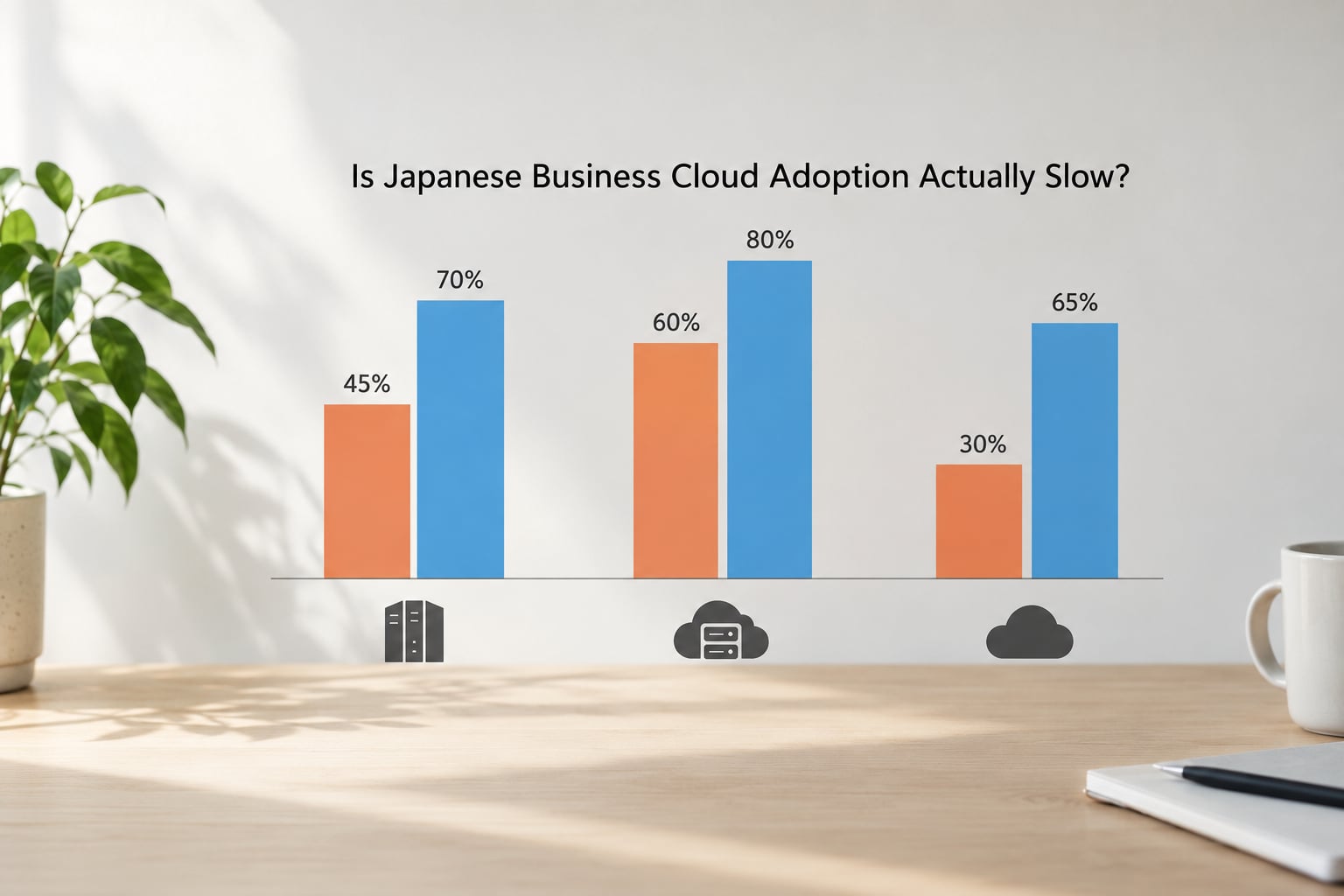
Partly. The evidence pulls in two directions, and the version that flatters Japan and the version that criticizes it are both selective.
The strongest case that the “behind” narrative is wrong: Japan has produced the world’s largest drop in IT labour productivity of any G7 country according to reported national figures, which points to underuse of digital technology rather than an inability to build it. Forum discussion on the same statistic splits three ways, and none of the three positions resolves cleanly.
The strongest case that it is right: public-cloud infrastructure penetration remains lower than in the US and EU, more application workloads sit in private cloud, and the projected 450,000-person IT shortfall by 2030 is a constraint on change regardless of intent. Meanwhile the SaaS market is on track to grow roughly 3.7x by 2030, which says the direction is right and the conversion is unfinished.
Indicators that conflict, and what each one actually proves:
- IT labour productivity: reported as the biggest drop among G7 countries. Points to underuse of installed technology.
- Early cloud readiness rankings: Japan has ranked among the Asian economies best prepared for cloud computing. Readiness is not adoption, but it kills the simple “late to the party” story.
- Private cloud reliance: roughly 78% of Asia-Pacific enterprises report running some applications in private cloud. Heavy private cloud use is compatible with slow public-cloud conversion.
- Cloud spend waste: over half of Asia-Pacific enterprises believe more than a quarter of public cloud spend is wasted. Adoption is being slowed by cost behaviour, not ignorance.
- IT talent shortfall: projected around 450,000 professionals short by 2030. Capacity, not appetite, is the ceiling.
- SaaS market growth: projected roughly 3.7x by 2030 on a high-teens compound rate. The gap is closing from a low base.
Why Do Adoption Barriers Differ by Company and Service?
“Japanese companies” is not a useful unit of analysis. A Tokyo startup with no legacy estate has almost none of these barriers. A regional bank’s core system has every one of them.
Where the barriers actually concentrate:
- Large enterprises and keiretsu members: legacy lock-in, nemawashi, incumbent SI relationships, capital budget cycles. The hardest segment, and the slowest.
- Banks, insurers and healthcare: regulatory review, information-security clearance, data-handling documentation. Frequently on Government Cloud-adjacent or domestic sovereign infrastructure.
- Manufacturers: latency and safety requirements keep plant-floor workloads local; corporate ERP and analytics can move. Split decisions, not uniform ones.
- Retail, logistics and agriculture: the easiest wins. Cloud POS, e-commerce backends and scheduling tools land quickly where there is little legacy to displace.
- Mid-market firms: budget and skills, not legacy. Often the segment with the most upside if the decision gets made at all.
- Startups: few barriers, low switching costs, but small absolute cloud spend that barely moves national numbers.
- Public sector: slowest of all. Government Cloud standards and Digital Agency procurement processes add a fixed, multi-year calendar on top of everything else.
Service type matters as much as company type. Team collaboration, CRM and business intelligence tools move first because they hold no regulated data and sit outside the core transaction path. ERP is next, slowly, because it is deeply integrated. Core banking, plant control and medical records move last, if at all.
What Can Japanese Companies Do to Adopt Cloud Software Faster?
Every barrier above has a corresponding move. In rough order of how quickly each one pays back:
1. Start with workload selection, not platform selection. List every application with its data classification, its integration count and its recovery requirement. Moving the wrong workload first is the most expensive mistake available, because the second approval is much harder to get than the first.
2. Build the business case against the refresh you already owe. Compare cloud against the on-premises option as it will actually appear in next year’s capital plan, including the staff time that keeps running. If the refresh is not comparable, the comparison is dishonest in both directions.
3. Migrate in phases with a kill decision at each one. One workload, a defined success measure, and an explicit point where the program can stop. Every Japanese enterprise migration I have read about that stalled did so after a big-bang attempt with no exit.
4. Do the security review once and reuse it. A single completed data-handling and security assessment, documented to APPI and internal policy, shortens every subsequent purchase in the same family of tools.
5. Decide localization requirements before technical evaluation. Japanese UI, support hours in Japanese, local implementation capacity and domestic references. Vendors who treat these as requirements rather than nice-to-haves discover them after the technical case is already built.
6. Plan the skills and staffing consequence openly. Cloud changes who runs the estate. Firms that name this early convert a hidden objection into a managed one; firms that avoid it never clear it.
7. Define what success means in numbers before you start. Provisioning time, incident recovery, infrastructure headcount, and cost per transaction. Anything without a baseline cannot demonstrate value to a finance committee in 2026 and will be relitigated next budget cycle.
Government pressure has also shifted. The Digital Agency’s Government Cloud standards, METI’s digital transformation push and the Tokyo Stock Exchange’s bilingual capital-market disclosure reform have turned sustainability reporting and cloud readiness into board-level topics. That changes who has to sign.
Frequently Asked Questions
Are Japanese companies less likely to use cloud software than companies elsewhere?
On public-cloud infrastructure, yes, the gap is real and persistent. On business software, the gap is narrower than it looks. Japanese enterprises run fewer cloud applications per employee than US peers, but their SaaS spending is among the fastest growing in Asia. Japan has also ranked among the Asian economies best prepared for cloud readiness, so capability is not the constraint. Conversion speed, legacy estate and procurement are.
Is cloud adoption mainly a problem for large Japanese companies?
Mostly. The legacy lock-in, nemawashi approval chains and keiretsu relationships that create the lag are concentrated in large enterprises and group companies. Small businesses and startups face budget and skills limits rather than structural ones, and retail, logistics and agriculture firms land cloud tools quickly where there is little to displace. Public sector bodies are slower still because procurement rules add a multi-year calendar.
Does data residency prevent Japanese companies from using global cloud platforms?
No. It constrains where specific data may sit, not which vendors may be considered. Major providers already operate Tokyo and Osaka regions, and Japanese companies routinely place regulated workloads there while running everything else on shared global infrastructure. What APPI adds is documentation and accountability: a lawful basis for any cross-border transfer, and a named owner for breach response. That is paperwork and governance, not a ban.
Which types of software are Japanese businesses adopting to the cloud first?
Applications that sit outside the core transaction path and hold no regulated data move first, which means collaboration tools, CRM, business intelligence and cloud-based point-of-sale and e-commerce backends. ERP follows more slowly because it is deeply integrated with domestic accounting and payroll systems. Core banking, medical records and plant-floor control move last, if at all, because of latency, safety and regulatory review.
Can Japanese companies use international SaaS platforms with English-only interfaces?
They can, but the platform rarely gets past procurement on those terms. Foreign vendors report that Japanese-language UI, Japanese-language support hours, local implementation capacity and domestic customer references are raised as prerequisites before technical evaluation begins. The same pattern applies to integrations: a tool that cannot post to a company’s existing general ledger, payroll and attendance systems will not be deployed regardless of interface quality.
How can a Japanese company convince executives and regulators to approve a cloud migration?
Start with a low-regulatory, well-bounded workload rather than the core system. Produce a data-handling assessment that answers APPI and internal information-security policy directly, with a named owner for each obligation. Compare against the hardware refresh already budgeted, not against zero, and give the approval committee a phase with a measurable success target and an explicit exit point. Regulators respond to documented control, not to platform branding.
Conclusion
Japanese cloud adoption is not one problem. It is eight, they land on different segments, and the ones that matter most sit in large enterprises, regulated industries and manufacturing, not in the startup sector everyone points at when they mean “Japan.”
So the useful first step is narrow. Pick one application with low regulatory exposure and few integrations, and quantify what it actually costs to keep running: licences, hardware refresh, staff hours, incident risk. That number is the business case, and it is the thing a Japanese approval committee will actually weigh. Everything after it is sequencing.