Japan has one of the densest vending machine networks on earth because a machine delivers reliable, unattended retail in a very small space, works around the clock, and sits in places people already stand and walk. Public spaces are safe enough to leave stocked with goods, so the machines never need a shop, a clerk, or a locked door.
I have walked through enough Tokyo side streets to stop being surprised by them. A drinks machine beside a laundromat, a rice-ball machine outside a hospital, an umbrella stand in a subway entrance. The odd part is not that one exists. It is that three or four of them share the same square metre of pavement, each doing a different job.
The word for a vending machine in Japanese is 自動販売機 (jidohanbaiki), and it has been in everyday use since the first practical machines appeared in the early 20th century. What changed since then is everything around them: the coin in your pocket, the land under them, the payment method, and the expectations of the people using them.
This guide walks through the practical reasons, the commercial ones, and the social habits that keep the whole thing running. It also covers what changes when you pay with a phone instead of coins, what to do when a machine eats your money, and why the same model rarely works outside Japan.
Table of Contents
- 1Why Vending Machines Are Everywhere in Japan
- 2How Widespread Are Japan’s Vending Machines?
- 3Why Are Vending Machines Placed So Close Together?
- 4How Convenience and Reliability Make Them Work
- 5They are open when nothing else is
- 6There is no queue and no interaction
- 7They behave like public infrastructure
- 8The price is on the button
- 9What Do People Buy From Vending Machines?
- 10How Have Technology and Payment Options Changed Them?
- 11IC cards changed the machine into a service point
- 12Mobile wallets widened the same door
- 13Temperature control turned drinks machines into food machines
- 14Remote monitoring made thin margins workable
- 15Disaster mode turns a machine into public infrastructure
- 16Environmental features are appearing at the edges
- 17Why Do Operators and Businesses Accept Them?
- 18Why Are Some Machines Outside Japan More Complicated?
- 19What Should Visitors Know Before Buying From One?
- 20Read the two temperature labels
- 21Check what the machine accepts before you put money in
- 22Expect prices to be in yen and change to be exact
- 23If a selection fails, take the refund rather than hitting again
- 24Do not assume the machine is stocked or working
- 25Drink on the spot, near the machine
- 26Do not litter, and take the empty container with you
- 27Start with the transit card machine
- 28Why Vending Machines Are Everywhere in Japan: The Bigger Picture
- 29Frequently Asked Questions
- 30Why are vending machines so common in Japan?
- 31Are vending machines in Japan cheaper than convenience stores?
- 32Can foreign visitors use contactless payment at Japanese vending machines?
- 33Can travelers buy food from vending machines late at night?
- 34Why are some Japanese vending machines dedicated to drinks?
- 35Conclusion
Why Vending Machines Are Everywhere in Japan
The short answer is that vending machines are everywhere in Japan because they solve four problems at once: there is almost no room for shops, there is almost no labour to staff them, people walk everywhere, and nobody expects public equipment to be broken or robbed. Add a currency that works in a single coin and you get a retail format that fits almost any gap in a city.
Start with the physical constraint. In dense wards, a metre of frontage can be worth an enormous amount of money, and the ground floor of a building is already spoken for by the shop or the apartment lobby. A machine is roughly the footprint of a single person standing still. It can sit on a strip of pavement no bigger than a doormat, run for most of the day and night, and take up no staffing cost at all.
Then look at demand. Japanese cities are built around walking and rail. People walk from the station to the office, wait on platforms, and walk again at night. A machine placed on that route captures demand that a shop cannot, because it is already there at the exact moment someone wants a drink, a meal, or a quick charge.
The fourth factor is trust. Public space in Japan is unusually safe and unusually orderly, which means a machine full of goods can sit outdoors with a thin plastic door and nobody worries. Vandalism is rare, so operators can leave machines exposed, which makes exposed locations viable, which lowers the cost of each sale.
None of these reasons is cultural in the postcard sense. Nobody decided vending machines would be charming. They became normal because they work, and then a couple of generations of daily use turned normal into something travellers photograph.
How Widespread Are Japan’s Vending Machines?
The network is nationwide rather than concentrated in one district, and it shows up in almost every environment you can walk through. Estimates of the total number vary by source and by how a machine is counted, so treat any single figure with care.
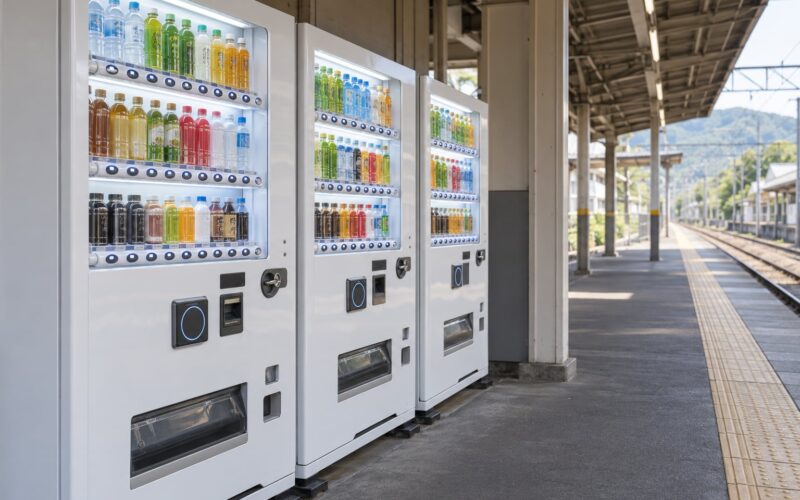
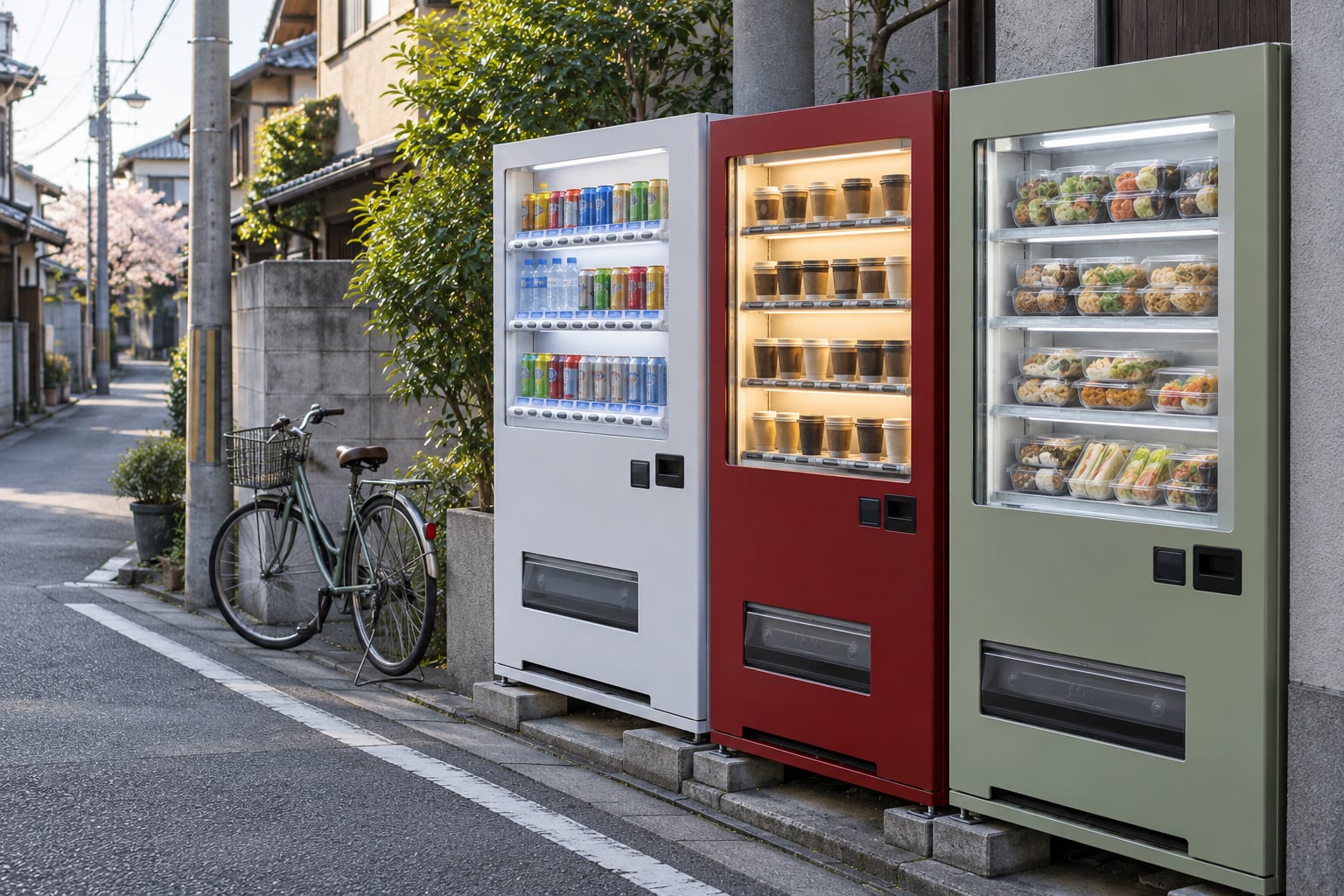
The most common sight is the drink machine on a residential street corner, often two or three units wide, selling cold water, tea, coffee, and soft drinks. One in the same cluster is almost always hot, with cans of coffee and tea marked with a red or orange あたたかい label meaning warm.
Beyond residential corners, the environments cluster in predictable groups:
- Train stations and platforms — drinks, coffee, and increasingly food, placed where people queue or wait.
- Office districts — drink machines in building lobbies and basement corridors for staff working late.
- Schools and universities — drinks and simple meals in outdoor bays on campus.
- Hospitals and clinics — drinks and light food near waiting areas and staff rooms.
- Hotels and accommodation — drinks at entrances, laundry-adjacent units, and beer or high-end coffee machines in some lobbies.
- Entertainment and nightlife areas — alcohol machines outside bars and karaoke buildings, including cigarette machines.
- Parks, shrines, and mountain paths — drinks at rest points, sometimes at locations that surprise visitors.
- Remote and rural areas — a single machine may be the only retail point for kilometres, which is exactly why it stays.
Photo threads online keep the odd ones: a machine near the summit of Mt. Fuji, one beside rice paddies, one outside a mountain temple. Those photos get attention precisely because the surrounding pattern is so ordinary.
Why Are Vending Machines Placed So Close Together?
Vending machines are placed close together because the sites that work best are narrow, busy, and saturated with demand, and the same few hundred metres usually satisfy all of those conditions at once. Once one machine proves a location worthwhile, a second product type appears beside it rather than on the next street.
Think about the economics from the operator’s side. A machine needs three things: people, space, and permission. People come from foot traffic. Space is a strip of pavement or a wall face. Permission comes from the landowner, who often wants nothing more than a share of the takings.
Density also does something subtle to pricing and product choice. When several machines serve one spot, they specialise. Two drink machines next to each other are a bad idea for either owner, so one goes hot and one goes cold, or one becomes coffee and one becomes cold tea. The cluster reads as variety even though it is really a division of labour.
Location also tells you what to expect. A drinks-only machine at a hospital tells you that is what people there want. A machine with rice balls and soup outside a station at 7am is aimed at commuters, not browsers. Observing the cluster is one of the fastest ways to understand who walks past that corner and when.
How Convenience and Reliability Make Them Work
Convenience and reliability are what separate a machine that gets used daily from one that gets ignored. The features people actually depend on are simple: it is there, it works, and it does not make a scene.
They are open when nothing else is
A drinks machine outside a station keeps selling at 1am. Shops in the same neighbourhood are shut. In an entertainment district, the alcohol machines outside a bar keep working long after the convenience store on the corner has closed its doors. That gap is where the machines earn their place.
There is no queue and no interaction
The transaction takes a few seconds and involves no conversation. That matters in a country where some people find small talk with strangers uncomfortable. There is also no minimum order, no waiting for a plate, and no decision beyond one button press.
They behave like public infrastructure
Machines are expected to be reliable, and they mostly are. Coins are accepted consistently, change comes back, and a product selected at the top of a machine is dispensed from the bottom in a predictable way. Once that behaviour is learned, people stop thinking about the machine at all.
The price is on the button
Every selection shows its price in yen before you touch it, and that number rarely shifts depending on where you are. Prices in tourist districts are not marked up the way they can be at ticket counters or in souvenir shops.
What Do People Buy From Vending Machines?
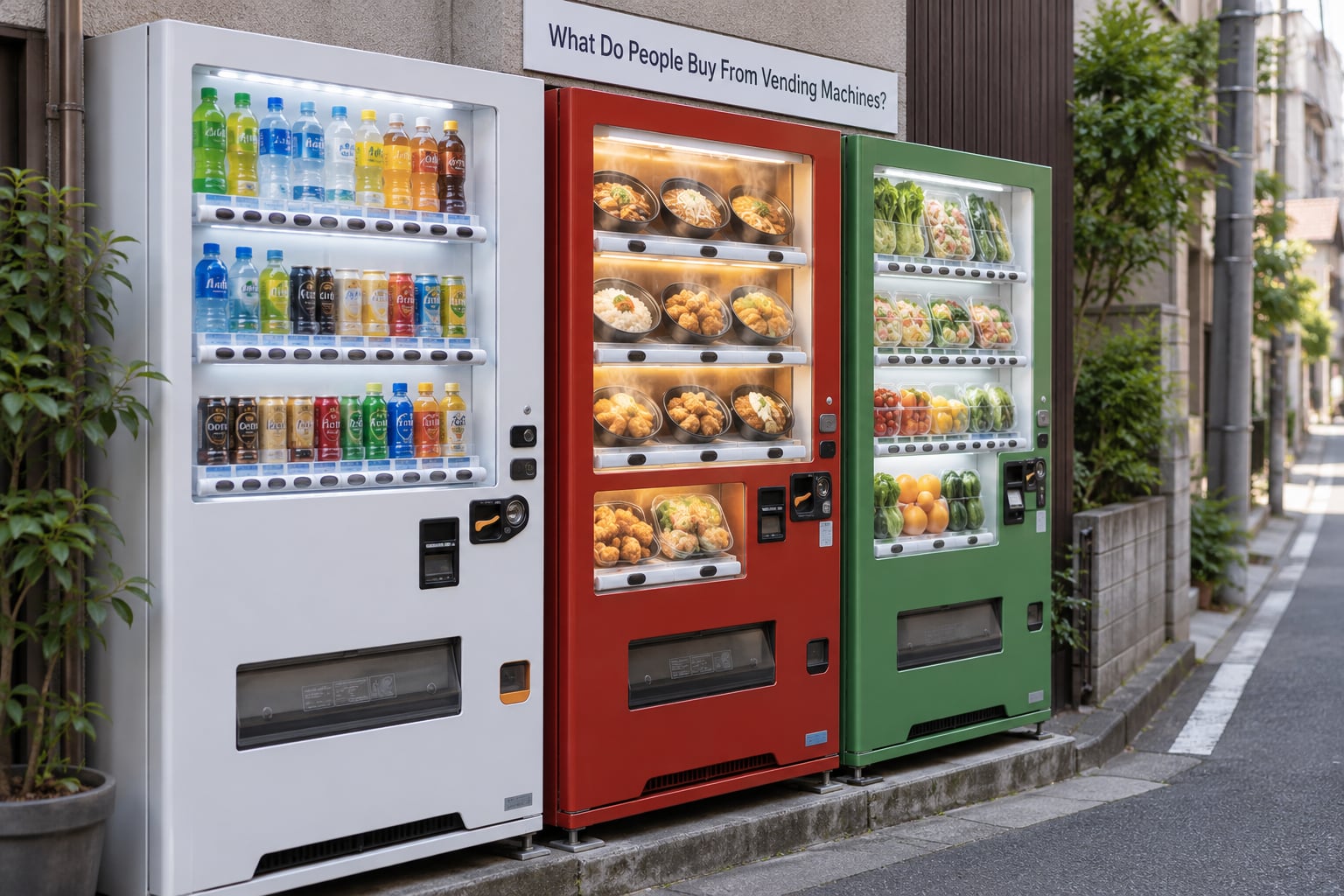
The drink machine is the famous one, but it is a minority of what is on the street. Japanese jidohanbaiki sell a genuinely strange range of things, and the range is the part that surprises first-time visitors.
- Cold and hot drinks — water, green tea, barley tea, canned coffee, juice, soft drinks, and sports drinks, often in one machine split by temperature.
- Coffee — canned drip coffee that is genuinely decent, and more recently single-canned specialty coffee aimed at commuters.
- Rice balls (onigiri) — triangles and squares of rice with seaweed, sold chilled in many machines and warm in others.
- Noodles — cups and bowls of instant ramen, and a smaller number of machines serving fresh udon or soba made on site.
- Fresh and prepared food — sandwiches, bento boxes, fried chicken, dumplings, and chilled prepared dishes in machines with refrigerated compartments.
- Tobacco — cigarette machines placed outside convenience stores and near vending machine clusters, restricted to adults with an IC card.
- Alcohol — canned chu-hi and beer outside bars and on entertainment streets, usually checked against an IC card.
- Prepaid and stored-value cards — transit IC card top-ups, which is how many visitors buy their first train fare.
- Emergency supplies — rice, water, batteries, masks, and simple first-aid items in machines built for disaster response.
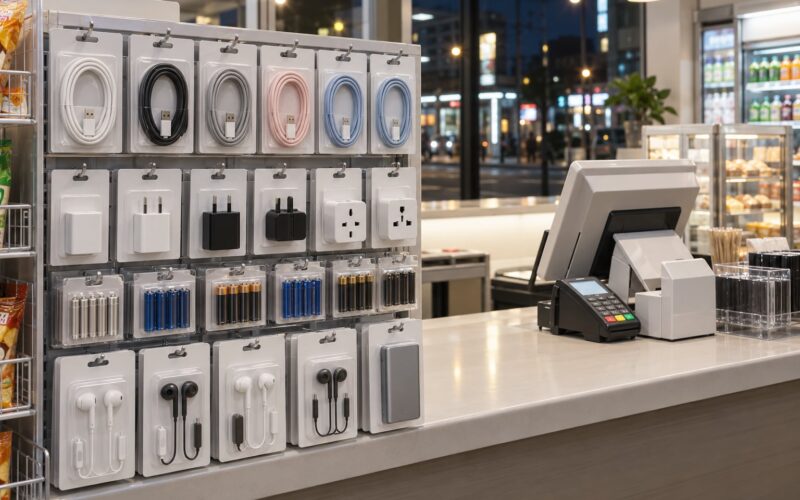
- Everyday hardware — batteries, cables, umbrellas, socks, and phone accessories, especially in machines outside hardware stores and near stationery shops.
- Novelty items — wedding rings, hanko seal stamps, regional sweets, batteries for the machine itself, and in one famous case a live lobster.
What you can buy depends heavily on where the machine stands. Near an electronics workshop you may find a machine dispensing solder, resistors, and other components, which is one of the more confusing things a visitor will photograph. Near a shrine you may find drinks rather than novelty goods, because that is what the traffic wants.
Season matters too. Cold drinks dominate the numbers in summer, when takings can roughly double compared with winter. Seasonal labels appear on the machines themselves, and a limited-edition release tied to a film, an anime, or a regional festival can be gone by mid-morning.
How Have Technology and Payment Options Changed Them?
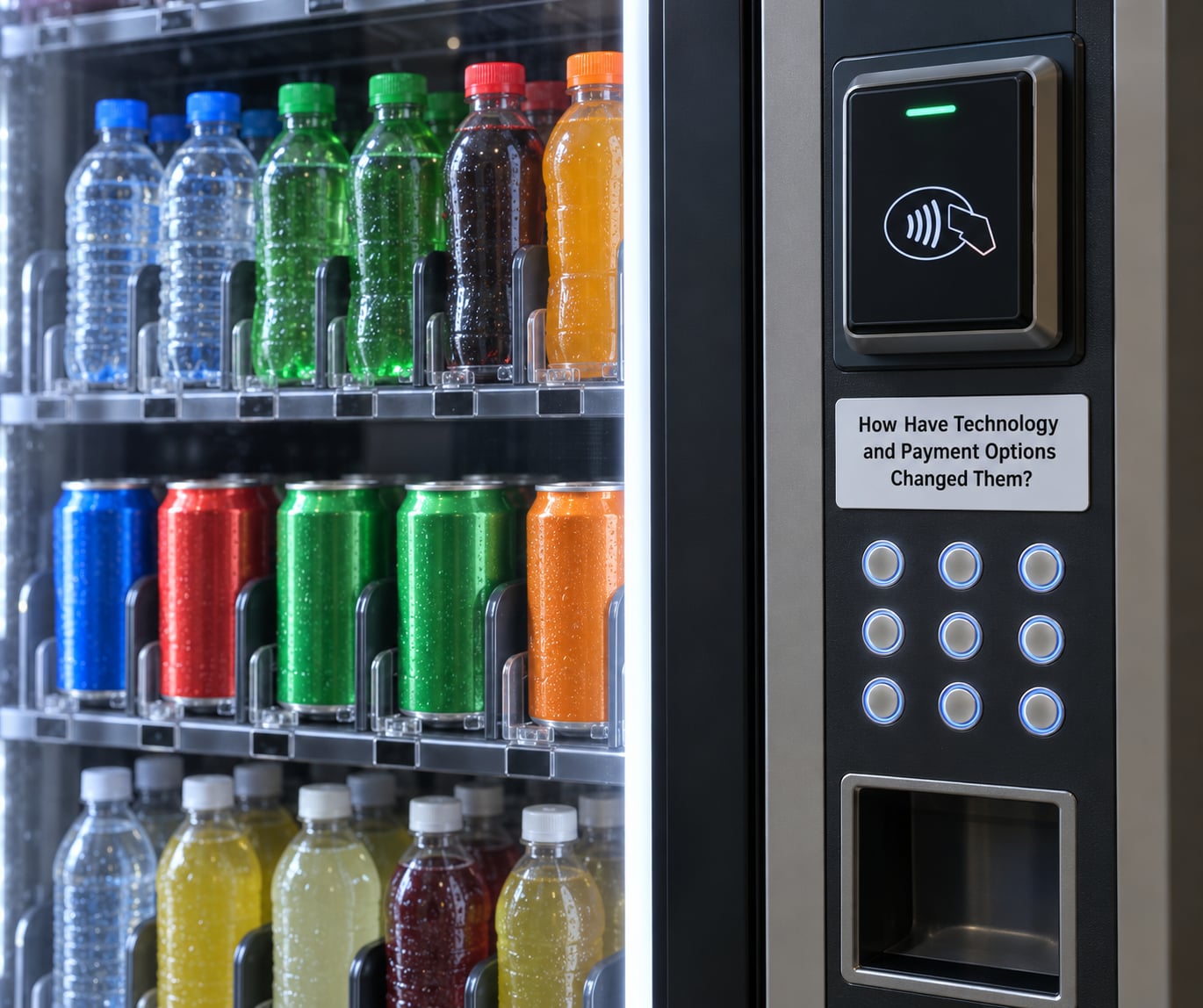
Machines were coin-operated for most of their working life. The last twenty years have added payment, temperature control, and network monitoring, which changed what a machine can stock and where it can sit. Cash still works almost everywhere, but it is no longer the only option, and that has changed the economics of the whole format.
IC cards changed the machine into a service point
Suica and PASMO, stored-value transit cards that double as payment, can be tapped on a reader or a phone. The same tap often handles the fare gate, a konbini basket, a locker, a laundromat, and a drink, which is why so many machines accept them.
Mobile wallets widened the same door
QR code payments and phone-based wallets such as PayPay, LINE Pay, and Apple Pay now appear on a large share of modern machines. The reader is usually marked with a small contactless symbol, sometimes with a second logo for a specific QR scheme.
Temperature control turned drinks machines into food machines
Refrigerated and heated compartments, accurate enough to keep prepared food safe for sale, are what allowed machines to carry rice balls, sandwiches, and bento boxes. Red あたたかい labels and blue つめたい labels tell you which end of the machine is which.
Remote monitoring made thin margins workable
Connected machines report sales, temperature, and faults back to the operator, which means a route driver can see what needs filling before driving there. A machine in a rural area can be checked without anyone visiting it in person.
Disaster mode turns a machine into public infrastructure
Certain machines are wired to local government and emergency services. When a disaster is declared, they release drinks free of charge, and some also act as a Wi-Fi point and a source of emergency broadcast information. Residents are told about this function in advance, and some municipalities have their own dedicated machines.
Environmental features are appearing at the edges
A smaller number of units include CO2-absorbing material to offset the carbon from their own refrigeration, and vending-machine operators have been involved in wider recycling programmes for the containers they dispense. These remain a niche rather than a standard.
Why Do Operators and Businesses Accept Them?
Placing a machine is not usually a decision a shopkeeper makes. In most cases a beverage manufacturer or a vending operator approaches the property owner, installs the machine at their own cost, and pays a share of the takings to the landowner. The owner supplies the ground and takes no risk, which is a remarkably easy deal to accept.
For the operator, the appeal is that a machine sells for most of the day without anyone being paid to be there. There is one delivery stop, one collection of cash, and a route the driver already walks. Compare that with a shop, which needs staff for every hour it is open and pays for that staff whether anyone comes in or not.
That gap grows in a country with a shrinking working-age population and empty rural neighbourhoods. A machine is one of the few retail formats that still makes sense in a place with two hundred residents and no supermarket.
Landowners like it for the same reason. A strip of pavement that earns nothing now carries a machine that pays a share of every sale, with no construction, no footfall counter, and no tenant negotiating an opening hours clause. In a city where space is the scarce resource, converting idle ground into sales is a straightforward win.
Why Are Some Machines Outside Japan More Complicated?
The same machine struggles in most other countries, and the differences are mostly about space, safety, payment behaviour, and labour cost rather than about the machine itself.
| Factor | Japan | United States | Western Europe |
|---|---|---|---|
| Typical density | One machine per roughly 23 to 40 people | Far lower, concentrated in schools, factories, and hospitals | Low outside specific venues |
| Street placement | Everyday part of the pavement | Mostly private property | Mostly private property |
| Public safety around machines | Vandalism rare, so outdoor units are viable | Vandalism and theft common, so units sit inside buildings | Vandalism common, stricter placement rules |
| Typical purchase value | Drinks, meals, and higher-value items such as alcohol and electronics | Usually low-value snacks and drinks in offices and schools | Snacks and drinks, often higher-margin |
| Payment norms | Cash, IC card, and mobile all common | Cash common, contactless in built environments | Contactless widespread, coins less so |
| Staff cost to open a shop | Rising fast, so unattended retail wins | Cheaper, so small shops stay viable | Higher, but vending sits in venues |
| Street-frontage cost | Extremely high, favouring tiny formats | Lower in much of the country | High in cities, low elsewhere |
The US case is the one people ask about most. American vending exists, but it concentrates where a captive audience already is: schools, universities, hospitals, factories, and offices with controlled access. Putting an open machine on a public sidewalk is possible, but theft and vandalism push the cost up and the assortment down.
Europe adds its own layer. Retail space outside the largest cities is cheaper, cash use is falling faster, and public pavement space is governed more tightly. A machine needs foot traffic and a low-risk spot, and there are fewer places where both exist.
South Korea and Taiwan run dense networks too, but with different product mixes and a heavier emphasis on food. What Japan has that is hard to copy is the combination: high density, safe outdoor space, low staffing costs relative to retail, and a population willing to walk.
What Should Visitors Know Before Buying From One?
Buying from a Japanese machine takes about twenty seconds once you know the labels. A few things catch people out the first week.
Read the two temperature labels
あたたかい (atatakai) means warm, printed in red or orange. つめたい (tsumetai) means cold, in blue. Products also carry a row of small icons showing allergens such as wheat, milk, eggs, and shellfish, which matters more if you have a restriction than most visitors expect.
Check what the machine accepts before you put money in
Look for a contactless symbol, an IC card logo, or a QR code panel near the coin slot. A machine with only coins and no reader is common enough that carrying some cash avoids a dead end. Where a machine accepts an IC card, the reader may require a tap before payment.
Expect prices to be in yen and change to be exact
Coins and bills are accepted in most cases, and change is returned normally. Budget bills over the maximum accepted by a given machine are a frequent cause of the coin return error light.
If a selection fails, take the refund rather than hitting again
A jammed item lights a red button near the money return. Press it and the machine refunds you, usually within a couple of seconds. Hitting the selection again can void the refund, and in that case the operator’s number is printed on the machine or on the surrounding area.
Do not assume the machine is stocked or working
Popular seasonal products do sell out, and an older machine on a quiet side street may be empty or partially broken. A row of buttons lit and a display showing numbers is the reliable signal. Taped-over buttons usually mean the selection is unavailable.
Drink on the spot, near the machine
Japanese vending machine etiquette is informal but clear. Drink the can or cup right where you bought it, usually standing beside the machine for a minute. Walking while drinking a drink is common enough, but a hot cup of noodles is meant to be eaten there.
Do not litter, and take the empty container with you
Japan has few public bins, so an empty can in your hand is your own responsibility. Many machines carry a small recycling box for containers, and there are usually bins at stations instead.
Start with the transit card machine
If you take trains, one of the first machines worth using is a prepaid card top-up unit at a station. It usually takes cash and gives you a Suica or PASMO card, and that card then works on drink machines, in shops, and in lockers.
Why Vending Machines Are Everywhere in Japan: The Bigger Picture
Pulled together, the reasons line up into seven, and each one is ordinary rather than exotic.
- Public trust and safety — an unattended machine outdoors only works where vandalism is rare, which makes trust a commercial requirement, not a cultural nicety.
- Land scarcity — a machine fits in ground no shop can use, so tight cities can host retail without giving up storefronts.
- A long selling day without staff — rising labour costs and a shrinking working-age population make unattended retail the cheaper option.
- Cash and simple payment habits — a single coin and a button press removed friction for decades, and IC cards and mobile wallets extended it.
- Walking and transit density — high foot traffic on fixed routes puts the machine exactly where demand spikes.
- Product variety small shops cannot carry — from canned coffee to fried chicken and IC card top-ups, machines fill gaps convenience stores leave.
- Disaster readiness — machines wired for emergency mode act as a public water and information point, which gives governments a reason to keep them.
That last point is the one that turns vending from a business decision into infrastructure. A network of unattended, connected, publicly trusted machines with refrigeration and a payment terminal is a ready-made emergency supply network that already exists, already has a refilling route, and does not need volunteers to switch it on.
So the honest answer to why vending machines are everywhere in Japan is not a national hobby. It is a chain of practical conditions: dense cities with expensive pavement, a population that walks, a currency built for single coins, rising staffing costs, safe public space, and a business model where the machine is installed for free and the landowner earns a share. Remove any one of them and the format gets much rarer.
What visitors react to is the cumulative effect. Each individual machine is unremarkable. Walking four blocks past six of them in different styles is what makes a country feel unusually well supplied with things you did not plan to buy.
Frequently Asked Questions
Why are vending machines so common in Japan?
They solve a small set of practical problems at once. Japanese cities have extremely expensive pavement and very little room for shops, labour costs keep rising, and residents walk everywhere, so an unattended machine in a tiny footprint captures demand a store cannot. Public space is also safe enough that a machine can stay outdoors, and the cash-and-button transaction is instant and requires no conversation.
Are vending machines in Japan cheaper than convenience stores?
Prices are usually in the same range, with drinks from a machine often sitting slightly below the shelf price of the same drink in a konbini. Food machines can undercut a convenience store meal as well. The bigger difference is not price but effort: a machine takes seconds and never queues, while a store trip involves a walk, a wait, and a basket.
Can foreign visitors use contactless payment at Japanese vending machines?
Yes, on most modern machines. Look for a contactless symbol near the coin slot, plus an IC card logo such as Suica or PASMO, or a QR code panel for phone-based wallets like PayPay, LINE Pay, or Apple Pay. Plenty of older machines are still coin and note only, so carry some yen as backup rather than assuming every machine is cashless.
Can travelers buy food from vending machines late at night?
Yes. Food machines sell rice balls, ramen cups, sandwiches, bento boxes, and fried chicken around the clock, and they are the practical answer when every shop nearby has closed. Some machines heat their food on site, which is how fresh udon and soba are served. Check the red warm label or blue cold label before choosing, and eat hot items there.
Why are some Japanese vending machines dedicated to drinks?
Because drink machines are the highest-volume format and cluster together to fill a small piece of pavement. When several machines share one spot, they specialise instead of duplicating: one goes cold, one goes hot, one becomes coffee. That division lets several operators share a busy corner, and it explains why drink machines outnumber food machines in most places.
Conclusion
Japan’s vending network exists because machines fit the country’s land, labour, currency, and safety conditions better than anything else, not because of a national fondness for canned coffee. Once you see it that way, a machine on a quiet residential corner looks less like a quirk and more like the obvious solution to a very crowded place.
If you are planning a visit, do one thing first: on your first walk, stop at a drinks machine and read the labels, the payment icons, and the temperature colours. Ten minutes of that tells you what every machine in the country will and will not do for you, and every purchase after it gets faster.