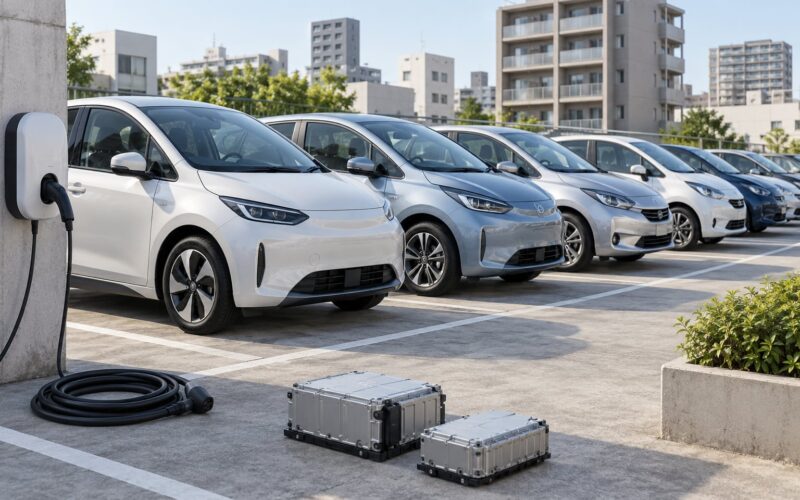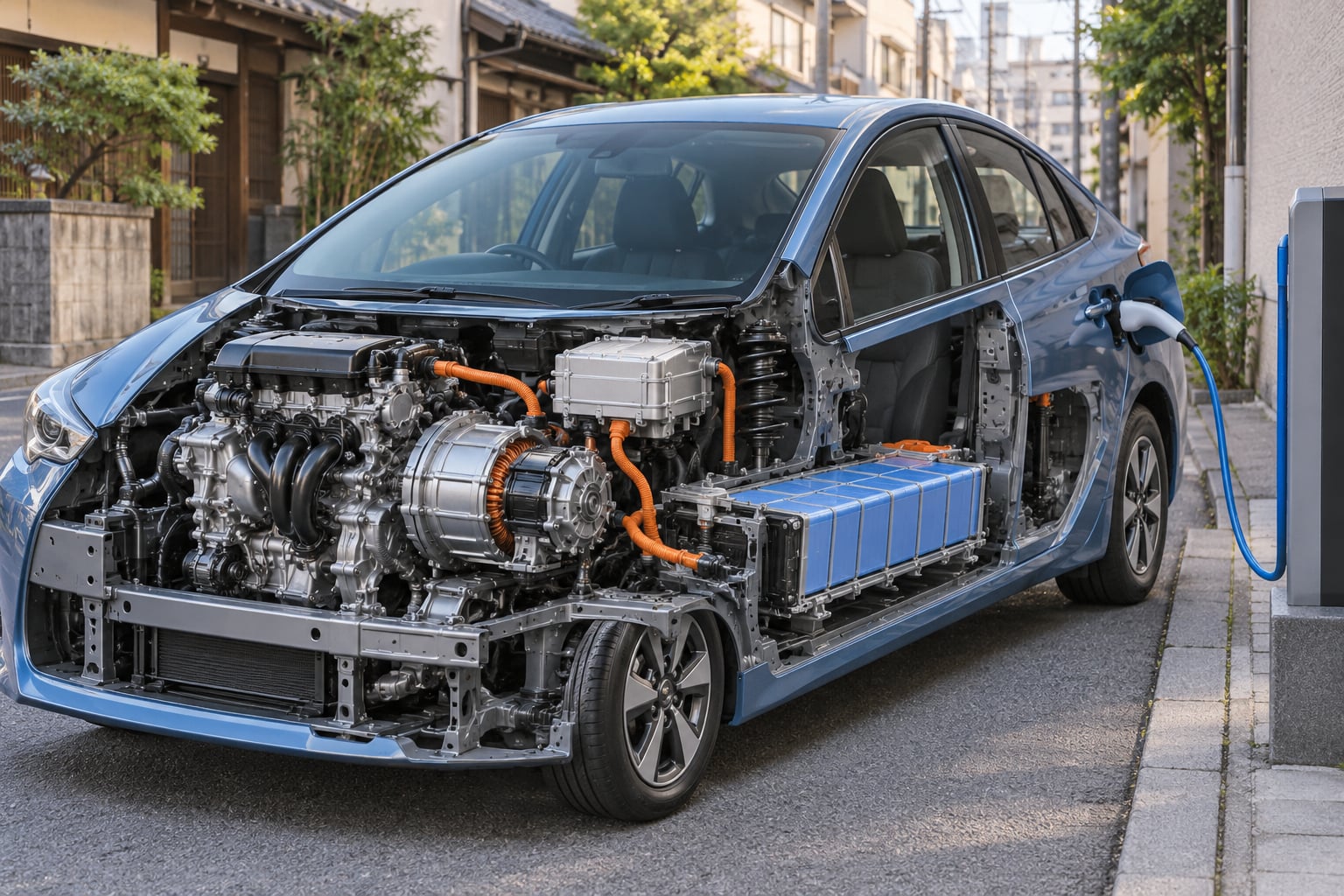
Japanese hybrid technology developed over roughly sixty years, from Toyota’s 1937 Hybrid Sports experimental car to the mass-produced Prius that launched in December 1997. The phrase covers powertrains that combine a combustion engine with an electric motor and rechargeable battery, and the supplier and policy machinery in Japan that made them cheap, reliable and ordinary.
Most people asking this question are looking for the vehicle story, and that story starts earlier than the marketing suggests. It also runs through consumer electronics and energy systems, where the same idea — combining two technologies that each work badly alone — produced walkman phones, hybrid solar-plus-storage installations and grid software.
The honest version of the history is messier than the one in brochure copy. Research funding arrived and dried up twice. Several companies got there before Toyota and most of them stopped. What Japan had, and what nobody else had at the same time, was a deep bench of powertrain and electronics suppliers who could turn a prototype into a product line running flat out.
Table of Contents
- 1What Does Japanese Hybrid Technology Mean?
- 2Why the phrase is used inconsistently
- 3How Japanese Hybrid Technology Developed Over Time
- 4Hybrid Milestones at a Glance
- 5Milestones and What Changed
- 6The Engineering and Market Forces Behind Japan’s Hybrid Model
- 7Why the 1970s stalled and the 1990s worked
- 8Consumer Electronics: When Hybrid Products Became Everyday Technology
- 9Hybrid Vehicles: From Engineering Experiment to Mass Market
- 10What Toyota put into production, and what Honda did differently
- 11What the spread taught the industry
- 12Energy, Homes and Smart Grids: Hybrid Systems Beyond Mobility
- 13Why Japan’s Hybrid Approach Was Successful
- 14What Japan’s Hybrid Technology Means for the Future
- 15Frequently Asked Questions
- 16Is Japanese hybrid technology one specific invention?
- 17Why did Japan become a leader in hybrid vehicles and electronics?
- 18How did Japan’s approach to hybrid cars differ from electric-only vehicles?
- 19Did Japanese companies invent all modern hybrid technology?
- 20What technologies is Japan currently combining with hybrid systems?
- 21Can lessons from Japan’s hybrid technology development be applied elsewhere?
- 22Where to Start
What Does Japanese Hybrid Technology Mean?
Japanese hybrid technology means engineering that merges two or more energy sources and their storage into one working system. In a car that is usually a petrol engine plus an electric motor plus a battery. In an electronics product it is a phone that is also a camera, or a music player that also makes calls.
It is worth separating this from ordinary product integration, because the word gets used loosely. Putting a camera in a phone is a feature. Putting a battery, a motor and an engine in one drivetrain and designing them to hand power to each other hundreds of times per minute is a different category of work, and that second category is what this article is about.
Why the phrase is used inconsistently
Three different things share the label. Vehicle people usually mean the series-parallel powertrain. Energy people mean solar generation combined with batteries and controllable demand. Consumer-electronics people mean a device that merges communication, media and computing.
The common thread is that each component already existed and was already cheap enough to use. The hybrid move is the joining of them. That pattern repeats whether the object is a car, a phone or a building, which is why the same word keeps showing up across unrelated industries in Japan.
Corporate claims blur the definition constantly. Marketing departments call any efficiency improvement “hybrid technology”, and press releases attach the phrase to products with no second energy source at all. Where a claim cannot be traced to a second power path, treat it as advertising rather than engineering.
How Japanese Hybrid Technology Developed Over Time
The development ran in three overlapping waves. The first was industrial and electronics capability after the war, which built the motors, inverters and control electronics every later hybrid needed. The second was energy policy from the 1970s onward, which funded research and then set standards. The third was commercial scale from the late 1990s, which turned a clever car into an ordinary one.
Hybrid Milestones at a Glance
- 1937 — Toyota builds the Hybrid Sports experimental car, pairing a petrol engine with an electric drive.
- 1969 — Toyota presents the RX, later designated FS-1E, a series hybrid using a gasoline engine as a generator.
- Early 1990s — Mazda demonstrates the RX-7 FC, a battery-electric prototype using a combustion engine purely as a range extender.
- 1992 — Toyota reveals the RAHS-2, a parallel hybrid research vehicle developed with advanced engineering test beds.
- 1993 — Honda sells the Civic Insight, built around the EG chassis, in Japan.
- 1995–1997 — Toyota approves the Prius name in 1995 and launches the first production hybrid in December 1997.
- 2001–2003 — Hybrid spreads to minivans, with the Estima Hybrid in 2001, then THS II arrives in April 2003 alongside the second-generation Prius.
- 2002–2004 — Nissan signs technical cooperation in 2002 and Ford takes a patent licence in 2004, spreading the technology globally.
- 2009 — The third-generation Prius launches in May, Prius sales pass one million in April, total hybrid output passes two million in August, and the Prius PHV plug-in arrives that December.
- 2014 — The Mirai brings the hydrogen fuel cell hybrid to a small production series.
Milestones and What Changed
Dates alone hide the important part, which is what actually improved between them.
| Year | Milestone | What changed technically |
|---|---|---|
| 1937 | Toyota Hybrid Sports | First demonstration that two drive sources could share one vehicle |
| 1969 | Toyota RX / FS-1E | Series layout, engine used mainly as generator |
| 1992 | Toyota RAHS-2 | Parallel layout with motor assist on a research platform |
| 1997 | Toyota Prius | Power split device, regenerative braking, production volume |
| 2003 | Hybrid Synergy Drive II | Inverter and power split redesign, higher power output |
| 2009 | Third-generation Prius | Lithium-ion battery, larger body, stronger electric assist |
| 2009 | Toyota Prius PHV | Plug-in capability with larger battery and charging port |
| 2014 | Toyota Mirai | Hydrogen fuel cell supplying an electric drivetrain |
Table data above covers vehicle milestones. The electronics and energy wave has its own chronology, covered further down.
The Engineering and Market Forces Behind Japan’s Hybrid Model
Japan’s position came from constraints rather than foresight. Almost all of the country’s energy is imported, so every unit of fuel saved is imported energy not purchased, and the arithmetic is national rather than personal.
Then there is the supplier network. Toyota did not build the Prius alone. Aisin Seiki made the transaxle that houses the power split device, Denso worked on the inverter and control electronics, and Panasonic built batteries. The keiretsu structure meant a carmaker could specify a component that no single company in Europe or the United States had the capacity to tool up and ship by the million.
Driving conditions did the rest. Japanese cities are dense, streets are narrow and traffic is stop-start, which is the exact pattern regenerative braking and electric torque fill exploit. Highway cruising favours petrol engines, so a system that runs on electric power in town and on the engine at speed beats a design optimised for either alone.
The kei-car tax class added its own pressure. Small vehicles carry favourable tax treatment in Japan, and a lightweight car with a small engine needed less power to move, which made the electric assist easier to justify in the segments where Japanese buyers actually shopped. Daihatsu and Suzuki pushed hard on weight reduction for the same reason.
Earthquakes pushed the other way, toward durability. Japanese buyers and fleet operators expect a car to keep running for a decade, and the hybrid system’s reputation for reliability was built as much in taxi fleets as in showrooms. Those high-mileage vehicles became an unusually large, unusually public durability test.
Why the 1970s stalled and the 1990s worked
This is the part most retellings skip. The 1973 and 1979 oil shocks did generate real Japanese hybrid research money, and prototypes followed. What did not follow was a market reason to build them at volume.
Fuel was still cheap by today’s standards, cold-start emissions regulation did not yet drive the design, and the electronics of the day — power transistors, control microprocessors, high-energy-density batteries — were not reliable enough to sell to the public. Japanese engineers built working machines that customers had no reason to buy.
What changed by the mid-1990s was a combination of better components and harder rules. Battery management, power electronics and inverter control matured at the same time as national fuel-economy standards tightened. Japan’s ratification of the Kyoto Protocol in 2002 added emissions obligations. The Eco-Drive Promotion Liaison Committee formed in 2003, the Next-Generation Vehicle and Fuel Initiative in 2007, and a Next-Generation Vehicle Strategy in 2010.
Add the California Zero Emission Vehicle mandate, which created an export market that rewarded hybrids as a bridge, and the hybrid stopped being a research project competing with petrol. It became a product line with a policy-backed market on both sides of the Pacific.
Consumer Electronics: When Hybrid Products Became Everyday Technology
The electronics side of Japanese hybrid technology ran on the same logic years before the Prius. A device built from a phone board, a camera module and a storage chip is a hybrid product, and Japanese makers got good at combining mature subsystems rather than inventing each one from scratch.
The move from dedicated devices to combined ones started with portable audio. Early attempts at combining music playback and telephony were awkward, and the early-2000s models were bulky and drew poor reviews. The combination stuck once storage became small enough and the phone itself became the thing people refused to carry two of.
The camera-phone convergence followed the same path. Japanese manufacturers controlled the small image sensors, the LCD panels, the removable flash media and the storage stack all at once, so turning a phone into a decent camera was mostly a question of which existing parts to combine. That vertical position is a large part of why Japanese electronics firms set the pace through the 2000s.
Mobile internet services came next, and the devices that mattered were hybrids in the purest sense: a screen, a radio, a keyboard and a media player behaving as one device with one battery budget. Battery life, not processing speed, was the constraint that shaped industrial design for a decade, and solving it taught exactly the sort of power-management discipline that later made vehicle hybrid systems practical.
Hybrid Vehicles: From Engineering Experiment to Mass Market
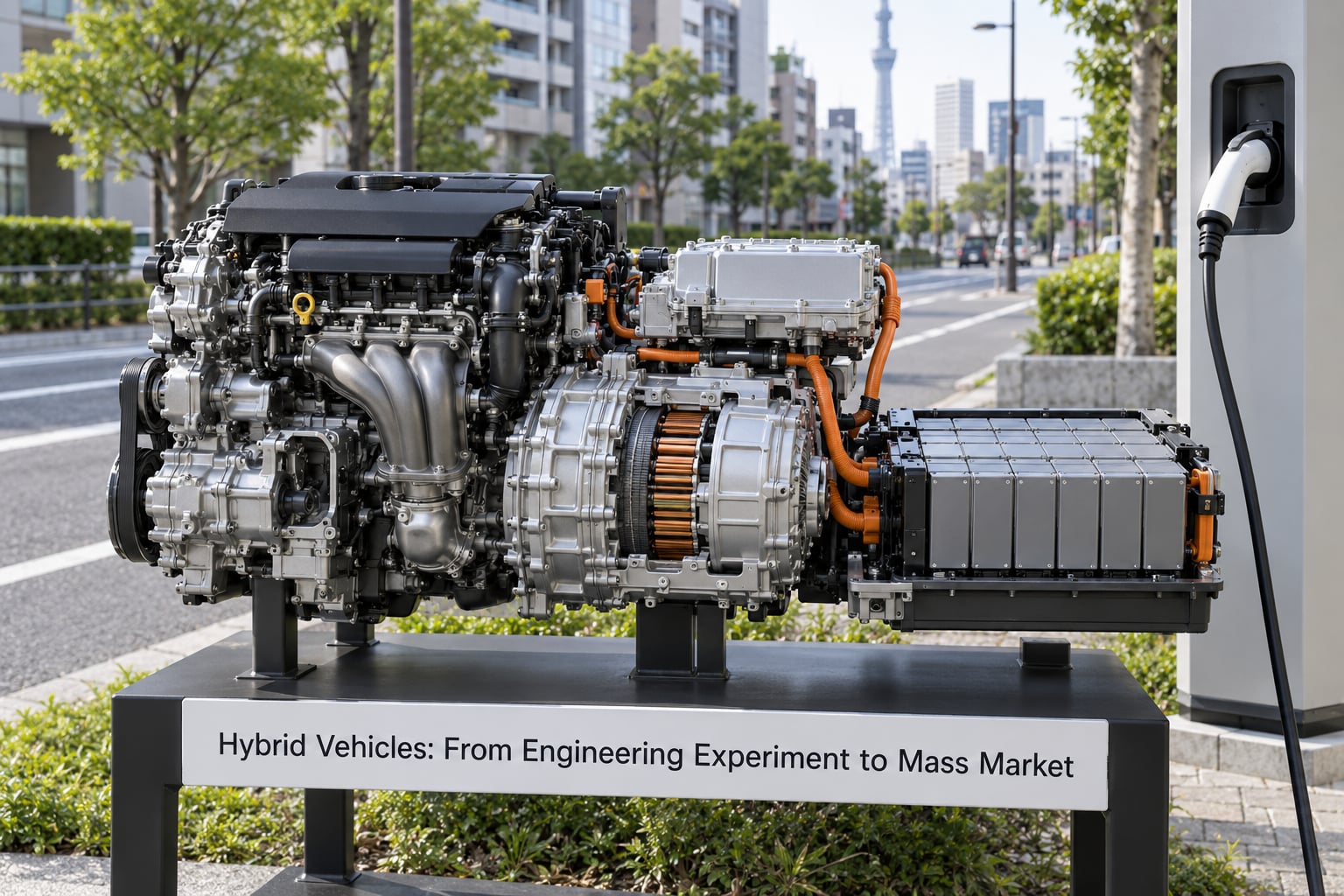
The powertrain that changed everything combined the engine and motor mechanically rather than choosing one or the other. A small engine drove a generator, a motor drove the wheels, and a planetary gear set — the power split device — continuously varied how much each contributed.
Because the motor delivered instant torque, the engine did not need to be large enough to satisfy peak acceleration. It could run at a narrow band around its most efficient point, which is where the Atkinson-cycle design of the later generations came from. Fuel economy in Japanese units of km/l improved as that band narrowed.
Regenerative braking handled the other half of the energy balance. Slowing the car turned the motor into a generator, sending energy back into the battery rather than dumping it as heat. That is where the separate brake pedal, and eventually brake-by-wire blending, came from — a real integration problem that early hybrids handled awkwardly.
What Toyota put into production, and what Honda did differently
Toyota’s system, sold as Hybrid Synergy Drive, leaned on the power split device. Honda took a parallel route: a crank-shaft-driven motor to start and charge the engine, plus an electric-only driving mode, which is what gave the Civic Insight its shape. Later Honda systems added a second motor to allow two-motor, three-mode operation, trading the mechanical split for more electric drive.
Battery chemistry moved in the same direction as everything else. The early Prius used nickel-metal hydride cells, which were heavy but tough and tolerant of abuse. Lithium-ion arrived with the third generation in 2009, cutting weight and improving energy density, and it is what made a serious plug-in hybrid package possible. The trade-off is a narrower tolerance for heat and overcharge, which pushed work into cooling and battery management.
Scale then did what engineering could not. One million Prius units rolled off the line in April 2008, and total hybrid output passed two million in August 2009. The technology escaped Japan by arrangement as much as by export: Ford took a patent licence in March 2004, and Nissan signed technical cooperation in September 2002.
What the spread taught the industry
Owners report hybrid systems as remarkably trouble-free, and the evidence is unusually solid because the cars have been in service for a long time under hard conditions. Japanese taxi fleets converted substantially to the Prius, which means a large population of the same drivetrain has been running extreme annual mileage in public for decades.
Owner communities on priuschat.com and toyotaownersclub.com spend a lot of their time on used buying decisions rather than breakdowns, which tells you where the real uncertainty sits. It is not the drivetrain. It is the cost of a battery replacement after the warranty ends, a question with genuinely mixed answers depending on the vehicle’s history.
Energy, Homes and Smart Grids: Hybrid Systems Beyond Mobility
The same combination logic reaches buildings. A house with solar panels and a battery is a hybrid energy system in the straightforward sense: one source charges a store that then feeds loads, so the two run as a pair rather than separately.
Japan has had residential solar and storage since the post-Fukushima period, when nuclear shutdowns pushed household demand for self-supply and for demand-response services. Utilities have since paid households for load shifting, turning the installed base into a grid resource rather than an island.
Appliances are the quieter half of this. Inverter-driven air conditioners, heat-pump water heaters and efficient refrigerators respond to grid conditions and price signals, and that behaviour comes from the same power-electronics discipline as the drivetrain inverter. Japanese manufacturers sold these systems domestically long before they had a market elsewhere, which made the domestic market the test bed.
Be careful with the numbers from this field. Demonstration projects get press coverage out of proportion to their deployed volume. The cases that genuinely run at scale are rooftop solar with storage, and air conditioners, heat pumps and water heaters that shift load rather than generate it.
Why Japan’s Hybrid Approach Was Successful
The transferable part is not the Prius. It is the operating discipline around it, which shows up in five places.
Long-horizon engineering. Japanese manufacturers kept funding hybrid work across the funding booms and busts between the 1970s oil shocks and the 1997 launch, when competing programmes were being cut.
Incremental refinement over reinvention. Kaizen, the practice of continuous small improvement, and monozukuri, the idea that making things well is a craft, both favour refining a proven architecture over replacing it. Each generation of Hybrid Synergy Drive kept the layout and rebuilt the components.
Compact design as a constraint. Dense cities and small tax classes mean every kilogram and every litre of displacement counts, which pushed manufacturers toward efficiency by weight rather than by specification.
Supplier depth. Because Aisin Seiki, Denso and Panasonic could tool and ship components at scale, a carmaker could launch a new powertrain without building a new supply chain from nothing.
Feedback from hard use. High-mileage taxi duty cycles produced reliability data that no laboratory programme would have matched, and that data fed straight back into design changes.
None of these are Japanese characteristics in the abstract. They are the result of a specific industrial structure, and other countries have adopted parts of it with varying success.
What Japan’s Hybrid Technology Means for the Future
Several developments are close enough to track now. Solid-state batteries would change packaging and charging behaviour, but prototypes are still prototypes. Plug-in hybrids have grown slowly outside China, where range and price expectations differ sharply from Japan’s.
The more interesting pressure is competition. Chinese manufacturers now lead in plug-in hybrid sales, using high compression ratios and aggressive fuel injection to close the efficiency gap that Japanese makers opened decades ago. Japan built its lead on fuel economy in a market that imports nearly all its energy; Chinese makers are optimising for a different market with different constraints, and doing it very well.
Connected mobility, artificial intelligence for energy management, grid-interactive charging and hydrogen all continue in parallel. The realistic near-term result is that hybrid concepts spread further into buildings, commercial vehicles and industrial equipment, where the engine-plus-electric logic suits duty cycles that a battery-only system handles badly.
Frequently Asked Questions
Is Japanese hybrid technology one specific invention?
No. It is a family of designs that combine a combustion engine, an electric motor and a rechargeable battery, plus the wider idea of merging two mature technologies into one system. In vehicles the classic example is Toyota’s power-split hybrid, which launched in the 1997 Prius. In electronics the same logic produced camera phones, and in energy it produced solar generation paired with batteries.
Why did Japan become a leader in hybrid vehicles and electronics?
Japan imports nearly all of its energy, so fuel economy is a national cost and a security question rather than a personal preference. It also had the supplier depth to build the parts at volume, with Aisin Seiki, Denso and Panasonic producing powertrain components and batteries, and dense cities where stop-start driving makes regenerative braking worth having.
How did Japan’s approach to hybrid cars differ from electric-only vehicles?
Japan pursued hybrids as the practical answer for a market that keeps combustion fuel infrastructure in place for decades. A battery-only vehicle depends entirely on charging access, while a hybrid refuels at any petrol station and recovers energy under braking. That made hybrids the low-friction transition for Japanese drivers, and it is why the technology reached millions of owners before battery-only cars did.
Did Japanese companies invent all modern hybrid technology?
No. The core idea of combining two power sources predates Japan’s work by decades, and parallel hybrids appeared in Europe and the United States as well. Japan’s distinctive contribution was the power-split architecture, the component supply chain behind it, and bringing the whole system to mass production reliably enough that buyers treated it as an ordinary car.
What technologies is Japan currently combining with hybrid systems?
Current work combines hybrid powertrains with connected vehicle services, grid-interactive charging, home solar plus storage, efficient heat-pump water heaters and inverter appliances, and demand-response programmes that let utilities shift household load. Hydrogen fuel cells, as in the Toyota Mirai, pair fuel-cell generation with the same electric drivetrain architecture.
Can lessons from Japan’s hybrid technology development be applied elsewhere?
Some of them. Funding research across funding cycles, refining proven architectures instead of replacing them, and building supplier capability before launching a new powertrain all transfer directly. What does not transfer is the constraint that made it work: near-total energy import dependence plus dense stop-start cities plus a supportive tax structure created the demand that the technology was built for.
Where to Start
Start with the 1997 Prius as the pivot point, then read backwards to the 1969 RX and the stalled 1970s programmes to understand why it took so long. Forwards, the useful comparison is not Japan against Europe on diesel but Japan against China on plug-in hybrids today, because that is the contest where the original advantage is under most pressure.