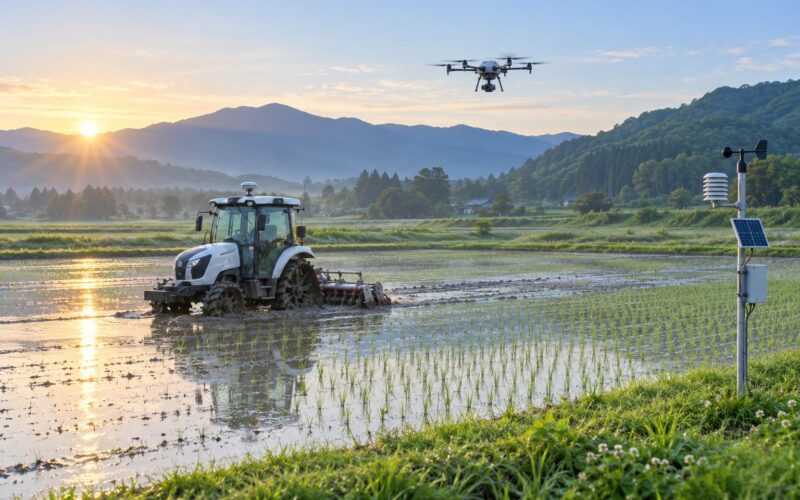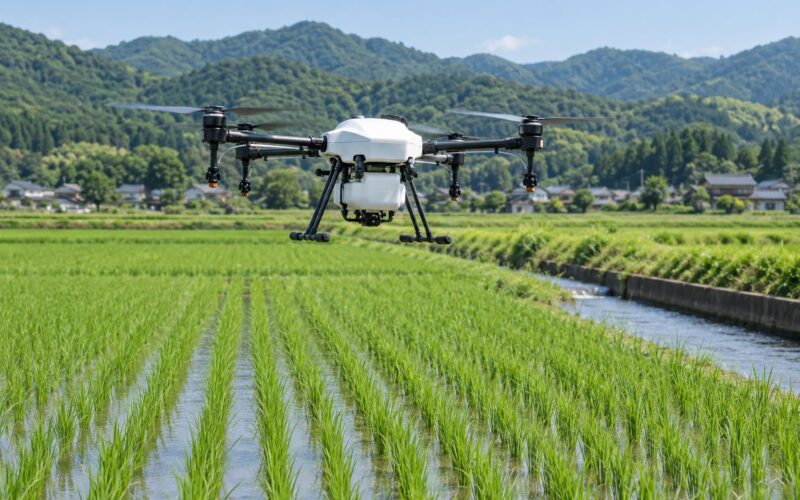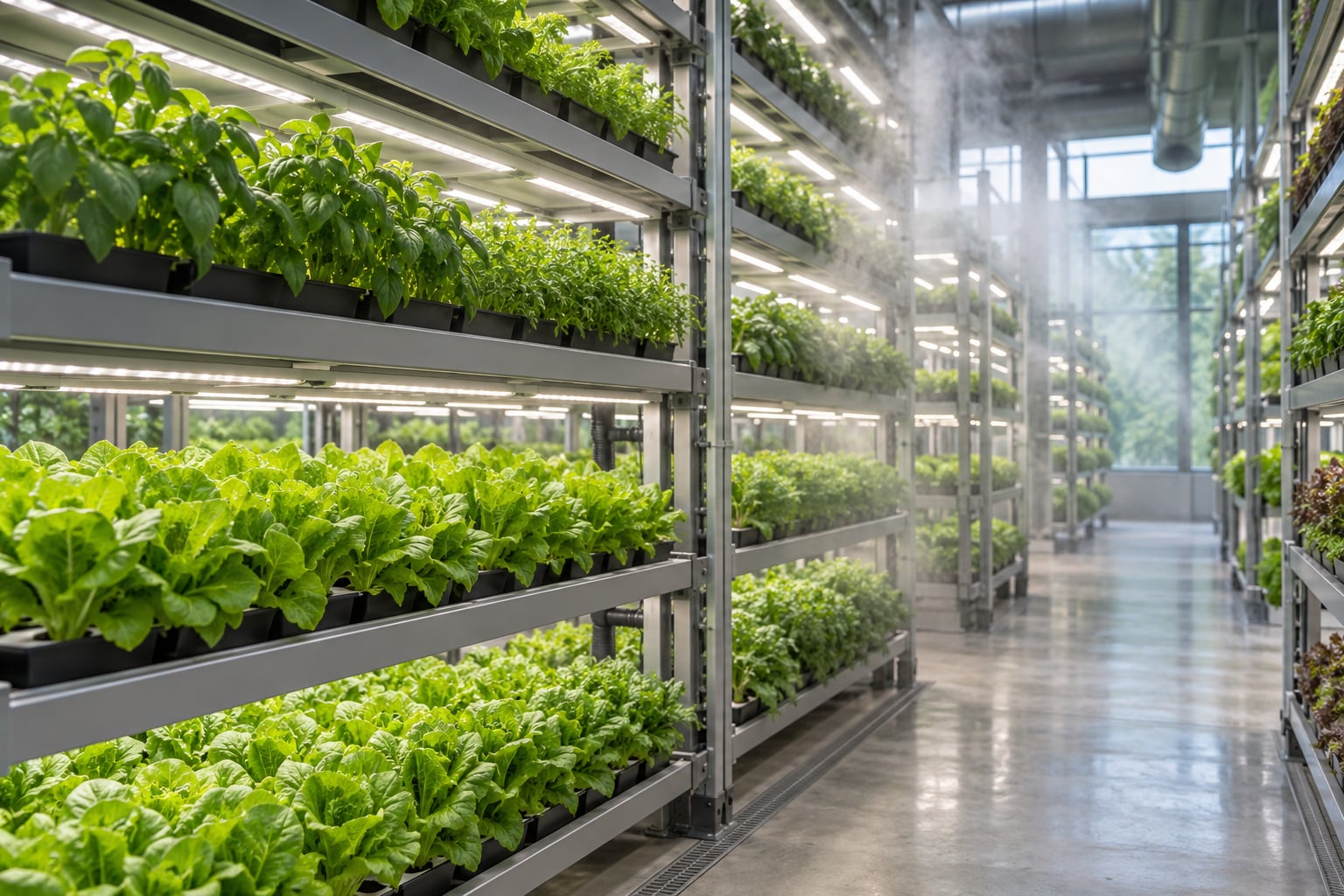
Japan invests in vertical farming because the country has almost no spare farmland, very few young people entering farming, and a food supply that depends heavily on imports. Growing crops indoors in stacked layers lets a Japanese company produce lettuce, herbs and strawberries through typhoons, heat waves and cold snaps, close to the supermarkets that sell them. It also happens to fit a national habit of backing precision manufacturing, from factory robotics to semiconductor equipment.
As of 2026, roughly 200 Japanese companies were using artificial-light cultivation, according to Toyoki Kozai, chief director of the Japan Plant Factory Association. Some of those operations are commercial farms; others are research facilities, municipal projects or divisions inside electronics conglomerates.
Table of Contents
- 1What Is Vertical Farming?
- 2Why Japan Invests in Vertical Farming
- 3How Japan’s Farming Constraints Created the Need
- 4How Technology Makes Vertical Farming Useful in Japan
- 5What Are the Main Business Models?
- 6Is Japan Investing for Food Security?
- 7What Challenges Could Limit the Investment?
- 8What Japan’s Investment Signals About the Future
- 9Frequently Asked Questions
- 10Is Japan using vertical farming to replace traditional agriculture?
- 11How much of Japan’s food is imported?
- 12Why are LED lights used in Japanese vertical farms?
- 13Can vertical farming use less water than ordinary farming?
- 14Which crops are most suitable for vertical farming in Japan?
- 15Why is vertical farming not yet widespread in Japan?
- 16Conclusion: Start With the Core Reason
What Is Vertical Farming?
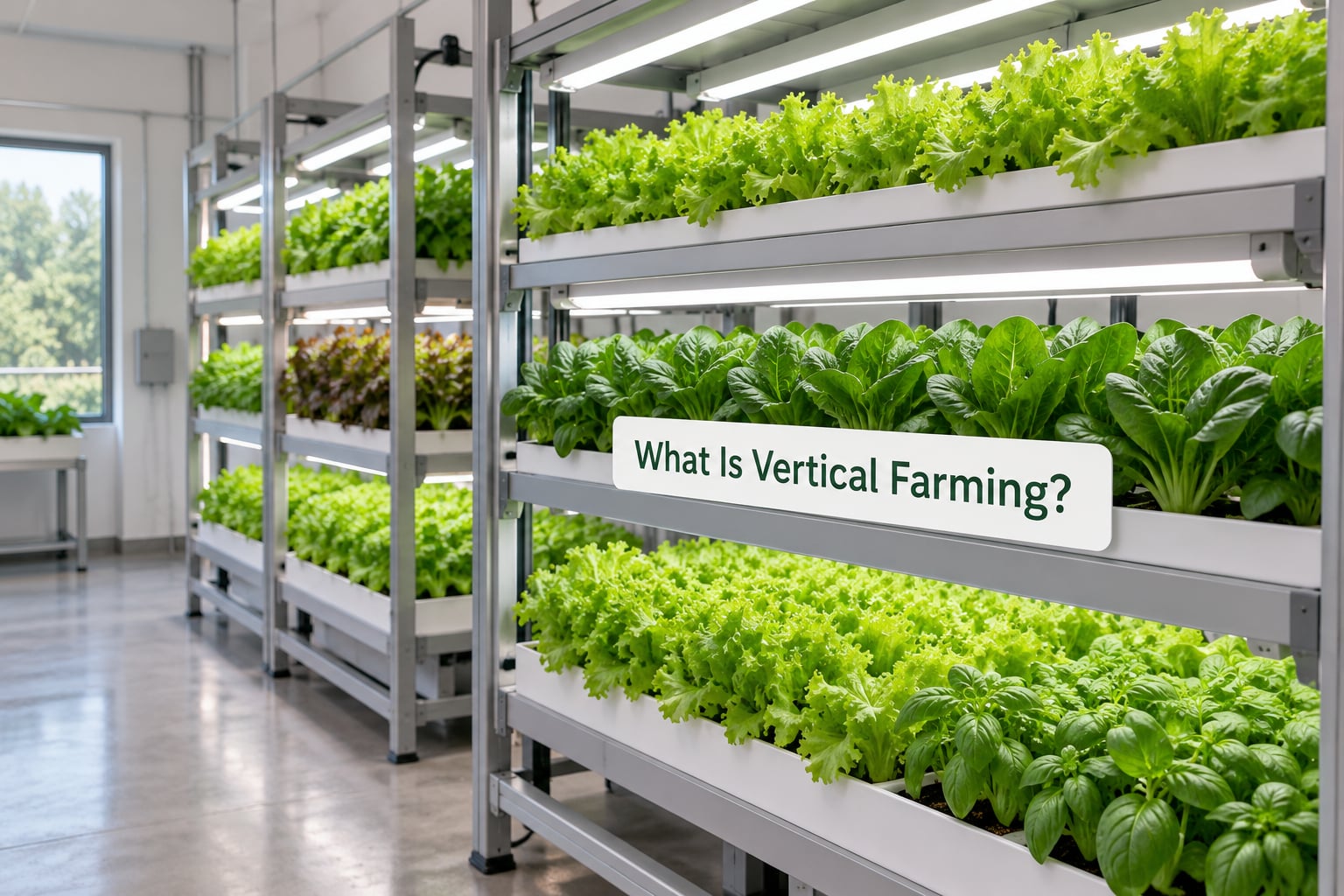
Vertical farming means growing plants indoors on stacked levels under artificial light, with the temperature, humidity, light and nutrients controlled rather than supplied by weather. In Japan these facilities are usually called plant factories, and they run on hydroponic systems: NFT, the nutrient film technique, where a thin film of water carries dissolved nutrients past the roots, and DFT, the deep flow technique, where roots sit in an aerated nutrient bath.
It is different from the other three things people group it with. Conventional farming depends on soil, rain and seasonal sunlight. Hydroponics describes the water-and-nutrient method, which a plant factory uses, but it does not imply stacking or indoor lighting. Greenhouses add plastic or glass to capture sunlight and extend the season, yet they still rely on outdoor climate. A vertical farm replaces the weather entirely.
That distinction matters for anyone comparing costs. A greenhouse is cheap electricity and expensive walls; a plant factory is the opposite. The result is year-round production, a clean growing surface with no soil-borne pests, and a harvest that does not move with the season.
Why Japan Invests in Vertical Farming
Five pressures push Japan toward controlled-environment agriculture, and they reinforce each other. Investors are not buying a faddish salad crop; they are responding to land arithmetic, labour demographics, import dependence, climate risk, and an industrial strategy that treats agriculture as a suitable target for automation.
- Land. Japan has a high population density and a mountain cover that leaves a small share of the country cultivable. Adding farmland is politically and practically difficult.
- Farmers. The average age of a Japanese farmer is around 67, and the average age of the wider farm workforce is in the seventies. There is no queue of replacements behind them.
- Imports. Calorie self-sufficiency sits at roughly 38 percent, so most calories, and much of the feed and fertiliser input, come from abroad. The 2011 Fukushima disaster showed how a single event can rattle that arrangement.
- Weather. Typhoons, heavy rain, summer heat and colder winters all damage open-field yields in the same growing season.
- Industrial policy. Electronics and precision-machinery firms already have the sensors, controllers and software to run a climate-controlled room, so the capability sits next door.
How Japan’s Farming Constraints Created the Need
Each constraint points at a different part of the system. Scarcity of land rewards density: stacking trays uses a floor area that conventional rows waste, and it can be sited on the edge of a city rather than in a distant plain. Water scarcity rewards recirculation, and a closed loop in a plant factory reuses roughly 98 percent of what a field operation would lose to evaporation and runoff.
Labour scarcity rewards repeatability. An automated plant factory transplants, waters, harvests and packs on a schedule, with the same instructions given at 3 a.m. as at noon. Urban proximity rewards speed: a facility in a suburban warehouse can deliver a salad to a regional supermarket chain the same day it is cut, which shortens the cold chain and cuts spoilage before the vegetable ever reaches a shelf.
These pressures compound rather than substitute for each other. Japan does not build plant factories because the weather is bad; it builds them because land, labour, water and logistics all point the same direction at once.
How Technology Makes Vertical Farming Useful in Japan
Vertical farming is not growing plants in a dark room. The technology package is what makes it viable, and Japan has assembled nearly every piece of it from its own manufacturing base.
LED lighting is the biggest single operating cost and the biggest single lever. LEDs let a grower dial light to a specific wavelength and intensity per crop and per growth stage, rather than accepting whatever the sun provides. Photoperiod can be set precisely, so flowering and root development respond to a schedule instead of a season.
Climate control covers temperature, humidity and carbon dioxide enrichment. Keeping carbon dioxide above outdoor levels speeds photosynthesis, while controlling temperature and humidity suppresses the fungal conditions that would otherwise thrive in a warm, wet, enclosed room.
Sensors and data close the loop. Operators describe their aim as traceability down to the second: light hours, nutrient pH, water temperature, yield per square metre and harvest weight are logged continuously. 808 Factory, a major lettuce producer, states plainly that it can backtrack everything per product, per second and per worker, and that fine record is how it improves a room rather than just running it.
Robotics and logistics are where the research money is going. Transfer seedlings, move trays, and harvest and pack machines are the tasks that still need hands. SPREAD, the Kyoto-based operator, has described ambitions for fully automated handling of a facility that outputs around 11 million heads of lettuce a year, because a plant of that size cannot be staffed the way a field is.
The practical takeaway is that these farms behave more like factories than farms. Output per square metre can run around 100 times what open field delivers, and a grower can schedule a harvest rather than negotiate with the calendar.
What Are the Main Business Models?
Most Japanese vertical farming money sits in one of four models, and the difference matters more than the crop list.
Supermarket supply. The operator sells consistent volumes of leafy greens to a regional or national retail chain on a fixed schedule. Margins are modest and the contract carries the volume risk, but a signed offtake agreement is what makes a capital-intensive build sensible.
Branded retail and direct sales. 808 Factory sells produce at up to three times the price of open-field vegetables, and the company invests heavily in consumer marketing, including television advertising, to justify it. The pitch is quality, cleanliness and traceability, packaged as a brand rather than a commodity. Japanese shoppers already know the category, which makes the branding job easier than it would be in a market that had never seen indoor-grown greens.
Premium fruit. Oishii Farm applies the same controlled environment to strawberries, a crop that is expensive, fragile and normally seasonal. MISUMI Group’s investment in Oishii signalled that industrial component makers want in, aiming to standardise the farm modules so a site can be built and replicated like factory equipment. Oishii has described its data collection in terms of billions of data points from its operation.
Research, municipal and corporate programmes. Panasonic, Toshiba, Fujitsu and Mitsubishi Gas Chemical all ran or ran plant factory initiatives. Several of those corporate efforts were cut back once the prototype phase ended, which is itself the honest lesson: technology demonstration and a viable business are different things.
Alongside these sit the industry networks. Japanese operators share risk on over- and under-supply through collaboration, and the Japan Plant Factory Association trains staff and publishes common guidance on hygiene and technique. A sector of small, capital-shy farms would be far more fragile without that shared infrastructure.
Is Japan Investing for Food Security?
Partly, yes, and it is worth separating the two claims that get bundled together. Food security is a real driver: producing more calories close to cities reduces exposure to import disruption, and a sealed indoor room is not vulnerable to a typhoon or a contaminated water source. Policy attention has followed, with a government target to raise food self-sufficiency to around 45 percent by 2030 from today’s 38 percent.
But vertical farming is not going to replace Japanese agriculture, and the numbers make that plain. Japanese diets draw on wheat, soy, maize, rice and livestock feed, and almost none of that comes from indoor hydroponics. The systems suit leafy greens, herbs and high-value fruit, and nothing else in the plan. Rice paddies, fruit orchards and grazing land stay in the ground.
The honest framing is resilience and premium value, not national calorie independence. For a national emergency, the value of a plant factory is a reliable, clean, local supply of a narrow band of crops. For a company, the value is a year-round, contract-backed, high-margin crop. Those are different motivations that happen to point at the same equipment.
What Challenges Could Limit the Investment?
The economics are genuinely difficult, and the people raising money know it. Electricity is the largest operating cost, and a plant factory trades sunlight, which is free, for lamps, which are not. Lighting power is the barrier that growers themselves name most often at commercial scale, and the argument about whether indoor farming counts as sustainable usually ends up at the same point.
Capital cost is the second problem. A facility is a building full of engineered systems, not a field you can lease. Custom-built sites are hard to replicate elsewhere, which is exactly what MISUMI’s investment in standardised Oishii modules is meant to fix.
Then there is crop biology. Tall, light-demanding plants such as tomatoes need far more light per kilogram than lettuce, and putting them under a ceiling runs into real limits. Fungi and pathogens can move fast through a sealed recirculating system, so hygiene protocols are stricter than in any field operation. Energy and water advantages are also uneven: water savings are dramatic and real, while energy savings depend entirely on the light source and whether solar or other generation offsets the grid draw. 808 Factory pairs a facility with roughly 700 kW a day of solar capacity, which is the direction the economics require.
Finally, glasshouses are a formidable competitor. A well-run greenhouse produces far more energy per unit of area than a plant factory, and government support has historically favoured protected cultivation over artificial-light systems. Japan will grow more indoors only while consumers and retailers keep paying for the quality and the story.
What Japan’s Investment Signals About the Future
The more telling signal is not the number of farms but the direction of travel. Japan is treating controlled-environment agriculture as a branch of smart agriculture and industrial automation, which means the near-term gains are in robotics, sensors, imaging and standardisation rather than in enormous new buildings. When a component manufacturer invests in a farm operator, the point is to turn a bespoke installation into a repeatable module.
It also points to a regional food system. Distributed facilities near cities shorten supply chains and keep production running when a region is cut off, which matters in a country of mountain ranges and long transit routes. And it is a test bed: Japanese plant factory modules are being designed to be exported and deployed in other food-insecure, water-stressed markets, where the technology and the financing travel together.
The most defensible conclusion for 2026 is that Japan’s interest in vertical farming is a bet on resilience and on industrial capability, not a bet that the country will stop farming outdoors.
Frequently Asked Questions
Is Japan using vertical farming to replace traditional agriculture?
No. Japan uses plant factories to add a reliable supply of leafy greens, herbs and premium fruit close to cities, not to replace paddy fields, orchards or livestock. Calorie self-sufficiency sits near 38 percent and the government target is about 45 percent by 2030, which mostly depends on improving yields and reducing waste in conventional farming.
How much of Japan’s food is imported?
Roughly 60 percent of calories consumed in Japan are imported, which is why officials treat food security as a national strategy. The exposure became obvious in 2011, when earthquake and tsunami damage disrupted production and raised concerns about energy and food supply chains. Reducing that dependence, even for a narrow group of crops, drives much of the investment.
Why are LED lights used in Japanese vertical farms?
LEDs replace sunlight, so growers can set wavelength, intensity and photoperiod for each crop and growth stage. That control makes production year-round and consistent, and it lets a farm schedule harvests instead of reacting to the season. LEDs are also the largest operating cost, which is why farms invest in efficient fixtures and pair them with solar generation.
Can vertical farming use less water than ordinary farming?
Yes, and the saving is large. A closed hydroponic loop recirculates roughly 98 percent of its water because there is no evaporation from open soil and no runoff to drainage ditches. Field agriculture in a warm, rainy country can lose significant water between the root zone and the sea. Water is the clearest resource advantage vertical farming has.
Which crops are most suitable for vertical farming in Japan?
Leafy greens lead: lettuce, spinach, mizuna, pak choi and herbs. They grow fast, sit close to the light, and are harvested whole, which suits automated handling. High-value fruit such as strawberries also works and can command a premium. Tall, light-hungry crops like tomatoes and any root vegetable or grain remain difficult because of the lighting cost.
Why is vertical farming not yet widespread in Japan?
The economics are the reason. Electricity is the dominant operating cost, facilities require heavy capital, electricity prices have risen in recent years, and crops suited to indoor systems are narrow. Efficient greenhouses deliver far more energy per unit of area. Japanese operations survive where a supermarket or restaurant chain signs a long-term supply contract or where consumers pay a premium.
Conclusion: Start With the Core Reason
Japan invests in vertical farming because it has to produce food reliably with almost no spare land, an ageing farm workforce, a diet that depends on imports, and a climate that punishes open-field growing. Everything else, the LED research, the robotics, the industrial partnerships, is the machinery built on top of that constraint.
When you judge any vertical farm claim, ask three questions. Does it have a buyer contracted in advance, or a consumer who will pay a premium? Which crops actually suit indoor light, rather than the ones in the marketing photo? And is the electricity cost being measured honestly against the alternative? Get those three right and the technology assessment takes care of itself.