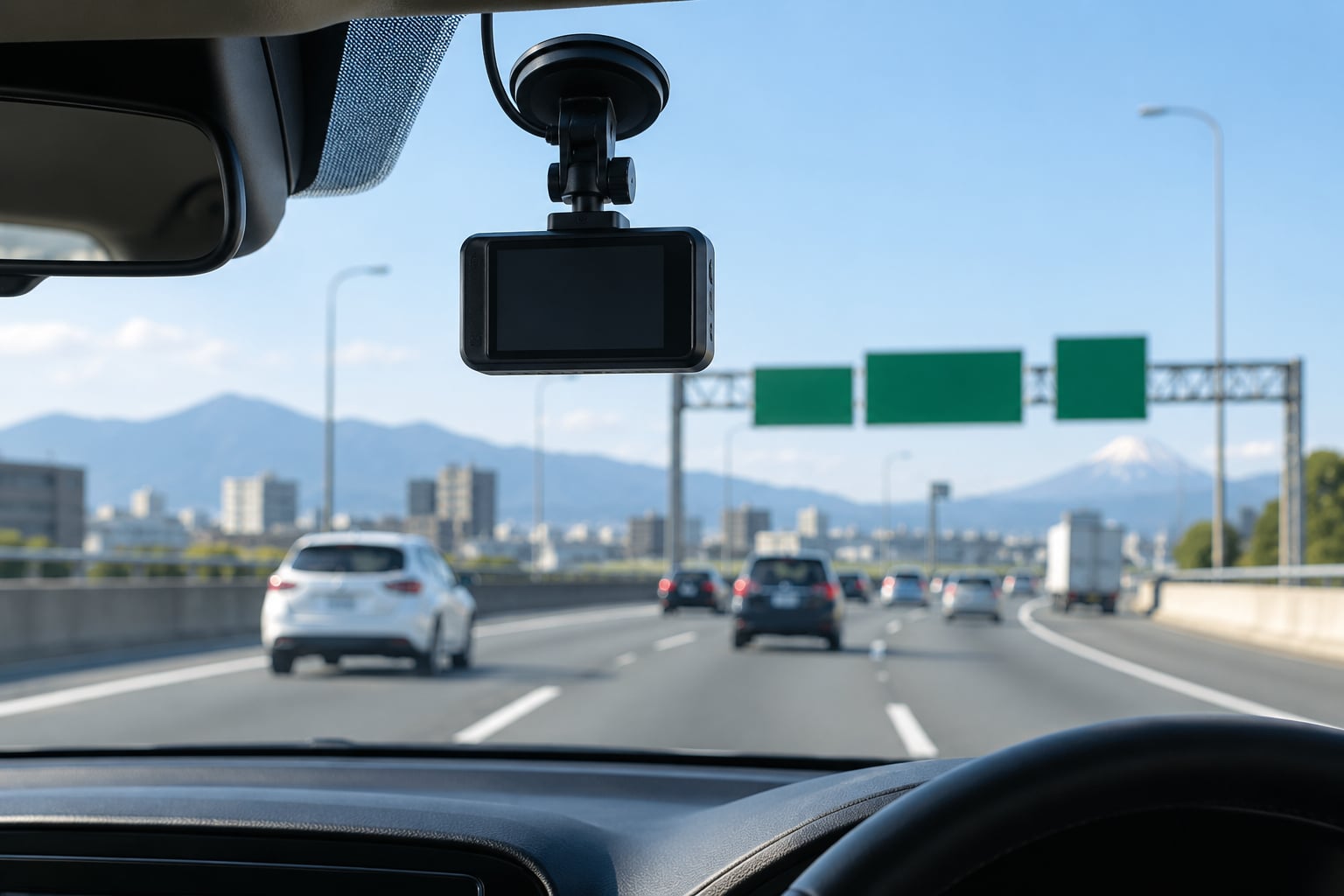
If you have driven in Japan, you have almost certainly seen one: a small camera stuck to the windscreen or the mirror housing, quietly writing video while the car moves. How Japanese dash cams became standard is not the story of one law or one product launch. It is the story of several forces pushing the same direction at the same time.
The short answer: insurers started treating the camera as a financial instrument, carmakers began fitting cameras to new cars, kei cars carried the volume into ordinary garages, the hardware got small and cheap enough to stop being worth arguing about, disputes over minor collisions created genuine demand for footage, and a recent shift in how drivers think about being recorded finished the job.
One caveat matters more than any other point in this article. Standard in Japan means fitted-or-owned across most new cars and most of the driving public. It does not mean required by law. No Japanese regulation ever compelled every registered vehicle to carry a camera.
Table of Contents
- 1How Japanese Dash Cams Became Standard
- 2What Does Standard Mean for Dash Cams in Japan?
- 3Why Japan Needed Better Driving Evidence
- 4How the Market Shifted From Niche Product to Common Accessory
- 5How Japanese Dash Cams Spread Through the Market
- 6What Technology Made Dash Cams More Useful?
- 7Why Insurers, Retailers, and Manufacturers Mattered
- 8How Safety Culture and Convenience Reinforced Adoption
- 9Why Dash Cams Are Not Literally Standard on Every Japanese Vehicle
- 10What Does Japan’s Dash-Cam Story Teach Consumers?
- 11Frequently Asked Questions
- 12Are dash cams legally required in Japan?
- 13Do Japanese insurance companies offer discounts for dash cams?
- 14Can a dash cam record while a car is parked in Japan?
- 15Are motorcycles required to have dash cams in Japan?
- 16Is a built-in vehicle camera better than a dedicated dash cam?
- 17Is recording audio or inside a private vehicle legal in Japan?
- 18Conclusion
How Japanese Dash Cams Became Standard
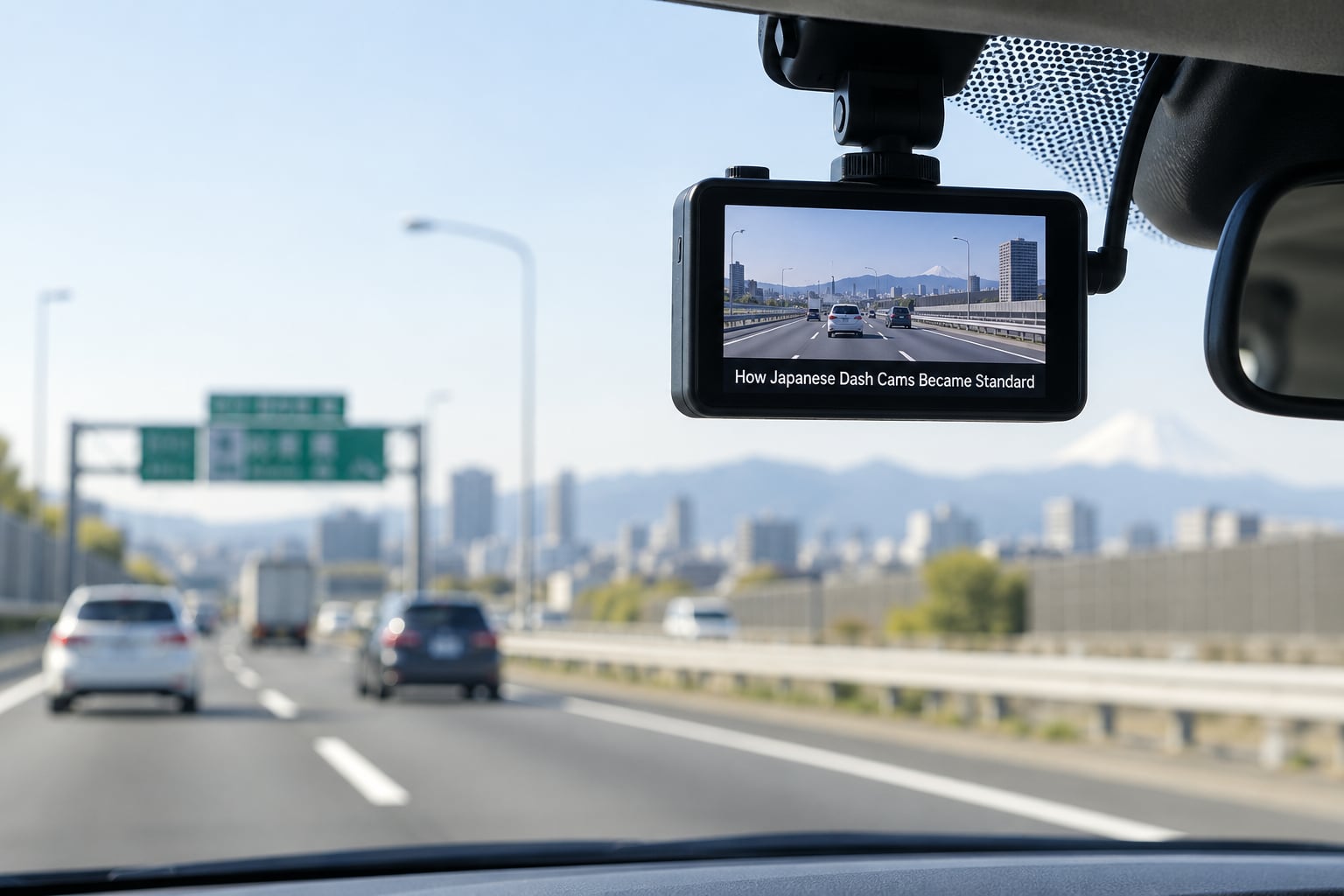
In Japan, the device is usually called a drive recorder (ドライブレコーダー), not a dash cam. It records continuously to a microSD card in a loop, overwriting the oldest footage when full, and stamps time, GPS position and speed onto each clip.
The adoption of how Japanese dash cams became standard happened in six overlapping steps, none of which alone would have been enough:
- Insurance made ownership pay. Several Japanese insurers began offering premium discounts or telematics-linked pricing to drivers who could supply driving data, which turned a gadget into a financial decision.
- Minor-collision disputes created real demand. In a country with frequent low-speed contact between vehicles on narrow streets, a neutral recording was worth something to the person holding it.
- Hardware collapsed in size and cost. Capacitor models, adhesive mounts and microSD storage turned a box-and-cable installation into a five-minute job.
- Carriers and cab operators fitted them first. Fleets adopted early because one camera settled dozens of arguments per year.
- OEMs moved the feature down-market. Japanese manufacturers began including recording hardware in the standard equipment list of mainstream models, with small kei cars doing most of the volume work.
- Parking and smartphone features closed the loop. Parked-car surveillance, app review and cloud sharing made the camera useful on days with no incident at all.
Steps one and two built the demand. Steps three through six removed every practical objection.
What Does Standard Mean for Dash Cams in Japan?
Popular usage is loose here, and most confusion about this topic comes from treating four different claims as one. They are not the same, and only the first two are comfortably true of Japan’s current market.
| What became standard | What did not become standard | What it means in practice |
|---|---|---|
| Most new cars sold in Japan come with a camera recording the forward view as listed equipment | Any legal requirement that a vehicle carry a camera | Assume factory equipment on a new car; never assume it on a ten-year-old used car or an import |
| Front-and-rear two-channel recording on ordinary small cars, not just flagships | Advanced driver assistance features remaining exclusive to premium models | Do not read a Japanese trim list as a luxury list |
| Drivers and insurers accepting footage as a routine part of settling a collision | Footage automatically deciding fault or a payout | Video changes the negotiation, not the outcome |
| Quiet, non-confrontational recording etiquette on public roads | A cultural habit of arguing with other drivers on camera | Recording is treated as documentation, not confrontation |
| Easy aftermarket fitting at accessory shops, dealers and coin parking garages | Universal coverage of older vehicles already on the road | Without a factory camera, most owners still buy one separately |
So the honest phrasing is this: camera equipment is standard equipment on Japanese new cars, and owning one is normal. It is not mandatory, and it is not universal.
Why Japan Needed Better Driving Evidence
Japan has a long-standing and well-documented problem with what happens after a small collision. Two drivers stop, and each gives an account of events that serves their own interest. There is often no physical damage worth photographing and no police officer present, so the exchange becomes a negotiation conducted entirely in words.
This behaviour has an ugly shorthand in Japanese: kyosai gakkou (交通事故), literally traffic accident cottage. It means the persistent practice of contesting minor collisions rather than resolving them, and it is the single strongest cultural driver behind demand for recorded evidence in the country.
Japan also runs its traffic dispute system differently from the UK or the US. Claims frequently run through lawyers rather than police or an official fault determination process, and in that setting a clear timestamped video changes who has to prove what. A driver holding footage is no longer arguing from memory.
None of this required a new law. It required a device that captured something a witness statement could not.
How the Market Shifted From Niche Product to Common Accessory
The early phase belonged to enthusiasts, delivery fleets and taxi operators. A taxi driver in a major city might absorb dozens of fender-bender claims a year, and a camera paid for itself quickly. Accessory shops sold to enthusiasts and professional drivers first, and installation advice came from owner clubs rather than from manuals.
Then three things happened at once. Prices fell far enough that the camera stopped being a considered purchase. Physical size collapsed, so the device no longer blocked the view through the windscreen and could be mounted out of sight near the mirror. Power supply simplified, with capacitor models charging while driving and holding just long enough to save a clip after impact, removing the lithium battery pack as a concern.
Retail distribution widened at the same time. A camera that used to require a specialist electronics shop now appears at ordinary accessory counters, at car dealers during service, at roadside assistance outlets, and through large online marketplaces with next-day delivery.
How Japanese Dash Cams Spread Through the Market
Adoption accelerated through convenience rather than persuasion. Five channels did most of the work:
- Insurer acceptance. When a claims team will actually look at submitted footage, the camera has financial value rather than sentimental value.
- Dealer fitment. Buying the camera with the car, correctly wired and installed, removes the installation question entirely.
- Online marketplaces. Wide comparison, constant pricing pressure and fast shipping made the device ordinary retail stock rather than specialist kit.
- Coin parking partnerships. Parking operators and car-wash businesses fitting or promoting cameras on site, tied to the parked-car use case.
- Integration with parking and camera systems. Japanese cars already carried reversing cameras, sensor displays and drive-mode electronics, so a recording device fit the existing electrical architecture instead of fighting it.
Each channel lowered a different friction. Price, skill, risk, trust and electrical compatibility were all solved in parallel.
What Technology Made Dash Cams More Useful?
Buyer confidence followed image quality, and image quality followed sensor and processing improvements. The practical leaps that mattered were unglamorous.
Resolution went from a genuinely coarse picture to full HD and beyond, which is the point where a plate across the road becomes legible. HDR and better low-light processing fixed the two scenes that used to produce useless footage: driving toward low sun, and driving at night under street lighting. Lens coverage widened so a front camera could capture a vehicle entering from the side at an intersection.
Two features changed behaviour more than resolution did. Loop recording removes the need to think about when to start a camera, because the device is always running and manages its own storage. Parking mode keeps the car watched while it is stationary, which turned the camera from an accident record into a general-purpose witness.
Supporting hardware improved alongside. GPS and speed stamping made a clip self-describing. Capacitor-based power meant the camera survives a hard cut without a battery that degrades in heat. Compact bodies and adhesive mounts meant installation no longer required a wiring route down the A-pillar.
Why Insurers, Retailers, and Manufacturers Mattered
Adoption of this speed does not happen because consumers independently decide a gadget is interesting. It happens because organisations with money and data make the same calculation from their side.
Insurers were the strongest pull. When driving-data products expanded beyond premium discounts into telematics-linked pricing, the camera became an input into a financial calculation. Products and discount levels differ between insurers and change over time, so anyone checking should read their own insurer’s current terms rather than trust a general statement of what is available.
Retailers made it available. Dense electronics retail, an enormous accessory market and reliable online fulfilment put a camera in front of anyone who wanted one within a day of deciding to.
Manufacturers closed the loop by including the hardware in the equipment list, which gave a generation of buyers their first exposure to the category. On the supply side, Japanese electronics and component suppliers have a long-standing presence in camera and sensor manufacturing, which is part of why the hardware arrived here early and improved quickly.
How Safety Culture and Convenience Reinforced Adoption
Once the camera exists, people find uses beyond proving fault, and those uses are what keep it in the car for years.
Parking is a good example. A car left at a coin parking space, at a private lot or outside a shop is exposed to scrapes and attempted break-ins, and a parked-car monitoring mode catches them. Delivery and taxi drivers use recorded footage routinely, sometimes for routes and customer disputes rather than crashes. Motorcycle riders across Japan use helmet and handlebar-mounted recorders as standard practice, and in a country where bicycles and motorcycles interact closely with larger vehicles at junctions, that footage tends to matter.
Ride-sharing and part-time delivery work added another driver base with a professional reason to be careful. And as cars gained built-in camera hardware for parking assistance and driver monitoring, the boundary between a recording device and a vehicle camera system started to blur, which is where the market is heading now.
Why Dash Cams Are Not Literally Standard on Every Japanese Vehicle
The counter-argument deserves a straight answer rather than a hedge. Several things genuinely are not standard.
Ownership skews heavily toward newer cars. A ten-year-old car that has never had a factory camera needs an aftermarket one, and many never get one. Rental fleets vary widely: some Japanese rental cars carry equipment, some do not, and coverage changes by company and by vehicle class rather than by law.
Built-in systems complicate the picture. A factory recording system is tied to the car’s own storage and software, often with subscription features, and it cannot be pointed in the direction the owner wants. A dedicated device is simple, movable between cars, and does exactly what it says.
Recording also carries limits. Continuous recording captures whatever passes a windscreen, including people on pavements and inside other vehicles. Interior camera recording inside someone’s private vehicle without their knowledge raises straightforward privacy problems, and audio recording raises more. Where a recording would obstruct a driver’s view, it is simply not a good idea regardless of what any rule allows.
Finally, footage is not a verdict. It shifts responsibility for proof in a negotiation that still depends on interpretation, and an over-confident driver who assumes the camera settles everything is usually wrong.
What Does Japan’s Dash-Cam Story Teach Consumers?
The adoption story is useful mainly as buying guidance, because the same forces that pushed cameras into Japanese cars tell you what to look for.
Check the power supply first. A capacitor-based model avoids a battery that ages badly in a hot car. Confirm the recording format and card capacity your device expects, because storage support is the most common cause of a camera that quietly stops recording. Decide between event recording and parking surveillance deliberately, since many devices handle one well and the other badly.
For evidence to be useful it has to be legible, so test the night footage rather than trusting a daytime sample. Front-and-rear two-channel recording is worth having on a car that spends time on narrow streets or in parking areas.
Finally, weigh a dedicated device against the built-in system your car already has. Built-in hardware is tidier and usually covered by warranty. A dedicated camera is cheaper, portable, and records continuously without a subscription. Most drivers who want reliable evidence end up wanting the second one.
And if you are driving a rental car in Japan, bring or buy your own. You will know where it is pointing, when it is running, and how to retrieve the file.
Frequently Asked Questions
Are dash cams legally required in Japan?
No. Japan has never mandated that vehicles carry a recording camera. What happened instead is commercial and cultural: insurers rewarded ownership, manufacturers listed cameras as standard equipment on most new models, and drivers treated footage as routine evidence. So cameras are extremely common and fitted on new cars, but a vehicle on the road without one is not breaking any rule.
Do Japanese insurance companies offer discounts for dash cams?
Some do, and the range has widened toward telematics-linked pricing rather than simple flat discounts. Products vary significantly between insurers and change often, so treat any general statement as out of date. The practical step is to read your own insurer’s current terms, then compare the discount against what a dedicated camera costs you.
Can a dash cam record while a car is parked in Japan?
Yes, on most modern models, using a parking surveillance or time-lapse mode that buffers video from a shock sensor. It is a genuinely common reason to own one, because street parking and private lots expose a car to scrapes and break-ins. Check how long the mode runs before the buffer overwrites, and whether the car needs a hardwired power supply to keep recording after ignition off.
Are motorcycles required to have dash cams in Japan?
No, there is no requirement. In practice they are close to universal among regular riders. Helmet and handlebar-mounted recorders are widely sold, partly because motorcyclists are physically more exposed and partly because footage is often the only account available after a collision with a larger vehicle. Buyers should check that the model is rated for vibration and weather resistance.
Is a built-in vehicle camera better than a dedicated dash cam?
It depends what you want. Factory equipment is tidier, covered by warranty, and often shares sensors with parking assistance, but it records only what the manufacturer intends and can depend on a subscription. A dedicated camera is cheaper, portable between cars, records continuously, and can be aimed where you want it. Plenty of owners of new cars with built-in systems still fit one.
Is recording audio or inside a private vehicle legal in Japan?
Rules here are narrower and stricter than in many countries. Recording audio inside a private vehicle without consent is generally treated as a serious problem, and interior cameras aimed at occupants carry real legal and social risk. A forward or rear-facing windscreen camera recording the road is a different matter. If you are unsure, keep audio off and point the camera outward.
Conclusion
Dash cams in Japan became normal because insurers made them pay, carmakers fitted them, kei cars carried them into ordinary households, the hardware became small and cheap, and a culture of contested minor collisions gave them a job worth doing. No single law caused it. Remove any one of those forces and adoption slows down noticeably.
For anyone buying one now, start by identifying which of three jobs you actually need. If you want evidence after a collision, prioritise a reliable front-and-rear setup with dependable power. If your worry is a parked car, prioritise parking surveillance and check the buffer behaviour. If you mainly want the parking and safety cameras your car already has, take a proper look at the built-in system before spending again.
Then decide whether you want the car’s camera or your own. Most Japanese drivers who end up with two have one reason, and it is usually the parked car.