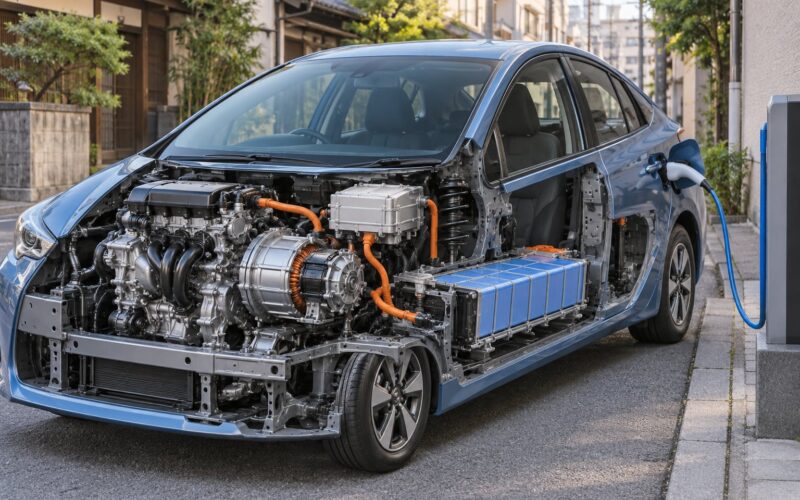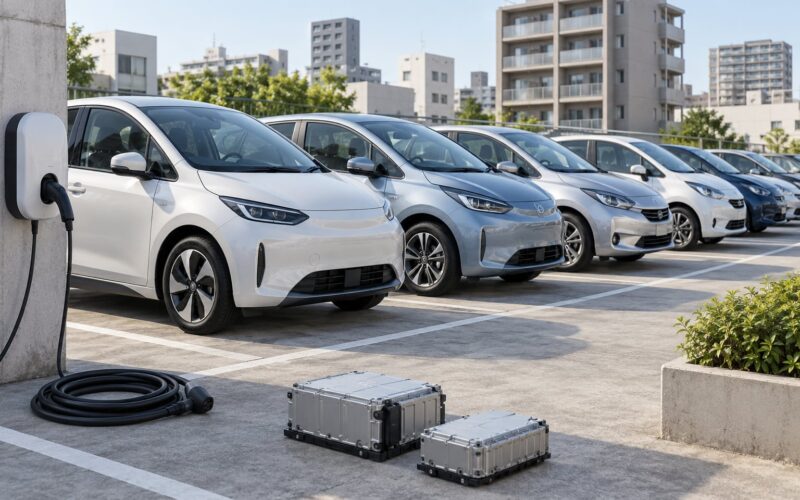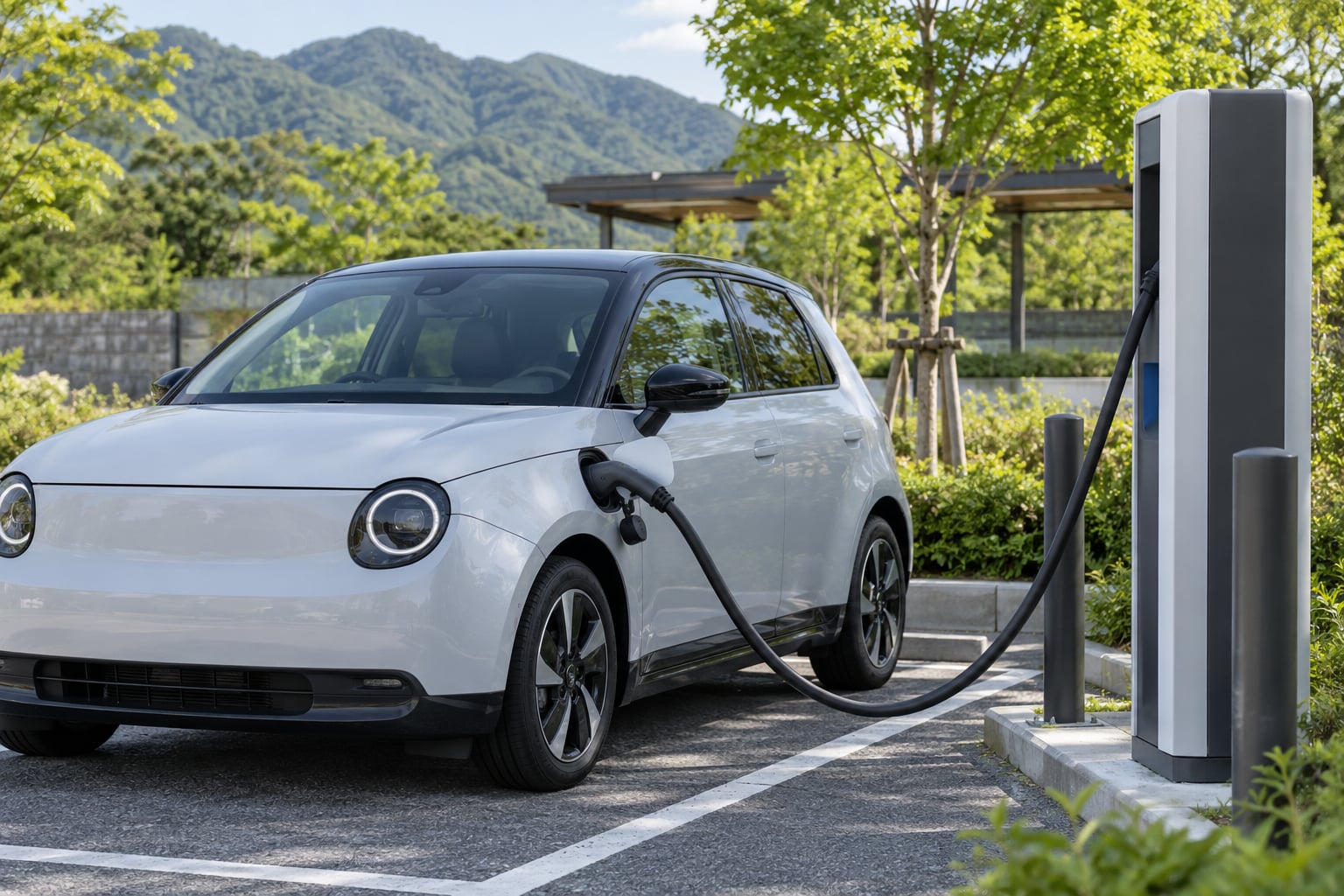
How Japanese EV charging works comes down to two connectors and three speeds. Most Japanese EVs carry a Type 2 socket for slower alternating current charging and a CHAdeMO socket for direct current fast charging. You park, activate the charger with an app, card or tap, plug in, and the car and charger negotiate the rate together before topping up the battery.
That is the whole system. Once you know which port your car has and how the charger wants to be paid for, charging anywhere in Japan stops being complicated.
This guide covers what actually happens during a session, which connectors you will meet, what a session costs to run, and how charging differs at home, in an apartment car park, at a hotel and on a highway rest stop. If you are new to the country, the sections on payment and connectors are the two worth reading first.
Table of Contents
- 1How Japanese EV Charging Works Step by Step
- 2Home charging
- 3Workplace and shared car park charging
- 4Public charging
- 5What Are the Main Charging Levels Used in Japan?
- 6Why the numbers are not fixed
- 7Charging slows down as the battery fills
- 8Why charger installation is regulated
- 9How Do Chargers and EV Batteries Communicate?
- 10The handshake in plain terms
- 11Why an adapter can make things slower
- 12Why battery voltage matters
- 13Why some cars cannot use some chargers
- 14Which Charging Connectors Are Common in Japan?
- 15Reading your own car
- 16Imported and second-hand cars
- 17How Do You Start Charging at a Public Station?
- 18Step 1: find the station
- 19Step 2: check the label before you park
- 20Step 3: activate the session
- 21Step 4: plug in and confirm
- 22Step 5: unplug and end the session
- 23How Much Does Charging Cost in Japan?
- 24What changes the final figure
- 25How to compare before you plug in
- 26What Apps and Payment Methods Can Drivers Use?
- 27The three payment routes
- 28Why foreign cards get refused
- 29Where to look first
- 30How Does Charging Work for Apartments, Hotels, and Long Stays?
- 31Homes with private parking
- 32Coin-operated and managed parking lots
- 33Hotels
- 34Workplaces and long-term parking
- 35What Should You Know Before Charging a Japanese EV?
- 36The connector
- 37Voltage, current and vehicle limits
- 38Battery charge limit
- 39Weather and timing
- 40When a session will not start
- 41Frequently Asked Questions
- 42Do EVs in Japan use CHAdeMO or CCS?
- 43What is the best app to pay for EV charging in Japan?
- 44Does EV charging slow down after 80%?
- 45Can I charge an EV with a foreign credit card in Japan?
- 46How long does charging take on a Japanese DC fast charger?
- 47Should I charge my EV to 80% every night?
- 48Conclusion
How Japanese EV Charging Works Step by Step
How Japanese EV charging works is the same everywhere in the country: find a charger, confirm your car can use it, activate the session, plug in, and unplug when you are finished. The difference between locations is who authorises the session and who pays for it.
Home charging
You plug your car into a wallbox or a domestic outlet and charging simply begins, usually overnight. There is no session to start and no app to open. A wallbox connected to a dedicated circuit will run faster than a normal household socket, and your electricity provider bills you through your normal meter.
Workplace and shared car park charging
Some offices and apartment car parks have a managed charger that runs through an operator’s app or card system. Others just give you a key or a code for a coin-operated bay. Permission to park and permission to charge are sometimes two separate things at the same location.
Public charging
Public chargers sit at convenience stores, highway service areas, shopping centres, car parks and along major roads. Most need you to activate first, then plug in. Some stations add a time limit per bay, so parking and charging are linked. Drivers on r/japanlife threads between Tokyo and Saitama point to availability and reliability, not price, as the practical worry: knowing whether a working charger will be free when you arrive.
What Are the Main Charging Levels Used in Japan?
Charging in Japan happens at three main levels: slow household power, Level 2 alternating current, and direct current fast charging. Anything beyond that is the same three levels with more power behind them.
| Level | Typical power | Typical 10-80% time | Connector | Where you find it |
|---|---|---|---|---|
| Household socket | Around 1.5 to 2 kW | 20 hours or more | Domestic 3-pin plug or Type 2 | Home, some apartment parking areas |
| Level 2 AC | 3.7 kW to 20 kW | 6 to 12 hours | Type 2 | Home wallbox, hotels, offices, car parks |
| DC fast charging | 50 kW to 150 kW, with some sites higher | 30 to 45 minutes | CHAdeMO, plus CCS2 and NACS on newer sites | Convenience stores, highway service areas, urban fast-charge sites |
Why the numbers are not fixed
A charger rating is a ceiling, not a promise. A 50 kW post serving a car that accepts 50 kW will run at that rate only while the battery is cool enough and the car’s own limit allows it. Small cars sit well below the headline number, and a hot battery after a long drive will not take the full rate straight away.
Charging slows down as the battery fills
Yes, charging slows down once the battery is roughly three-quarters full, and many cars will not accept the last ten percent on a fast charger at all. That taper is deliberate: the cells are near their peak voltage, and pushing hard creates heat. If you are set up for home charging, treat the fast charger as the top-up tool rather than the main event.
Why charger installation is regulated
Japan treats high-power charging equipment as electrical infrastructure. Anything above 20 kW, and especially equipment above 50 kW, triggers extra requirements, and anything classified as an electrical substation, which includes the highest-power chargers, faces tougher rules still. These thresholds shaped how quickly ultra-fast charging could spread, and rule changes aimed at speeding up installations have been a recurring topic in Japanese EV policy.
How Do Chargers and EV Batteries Communicate?
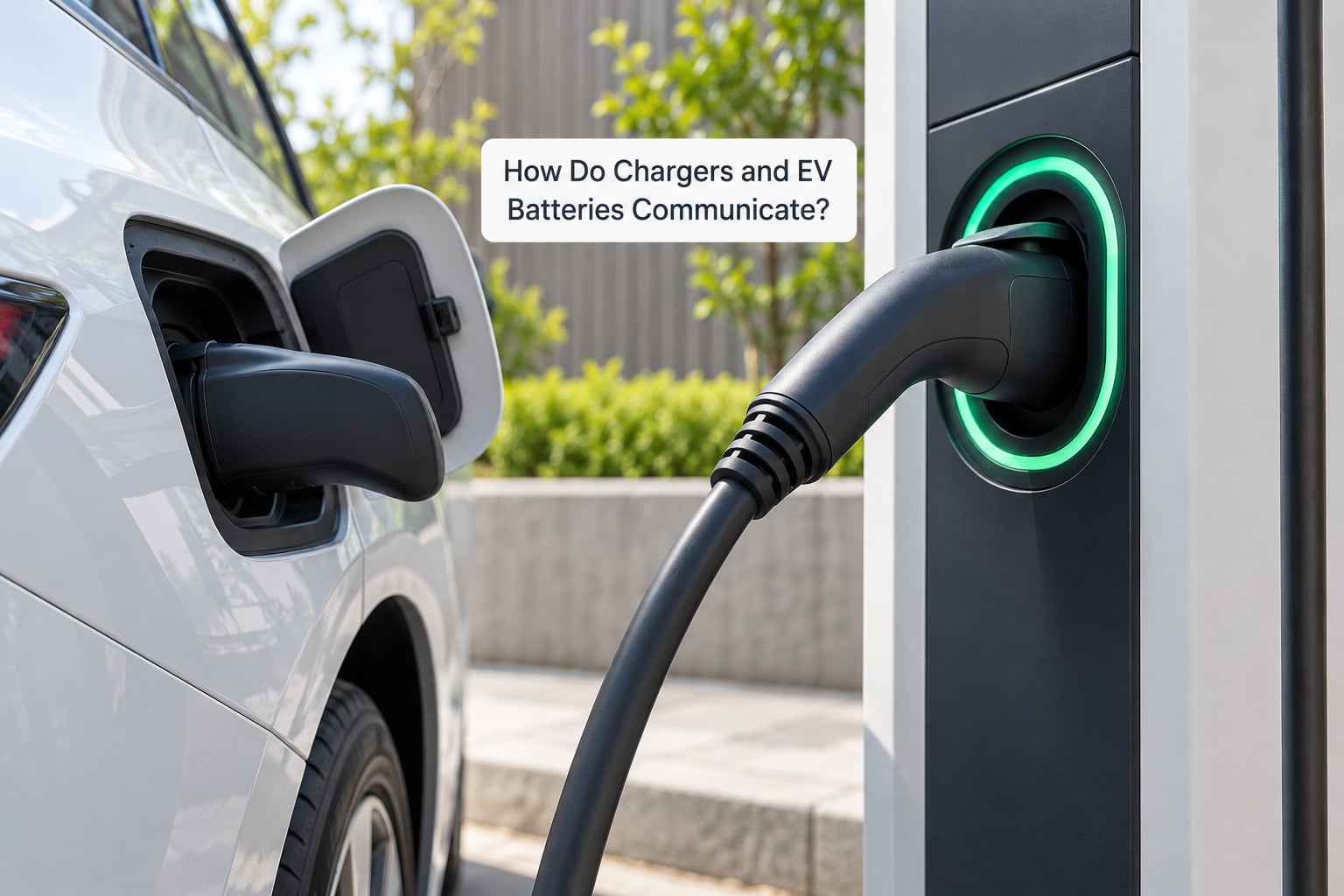
Chargers never push power at full speed and hope for the best. The car and the charger hold a continuous conversation before and during every session, and the car’s battery management system has the final say.
The handshake in plain terms
When you plug in, the car sends a signal saying what it is and what it can accept. The charger replies with what it can deliver, then the two agree on voltage, current and, on DC units, maximum power. That agreed figure sets the session.
Why an adapter can make things slower
Adapters work by translating between two connector languages. If either side is limited by what it can express, the session runs at the lower capability. An adapter is a convenience for occasional use, not a substitute for a native port.
Why battery voltage matters
A 400-volt architecture can pull more current to reach the same power level than an 800-volt car, and current is what makes cables heat up. Cars with higher-voltage packs, common on newer Japanese models, can use a 150 kW-class post more efficiently than an older 400-volt car can. This is why charger counts alone do not tell you how good the fast-charging experience will be.
Why some cars cannot use some chargers
Connectors have locking pins, signal pins and safety interlocks that must all agree. A car without the right socket simply cannot start a session, no matter how powerful the post is. Several cars also refuse DC fast charging entirely below a minimum state of charge, which protects the battery in cold weather.
Which Charging Connectors Are Common in Japan?
Two connectors dominate Japanese charging today: Type 2 for AC and CHAdeMO for DC. CCS2 and NACS are appearing on newer sites, but CHAdeMO and Type 2 remain the ones you will rely on.
| Connector | AC or DC | Power range | Where it is standard | Status in Japan |
|---|---|---|---|---|
| Type 2 | AC | 3.7 kW to 22 kW, some sites to 50 kW | Europe, Japan, most other markets | Standard on essentially every Japanese EV |
| CHAdeMO | DC | Originally 62.5 kW at 500 V and 125 A, later versions far higher | Japan, plus parts of Europe and North America | The historic Japanese fast-charging standard, still widely deployed |
| CCS1 | AC and DC in one port | 50 kW and up | North America | Not used on Japanese-market cars |
| CCS2 | AC and DC in one port | 50 kW and up | Europe, increasingly Japan | Appearing on newer public sites alongside CHAdeMO |
| NACS | AC and DC in one port | 50 kW to 250 kW-class | North America | Rolling out on Japanese sites and newer Japanese models |
Reading your own car
Open the charging flap and look. A round socket with seven small pins arranged around a larger one is Type 2. A wide, bulky plug with two large power pins at the bottom and a row of smaller signal pins above is CHAdeMO. If your car has both, you have the full choice Japan has to offer.
Imported and second-hand cars
A car imported from North America may arrive with CCS1, which almost no Japanese charger uses, so check before you buy. Cars built for Europe with CCS2 can often use Japanese CCS2 sites directly. A CCS2-to-CHAdeMO adapter cable exists for DC use and can add a DC socket to some cars, but confirm your exact model supports it, and expect the session to run at the lower capability of the two sides.
How Do You Start Charging at a Public Station?
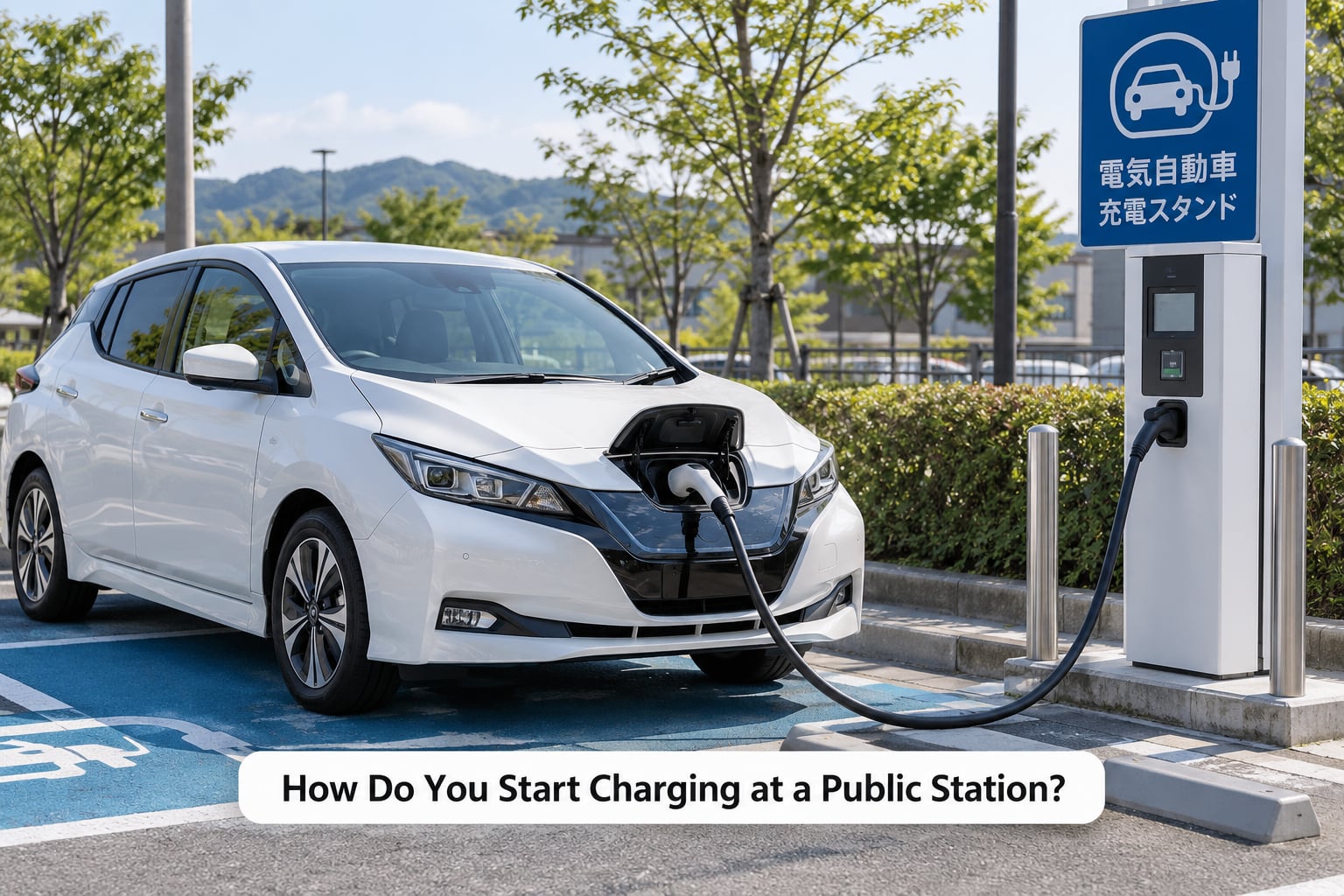
Start at any public charger by confirming compatibility, activating the session, then plugging in and checking the display. The whole thing takes a few minutes once you know which of the three payment routes that particular post supports.
Step 1: find the station
Operator apps and map services list chargers with their output, connector type, opening hours and whether parking is required. Highway service areas and convenience stores with chargers are the most dependable options on a long trip.
Step 2: check the label before you park
Look for your connector and the power output. A post marked 50 kW will not charge a car limited to 50 kW faster than that, and a 20 kW AC post serves a completely different need from a DC plug.
Step 3: activate the session
Three routes are common. Tap a contactless credit or debit card at the reader. Use the operator’s app, which often requires an account and a Japanese phone number for verification. Or use an RFID card issued with a subscription or by a partner company.
Step 4: plug in and confirm
Push the connector fully in until it locks, then look at the charger screen. It should show your car, the agreed power and a running timer. If nothing happens, the usual causes are a session that was never activated, a bay that is already occupied, or an error message that needs the app to accept.
Step 5: unplug and end the session
Press the stop button on the charger before you remove the cable. Some operators will not allow you to leave while a session is still running, and a forgotten session keeps billing.
How Much Does Charging Cost in Japan?
There is no single national rate. What you pay depends on the operator, the power level, the time of day, how the charger bills you and whether parking is tied to the session.
What changes the final figure
- Power level. A faster post costs more per hour, though not always per kilowatt-hour. Compare the two when a station offers both.
- Energy versus time. Some DC chargers bill by the kilowatt-hour delivered, others by the minute plugged in. A car that charges quickly and leaves is cheaper on time-billed posts.
- Time of day. Overnight and off-peak rates are common, and some operators discount sessions that finish before morning traffic.
- Membership. Subscription services usually include a monthly fee in exchange for discounted session rates. It pays off for regular users and rarely does for occasional ones.
- Parking. Where the bay is free for charging, the session may be capped at a set time. Where charging requires a paid ticket, the parking fee is separate from the charging fee.
How to compare before you plug in
Look at the session cost estimate in the app or on the charger’s screen before starting, and note the time limit. Charge to the level you need rather than to full, because the last stretch of a DC session is slow and often billed at the same rate. Rates change, so check the operator’s own page for current figures rather than trusting an old figure quoted somewhere online.
What Apps and Payment Methods Can Drivers Use?
Japan has no single national charging platform. Each operator runs its own app, and a station may accept several unrelated payment routes at once, which is the single most common source of confusion for newcomers.
The three payment routes
- Contactless cards. Tap a credit or debit card on the reader. Widely supported at convenience store and highway chargers, though foreign cards are sometimes declined by the terminal rather than by the operator.
- Operator apps. Used for locating chargers, reserving bays, starting sessions and paying. Some require a Japanese mobile number for verification, which is the main obstacle for visitors.
- RFID cards and QR codes. Issued by subscription services, mobility services or facility operators, and tapped on a reader or scanned from a phone.
Why foreign cards get refused
Card declines at Japanese chargers are a recurring complaint in owner discussions, and the problem is usually the terminal rather than the card itself. Some readers only handle cards issued domestically, and some reject a foreign transaction before it reaches the operator. Keeping a second card, and an app account with a QR payment option ready, avoids a stranded car.
Where to look first
Build your shortlist around convenience store chains with chargers, highway service areas on your regular routes, and the operator apps that cover your city. r/japanlife threads on Tokyo and Saitama charging are a practical read for which sites work reliably, and drivers consistently flag sites that were blocked, occupied or out of service more than they flag fees.
How Does Charging Work for Apartments, Hotels, and Long Stays?
Housing is where Japanese EV charging differs most from North America and Europe, because most urban residents do not have a private parking space with a dedicated circuit.
Homes with private parking
This is the easy case. A licensed electrician can install a wallbox on a dedicated line, and charging happens overnight like any other appliance. Confirm the circuit rating with the vehicle manual before choosing hardware.
Coin-operated and managed parking lots
Many apartment car parks and coin parking lots have a limited number of charging bays. Access is usually controlled by a card, key or parking ticket from the facility operator rather than the charging company. Some older facilities have no charge bay at all, so ask before you sign a lease.
Hotels
Charging at a hotel charger may be free, or it may be billed per session on top of parking. The rules are set by the property, so confirm at reception rather than assuming. A hotel with only AC charging is still useful overnight, just slower.
Workplaces and long-term parking
Company car parks often install chargers with an employee app or card system, and some have restricted hours for overnight charging, which matters for apartment dwellers without home charging. Private monthly car parks follow the same model. Ask in writing who pays for electricity and who can authorise a session.
What Should You Know Before Charging a Japanese EV?
Check four things before your first session and most charging problems never come up: the connector, the power limit, the payment route and the parking rules.
The connector
Type 2 for AC, CHAdeMO for DC. Check the flap before you book anything, and check the charger label before you park.
Voltage, current and vehicle limits
The car will negotiate power with the charger, so an underpowered post is safe, just slow. Follow the manufacturer’s guidance on a domestic outlet if you charge that way overnight.
Battery charge limit
Most cars let you set a daily maximum charge, commonly around 80 percent, and leaving a daily routine on a fast charger is what long-term battery wear looks like. Use a higher limit for a trip and let the car sit at a lower limit the rest of the time. Owners who live with daily 100 percent fast charging are the ones who report battery health dropping year after year, which is the pattern worth avoiding.
Weather and timing
Cold weather reduces fast-charging acceptance, so on a winter road trip expect a longer first stop. Heat does the same after sustained high-speed driving.
When a session will not start
Check that you activated it, that the bay is not already occupied, and that the screen has no error message needing an app confirmation. If the connector will not lock into the car, stop pushing and check the car’s charge-port flap, since an internal latch sometimes stays engaged. Electrical work on a charger or your home supply belongs with a licensed professional.
Frequently Asked Questions
Do EVs in Japan use CHAdeMO or CCS?
Most Japanese-market EVs carry both a Type 2 socket for AC charging and a CHAdeMO socket for DC fast charging, which is why the two ports confuse drivers used to a single combined plug. Newer public sites are adding CCS2 and NACS alongside CHAdeMO as the transition advances. If your car has Type 2 and CHAdeMO, you can use almost every charger in the country.
What is the best app to pay for EV charging in Japan?
There is no single national app, because each charging operator runs its own. For most drivers, using operator apps to locate chargers and reserving bays is convenient, while contactless credit or debit cards work well at convenience store and highway chargers. Keep a card backup, since some apps require a Japanese mobile number and some terminals refuse foreign cards.
Does EV charging slow down after 80%?
Yes. From roughly three-quarters full, most cars taper charging because cell voltage is near its peak and pushing harder creates heat. Some models will not accept the last ten percent on a fast charger at all and ask you to finish on AC. That is why a full DC session takes much longer than a 10 to 80 percent figure suggests, and why long-term owners top up on a slow charger overnight.
Can I charge an EV with a foreign credit card in Japan?
Sometimes, but not reliably. Many convenience store and highway terminals accept contactless cards and some accept foreign-issued ones, yet a share of readers decline anything not issued in Japan, and a few operators require their own app or RFID card first. Assume your foreign card might fail, register an app account in advance, and carry a second card. A declined card with an empty battery is a genuinely stressful afternoon.
How long does charging take on a Japanese DC fast charger?
A typical Japanese DC fast charger runs from 50 kW to around 150 kW, and going from 10 to 80 percent usually takes 30 to 45 minutes on a car that accepts the power. Smaller cars charge more slowly, and cars on a 400-volt architecture use a 150 kW post less efficiently than an 800-volt car does. Very cold or very hot batteries extend the time further.
Should I charge my EV to 80% every night?
As a routine for daily driving, yes. Setting a daily limit around 80 percent keeps the battery out of the high-voltage range it spends most of its time in, which slows long-term wear. Raise the limit when you need the extra range, and leave a full charge for a trip rather than sitting on 100 percent for weeks. If you have no home charging, fast-charge to what you need and top up overnight wherever you can.
Conclusion
How Japanese EV charging works is simpler than the number of standards suggests. Every Japanese EV uses Type 2 for AC and, historically, CHAdeMO for DC fast charging, and the charger only ever delivers what your car can accept. Pay with a contactless card, an operator app or an RFID card, and the physical act of charging is the same as anywhere else.
What needs planning is the surroundings: the payment route at that particular charger, the parking rules, and whether home or workplace charging is available to you. Do that first. Check which ports your car has, pick your payment method before you need it, and confirm who can authorise charging where you park. Everything after that is plugging in and waiting.