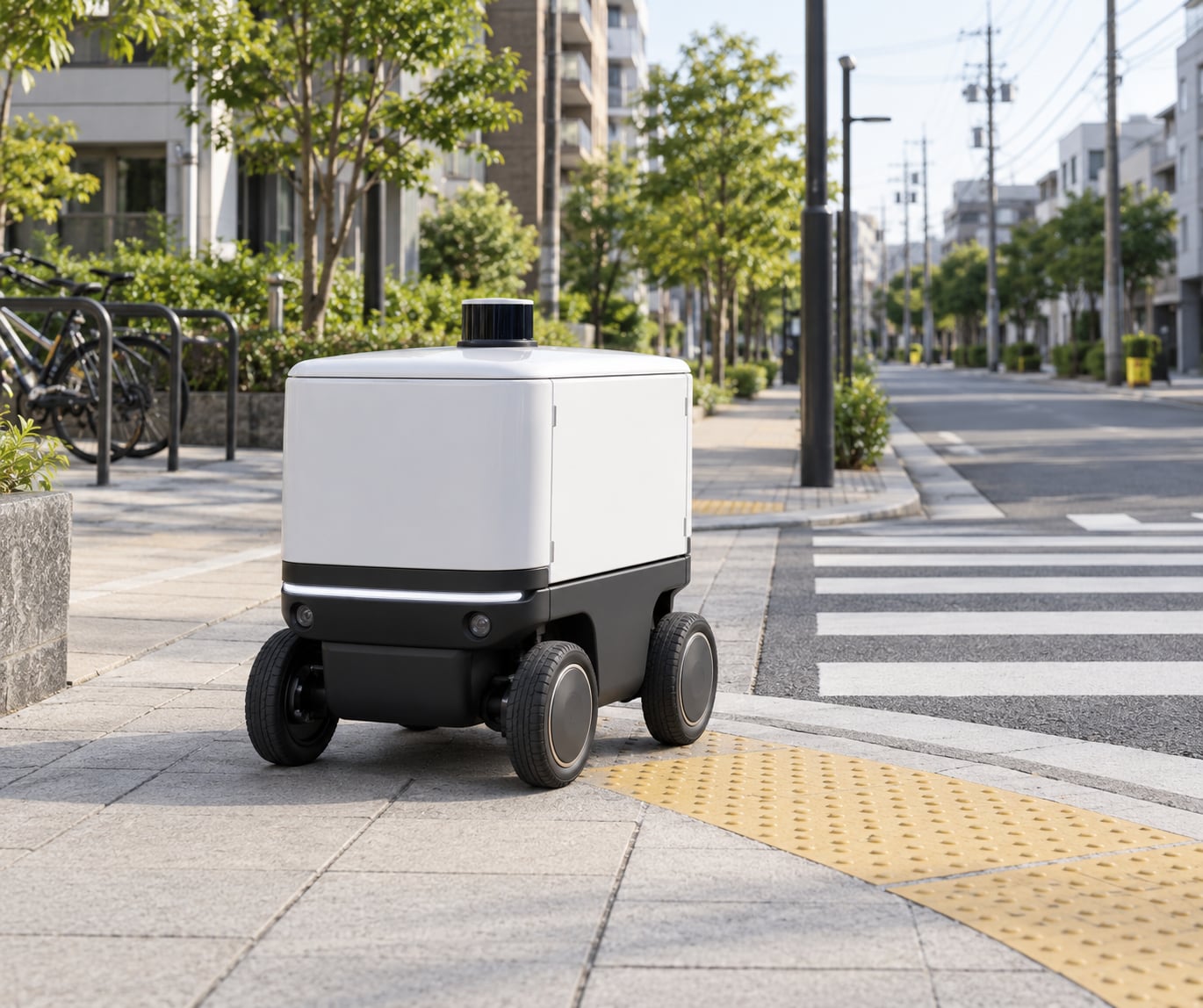
Japanese delivery robots navigate sidewalks by repeating one loop thousands of times a day: sense the space, work out exactly where they are on it, plan a short safe path, move, then check again. They follow routes mapped and approved for pedestrians, stay near walking speed, yield to anyone on foot, pause at crossings until the signal or a gap in traffic makes it safe, and hand control to a remote operator the moment something does not add up.
That loop is why the machines work on a 1.5-metre strip of concrete that a car would struggle with. But Japan’s version of the problem has quirks you rarely see elsewhere: utility poles planted in the middle of the path, tactile paving that swallows small wheels, drainage grates, guardrails, post boxes, and residential streets steep enough to matter on a wet day.
The rest of this guide walks through the actual stack — which sensor does which job, how a route gets built, what happens at a crosswalk, and what the human operator is doing while the robot appears to be on its own. Status of deployments below is current as of 2026.
Table of Contents
- 1How Japanese Delivery Robots Navigate Sidewalks Safely
- 2What Sensors Do Delivery Robots Use?
- 3LiDAR: the geometry layer
- 4Cameras: the classification layer
- 5Ultrasonic: the last 30 centimetres
- 6GPS, IMU and encoders: knowing where you are
- 7How Do the Robots Build and Follow a Route?
- 8How Do Delivery Robots Detect and Avoid Pedestrians?
- 9How Do They Handle Crossings, Intersections, and Tight Spaces?
- 10What Role Do AI and Remote Operators Play?
- 11What Safety Rules and Delivery Practices Apply in Japan?
- 12Frequently Asked Questions
- 13How do Starship robots navigate?
- 14Are people driving the Coco delivery robots?
- 15Are there delivery robots available in Japan?
- 16Why was Amazon Scout cancelled?
- 17Can delivery robots use sidewalks in Japan?
- 18How fast do Japanese delivery robots travel?
- 19Conclusion
How Japanese Delivery Robots Navigate Sidewalks Safely
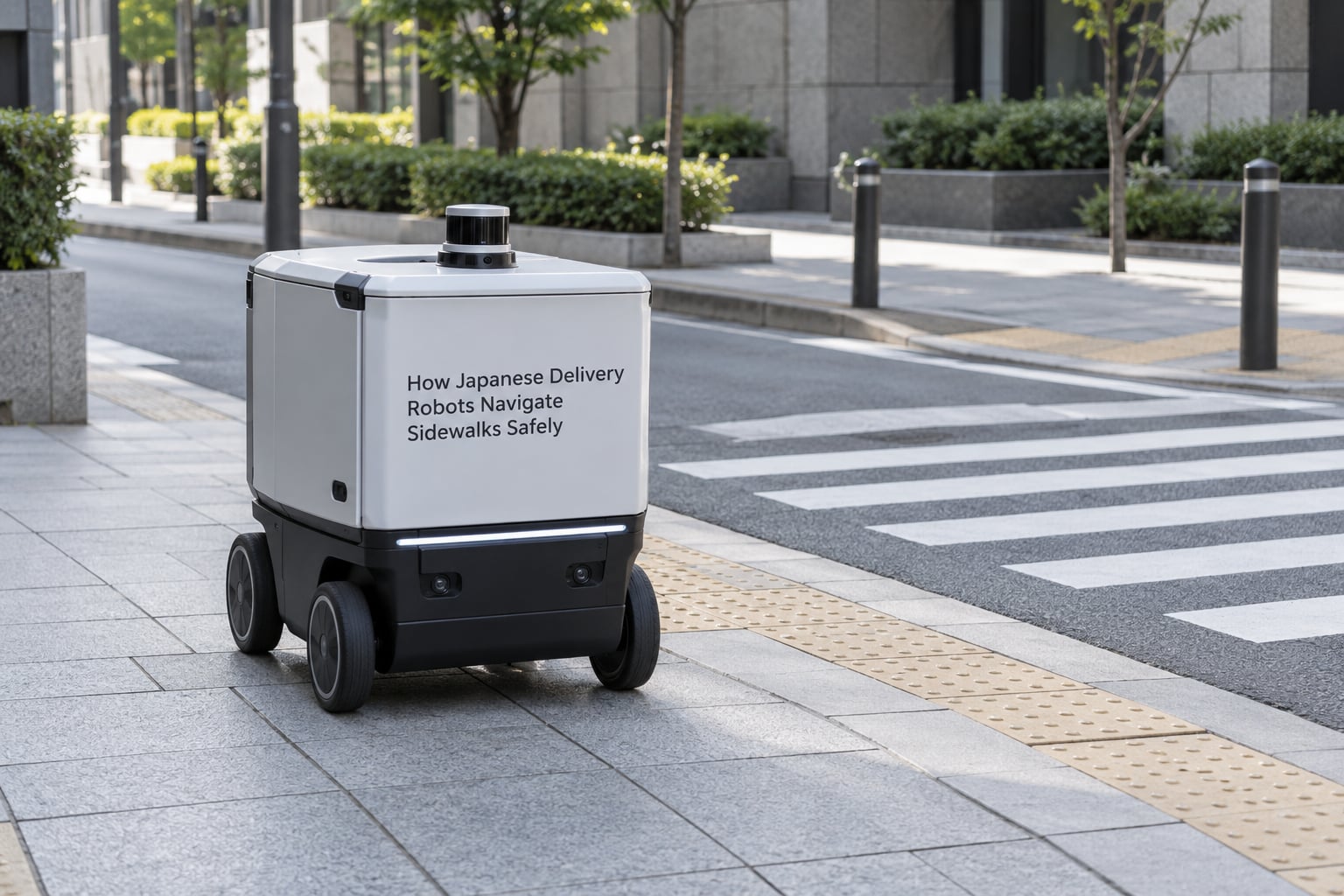
The short version: they do not improvise. A route is surveyed and loaded before the first delivery, the robot’s drive stack turns sensor data into a position on that route, and a behaviour layer decides whether moving forward is acceptable right now.
Split that into five repeating steps, and the whole system is easy to picture.
- Sense. LiDAR, cameras, ultrasonic sensors, GPS and wheel data describe the space in front of and under the robot.
- Localise. The robot matches what it sees against its stored map to work out its position to centimetre-level accuracy.
- Plan. It picks a trajectory along the walkable part of the path, holding a safe distance from the kerb, walls and street furniture.
- Act. Wheels or legs move the body along that trajectory at a controlled speed.
- Re-check. At roughly 10 Hz the safety layer re-reads the scene. If a person, bicycle, car or unknown object enters a safety envelope, the robot slows, stops, or re-plans before the next step is taken.
Step five is the one that matters on a crowded street. A robot that only planned once would be driving on information that expired several seconds ago.
What Sensors Do Delivery Robots Use?
No single sensor is enough. Each one covers a specific weakness of the others, and the robot fuses them into one shared picture of the world.
| Sensor | What it measures | Why the robot needs it |
|---|---|---|
| LiDAR | Distance to surfaces using reflected laser pulses | Builds a 3D shape of the path, sees kerbs and obstacles at any lighting level |
| Stereo / depth cameras | Colour images plus distance per pixel | Classifies what a person, bicycle or signboard actually is |
| Ultrasonic proximity sensors | Very close range distances | Final check on the last 15 to 30 cm, where cameras and LiDAR blind spots sit |
| GPS / RTK-GPS | Satellite position, corrected to centimetres | Global position on the route, including under tree cover and between tall buildings |
| IMU (gyroscope, accelerometer) | Orientation, tilt and acceleration | Knows when the body tips on a slope or hits a kerb edge |
| Wheel encoders | Rotation of each motor | Dead-reckons distance travelled and wheel slip |
LiDAR: the geometry layer
LiDAR spins a laser and measures how long each pulse takes to come back, producing a cloud of 3D points. On a sidewalk that is the only sensor that reliably tells the robot where the kerb edge is and how high a kerb step is, at dusk or in light rain.
2D LiDAR gives a flat profile, useful for corridor-following. 3D units give height information, which is what lets a robot decide whether a low object in its path is a kerb, a ramp, a fallen branch or a shopping bag.
Cameras: the classification layer
LiDAR knows a shape exists but not what it is. Cameras fill that in, and stereo pairs or depth modules add a second distance estimate to the same frame, which gives the robot enough information to tell a pedestrian from a bollard from a bicycle leaning against a guardrail.
Vision also handles traffic lights. Colour and position recognition on a signal head is how a robot knows whether the little human figure is standing or walking.
Ultrasonic: the last 30 centimetres
Cheap, blunt and short-sighted, which is exactly why they sit at the front. Below roughly 15 cm, a kerb lip, a bicycle pedal or a cat’s tail can be below a camera’s usable frame or a LiDAR’s minimum range. Ultrasonic sensors cover that band and trigger a hard stop.
GPS, IMU and encoders: knowing where you are
Satellites alone are not accurate enough for a 1.5-metre walkway. RTK-GPS correction brings a fix into the centimetre range; the IMU carries the robot through the moments when that fix is unreliable, and the wheel encoders cross-check the whole system. When all three disagree by more than a set margin, the robot assumes it is lost and stops.
How Do the Robots Build and Follow a Route?
Most deployments in Japan run on a pre-surveyed, human-approved corridor rather than open-ended map-free driving. An operator records the walkable line, marks the crossings the robot may use, and the vehicle replays that corridor with live corrections layered on top.
Route planning splits into three jobs that run at different rates:
- Route level (once, before the trip). A path is chosen that uses designated crossings and avoids known stairs, private driveways and construction zones.
- Path level (several times a second). The robot tracks a centreline offset from the kerb, far enough out that a parked bicycle does not trap it against a wall.
- Local level (continuous). A small dynamic window around the robot decides speed, braking and lateral nudges as people move through it.
Localisation runs alongside all three. The robot matches current sensor data to the stored map, then estimates its position with a filter that combines GPS, IMU and wheel odometry continuously, because each one fails differently.
Research in the field has pushed toward mapping-free navigation on Japanese sidewalks, building the map as the robot moves. For live delivery work the surveyed route still wins, mainly because an operator can guarantee in advance that every crossing on it is legal to use and every pinch point is wide enough.
How Do Delivery Robots Detect and Avoid Pedestrians?
Detection is the easy half. The robot segments out people, tracks each one frame by frame, and keeps a predicted position for a second or two ahead based on heading and speed.
Avoidance then follows one rule: a person always has priority. Inside a safe envelope — typically several metres ahead and a metre or so to each side — the robot slows. Inside a closer envelope it stops. It will hold position rather than edge past someone, and it will wait for a group to break up rather than thread through the gap.
Japanese deployments add a few conventions that come from local pedestrian culture. Robots make their presence known before they arrive, and they decelerate noticeably rather than gliding silently up behind someone. Wheelchairs, strollers and guide dogs get a wider berth than the standard envelope, because a wheelchair user cannot simply step aside.
Real-world failures are rarely exotic. The recurring ones are mundane clutter: a signpost or guardrail narrowing the usable width, a construction hoarding forcing a detour, a bicycle parked in the mapped line, or a cat sitting in the middle of the path. Stray cats blocking delivery robots has become a recurring, oddly good-natured story in Japanese media — footage of a robot waiting politely for a cat to move has circulated more widely than most of the safety literature.
When a route is genuinely blocked, the robot stops and asks the operator. Some trials re-plan around the blockage; others end the trip and reschedule the parcel.
How Do They Handle Crossings, Intersections, and Tight Spaces?
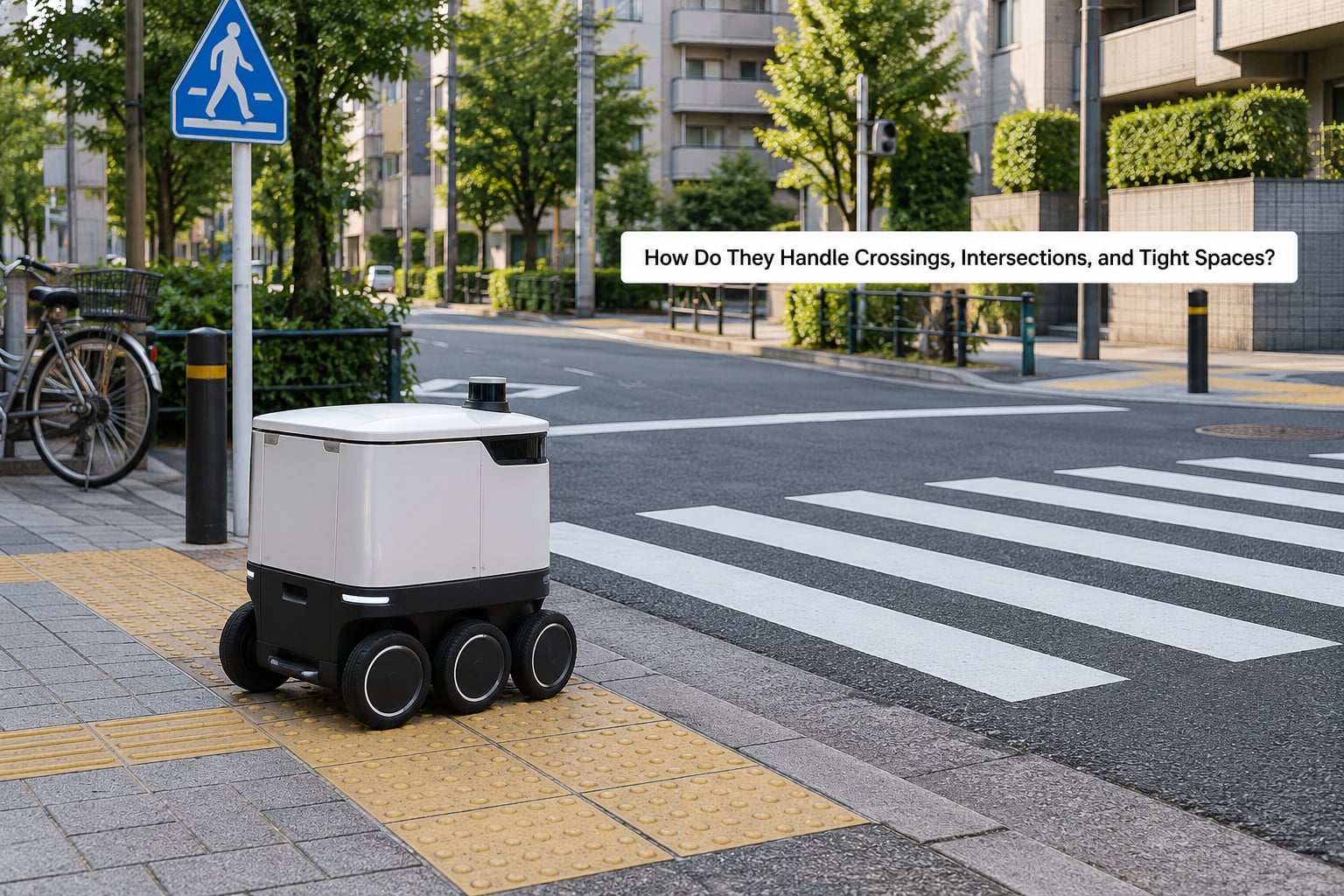
Crossing a road is the hardest thing a sidewalk robot does, because for those few seconds it leaves the environment it was designed for. A documented sequence looks like this:
- Approach and stop. The robot pulls up at the kerb edge and halts, in position but not protruding into the road.
- Check the crossing. Cameras and LiDAR scan both directions along the road; signal state is read from the crossing’s light if there is one.
- Decide. With a pedestrian signal, it waits for the walking phase. Without one, it looks for a gap in traffic large enough at the current flow, and it treats a vehicle that slows as a vehicle that intends to stop.
- Commit quickly. It crosses at walking pace without dithering. A robot that hesitates mid-crossing is more dangerous than one that sets off.
- Re-check behind. Bicycles are the recurring risk at Japanese crossings, so the robot tracks them through the manoeuvre rather than only ahead.
- Rejoin the sidewalk. It climbs or descends the kerb using wheel articulation or a ramp alignment, then reacquires its centreline.
Japan’s 2023 legal change requires exactly this kind of conservative crossing behaviour before a robot may use a crossing, which is why crossing logic is written to refuse rather than to optimise.
Tight spaces are where the hardware differences show. Most units use independently driven wheels that steer and rotate to hold balance and squeeze through gaps. PiezoSonic’s Mighty took a different route: each wheel sits on its own hinged leg, so the wheels can turn 90 degrees to strafe sideways or spin in place while the body stays level. Its published figures include a 20 kg payload, 15 cm obstacle clearance, a 15 degree slope limit and roughly four hours of runtime per charge, with a top speed of 10 km/h — figures that describe a machine built for uneven residential ground rather than smooth indoor floors.
Standard wheeled units are simpler and cheaper, but they need ramps or gentle kerb cuts. Articulated designs cost more and absorb kerbs, tactile paving blocks, drainage grates and steep lanes without stopping.
What Role Do AI and Remote Operators Play?
AI handles the routine: tracking people, reading signals, tracking the centreline, choosing a safe speed. The operator handles the exceptions. A remote monitoring centre — 遠隔監視, enkan kanshi — watches video feeds from the robots, and a supervisor can take over when a unit is unsure, blocked or stopped for too long.
So yes, a human is connected. The honest framing is that autonomy covers the drive between pickup and drop, while a human retains the ability to intervene at any point. Some deployments attach a staff member walking behind the robot; others watch from a room. Which one you get depends on the operator and the phase of the trial.
The reason operators push for more onboard autonomy is arithmetic. A teleoperated robot costs roughly what a supervised employee costs, so the business case collapses at volume. Remove most of the human minutes per delivery and the unit economics start to work, which is exactly why a company like Amazon shut down its Scout programme in the United States rather than run a fleet that needed constant remote attention.
| Sidewalk delivery robot | Self-driving car | |
|---|---|---|
| Top speed | Around 6 km/h | Motorway speeds |
| Legal classification in Japan | Low-speed autonomous delivery robot, treated as a pedestrian | Motor vehicle under traffic rules |
| Operating area | Walkways, crossings, private sites | Full road network |
| Supervision | Remote operator, 遠隔監視 | Safety driver or fully driverless with geofenced operations |
| Cost per delivery | Low once autonomy covers most minutes | Very high |
Compare Starship Technologies or Serve Robotics in the US, and the model is the same: the robot handles navigation, a remote operator supervises, and a support number on the cargo lid exists for stranded pedestrians. Nuro and others go a different route entirely, driving on roads at car speeds and never touching a sidewalk.
What Safety Rules and Delivery Practices Apply in Japan?
The legal change is the reason any of this is happening at scale. Until April 2023, a self-running robot on a public sidewalk was not permitted without a human walking beside it, which made a genuinely autonomous service impossible. The amendment to Japan’s Road Traffic Act created a new category — 低速走行型自律配送ロボット, a low-speed autonomous delivery robot — which may travel on sidewalks as if it were a pedestrian, under conditions the National Police Agency sets out.
The core conditions are straightforward: the robot stays within a set top speed, follows designated crossings, yields to people, and operates under remote monitoring. The classification is not a licence to drive anywhere. Each deployment is tied to a defined area and a defined route.
- 配送ロボット (haisō robotto) — delivery robot, the general term in everyday use.
- 低速走行型自律配送ロボット — low-speed autonomous delivery robot, the official legal category created in 2023.
- 歩道 (hodō) — sidewalk, the designated operating surface.
- 遠隔監視 (enkan kanshi) — remote monitoring, the supervision duty the law attaches to operation.
- SLAM — simultaneous localisation and mapping, the technique that lets a robot build and hold a map at once.
Delivery practice is equally constrained. Parcels usually arrive in lockable compartments the customer opens with a code or a phone, so there is no handover and no doorstep entry. Robots run in daylight and in fair weather, with rain and night operations treated as separate engineering problems rather than assumed.
As of 2026, the named programmes run from pilots to early commercial work, and the distinction matters when judging claims:
| Operator and developer | Machine | Use case | Status as of 2026 |
|---|---|---|---|
| Japan Post with ZMP | DeliRo | Postal and store parcel delivery | Commercial delivery in multiple prefectures, scaled back from earlier ambitions |
| 7-Eleven Japan with Lomby and Suzuki | Box-type autonomous unit | Store-to-door delivery via 7NOW, Hachioji trials | Pilot running in hilly neighbourhoods including Minami-Osawa |
| ZMP | Delivery platform robots | Retail, agriculture, security patrol | Commercial platform, several use cases beyond parcel delivery |
| TIER IV | Autonomous driving and logistics stack | Low-speed vehicle autonomy, transport services | Active in transport and low-speed autonomy programmes |
| KDDI with partners | Autonomous delivery units | Service trials including welfare and monitoring applications | Trials and research deployments |
| Hakobot | Compact delivery robot | Last-mile delivery on private and public walkways | Early deployments and trials |
| PiezoSonic | Mighty | Uneven terrain, patrol, agriculture, soil sampling | Prototype and demonstration stage, CES 2022 Innovation Award |
What drives all of this is arithmetic on the other side of the equation. Japan has a shrinking working-age population, an ageing customer base, and a large volume of small parcels moving to homes that are increasingly hard to reach by van. Sidewalk robots fit the awkward middle: too small for a truck, too slow to justify a dedicated vehicle, but numerous enough to matter.
They also do not fix everything. Automation reduces the number of delivery legs driven by people; it does nothing for eldercare, healthcare or regional depopulation, and a robot cannot carry a heavy grocery order up a staircase to someone on the third floor.
Frequently Asked Questions
How do Starship robots navigate?
Starship robots, like Japanese sidewalk robots, navigate with a layered sensor stack: LiDAR for 3D geometry, cameras for classifying people and objects, ultrasonic sensors for the last 30 centimetres, and GPS plus wheel odometry for position. The system builds a map of the area, tracks pedestrians frame by frame, predicts their next few seconds of movement, and yields or re-routes when a person enters its safety envelope. A remote operator supervises and can intervene at any time.
Are people driving the Coco delivery robots?
Partly, and this is the most common misunderstanding about the whole category. The robot drives itself between pickup and drop using its onboard autonomy, but a remote operator monitors video feeds and can take over the moment the unit is uncertain or stopped. Early trials often had staff walking behind the robot physically. Coco-style systems are therefore supervised autonomy, not remote piloting for every metre of the trip.
Are there delivery robots available in Japan?
Japan is one of the world’s most active markets for sidewalk delivery robots, though most programmes are pilots rather than open public services. Japan Post runs DeliRo with ZMP, 7-Eleven Japan runs store-to-door trials with Lomby and Suzuki, and TIER IV, KDDI, ZMP and Hakobot all run commercial or trial deployments. Availability depends on the neighbourhood, since each deployment is approved for a defined area and route.
Why was Amazon Scout cancelled?
Amazon ended its Scout delivery programme in the United States in 2020, citing the difficulty of scaling the effort. The core problem is economic: a fleet that needs constant human remote attention costs roughly what supervised human couriers cost, and small sidewalks with kerbs, bicycles and driveways proved harder than expected. The lesson shaped Japan’s approach, where operators push for genuine onboard autonomy to cut human minutes per delivery.
Can delivery robots use sidewalks in Japan?
Yes, under rules introduced in April 2023. An amendment to the Road Traffic Act created a new category, the low-speed autonomous delivery robot, which may travel on sidewalks as though it were a pedestrian, provided it respects a set top speed, uses designated crossings, yields to people and operates under remote monitoring. Each deployment is limited to a defined area and route rather than allowed anywhere.
How fast do Japanese delivery robots travel?
Most cap out around 6 km/h, which is walking pace and a condition of their legal classification as pedestrians rather than motor vehicles. That limit is a safety design choice as much as a legal one: at walking speed, a robot can stop within its own sight line and a pedestrian can always step in front of it. Wheeled units are often set below the cap, roughly 4 to 5 km/h, for stability and for comfort on narrow paths.
Conclusion
Japanese delivery robots navigate sidewalks by combining three things: a human-surveyed route, a redundant sensor stack that understands the space in three dimensions, and behaviour that always favours the person on foot. Crossings are handled by refusing rather than by optimising, and a remote operator stands behind every trip.
If you are comparing deployments, look at one thing first: the share of each delivery that the robot completes without human input. That single number tells you whether a service is genuinely autonomous, still teleoperated, or a pilot with a person walking behind it — and it predicts the cost per delivery better than any top-speed figure on a spec sheet.