Japanese bicycles have electric assist because the country that invented the modern e-bike also has the hills, the aging riders and the bicycle-only traffic law that make a small motor worth carrying. Yamaha released the PAS in November 1993 as the world’s first mass-produced electric-assist bicycle, and the motor only ever adds to your own pedalling, then stops completely at 24 km/h. That design turned an uphill problem into a 10-minute ride and made the assisted bicycle Japan’s default city bike.
Three things had to line up before that happened: Yamaha engineers working out how to make a motor feel like stronger legs instead of a throttle, a legal framework that kept the machine firmly in the bicycle class, and a battery that got cheap enough to put in millions of homes. Understanding why Japanese bicycles have electric assist means following all three.
Table of Contents
- 1What Does Electric Assist Mean on a Japanese Bicycle?
- 2Why Do Japanese Bicycles Have Electric Assist?
- 31. Terrain: a country of short, steep slopes
- 42. The bicycle base Japan already had
- 53. An aging population that wanted to keep riding
- 64. The 1997 television campaign that sold it to mothers
- 75. Batteries got cheap enough to mass-produce
- 8How Does the Motor Respond When the Rider Pedals?
- 9Why a Hill Bike Became the Default Commuter in Flat Cities
- 10How Japanese Regulations Shaped Electric-Assist Bicycles
- 11How Electric Assist Differs From Other Motorized Bikes
- 12Where an Assist Motor in Japan Matters Most
- 13What Are the Advantages and Drawbacks for Daily Riders?
- 14What Should Riders Check Before Buying or Renting One in Japan?
- 15Frequently Asked Questions
- 16Are electric-assist bicycles in Japan fully automatic?
- 17Do you have to pedal an electric-assist bicycle in Japan?
- 18Why do Japanese e-bikes stop assisting at a relatively low speed?
- 19How far can an electric-assist bicycle travel on one charge?
- 20Can tourists rent an electric-assist bicycle in Japan?
- 21Why is a Japanese electric-assist bicycle sometimes heavier than a normal bicycle?
- 22Conclusion
What Does Electric Assist Mean on a Japanese Bicycle?
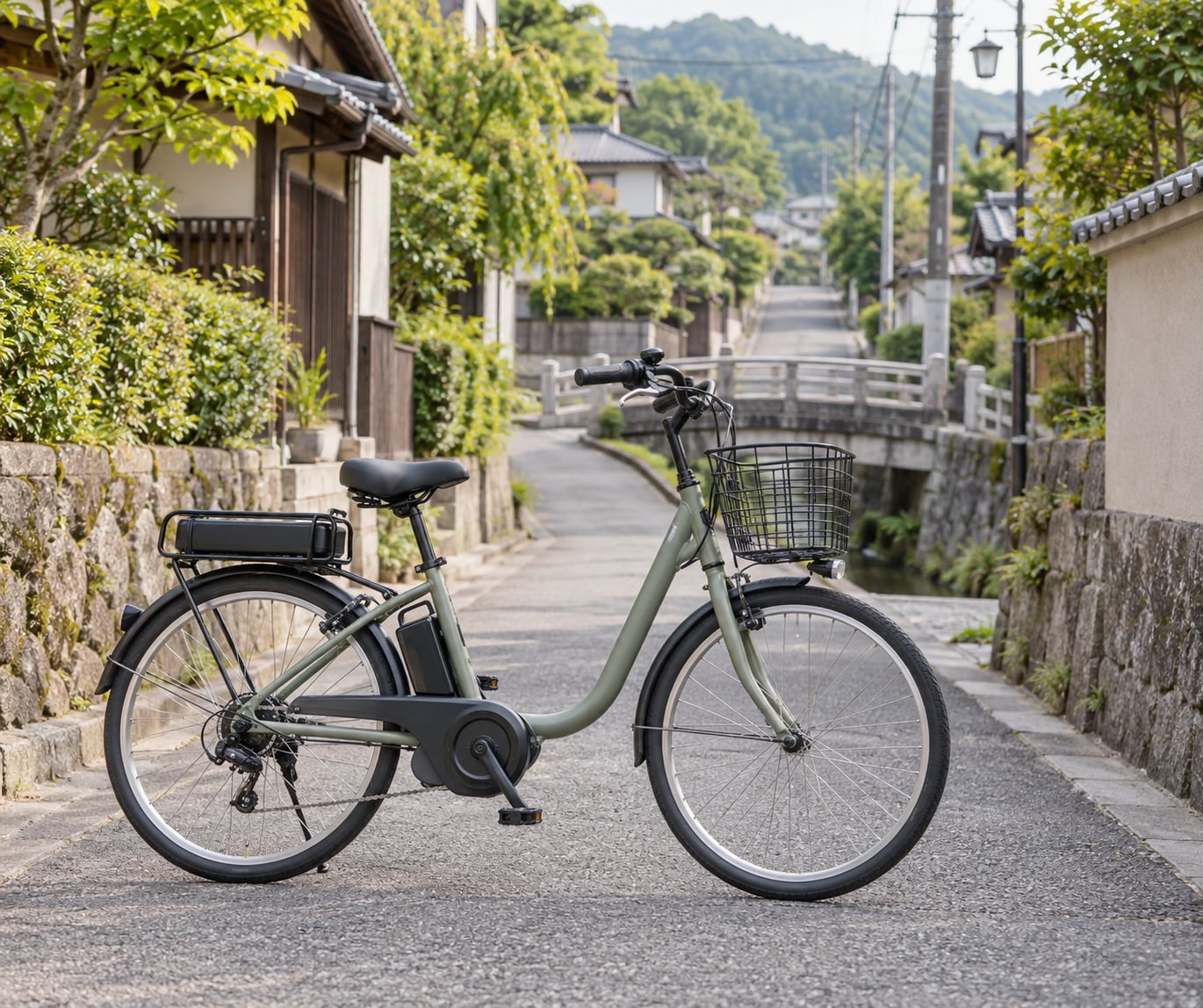
An electrically power-assisted bicycle — in Japanese, denki assisted jitensha — is an ordinary bicycle with a small motor and a rechargeable battery that supplement your pedalling. It is not a moped. The rider stays the source of all motion; the motor simply makes your legs feel stronger on the parts of the ride where you need them.
That is the whole design idea, and it separates a Japanese assist bike from most electric bikes sold in North America. A throttle e-bike can move under its own power at the twist of a wrist. A Japanese assist bicycle cannot. Lift your feet and the motor goes quiet.
Every assist bicycle has a handful of rider-controlled settings, and Japanese law adds hard limits on top of them. Here is what actually governs one.
| Parameter | What it means | Rider control |
|---|---|---|
| Assist level | Low, medium or high support chosen on the handlebar display | Rider sets it |
| Assist ratio | Motor force compared with your own pedalling force, capped by law at roughly 2 to 1 below 10 km/h | Set by the standard, not the rider |
| Assisted speed ceiling | Assistance tapers between about 10 and 24 km/h, then stops at 24 km/h | Fixed |
| Motor output | Rated output up to 250 W on street-legal models | Fixed |
| Walk mode | Very low motor push below walking pace while you stay on the saddle | Rider on or off |
| Battery level and range | Displayed on the console, usually in remaining distance or assist bars | Read only |
The 2-to-1 ratio is the piece people misremember most. It is not a fixed amount of extra force — it is a ceiling. Put 150 watts into the pedals at a crawl and the motor may add up to roughly 300 watts on paper, though manufacturers usually tune their bikes well below that limit for a smoother ride.
Why Do Japanese Bicycles Have Electric Assist?
Five forces pushed Japan toward pedal-assist bicycles, and they arrived in a specific order rather than all at once.
1. Terrain: a country of short, steep slopes
Japan’s urban and residential areas are famously hilly, and the Government of Japan has named slopes as a major barrier to cycling directly. Cities like Kobe, Nagasaki, Sapporo and Yokohama pack dense housing onto hillsides, where a ten-minute errand can mean a 10% grade in both directions.
On a plain bicycle, that turns a shopping trip into a sweaty climb home with shopping bags. With assistance, the climb takes a couple of minutes and the rider arrives able to brake carefully. The motor’s job here is not speed. It is removing the reason people gave up on the bicycle in the first place.
2. The bicycle base Japan already had
Japan built a mass bicycle culture earlier than most countries, and the government’s own history of the PAS notes that the number of bicycles in the country had already climbed past 60 million by the late 1980s. Electric assist was not sold into an empty market; it was added to a market that already moved millions of people a day.
3. An aging population that wanted to keep riding
Development of what became the PAS started during Japan’s high-growth era, and the earliest buyers were older riders. Someone who has stopped cycling because a slope hurts their knees does not start again because a friend bought a faster bicycle. They start again because the bicycle got easier.
4. The 1997 television campaign that sold it to mothers
The turning point was not a gadget launch. The Government of Japan’s account records that demand surged in the late 1990s as TV advertising reached mothers doing the kindergarten drop-off, and the child-carrying mama-chari became the format people recognised. Once a bike carried two children uphill, a shopping basket and a rain cover, it stopped being a sports product and became a household appliance.
5. Batteries got cheap enough to mass-produce
Early PAS bikes were expensive partly because lithium-ion cells were still rare. Through the late 1990s battery performance improved while unit costs fell, and economies of scale turned a niche assist motor into something a family could buy. This is the unglamorous reason PAS spread, and it matters: the same engineering later shipped to Europe as drive units.
How Does the Motor Respond When the Rider Pedals?
The motor works from a reading of what you are doing, not from a button. Most Japanese assist bikes use one of two sensors, sometimes both.
A torque or pedal-force sensor measures how hard you push on the pedals and multiplies that force. A cadence sensor measures how fast the pedals turn. The first gives a ride that feels like your legs got stronger; the second gives a simpler on-off push that many riders find less natural. Several drive units read both, so gentle pressure at a steady cadence feels different from heavy pressure on a downhill.
The assist level on the handlebar sets the ceiling, so level 1 gives a nudge at intersections and level 3 gives you a hill. Below roughly 10 km/h the motor can work at its full permitted ratio. Between about 10 and 24 km/h the assistance tapers so the bike never feels like it is accelerating itself, and above 24 km/h the motor stops providing anything.
So no, the battery does not charge meaningfully from pedalling. It recharges from the wall, and pedalling is the trigger that lets the motor draw on that stored energy.
Why a Hill Bike Became the Default Commuter in Flat Cities
Here is the odd part. Tokyo is flat, and yet the assisted mamachari is the bike you see on almost every residential street in the outer wards. Riders on r/japanlife make the point plainly: the assist earns its keep on steep commutes, and on flat roads a plain cross bike can be quicker.
The explanation is that Japanese households buy one bike that must handle the worst part of the day, not the best part. A shopping run on a flat shopping street is easy on any bicycle. The same trip home, loaded, uphill from the station, is not. Buy for the hill and the flat sections simply come along for the ride.
Assist also matters at walking pace, where a r/japanlife poster reports it has been blown sideways by the wind several times. On a narrow shared path, that is the assistance’s real side effect — strong low-speed push, zero need for speed. Riders new to the format routinely find it startling on the flat.
How Japanese Regulations Shaped Electric-Assist Bicycles
The law is the reason the machine looks the way it does. Under Japan’s bicycle classification, an electrically power-assisted bicycle is treated as an ordinary bicycle as long as it meets the assist conditions — so it needs no licence, no registration plate and no insurance for road use, and it can use the same lanes and paths as any other bike.
The three conditions that matter to a rider are that the motor assists only in response to pedalling, that the assistance ratio stays within the standard, and that it cuts out at 24 km/h. The rated output cap of 250 W is a separate limit riders often merge with the ratio rule in conversation; they are two different numbers solving two different problems.
Two later changes loosened and then tightened the design in ways that shaped the market. A 2008 revision of the assistance-ratio rules gave manufacturers more latitude, which is why the strongest modern PAS bikes feel more capable than early ones. A 2009 bicycle safety standard for two child seats turned the mama-chari from a convenience into a regulated product category.
On the street, the visible proof is paperwork. Look for the TS mark (a diamond-shaped type-approval mark, shikata nintei) and the BAA sticker carrying the assist ratio on the frame or battery. A bike with both is street-legal Japanese spec. A throttle-equipped import without them is not a bicycle under Japanese rules at all.
Standards, enforcement practice and reform proposals shift over time, so check the current position before buying or importing. Also note that traffic penalties for ordinary violations tightened in recent years, and that applies to cyclists on an e-bike exactly as it does to anyone else on a normal bike.
How Electric Assist Differs From Other Motorized Bikes
Most confusion about Japanese e-bikes comes from importing a definition built for another market. Here is how the three categories actually behave.
| Pedal-assist bicycle (Japan) | Throttle e-bike | Conventional bicycle | |
|---|---|---|---|
| What moves the bike | Your pedalling, plus motor support | Motor alone or with pedalling | Your pedalling only |
| Does it move with no pedalling? | No, apart from a low-speed walk mode | Yes | No |
| Assisted speed ceiling | 24 km/h | Varies by class, often 20 to 45 km/h | Whatever the rider can manage |
| Motor output | Rated up to 250 W | Typically 250 to 750 W | None |
| Road class in Japan | Bicycle | May count as a motorized vehicle | Bicycle |
| Licence or registration | None | Depends on specification | None |
| Typical feel | Stronger legs | Motorbike-ish | Bicycle |
Read that table as a single sentence: the 24 km/h cutoff is what keeps the vehicle legally a bicycle. Remove it and the same bike would need registration, a licence and a plate, which would have ended Japanese mass adoption decades ago.
Where an Assist Motor in Japan Matters Most
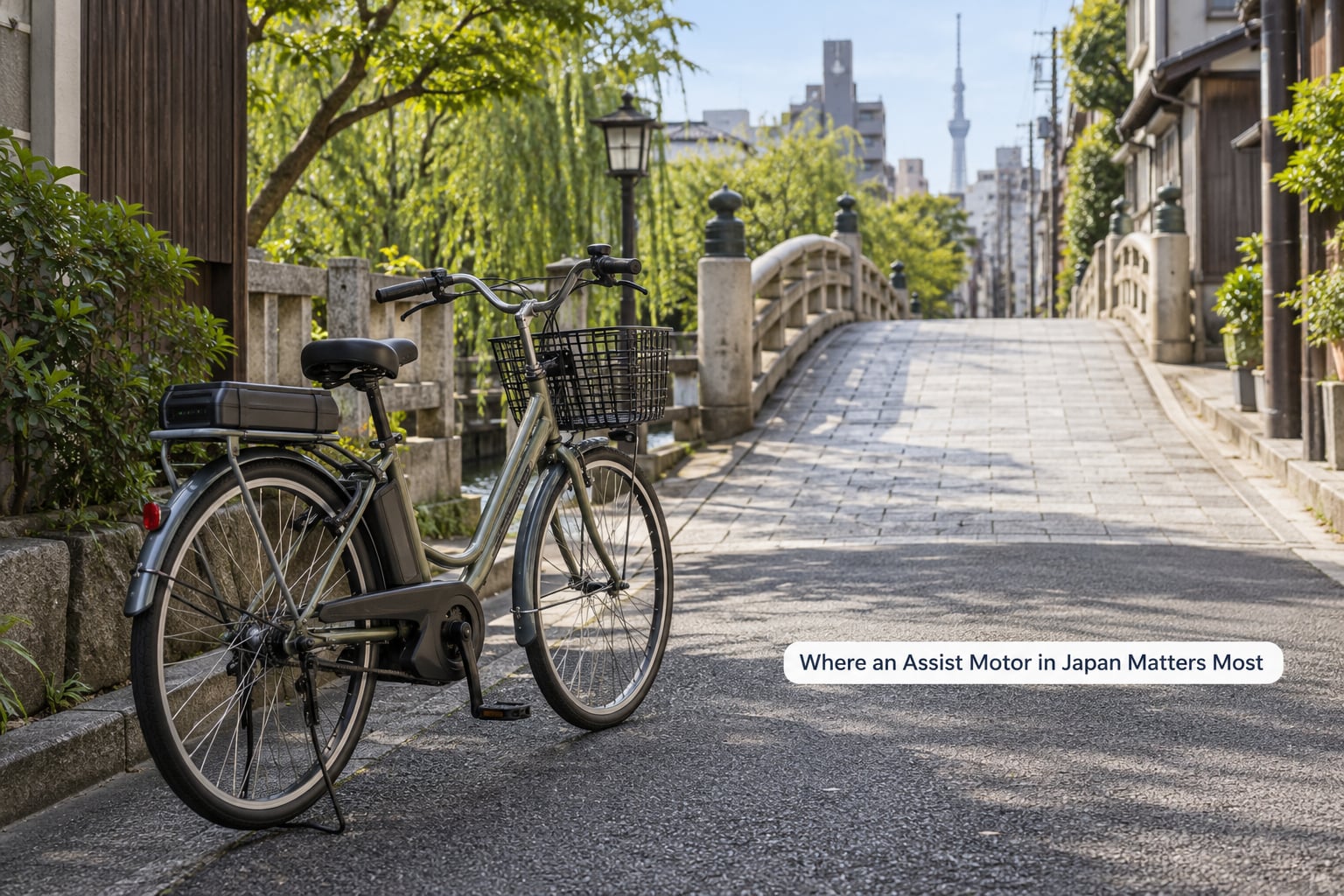
The strongest case is the approach to a bridge or a long slope, where the bike carries weight it would otherwise have to push uphill.
A loaded mama-chari with two children is the clearest example. School runs are short in distance but steep in gradient, and the passenger weight turns a normal hill into a stop-start push. On an assist bike the same run takes under a quarter of the effort, which is exactly why the format became the default family bicycle.
Shopping and delivery routes show the same pattern at a smaller scale. A rider carrying groceries uphill from a station, or a courier repeating the same steep loop all day, uses the assist every single trip. Riders on r/japanlife also note the effect against a headwind, where the motor covers a resistance that pedalling alone cannot.
On narrow streets and shared paths, assist changes handling rather than speed. It makes a bike with a heavy cargo rack or child seat far more manageable at walking pace, though riders new to the format find that strong low-speed push surprising on paths used by pedestrians and other cyclists.
Rail-and-ride is the pattern that shows up repeatedly in planning discussions on bicycles.stackexchange: ride to the station, take the bike on the train, then ride again at the far end. Assistance makes the short first and last kilometres of a long Japanese journey doable, which is far more useful than one long ride that would be slower than the train.
What Are the Advantages and Drawbacks for Daily Riders?
The advantages are real and they show up in ordinary use. Starting from a standstill on a slope is the one riders mention first, because a heavy bike with a passenger otherwise needs a running start. Hills stop being a route-planning problem, shopping bags and children stop being reasons to drive, and riders who have knee or balance trouble keep cycling longer than they otherwise would. On flat ground the motor can simply be switched off and the bike ridden as an ordinary bicycle.
The drawbacks deserve equal airtime. An assist bike weighs considerably more than a plain bicycle once you add the battery, the motor and the reinforced rear rack, and that weight is most obvious when you have to carry the bike up stairs or lift it onto a train. Charging takes hours on a wall unit, and the pack should be kept away from extreme heat and cold.
Battery replacement is the cost most riders underestimate. Packs degrade over years and high motor cycle counts, and a ten-year-old bike may need a new pack or a new controller to be usable again. Wide, motorcycle-width tyres — a detail riders on r/japanlife note with amusement on Tokyo streets — add grip but also rolling resistance and puncture risk.
Speed management is the practical hazard on shared paths, not crashes at speed. The bike tops out near 25 km/h with a rider working, so the danger is arriving at a junction faster than expected.
On brands, Yamaha holds the PAS and e-Kit heritage and builds its own drive units; Panasonic is the other long-standing name, with a strong reputation for efficiency and battery work; Bridgestone covers the mainstream city and family end. Riders argue about all three, and the honest summary is that drive-unit feel matters more than the badge once a bike is more than about five years old.
What Should Riders Check Before Buying or Renting One in Japan?
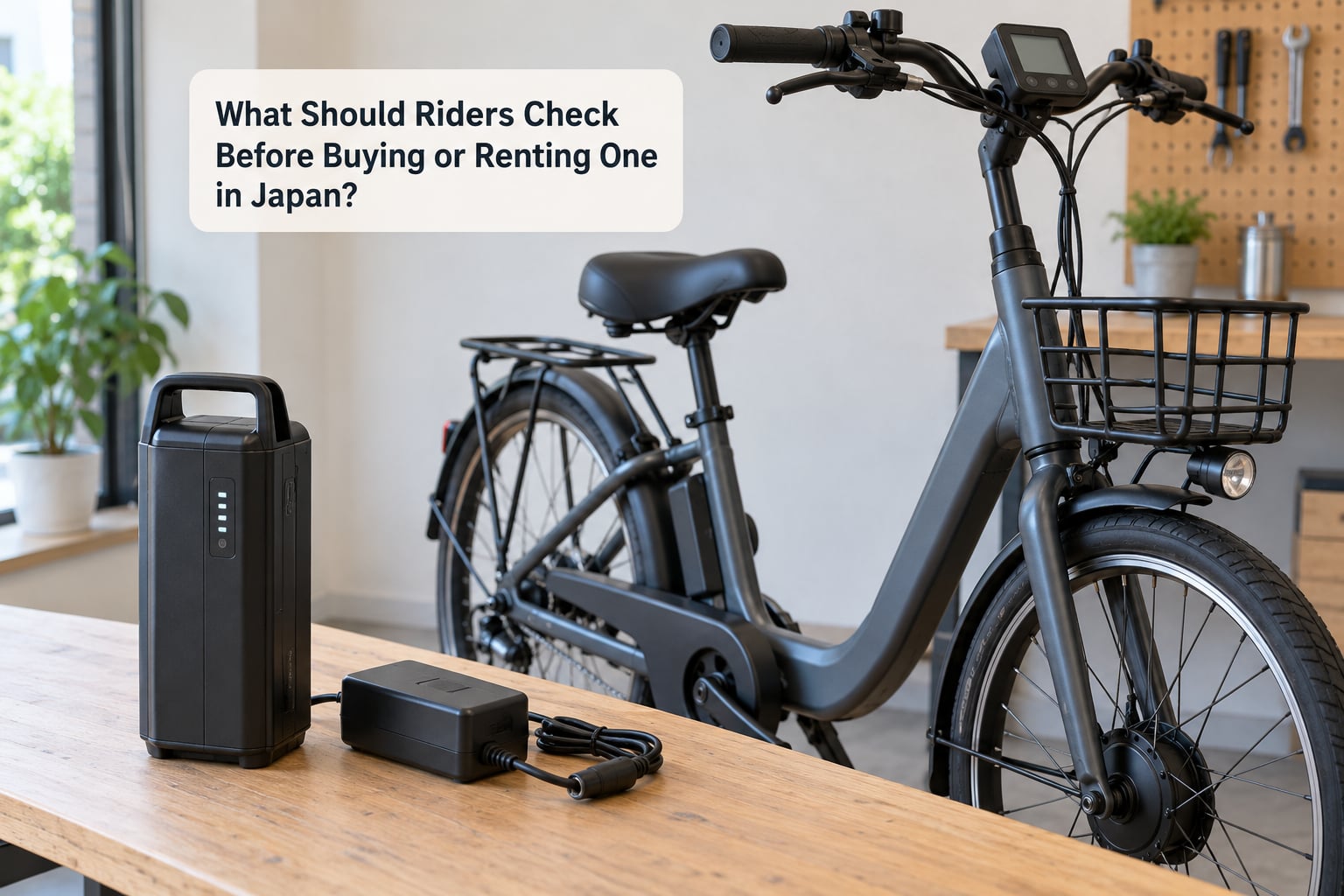
Visitors and buyers should work through a short list before committing.
Check the legal classification first. Confirm the TS mark and BAA sticker are present, and confirm there is no throttle. If you are bringing a bike from overseas, assume a Class 2 or Class 3 throttle e-bike is not street-legal here and plan to rent instead.
Then check the assist behaviour in person. Ride it at walking pace and at a fast flat stretch. If the push at low speed feels aggressive on a shared path, that model suits you badly.
On range, ask for real figures rather than the display’s optimistic estimate. Battery capacity in watt-hours, the rider’s weight and the hills on your actual route matter far more than the advertised distance, and cold winter weather costs range. Note whether the battery removes for charging indoors, because carrying a heavy pack down a stairwell is an unpleasant surprise.
Look at the display and controls. A readable battery gauge, a walk mode and a simple assist selector matter more than app connectivity, and a bike whose owner cannot explain the display is usually a bike with a tired battery.
On a used bike, ask for the motor cycle count, test all three assist levels, check that the battery charges and holds charge, look for rust at the chainstay and wheel rims, and confirm the TS mark is legible. Japanese second-hand e-bikes are a large and mature market, but the pack is usually the part that has done the most work.
Finally, look for local support. Japanese brands keep parts and manuals in Japan, which matters more than connectivity features when something stops behaving.
Frequently Asked Questions
Are electric-assist bicycles in Japan fully automatic?
No. A Japanese assist bicycle has no automatic mode and no throttle. The motor responds only while you pedal, and it switches off completely above 24 km/h. Some models include a low-speed walk mode that pushes the bike while you sit on the saddle at walking pace, but it is deliberately weak. An overseas rider expecting a twist-and-go e-bike will find the Japanese format far more manual.
Do you have to pedal an electric-assist bicycle in Japan?
Yes, pedalling is what triggers the motor. Sensors measure your pedal force and cadence, then the drive unit adds assistance in proportion, up to the legal ratio and only below the speed ceiling. Pedalling does not meaningfully recharge the pack, so a flat battery means riding home like an ordinary bicycle. Two things switch the motor off: lifting your feet, or exceeding 24 km/h.
Why do Japanese e-bikes stop assisting at a relatively low speed?
Because that cutoff is what keeps the bicycle legally a bicycle in Japan. Assistance is at its full permitted ratio below roughly 10 km/h, tapers through the middle range and stops at 24 km/h. Stay above that and the machine is powered by your legs alone. Remove the ceiling and the same bike would fall into the motorized-vehicle class, requiring registration, a licence and a plate, which would have killed mass adoption in the 1990s.
How far can an electric-assist bicycle travel on one charge?
A single charge typically covers a normal urban or suburban riding day, often 30 to 60 km depending on the pack size, your weight, the hills and the assist level you use. Treat any published range figure as a best case. Cold weather, a heavy rider and repeated steep climbs all cut it, and the display estimate is usually optimistic. Ask the seller for the pack capacity in watt-hours and check the charge time on the wall unit.
Can tourists rent an electric-assist bicycle in Japan?
Yes, and it is one of the easiest ways to see Japanese cities beyond the tourist streets. Rentals from major train operators, tourism offices and local shops normally come with the TS mark and BAA sticker, so they are street-legal spec. Book ahead in spring and autumn, when demand is highest. Bring your own overseas e-bike only if you have confirmed it meets Japanese rules, since a throttle-equipped bike may not be legal on public roads here.
Why is a Japanese electric-assist bicycle sometimes heavier than a normal bicycle?
The motor, the battery, the controller and the reinforced rear rack all add weight, and none of them can be removed without losing the assistance. A typical assist bike is noticeably heavier than a comparable city bicycle, and the difference is obvious when you lift it onto a train. Wide tyres, often closer to motorcycle width, add grip but also rolling resistance and puncture risk. Range figures suffer a little for the same reason.
Conclusion
Electric assist in Japan is a pedal-powered solution, not a motorbike in bicycle clothing. Yamaha’s 1993 PAS solved the engineering problem of making motor support feel like stronger legs, and the law solved the legal problem by cutting the motor at 24 km/h and capping it at a 2-to-1 assist ratio, which kept the whole class inside ordinary bicycle rules. Add short steep slopes, an aging population, a family habit of riding to the kindergarten and falling battery costs, and the result is the most ordinary object on Tokyo streets.
Before you choose a model, check two things first. Find out where the assist actually stops and how it feels at walking pace, because that is what you will feel every day. Then get a realistic range figure for your own weight on your own hills rather than the number on the display. Everything else about a Japanese e-bike is a detail on top of those two answers.