If you have ever walked into a 7-Eleven in Tokyo at 11pm with a dead phone, the answer is already obvious. Japanese convenience stores sell small electronics because accessories are cheap to stock, easy to shelf, and needed at the exact moment a store happens to be within walking distance. The why behind it comes down to accessories rather than devices, a price premium people accept for immediacy, and store networks dense enough to make the whole thing work.
Last updated: October 2026. This is a look at the retail logic, not a shopping list.
Table of Contents
- 1Why Japanese Convenience Stores Sell Electronics
- 2What Kinds of Electronics Do Japanese Convenience Stores Sell?
- 3Why konbini sell accessories instead of devices
- 4How Convenience Makes Electronics Easy to Buy
- 5The role of the neighborhood store
- 6What Does This Say About Japan’s Tech Market?
- 7Are These Products Cheaper Than Electronics Stores?
- 8What Should Visitors Look for When Buying Electronics in Japan?
- 9Frequently Asked Questions
- 10Why do convenience stores in Japan sell electronics?
- 11Are electronics from Japanese convenience stores good quality?
- 12Can I use a convenience-store charger or device while traveling in Japan?
- 13Why are Japanese convenience stores selling so many small gadgets?
- 14Can I return electronics bought at a Japanese convenience store?
- 15Is it cheaper to buy electronics at a convenience store in Japan?
- 16Conclusion
Why Japanese Convenience Stores Sell Electronics
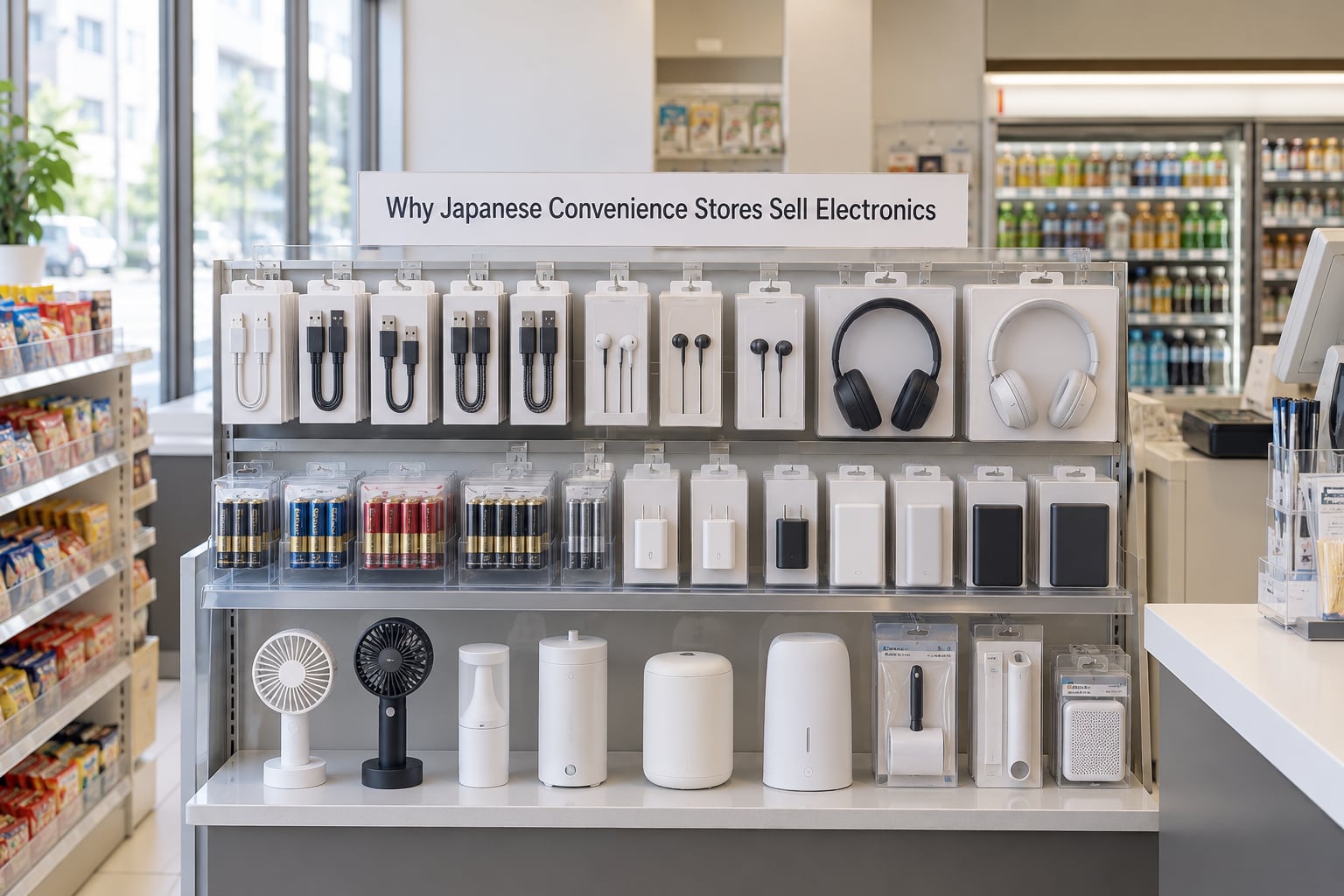
Japanese convenience stores sell electronics accessories as a convenience service, not as a consumer-electronics business. They stock travel adapters, charging cables, earbuds, power banks, batteries, memory cards and phone cases, because those items cost little to hold, never need to be returned, and solve a problem that shows up at the worst possible moment: now.
Six forces put those items on the shelf:
- The need is urgent and unpredictable. Nobody plans to lose a cable. The demand appears without warning, usually hours away from an electronics district.
- The store is already on the route. You are buying coffee, an onigiri or a bento at 7am, not shopping for gadgets.
- Low absolute cost, healthy markup. A cable is a small number of yen to buy and can be priced well above what you would pay at a specialist shop.
- No returns and no restocking. Once you buy a sealed cable, it stays sold. There is no return queue eating staff minutes.
- Point-of-sale data makes a long tail affordable. Chains run on real-time sales data from thousands of stores, so a thin line of oddly specific SKUs can still be ordered in the right quantities for the right neighbourhood.
- Inbound visitors add a second demand curve. Travellers need plug adapters and spare cables in a country whose outlets and plugs are unlike most of the ones they know.
Put those together and the picture is clear. Japanese convenience stores, called konbini, are not trying to beat Akihabara or Bic Camera. They are monetising the gap between when a need appears and when the customer would next pass a store that can solve it.
There is a useful piece of retail vocabulary here. An attach rate is how often an extra item gets added to a basket that was already happening. Konbini electronics are close to pure attach-rate products: the coffee was the sale, the cable was the bonus. That is a completely different job from selling a television, and it explains why you will never find a laptop in one.
What Kinds of Electronics Do Japanese Convenience Stores Sell?
Why konbini sell accessories instead of devices
The boundary is deliberate. Devices are expensive, need demonstration space, carry warranty and return obligations, and lose value fast on a shelf. Accessories are none of those things. A travel adapter either fits or it does not, it weighs almost nothing, and it can sit in a shallow drawer for months and still sell.
Everyday essentials are the core of the range:
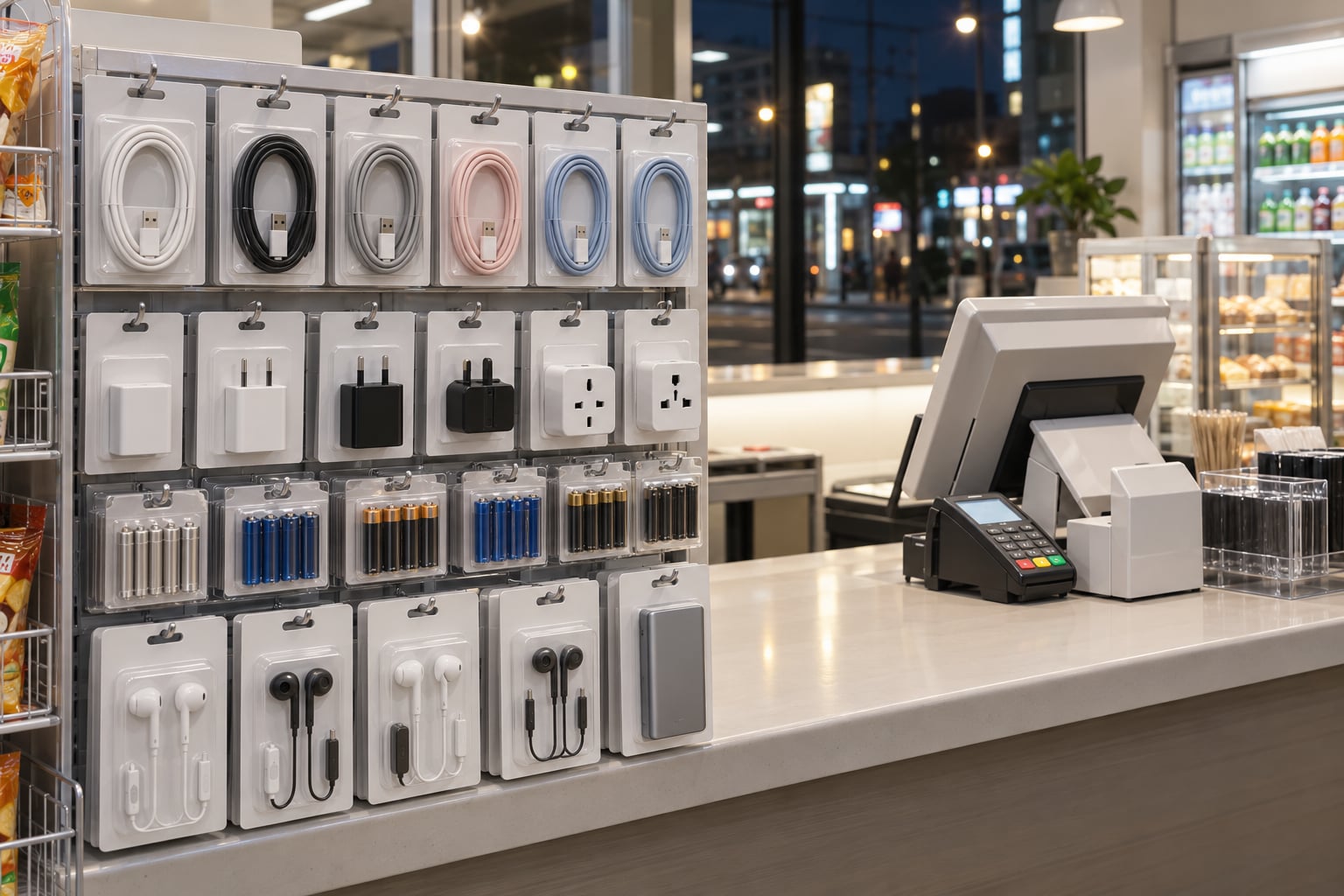
- Travel plug adapters for several regional plug types, sometimes sold in a multi-country pack.
- Charging cables in USB-C, Lightning and older multi-head formats, sometimes bundled with a wall plug.
- Earbuds and earphones at the budget end, aimed at a forgotten pair or a lost set rather than sound quality.
- Power banks and portable batteries, in sizes that fit a coat pocket.
- AA, AAA and coin-cell batteries sold in blister packs of two or four.
- Memory cards and small adapters for cameras and older devices.
- Phone cases and screen protectors, often stocked to match the models popular locally.
- Compact household devices such as small kitchen gadgets, personal-care items and health-oriented products like thermometers and masks.
Some stores go a step further and carry prepaid SIM cards, small cameras, or selected phones, but that is the exception rather than the rule, and it varies a lot by chain and by location. Major station-based or high-traffic stores are the likeliest places to find anything beyond accessories.
Equally useful is what konbini do not sell. No laptops, no televisions, no large appliances, and generally no full-service electronics counter with staff who can set things up or process a warranty claim. If a forum post tells you a konbini can replace your laptop, it is wrong.
Here is how the category behaves economically:
| Item | Cost profile | Role in the basket | Why it fits the model |
|---|---|---|---|
| Travel plug adapter | Low absolute cost | Emergency purchase | Sealed, never returned, travel-season demand |
| Charging cable | Low, high percentage markup | Impulse add-on at the register | Adds seconds to the transaction |
| Earbuds | Mid, high percentage markup | Small planned or panic buy | One size, no fitting needed |
| Power bank | Mid to high relative to others | Trip purchase before a long journey | Bulky but sells fast near stations |
| AA and AAA batteries | Very low | Repeat consumable | Constant turnover, no shrinkage risk |
| Memory card | Low | Camera trip or device replacement | Few SKUs cover most demand |
| Phone case and screen film | Low to mid | Register add-on | Model-specific rotation driven by sales data |
The pattern in that table matters more than any individual row. These are items a store can order by the case, display flat, and sell without a conversation.
How Convenience Makes Electronics Easy to Buy
Long hours and tight location density do most of the work. When a chain runs stores close enough together that you are rarely more than a few minutes from one, an item becomes available on demand rather than on a shopping trip. At 23:40, or during a rainstorm, or on a Sunday in a town with no electronics shop open, that availability is the product.
Walk-in shopping helps too. There is nothing to research and no delivery window. You see the shelf, you take the item, you pay. For a product that costs roughly the amount of a convenience-store meal, hesitation is the only real obstacle, and seeing the actual cable in your hand removes most of it.
The role of the neighborhood store
Chains in Japan build area-dominant networks: many stores clustered tightly in one district rather than spread thinly across a region. Each store then serves a small, well-defined catchment, which is why sales data from that cluster is so useful. If a particular model of case moves fast in three neighbouring stores, ordering more for the fourth is a low-risk bet.
Store managers also order from handheld terminals against live sales rather than a fixed seasonal catalogue. Chains talk about introducing close to a hundred new items a week somewhere in the network, and only a fraction of that would fit in a small format. The accessory aisle is where the churn is easiest to absorb, because the shelf space is tiny.
Payments matter here more than people expect. A foreign visitor who can tap an IC card, pay by phone, or hand over a card without explaining anything is far more likely to make an unplanned accessory purchase at the register than one who has to work out a purchase with a visitor-facing terminal.
What Does This Say About Japan’s Tech Market?
It says the accessory is treated as an infrastructure purchase rather than a considered one. In Japan, charging a phone or powering a small device is ordinary enough that solving it mid-errand feels normal, the way topping up a travel card does. The same need in a country with fewer late-opening shops turns into a planned purchase or an online order with a delivery wait.
Cashless payment is the second signal. Cards, IC cards and phone-based wallets settle a small basket in seconds, which removes the friction that would make a low-value item unprofitable to handle. A store that could not take an instant payment would struggle to justify selling something worth a couple of dollars of margin.
Compact urban living shapes the rest. Small homes have less storage, so bulky accessories are less attractive, while small essentials that solve a problem immediately fit the lifestyle. Domestic brands also do well here because the shelves are stocked for what nearby neighbourhoods actually buy, and domestically made accessories are simple to replenish quickly through the same distribution system as everything else in the store.
Fast turnover is the last piece. Accessory lines change constantly, and a shelf that refreshes gives regular customers a reason to look again on every visit.
Are These Products Cheaper Than Electronics Stores?
Usually not. You pay a premium at a konbini, and that premium is the point. The store is selling immediacy, and immediacy has a price, much like buying anything else out of hours.
Specialist electronics retailers win on four things. They carry far more choice in any one category, including models that would never earn a shelf in a convenience store. They price against each other rather than against the price of a coffee. Their staff can advise on compatibility. And their warranties and returns are handled by people who do that all day.
Online marketplaces win on price and range again, and on the ability to read reviews before committing. The trade-off there is delivery time and the inability to handle a faulty item face to face.
Konbini win on exactly one dimension: you can have it in the next two minutes, on a street you are already walking down, at an hour when nothing else is open. When you are replacing a cable that died ten minutes before a long train ride, that dimension is worth more than the difference in price. When you are planning a purchase, it is worth very little.
There is a broader ecosystem worth knowing about if you are buying real electronics in Japan. Large electronics retailers run point programmes, and points earned elsewhere are commonly redeemable against electronics purchases, which changes the effective price for anyone who shops there regularly. Department stores and specialist districts also offer tax-free handling for eligible visitors. A konbini cable plays no part in any of that, and it is not trying to.
What Should Visitors Look for When Buying Electronics in Japan?
If you are buying something small at a konbini, a few checks take ten seconds and prevent most problems.
- Plug type and voltage. Japan uses two flat-pin plug shapes and 100 volts at 50 or 60 hertz depending on region. Check the label before you buy anything that heats, cools or spins.
- Interface, not brand. A cheap USB-C cable from a konbini will charge a phone. It may charge slowly, and it may not carry data at full speed. If the cable is also the connection for a laptop, buy from a specialist.
- Language. Packaging and instructions are usually Japanese only. Instructions with pictograms work fine; anything requiring fine print deserves caution.
- Warranty. A consumer accessory from a konbini is typically sold as-is, with the store’s own return policy covering a short window. A specialist retailer gives you a manufacturer warranty you can act on later.
- Receipts. Keep the receipt, especially if you are a visitor and may need proof of purchase when leaving the country.
- Payment. Major chains accept foreign cards and cash, and many accept IC cards and phone-based payments. Smaller stores vary more.
- Intended market. Domestic-market products are designed for Japanese conditions and may not carry foreign safety or radio certifications. That matters for anything plugged in at home, and for any device with a radio.
A simple rule covers most cases. If it is an accessory replacing something that just broke, the konbini is a reasonable answer. If it is a planned purchase, a device, or anything you will plug into a different country’s mains, go to a specialist retailer.
Frequently Asked Questions
Why do convenience stores in Japan sell electronics?
Because accessories solve urgent needs at a moment when the shop is already close by. Konbini stock travel adapters, cables, earbuds, power banks and batteries because they are cheap to hold, never need returning, and can be sold during a purchase that was already happening. The chains do not compete with electronics retailers on price or range. They sell immediacy, which is why the markup is high and why the range stops well short of actual devices.
Are electronics from Japanese convenience stores good quality?
They are ordinary commercial products, not premium ones. A convenience-store cable will charge a phone and will rarely do much more. Buyers treat these items as emergency replacements, not long-term upgrades, and that expectation matters. If you want reliable fast charging, wide compatibility or a manufacturer warranty, buy from a specialist electronics retailer instead. Konbini ranges are fine for getting through the day and poor for building a kit.
Can I use a convenience-store charger or device while traveling in Japan?
Yes, for adapters and cables, since those are built for exactly that situation. Buy the plug adapter that matches the country you are heading to, and check that any mains-powered device is rated for 100 volts and the correct plug shape before you plug it in. Devices intended for the domestic market may not carry foreign safety or radio approvals, which is worth checking for anything you will use regularly once you get home.
Why are Japanese convenience stores selling so many small gadgets?
Small gadgets are the cheapest way to grow a basket that already exists. Because chains run on real-time point-of-sale data from dense clusters of stores, they can order a long tail of low-cost items in small quantities and match them to what a neighbourhood actually buys. The range keeps rotating, which also gives regular customers a reason to keep looking at the shelves. Item turnover is a deliberate part of the model, not clutter.
Can I return electronics bought at a Japanese convenience store?
Sometimes, and it depends entirely on the chain and the item. Faulty sealed accessories are often accepted or exchanged under the store’s own policy within a short window, and receipts make the process far faster. Manufacturer warranties are a separate matter and generally require going through the manufacturer or a specialist retailer. There is no equivalent of the extended in-store support you would get at a large electronics retailer, so keep the receipt and ask at the counter before you leave.
Is it cheaper to buy electronics at a convenience store in Japan?
No. Konbini prices carry a deliberate premium for location and 24-hour access. Specialist electronics retailers price against each other and carry much more choice, and they can offer manufacturer warranties and proper returns. Online marketplaces are usually the cheapest option of the three. The convenience-store price only makes sense when you need something immediately, in the next few minutes, and nothing else is open. For planned purchases, compare the specialists first.
Conclusion
Japanese convenience stores sell electronics accessories because a small, sealed, high-markup item is the easiest way to solve a problem that appears without warning, on a street you are already walking down, at an hour nothing else is open. The first move is simple: go to the konbini on your route when something has just broken, and treat what you buy there as the fix. For anything planned, a device, or anything with a warranty attached, compare specialist electronics retailers and online listings first, where the selection and the prices are on your side.