Gacha games make money the same way most free mobile games do: by selling randomised draws and convenience inside a game that costs nothing to download. Players buy a premium currency, spend it on pulls from a character banner, and often pay again when the odds do not deliver. On top of that sit subscription passes, battle passes, cosmetics and, in some cases, real-world merchandise. The rest of this guide breaks down each revenue stream, the psychology behind it, and the rules that govern it.
Table of Contents
- 1How Gacha Games Make Money
- 2The core mechanics behind gacha revenue
- 3What a pity system is really for
- 4The main gacha revenue models
- 5Case study: Genshin Impact
- 6Why players spend money on gacha
- 7How developers calculate and improve revenue
- 8The difference between gacha revenue and other game revenue
- 9Costs, risks, and regulation
- 10The regulatory timeline
- 11Frequently Asked Questions
- 12Are gacha games gambling?
- 13How do pity systems work in gacha games?
- 14Can you finish a gacha game without spending money?
- 15Why do gacha games use limited-time characters and items?
- 16How can players avoid overspending on gacha games?
- 17Do gacha games make more money from whales or from many small spenders?
- 18Start with the monetization loop
How Gacha Games Make Money
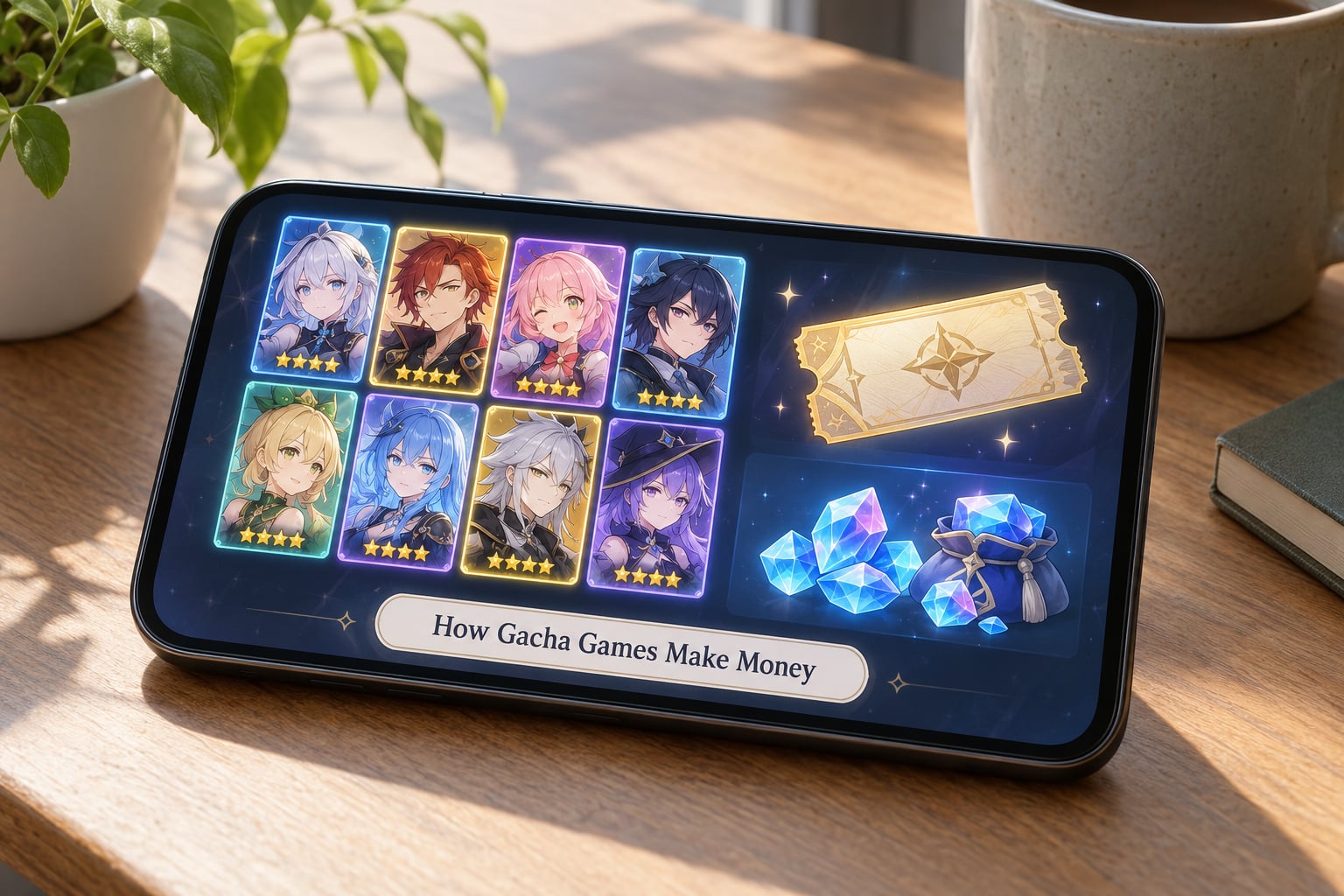
Short version: in-app purchases on randomised character and item draws, layered with recurring passes and cosmetics. A small share of players supplies most of the cash.
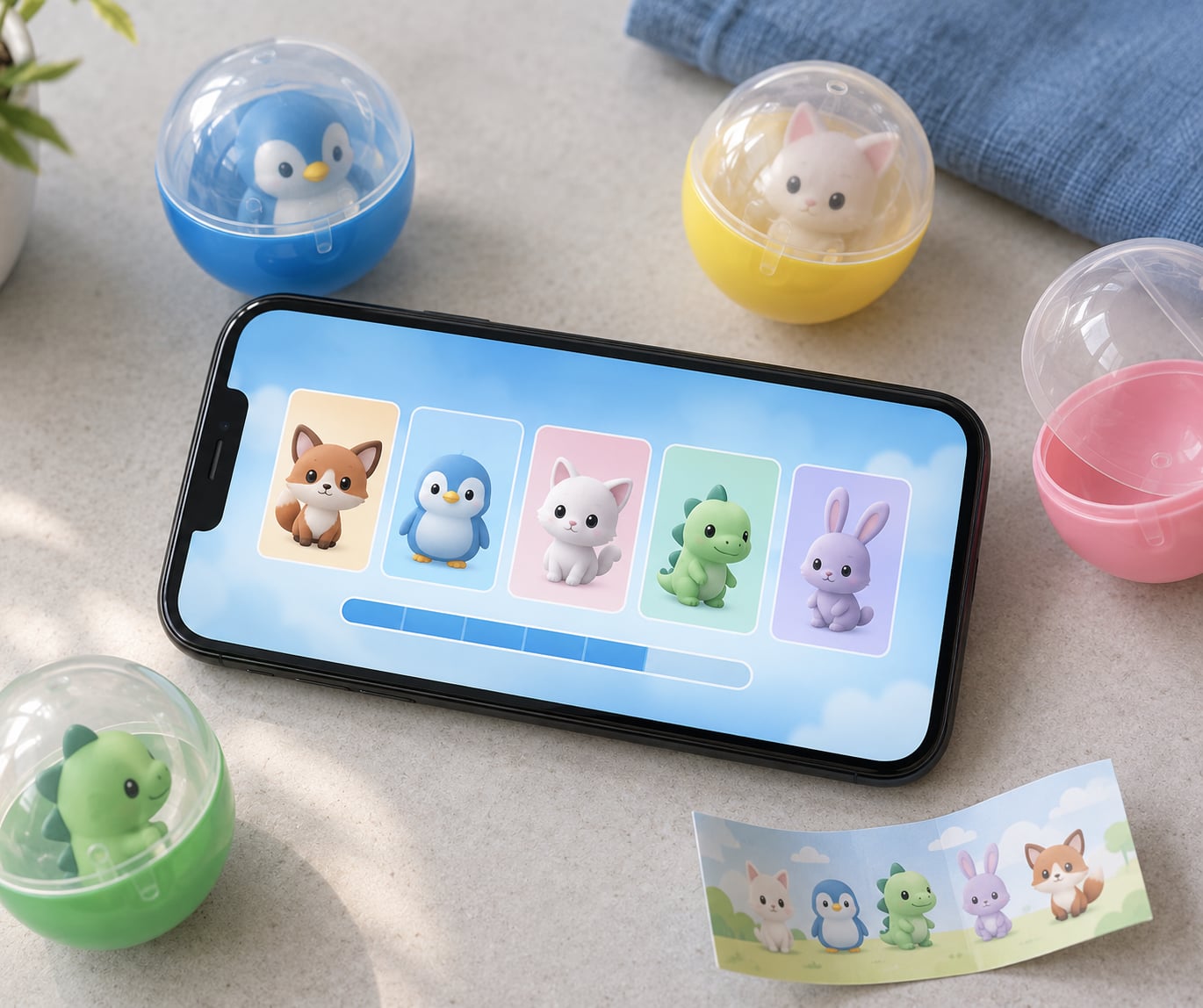
The word comes from gachapon, the Japanese capsule-toy vending machine that dispenses a random figure for a fixed coin. Konami turned that toy-machine idea into a full game with Dragon Collection, which reached roughly six million players by 2012 and helped lift the company’s year-on-year net profit by close to 80%. Mobile games later moved the same mechanic from physical capsules to a screen.
Two terms get tangled constantly. Gross bookings is the money players actually pay in. Revenue is what remains after the app store takes its cut, taxes and payment fees. Profit is what survives salaries, art, voice acting, servers and marketing. A studio can report enormous bookings and still be working hard for each unit of currency.
The structural point that surprises newcomers: gacha monetises repetition rather than a single purchase. Cosmetics are bought once, but a live-service character roster creates a fresh reason to open the shop every three to four weeks.
The core mechanics behind gacha revenue
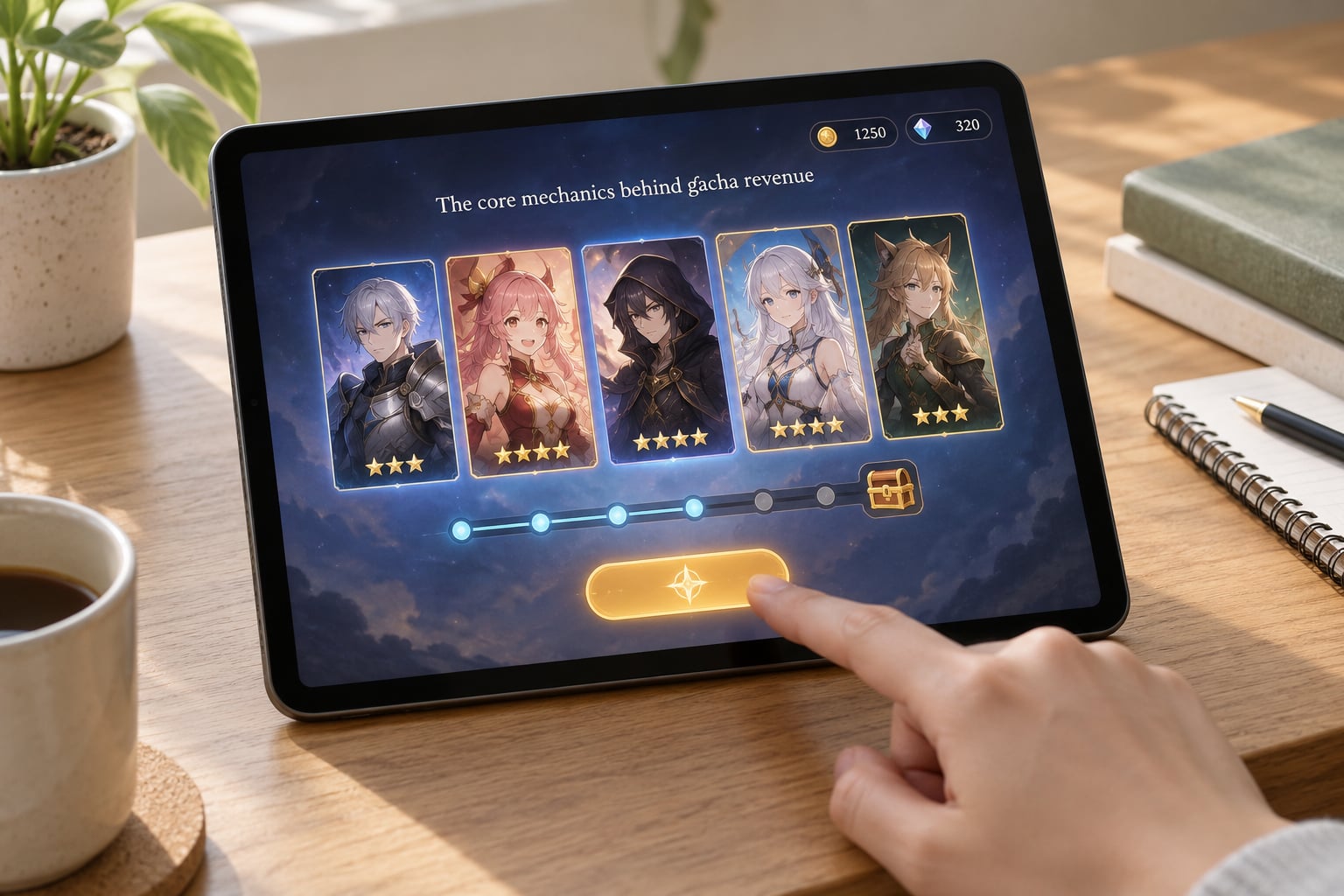
Every gacha title has its own twist, but the revenue-bearing parts come from a short list of repeating systems.
- Premium currency conversion. Real money buys crystals or coins, and those buy the ticket that opens a single pull. Layering one currency on another hides the cash cost of one draw from the player, which makes small top-ups feel smaller than they are.
- Limited-time banners. A character is usually offered on one banner for a fixed window. Miss it and the next window may be months away, or the character may never return in that form.
- Pity and guarantee systems. A counter tracks pulls without a top-tier drop and eventually forces one. This caps the theoretical worst case and, commercially, sets a target the player is inclined to finish.
- Stamina and speed-ups. Energy limits cap daily play, and players buy items that remove the cap. The purchase buys time rather than power, which keeps it out of most pay-to-win arguments.
- Battle passes and subscription passes. A season pass rewards steady daily logins with a flat fee. A monthly pass sells a steady drip of premium currency. Both convert irregular enthusiasm into predictable recurring revenue.
- Cosmetics and merchandise. Outfits, house decorations, and physical goods such as plushies and blind-box figures extend the same characters beyond the app.
Not every game uses all six. Some treat cosmetics as the main revenue line and keep rates generous. The mechanism is a design choice, not a rule.
What a pity system is really for
The pity system does two contradictory jobs at once. It promises fairness by guaranteeing a rare drop within a fixed number of pulls, and it creates a spending target that feels unfinished until crossed. Soft pity, where the drop rate quietly rises as the counter climbs, makes the last few pulls in a sequence feel unusually lucky. Hard pity, the hard ceiling where a rare item is guaranteed, gives the player a number to plan around.
Players have noticed the pull from both sides. In the larger gacha communities the standard piece of advice is that pity exists precisely so you will top up to finish the counter rather than walk away from it at seventy pulls.
The main gacha revenue models
Most publishers run three or four of these at once. The mix shifts as a title ages: early months lean on banner sales, later months lean on passes and cosmetics.
| Revenue model | How it works | Why players pay | Primary role |
|---|---|---|---|
| Character banner pulls | Premium currency buys randomised draws from a rotating set | Access to a specific character and its power spike | Largest single line in most gacha titles |
| Monthly subscription pass | Flat daily fee delivering a fixed amount of premium currency | Steady supply without topping up each banner | Predictable recurring revenue |
| Battle pass | Season-long track of tiers unlocked by playing | Discounted cosmetics and materials for daily logins | Retention tool that also lifts pass ownership |
| Stamina and speed-ups | Energy caps daily attempts; items lift the cap | More play time for players with busy schedules | Sell time, not power |
| Cosmetics and collection completion | Outfits, effects, decorations sold directly or via pulls | Appearance and completion of a set | High margin, low complaint rate |
| Rewarded and interstitial ads | Ads offered for a free reward or between sessions | Free currency without a purchase | Secondary, common in the West, rare in Japan |
| Licensing and platform fees | Adaptations, crossovers and storefront terms | Not a player payment | Publisher-side economics |
Case study: Genshin Impact
Genshin Impact, published by miHoYo, now HoYoverse, is the clearest worked example of gacha monetization at scale. It passed five billion dollars in global consumer spending faster than any other mobile game, a figure confirmed by third-party trackers such as Sensor Tower rather than by the company. Its structure follows the pattern above closely: a beginner banner, a rotating limited banner, a standard pool, a soft pity ramp, and a hard pity ceiling commonly reached at ninety pulls.
The currency layering is the part players argue about most. Real money buys Genesis Crystals, which convert into a different premium currency, which buys a wish ticket for one pull. By the time a draw is priced, the player has moved through three conversions and rarely converts it back into real money in their head.
Effort spent is shared socially. Pull results get posted, streamed and discussed, so a large sample of players watches the same banner cycle, which speeds up the decision to spend on the next one.
Why players spend money on gacha
Convenience explains a purchase. It does not explain repeated purchases across three years, so the design targets something else.
- Variable reward scheduling. The outcome of each pull is uncertain, and uncertainty is more attention-grabbing than a fixed reward. A predictable bonus is checked once; a variable one is checked again.
- Scarcity and a countdown. A banner that closes on a specific date turns a preference into a deadline, and deadlines compress deliberation.
- Loss aversion and sunk cost. Ninety pulls with no rare drop feels worse than ninety pulls with nothing at stake. Past spending adds pressure to protect the value already paid for.
- Character attachment. Players form real attachments to illustrated characters. A favourite character with a hard pity counter nearby is a difficult situation to budget around.
- Social proof. Community spending totals are public, so whales set a visible norm that newcomers misread as typical.
The critics have a sharper version of this argument than the design side usually admits. The pull itself may not be the real problem: many monetised systems sell faster progress through a resource grind rather than luck. If progression gates are tuned so slowly that only spending feels efficient, the grind is doing the monetising and the gacha is the visible layer.
Free-to-play titles often lean on a give-and-take bargain instead. Most players expect to be rewarded for logging in daily, and publishers satisfy that expectation with small free drops rather than cash payments.
How developers calculate and improve revenue
Drop rates, pity thresholds and banner schedules are not improvised. They are tuned against lifetime projections before a banner goes live.
A studio sets a target for a banner, then models the expected number of pulls per payer, the rate at which free currency is earned in game, and where the pity counter tends to stop. If the free currency supply covers a pity cycle for most players, the banner earns from dedicated spenders only. If it falls short, more players top up near the ceiling. That gap is a deliberate number.
Behind those decisions sit the metrics teams read every week.
- Retention measures whether players return on day one, day seven and day thirty.
- Payer conversion measures what share of players ever complete a purchase.
- ARPU is average revenue per user across everyone who installed.
- ARPPU is average revenue per paying user, which reveals how far the top of the distribution has stretched.
- Cohort analysis groups players by the week they arrived, since a launch cohort that keeps spending for months is worth more than a re-install spike.
Because a small group supplies most of the cash, publishers study that group’s behaviour closely, and player forums show the effect from both directions: some players audit their totals and cut spending once a title starts handing out good characters for free, while others report doing the opposite.
The spending split below uses labels the community invented rather than any published threshold.
| Spending tier | Typical monthly spend | Share of players | Share of revenue |
|---|---|---|---|
| Minnow | Nothing, or an occasional starter bundle | The large majority of installs | A modest but non-zero slice |
| Dolphin | Monthly pass plus small top-ups | A small minority | A meaningful share of the total |
| Whale | Thousands per month during banner cycles | Roughly 1-2% of players | Roughly 50-70% of revenue |
Those figures are widely cited industry estimates, not audited disclosures, and they describe shape rather than exact values. Case reports show how far the top of the distribution goes: a Wall Street Journal profile followed a Fate/Grand Order player who reported spending about seventy thousand dollars, and a Singapore case covered a minor charged roughly twenty thousand Singapore dollars on a parent’s card.
The difference between gacha revenue and other game revenue
Gacha is not the only way to monetise a game, and the differences matter for how a player experiences spending.
| Model | Randomness | Typical spend pattern | Who pays | Regulatory exposure |
|---|---|---|---|---|
| Gacha | Central, character-focused | Large and lumpy, tied to banners | A small high-spending group | High, treated as gambling in some jurisdictions |
| Loot box | Incidental, embedded in play | Small and frequent | The whole player base | High in Belgium, the Netherlands and parts of Australia |
| Battle pass | None | Flat seasonal fee | Committed regular players | Low |
| Conventional store | None | Deliberate, planned | Every buyer | Low |
| Premium purchase | None | One payment up front | Every buyer, before playing | None |
| Advertising | None | Attention instead of money | Non-payers, indirectly | Consent rules |
An upfront purchase is the cleanest exchange: you pay once, you own the thing. Gacha inverts that. The purchase is repeated, the price of the outcome is unknown until the draw happens, and the buyer commits again while an unfinished counter sits on screen.
Costs, risks, and regulation
Bookings are not profit. A gacha budget is heavy in places that surprise people, starting with character illustration and animation, then voice acting and localised writing for each market. Servers and live operations run continuously. Marketing can run at or above development cost for a title chasing a top slot. The app store and payment processor take their cut before anyone else is paid.
Several costs sit outside the studio entirely. Blind-box merchandise carries its own manufacturing and retail margin. Crossovers with other franchises divide licensing income. Physical goods need warehouses and shipping, which is a different business from an app.
The regulatory timeline
- 2012: Japan’s Consumer Affairs Agency restricted so-called kompu gacha, where completing a second purchase made a rare character guaranteed, on the grounds that it functioned as a prize contest.
- 2016: Japanese rules required probability disclosure for all gacha items and set rules on sales targeting minors.
- 2018: Belgium’s gaming regulator ruled that loot boxes constitute gambling, and the Netherlands followed with a similar ruling.
- 2019 onward: China introduced approval rules, playtime caps and spending limits for minors, and tightened restrictions further in subsequent years.
- Present day: Probability disclosure is standard practice in Japan and South Korea and increasingly expected in Europe and North America, while the legal classification of character-based gacha varies by country.
The honest answer to whether gacha is gambling is that it depends on which regulator you ask. The mechanic has the defining features of a chance-based game of skill, which is how legal scholars and academics have classified it. Randomness of outcome, real money, and near-miss effects resembling losses all appear. What usually keeps it outside gambling law is that the prize has no cash-out value: the character exists only inside the game.
That distinction is thinner than it sounds once a character is treated as something a player owns and has attached real value to, which is why the legal debate continues rather than settling.
Spending harm is documented in the research literature as a genuine problem rather than a moral failing by players. Studies in information and behavioural journals have found links between problem gacha spending and higher rates of problem gambling and financial strain elsewhere. Reported risk factors include impulsivity, chasing losses after a bad run, and spending that crowds out other needs.
Frequently Asked Questions
Are gacha games gambling?
It depends on the regulator. Gacha has the core features of gambling: money is staked, outcomes are random, and near-misses trigger loss feelings. What keeps it outside gambling law in many countries is that prizes cannot be cashed out and have no value outside the game. Belgium and the Netherlands have treated loot boxes as gambling, so the answer is jurisdiction-dependent rather than settled.
How do pity systems work in gacha games?
A pity counter records pulls since your last top-tier drop. Soft pity quietly raises the drop rate as the counter climbs, and hard pity guarantees a rare item within a fixed number of pulls, commonly ninety. The system caps your worst case, but it also creates a visible target. Stopping just short of the guarantee feels wasteful, which is why many players top up.
Can you finish a gacha game without spending money?
Yes, though it takes far longer. Story content, standard characters and most events are reachable through free currency earned by playing and daily login rewards. The wall appears at hard endgame content, competitive ranking and collection completion, where free currency income no longer covers the pity cycle in a reasonable timeframe. Cosmetic-only spending is the most common compromise among low spenders.
Why do gacha games use limited-time characters and items?
Scarcity creates a deadline, and a deadline removes the chance to deliberate. If a banner runs for two weeks, a player who wants the character must decide inside that window, often mid-banner rather than after saving. Returning the character later at a higher rate dilutes the pressure, so publishers keep demand high by keeping the window short.
How can players avoid overspending on gacha games?
Set a monthly ceiling in a payment app or platform settings and remove saved payment details from the store account. Pause before any pity counter reaches its final pulls, because that is where top-ups cluster. Track your total over time rather than per session, use your free currency down to zero before buying more, and hide the shop if your client allows it. If spending affects rent, food or debt, treat that as a problem worth raising with someone you trust.
Do gacha games make more money from whales or from many small spenders?
From whales, by a wide margin. Industry estimates put whales at roughly 1-2% of players while accounting for 50-70% of gacha revenue. Small spenders still matter because subscription and battle pass buyers supply steady recurring income that smooths the monthly numbers, and a broad base of modest spenders makes a title look healthy to advertisers and investors.
Start with the monetization loop
The whole model runs on a loop: a new character or banner appears, a countdown starts, players draw on free currency until it runs out, some top up near the pity ceiling, and the next banner arrives weeks later. Everything else, passes, cosmetics, merchandise and ads, feeds the same loop or extends it into a physical product. That loop is why how gacha games make money is less about one purchase than about a schedule of small deadlines.
Before you spend on any of it, check four things. Read the published drop rates and find out whether a pity guarantee exists and where its ceiling sits. Work out the real cash cost of one pull by tracing the currency chain back to the purchase screen. Note the banner’s closing date, then decide what you can afford regardless of what happens on the final day. And set the limit somewhere outside the game, because most clients make it easy to spend and awkward to see the total.
A market data survey from GameRefinery, dated 2022, found a gacha shop in about 66% of the top-grossing 100 US mobile games and about 92% of their Japanese counterparts. That spread is the clearest summary of the answer: this is now the standard business model for the genre rather than an outlier tactic, and the debate worth having is about transparency, spending safeguards and disclosure rather than about whether the model exists.