
If you sell software into Japan, the deal rarely dies from a bad demo. It dies from a wrong assumption about silence. Japanese enterprise software buying works through internal alignment long before a purchase order exists: one person builds support conversation by conversation, a written proposal circulates for sign-off, and only then does a budgeted decision get made. Vendors who read the quiet middle as lost interest tend to damage the one person who could have carried the deal.
This guide walks through that process stage by stage, the departments involved, what a vendor should have ready at each point, and where global teams most often misread the room. It also covers ringi (稟議), the approval practice that trips up most first-time entrants.
Table of Contents
- 1How Japanese Enterprise Software Buying Works at a Glance
- 2Who Takes Part in an Enterprise Software Purchase?
- 3How Japanese enterprise software buying works across departments
- 4How Do Japanese Companies Define Software Requirements?
- 5How Do Buyers Evaluate and Shortlist Vendors?
- 6Why Does the Pilot Stage Matter?
- 7How Does Internal Consensus Affect the Decision?
- 8What Happens During Negotiation and Approval?
- 9How Is the Software Implemented and Reviewed?
- 10How Can Global Software Vendors Work Better With Japanese Buyers?
- 11Research the buyer before the first call
- 12Put a one-page Japanese summary in the drafter’s hands
- 13Make the pricing quotable
- 14Answer technical questions in detail, immediately
- 15Bring credible Japanese support and proof points
- 16Let the process take the time it takes
- 17What Differences Should Buyers Expect?
- 18Frequently Asked Questions
- 19How long does enterprise software buying usually take in Japan?
- 20Do Japanese enterprise buyers require materials in Japanese?
- 21Can a global software vendor sell directly to a Japanese company?
- 22Who has the final say in a Japanese enterprise software purchase?
- 23How should a software vendor prepare for a Japanese enterprise procurement process?
- 24Conclusion
How Japanese Enterprise Software Buying Works at a Glance
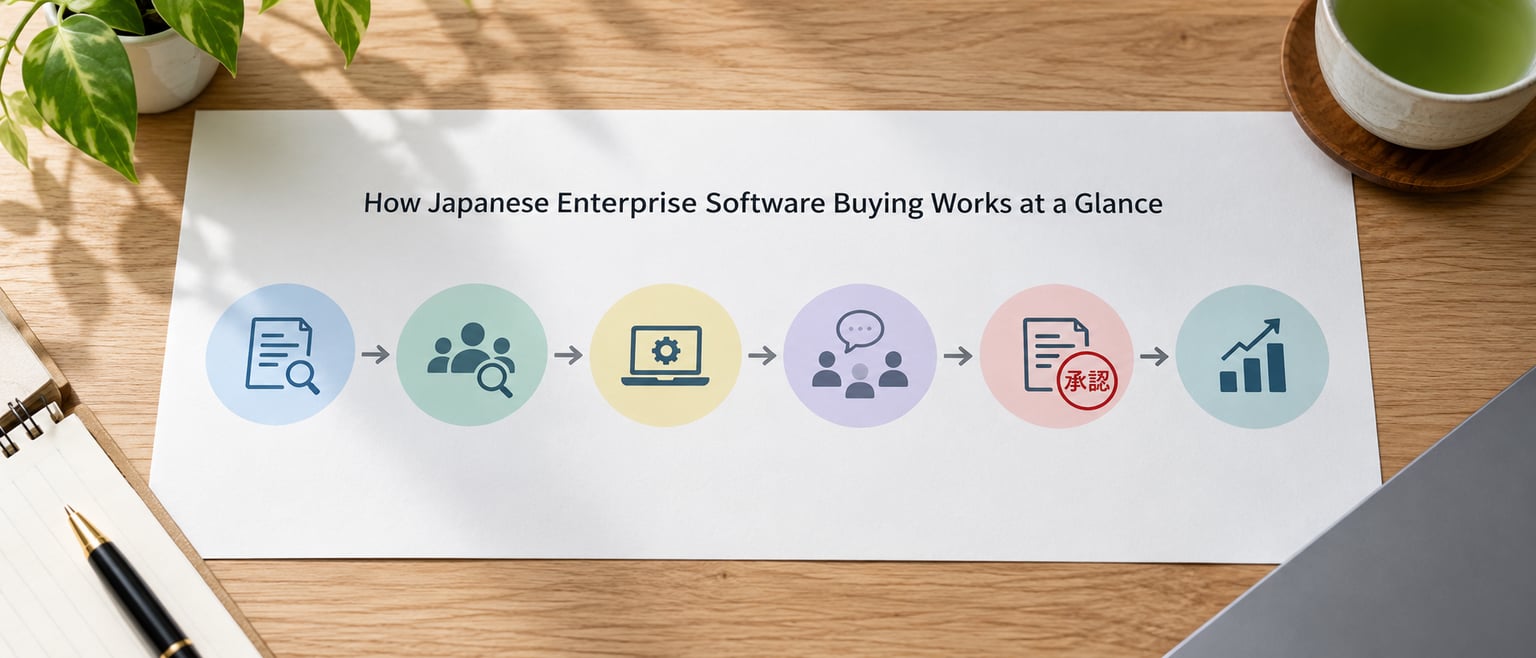
Japanese enterprise software buying works as a staged approval process. A business need becomes a documented internal proposal, that proposal is pre-aligned informally across the departments involved, then circulates for formal sign-off in sequence. The authorized decision-maker approves it against a specific budget, a contract is signed, and implementation starts with a plan most vendors have already built together with the buyer.
Each stage has an owner, a deliverable and a failure mode. Watch for these details.
| Stage | Typical owner | Expected output | Main risk |
|---|---|---|---|
| Need recognition | Business owner or department head | Problem statement with a rough benefit case | Framed as a technology project instead of a business one |
| Internal alignment | Day-to-day project owner | Agreement on scope and approach before any vendor is chosen | A vendor appears too early and shapes the requirement around one product |
| Requirements and evaluation criteria | Business owner with IT | Mandatory requirements and preferred options | Criteria written around a favoured supplier |
| Vendor research and shortlist | Project owner | A shortlist of three to five candidates with rationale | Shortlist built from reputation rather than fit |
| Demo and pilot | Business users and IT engineers | Evidence from real workflows, ideally integration tests | Treating the demo as the pilot, then discovering gaps late |
| Consensus review | Project owner and stakeholders | Written approval document moving through approvers | Unresolved objections surfacing at the last approver |
| Budget confirmation and decision | Finance and the authorized approver | A funded purchase order or rejection with a reason | Perfect evaluation, no money available this fiscal year |
| Contract and signature | Procurement and legal | Executed order form, master agreement, data terms | Security or privacy review restarting the clock late |
| Implementation and review | Project owner and IT | Configured system, migrated data, trained users, adoption review | Treating go-live as the finish line instead of the first measurement point |
Who Takes Part in an Enterprise Software Purchase?
Software decisions involve more groups than the vendor ever meets directly. An executive sponsor may own the budget line but rarely reads the technical evaluation, while the person drafting the approval document is often a working-level manager with no authority to sign anything.
- Executive sponsor — funds the initiative and attends the meeting where the decision is confirmed. Watches for payback and reputational risk.
- Business owner — the department head who needs the capability and who owns the benefit case. Often the most vocal supporter and the most exposed if it goes wrong.
- Project owner — the day-to-day manager running the evaluation. Frequently the real counterpart of a vendor’s account executive, and frequently the person writing the internal proposal.
- IT and information systems — integration, deployment model, maintenance, licensing fit and the internal architecture review.
- Information security — data handling, access controls, certifications, logging, and where data is stored.
- Procurement — supplier registration, contract templates, payment terms, and thresholds above which additional approval is required.
- Finance — cost of ownership across the term, budget availability, and the accounting treatment of the spend.
- Legal — terms of service, data processing terms, liability caps, confidentiality and termination rights.
- End users — the people who will live in the tool. Their feedback carries weight, especially in the pilot.
How Japanese enterprise software buying works across departments
The division of labour matters more than the titles. Requirements start with the business, technical validation happens with IT, risk review happens with security and legal, and the final call belongs to whoever holds approval authority for that amount.
Two patterns show up often. In a large manufacturer or bank, the business department owns the requirement while a central systems division runs a formal selection process with scored vendor responses. In a mid-sized firm, one manager does all of it and the approval exists to document a decision already reached.
Authority shifts with the number. A small purchase may need two signatures; a large one may touch a department head, a division head, a corporate centre and an executive. Delegation-of-authority rules decide this, not seniority in the abstract.
How Do Japanese Companies Define Software Requirements?
Requirements start as a business problem and get translated into something testable. A request like “we need better visibility into project risk” becomes specific conditions: which data must appear on a dashboard, how fresh it must be, who is allowed to see it, and what happens when a field is missing.
Categories that routinely appear: integration with existing systems, security controls and certifications, Japanese-language interface and documentation, support coverage during Japanese business hours, deployment model, data handling and storage location, ease of use for non-technical staff, total cost across the contract term, and procurement constraints such as approved vendor status.
Buyers usually separate mandatory requirements from preferences, and vendors should ask which list an item is on. A mandatory item that fails ends the evaluation. A preferred item that fails just costs points.
There is no universal checklist, though. A regulated buyer adds audit logging and data residency clauses; a creative agency cares about workflow speed and interface quality far more. The honest move is to ask the buyer for their own list rather than shipping yours.
How Do Buyers Evaluate and Shortlist Vendors?
Evaluation is evidence gathering with structure, even when the structure is informal. Buyers collect material from vendor sites, industry events, referral from another department, and trusted peers in the same industry.
Shortlists usually narrow in a predictable order. First pass is surface criteria: does the product cover the mandatory requirements, is there support in Japan, is there a local presence or partner. Second pass compares shortlisted products on workflow fit, integration effort, implementation resourcing and total cost. References get checked, often by telephone, with customers in a comparable industry.
Alongside features, buyers weigh things that are hard to put in a feature matrix: how long the vendor has operated in Japan, whether named accounts are recognizable locally, whether the vendor can commit to response times in writing, and whether the vendor will still be around in three years.
Market presence and credibility often carry real weight here. A product with excellent fit but no Japanese support, no local entity and no reference customers can lose to a slightly weaker product that checks all three boxes. That surprises vendors used to competing on capability alone.
Why Does the Pilot Stage Matter?

A pilot is a limited, time-boxed trial on real work by real users. It exists to answer questions a demo cannot: does this integrate with our actual systems, will our people adopt it, what happens when the data is messy, how fast does support respond in Japanese.
A demo shows a prepared script on prepared data. A pilot exposes failure. Expect teams to load a sample of production records, connect one live system, run a real approval flow, and measure how long a typical task takes.
Success criteria should be agreed in writing before the pilot starts, which is worth pushing for. Without agreed criteria, the evaluation becomes a matter of opinion, and opinions travel badly through an approval chain.
Duration, scope and who decides the outcome vary widely. Some pilots run a few weeks with a single team; others run a full quarter across two departments with a formal scorecard. What stays consistent is that the pilot generates the evidence the approval document later cites.
How Does Internal Consensus Affect the Decision?
Agreement is built before any document circulates. In the practice known as nemawashi (根回し), a proposal is taken to each affected party individually, objections are heard early, and revisions are made before anyone is asked to approve a fixed version.
This explains a pattern that confuses newcomers. The meeting where a decision appears to be made is usually confirming something already settled. The real work happened in conversations that the vendor never witnessed.
Seniority alone does not decide the outcome. A senior executive who has not heard a concern directly can still ask about it, and that question travels back down. Operational evidence, risk controls and a defensible financial case move a proposal further than rank does.
The most common failure mode is a proposal arriving without groundwork. It gets read slowly, questions surface late, and it quietly disappears into an approval queue while everyone waits for someone else to object first.
The second is speed. An unresolved objection discovered after the document is in circulation can send the whole thing back to the start, which is why buyers who identify objections early are usually being careful rather than obstructive.
What Happens During Negotiation and Approval?
Negotiation in Japan tends to look different from a Western enterprise deal because the commercial conversation and the approval conversation are separate tracks. Prices get discussed while the internal decision is still forming, and both need to land before signature.
Work through these areas in order:
- Commercial review — list price, volume tiers, multi-year terms, payment terms in line with the buyer’s standard conditions, and any implementation fees separated from subscription cost.
- Security review — access control, encryption, audit logging, vulnerability handling, penetration testing, and certifications such as ISO 27001 where required.
- Privacy and data handling — what personal data is processed, where it is stored, whether it leaves Japan, sub-processors, retention and deletion, and breach notification duties. In regulated industries this review can be the longest step.
- Legal terms — liability caps, indemnification, confidentiality, suspension rights, termination, and the order of precedence between the vendor’s standard agreement and the buyer’s procurement template.
- Service levels — uptime commitments, response targets, support hours, and whether they are written as obligations rather than intentions.
- Procurement thresholds — amount-based rules that add a layer of review or a formal sourcing event. Crossing a threshold can restart the process from the shortlist stage.
- Final sign-off — approval by the person holding authority for that amount, possibly ratified at a management meeting that includes functions the project team never met.
One practical note: any commercial concession made verbally should be reflected in writing immediately. A price the buyer’s finance team cannot reproduce from documentation creates a new approval problem rather than solving the old one.
How Is the Software Implemented and Reviewed?
Implementation planning starts before signature, not after. The pilot has usually already produced a configuration plan, an integration list, a data migration approach and a rough schedule, so the post-signature phase is about execution rather than discovery.
The typical sequence runs from contracted scope through system configuration, data cleansing and migration, integration with existing applications, user and administrator training, then a phased rollout by department or site. Large rollouts often start with a limited group that already used the product in the pilot, which gives the wider organisation a visible success to point at.
Adoption is measured after go-live: active users against licensed users, completion rates for the workflows the tool was bought to improve, and support ticket volume as a signal of where configuration gaps remain.
The post-launch review is where the original business case gets checked. If the benefit case promised shorter approval cycles or fewer manual handoffs, that promise belongs on the review agenda alongside uptime and cost. A project that delivered the software but missed the case is still a failed project, and buyers know it.
Once a deal closes this cleanly, it tends to stay closed. Expansion happens through the same alignment process rather than a quick upsell, which is why relationship quality keeps paying off after signature.
How Can Global Software Vendors Work Better With Japanese Buyers?
Most of this comes down to evidence and patience. Vendors who adapt well treat the long middle of the cycle as normal rather than as a problem to solve with more email.
Research the buyer before the first call
Know the industry, the department structure, the systems the project must integrate with, and whether the company operates under a multinational parent whose procurement rules may apply. A vendor that arrives with specifics about a comparable Japanese company in the same sector starts from a much better position than one asking what the buyer does.
Put a one-page Japanese summary in the drafter’s hands
This is the single highest-leverage thing a vendor can do. The person writing the internal approval document needs a page they can adapt and paste: what the problem is, what the product does, what it costs over the term, how long implementation takes, what support looks like in Japan, and what the main risks are. Every extra hour the drafter spends writing from scratch costs the project weeks.
Make the pricing quotable
A price that needs verbal caveats in Japanese will be questioned in the approval meeting, and the drafter will not fight for it. Give per-user and per-department pricing, multi-year terms and implementation costs separately, so the number on the page is the number finance will test.
Answer technical questions in detail, immediately
Specific questions arriving weeks after a demo are normal, not a sign of trouble. They usually come from an approver working through the document and finding an area they need to understand. Detailed answers sent back within hours, in Japanese where the writer is working in Japanese, keep the document moving.
Bring credible Japanese support and proof points
A local phone number, Japanese-language support hours, a documented data handling position, and reference customers in comparable industries give every approver something concrete to write down. Where a Japanese entity does not exist, say so plainly and describe how support is actually delivered here.
Let the process take the time it takes
Do not push the internal champion to move faster, do not go over their head to reach a senior executive, and do not treat a quiet two weeks as a lost deal. When a ringisho is in circulation, the champion is managing internal politics and needs support, not pressure. Going around them costs credibility that takes a year to earn and can end the deal outright.
What Differences Should Buyers Expect?
No single process governs every Japanese organisation. Company size, industry regulation, ownership and internal maturity change the shape of the buying process considerably.
| Factor | What tends to change |
|---|---|
| Company size | Larger firms add formal sourcing events, scored vendor responses and more approval layers. Smaller firms move faster with fewer signatures and less documentation. |
| Industry regulation | Finance, healthcare and public sector buyers add data handling, audit and residency reviews that can outlast the technical evaluation. |
| Procurement system | Some companies run all sourcing through a formal portal with supplier registration. Others let departments buy directly within a threshold. |
| Digital maturity | Mature IT organisations test integrations and security settings early. Others may prioritise usability and rollout speed over technical depth. |
| Multinational ownership | Group-level agreements and shared platforms can override a local preference, or a local subsidiary can be given freedom to choose. |
| Relationship history | An existing vendor relationship often carries weight that no proposal can match quickly. |
Hybrid practice is the norm. A digital-native subsidiary in a manufacturing group may run a lightweight evaluation inside a traditional approval shell. Expect to be asked for a formal proposal and a short informal process at the same time.
Frequently Asked Questions
How long does enterprise software buying usually take in Japan?
It varies more than most vendors expect. Timeline depends on deal size, number of departments involved, security and privacy review depth, and whether budget already exists for the current fiscal year. A short, well-defined purchase with an existing budget can close in weeks. A cross-department rollout needing new budget, legal review and procurement registration can run many months. The approval step is rarely the slowest part; budget availability and security review usually are. Ask your contact whether the money is already allocated before you build a forecast around a date.
Do Japanese enterprise buyers require materials in Japanese?
In practice, yes for anything that enters an internal approval document. Vendor materials in English can work for technical evaluation, but the summary that travels with the approval should be in Japanese, and so should commercial terms, pricing structure and security responses. Sales conversations often run in English with a bilingual contact, yet the paper trail is Japanese. Budgeting for professional translation of your key documents is standard practice, not an extra.
Can a global software vendor sell directly to a Japanese company?
Yes, many do, but most pair direct sales with a local partner, reseller or distributor. Direct entry gets harder as deals get larger or as procurement rules require a registered supplier with a local address and Japanese support capability. A partner adds invoicing capability, first-line support and credibility with departments that have not worked with the vendor before. Some companies prefer partners because procurement and finance processes are simpler that way. Others run everything direct and expect a Japanese entity or an agreed arrangement for local contracting.
Who has the final say in a Japanese enterprise software purchase?
The person holding approval authority for that amount, and sometimes a management meeting that only ratifies what has already been agreed. In practice, the final approver rarely decides alone. The day-to-day project owner gathers requirements, coordinates the pilot and drafts the approval document, so most of the outcome is shaped long before the last signature. Understanding how Japanese enterprise software buying works means tracking that project owner rather than chasing the executive, and giving them material they can actually use.
How should a software vendor prepare for a Japanese enterprise procurement process?
Prepare for evidence, not persuasion. Learn the buyer’s industry and systems, produce a one-page Japanese summary covering problem, product, cost, schedule, support and risk, quote a price that needs no verbal caveats, and have answers ready on data handling and Japanese-language support. Identify the project owner early and treat them as the route through the process. Then leave room in your forecast for a long approval cycle and a fiscal year boundary, because how Japanese enterprise software buying works makes patience part of the method.
Conclusion
Japanese enterprise software buying is a documented approval process wrapped around informal groundwork: alignment first, a written proposal next, formal sign-off after that, and a funded decision at the end. The rhythm looks slow from outside because the useful work happens in conversations nobody invites you to.
Three things to do first. Map who actually decides and who drafts the internal document, then build your relationship with the drafter. Separate mandatory requirements from preferences in writing, so evaluation does not become a negotiation. And prepare evidence that survives review: quotable commercial terms, a one-page Japanese summary, a clear data handling position and named references in the buyer’s industry.
Do that groundwork early and the long middle of the cycle stops feeling like delay and starts doing its job.