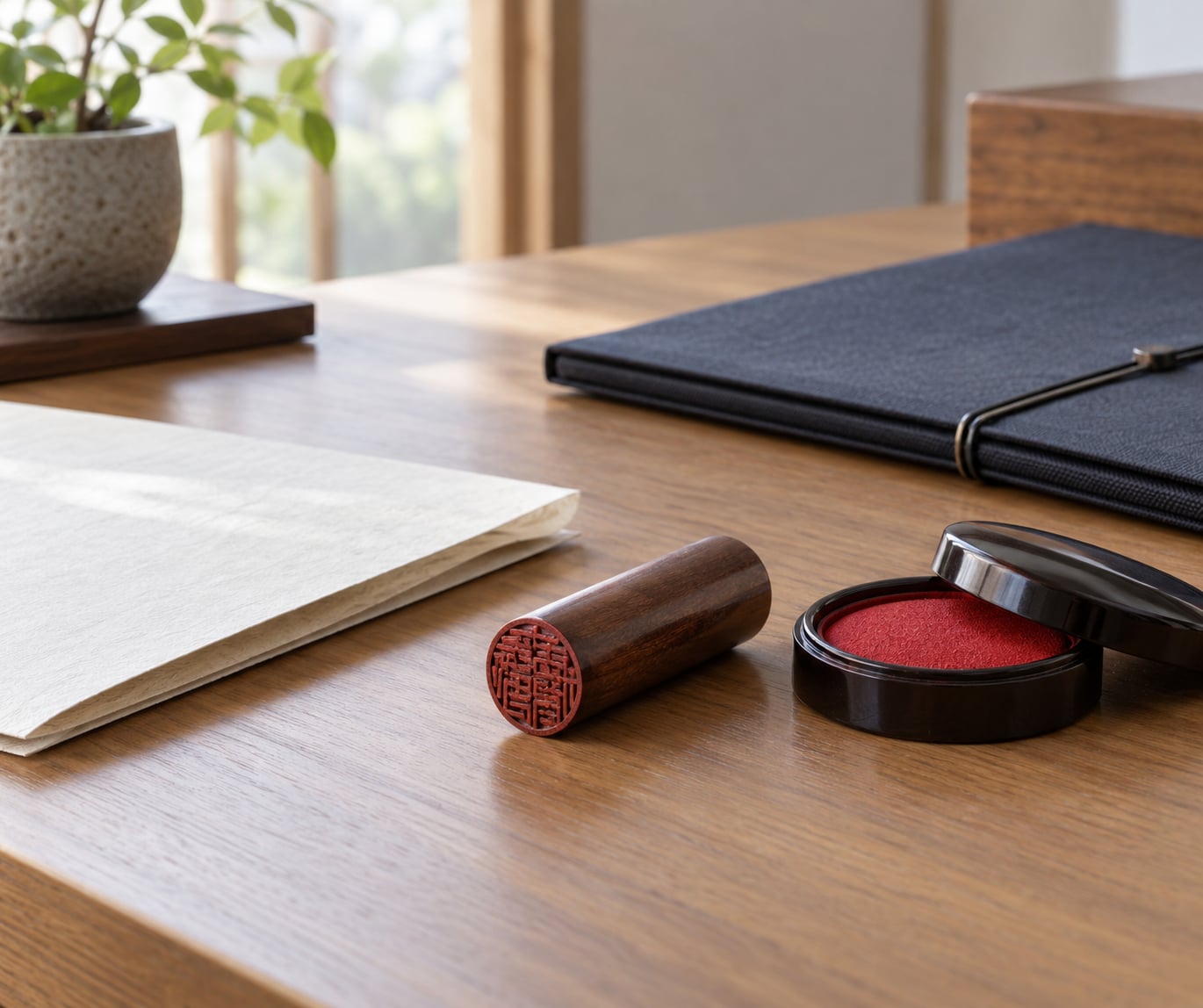
Japanese offices rely on personal seals because a seal functions as an identity mark that cannot be copied convincingly by someone else, and because the legal and administrative system was built around seals rather than handwritten signatures. A carved hanko pressed into red ink tells a clerk, a bank, or a colleague that a specific named person approved a specific document, took responsibility for it, and stands behind the terms. That is the whole answer, and everything below is the detail behind it.
I have watched this play out in meeting rooms in Tokyo, Osaka, and Nagoya, and the pattern is the same everywhere. Documents get stacked, a red ink pad comes out, and within a minute there is a signature on a page that carries real weight in a way a fountain scrawl does not. Foreign founders often read it as a formality. It is closer to a legal instrument.
Why Japanese offices rely on personal seals comes down to four things: a legal framework that treats a registered seal as proof of identity, a bureaucracy built on stamped paper, a workplace culture of accountability, and a slow but real shift to electronic signatures that has not finished yet. Here is how each piece works.
Table of Contents
- 1Why Japanese Offices Rely on Personal Seals
- 2What Is a Personal Seal, or Hanko?
- 3The four personal seal types
- 4Corporate seals are a different animal
- 5What Does Hanko Represent in Japanese Business?
- 6How Are Personal Seals Used in Offices?
- 7Why Japanese offices rely on personal seals day to day
- 8Which document takes which seal
- 9Why Did Japanese Offices Make Seals So Important?
- 10Are Japanese Companies Moving Away from Physical Seals?
- 11The tools doing the work
- 12Adoption differs sharply by employer
- 13What Should Foreigners Know When Dealing with Japanese Offices?
- 14Frequently Asked Questions
- 15What is the difference between a Japanese hanko and a handwritten signature?
- 16Is a personal seal legally required for Japanese business documents?
- 17Can Japanese companies use electronic seals instead of physical hanko?
- 18Do foreign companies need a Japanese seal to work with local offices?
- 19What is a corporate seal, and how is it different from an individual hanko?
- 20How can someone in Japan obtain a personal seal for business paperwork?
- 21Conclusion
Why Japanese Offices Rely on Personal Seals
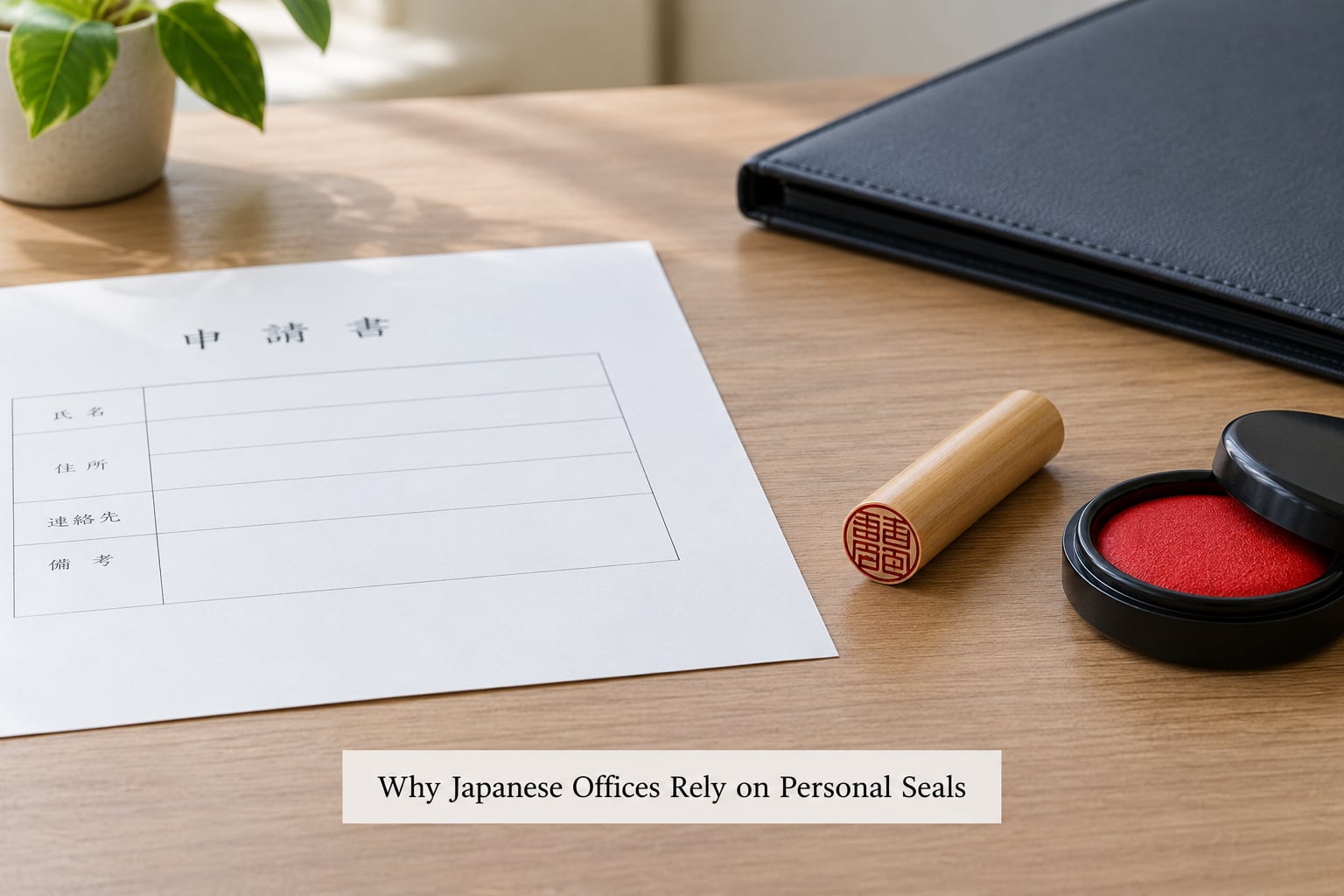
The short version is that the seal replaces the signature. Instead of writing your name, a Japanese office stamps a carved block of stone, wood, horn, or metal into red ink, and that impression functions as your legal mark of approval on contracts, internal forms, bank paperwork, and government filings.
Four forces created that habit, and none of them is nostalgia.
- A legal framework that recognizes seals. Japanese commercial law treats a properly registered seal as a legal mark, which means a stamped document can bind a person or a company without any further proof of intent.
- A paper-driven bureaucracy. Registers, tax filings, payroll records, and corporate minutes were all built to be physically stamped, and the physical systems are still running.
- Accountability culture. A stamp says a specific person owns the decision. Handing a document around for signatures spreads the blame; a seal pins it to one name.
- Administrative convenience. One carved object works for a pay slip, a leave request, a bank transfer instruction, and a contract, so nobody has to think about which form needs what.
The result is practical rather than sentimental. Ask an office manager why the seals stay and you will usually hear something about how a stamped page cannot be altered without detection, while a signature can be traced, mimicked, or added later.
What Is a Personal Seal, or Hanko?
A hanko is the carved stamp itself. The red impression it leaves on paper is called an inkan. Both words get used loosely for both objects in everyday English, but in Japanese the distinction is clean, and it matters when you are reading a document.
Japanese law limits the physical size of a registered seal. Common diameters run from about 8 mm for small everyday stamps up to 25 mm for official ones, which is why office seals look small in the hand.
The four personal seal types
Not everyone owns one seal. Most office workers own two or three, because each one signals a different level of authority.
| Seal type | What it is | Typical office use | Registration |
|---|---|---|---|
| Jitsuin (実印) | The official personal seal, highest personal authority | Contracts, property, loans, wills, HR filings | Registered at a municipal office with an inkan shomeisho certificate |
| Ginkoin (銀行印) | Bank-registered seal | Withdrawal and transfer instructions, loan paperwork | Registered with the bank itself |
| Mitomein (認印) | Informal or approval seal | Internal forms, timesheets, expense claims, delivery receipts | No registration needed |
| Sanmonban (三文判) | Simple ready-made stamp, often bought from a vending machine | Receipts, routine admin, non-binding paperwork | No registration needed |
Most confusion in offices comes from mixing these up. If a form says 認印印, an employee mitomein works. If it says 実印印 or requires an inkan registration number, only a registered jitsuin is acceptable, and a cheap sanmonban will get the paperwork rejected.
Corporate seals are a different animal
A company does not use an employee’s personal seal to bind itself. It uses its own.
- Kaisha jitsuin (会社実印) is the corporate official seal, registered with the legal affairs bureau (houmukyoku). It represents the company as a legal person and is required on contracts, bank agreements, and corporate filings.
- Kaisha ginkoin (会社銀行印) is the seal registered with a bank for that company’s accounts.
- Kaisha kakuin (会社角印) is a squarish or rectangular office stamp used for routine internal paperwork, often carrying the company name in katakana or with a rounded rectangular frame. It is not for contracts.
That separation matters in practice. A section manager might stamp a delivery note with the company office seal, then route a supplier contract up the chain for the kaisha jitsuin and a signature from a director. The approval chain and the seal choice are two different mechanisms.
What Does Hanko Represent in Japanese Business?
A personal seal represents authority the person actually holds, and it attaches that person’s name to a decision in a way that can be checked later. When a manager stamps a purchase approval, the stamp is a claim about authority as much as about identity.
Four ideas sit underneath that claim.
Approval and finality. A red impression on an internal form usually means the decision is done. Reopening it requires a new document, not a phone call.
Responsibility. Japanese corporate practice tends to push decisions down to named individuals rather than leaving them with a committee. The seal is the record of who accepted the risk.
Verification. A registered jitsuin is tied to a government-issued certificate of registration. When a bank or a registry office accepts a stamp, it is accepting the identity behind it, not just the shape of the mark.
Formality and hierarchy. Stamp choice signals rank. A fresh hire with a plastic sanmonban is not going to be trusted to sign anything that matters, and everyone in the room knows it.
There is also a cultural layer. Seals carry a long association with craft and continuity, and a family or a firm can pass one down for generations. That history matters, but it is decoration on top of a functional system, not the reason the system survives.
The legal weight of an approval follows a rough order that practitioners widely use: a handwritten signature plus a registered hanko carries the most weight, a signature alone less, a digital approval plus a hanko close behind that, and a digital approval alone the least. That hierarchy is informal rather than statutory, but it decides arguments in practice.
How Are Personal Seals Used in Offices?
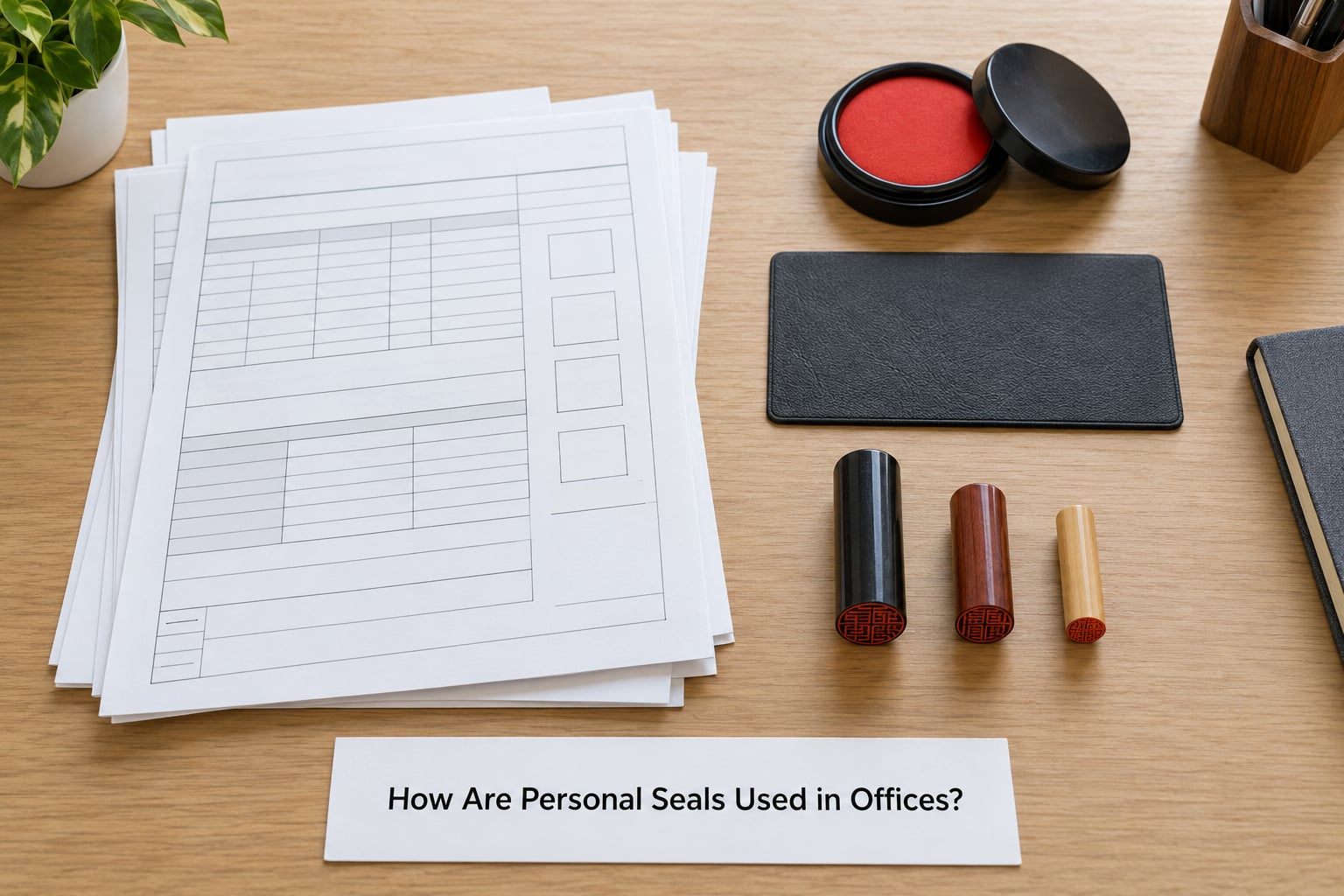
Offices use personal seals as a routing mechanism. Each stamp answers a question: who checked this, who approved this, and does that person have the authority to say so.
The daily cycle usually looks like this: an employee fills in an application or claim, a supervisor stamps it to show review, a department head stamps it to show approval, and an authorized signer adds a signature for anything that leaves the company. The seal covers internal authority. The signature covers legal commitment. Companies that get into trouble are the ones that swap them.
Why Japanese offices rely on personal seals day to day
This is the everyday answer to why Japanese offices rely on personal seals. The seals are how approval is recorded on paper, and the office cannot function until that step happens.
Which document takes which seal
| Office document | Seal normally used | Who stamps it |
|---|---|---|
| Timesheet or attendance record | Mitomein or office stamp | Employee, then supervisor |
| Expense and reimbursement claims | Mitomein or office stamp | Claimant, then approver |
| Purchase requisition | Office stamp (kaisha kakuin) or department seal | Requesting department |
| Supplier contract | Kaisha jitsuin plus a director’s signature | Authorized representative |
| Employment offer, contract renewal, HR filings | Kaisha jitsuin; personal jitsuin for personal declarations | HR director |
| Payroll and bank transfer instructions | Kaisha ginkoin | Authorized finance officer |
| Delivery receipts and signed shipment records | Mitomein or office stamp | Receiving clerk |
| Board minutes and corporate resolutions | Kaisha jitsuin, often with directors’ seals | Company representative |
| In-house certificates issued to clients | Kaisha kakuin | Sales or admin staff |
Two more small seals show up constantly in documents rather than approvals. A kei-in is a page-numbering stamp pressed across the fold of a multi-page contract so no page can be swapped out later. A wari-in does a similar job across multiple copies. Corrections use a teisei-in, which amends a specific character, or a sute-in, a small mark placed in the margin. They are minor until a contract is challenged, and then they decide the outcome.
Self-inking stamps called shachihata exist, but they are not accepted everywhere. Documents at a ward office or a registry will often refuse them, which is the kind of rejection that surprises new employees and foreign residents more than any other rule in the system.
Why Did Japanese Offices Make Seals So Important?
Japan used seals in official contexts long before modern companies existed. Seals appear on documents from the Nara period, and by the Edo era they were the normal way an ordinary person proved anything in writing. The Meiji-era legal system then locked the habit in place, and that is the version offices still run on.
Six reasons explain why seals beat signatures as the default.
1. Writing was expensive and slow. For most of history, a signature cost time and paper. A carved seal stamped repeatedly was simply cheaper per approval.
2. Literacy rates were uneven. A seal works in a society where not everyone can write their name fluently in kanji. The stamp sidesteps that entirely.
3. Standardized administration. Once the state decided that a document without a proper seal was not valid, every office, registry, and court inherited the same rule.
4. Signatures were forgeable. Handwriting can be traced or copied by someone who sees a sample. A carved seal has a physical form that is hard to reproduce and easy to compare against a registered sample.
5. Commercial reliability. A registered jitsuin carries an identity number that a counterparty can check. In a market where credit depended on verifiable identity, that mattered a great deal.
6. Corporate procedure made it easy. A company that adopts a uniform approval stamp can route documents without negotiating authority for each case. The seal becomes the paperwork’s operating system.
Add the craft tradition around seal carving, which produces objects that are genuinely beautiful and often inherited, and you get a system with both functional and emotional reasons holding it up. Remove the emotion, though, and the functional reasons still explain most of the persistence.
That craft side is worth a closer look, because it is where the practice survives longest. A hand-carved seal takes weeks and a trained carver’s judgment about how to lay characters inside a circle so they stay legible when pressed. Fine boxes, padded cases, and ink sold specifically for seals come with the object, and an office that has had the same seal for three decades is unlikely to throw it away.
There is also a parallel tradition in gagō-in, the small art seals that painters and calligraphers press onto finished works. It carries no administrative force at all. It survives because people like owning an object that marks their work as theirs, which tells you something about why the business seal has held on too.
Are Japanese Companies Moving Away from Physical Seals?
Yes, gradually, and unevenly. Electronic signatures and digital approval tools have moved from novelty to default at many companies, but the paper system has not been dismantled, so most organizations run both in parallel.
The COVID-19 pandemic forced the issue. Offices that had relied on physical timesheets and stamp circulation had to keep payroll running while staff stayed home, and the workaround was usually a digital approval tool bolted onto the existing HR system. People on r/japanlife and r/japan described the awkward part clearly: the monthly commute that existed only to have a supervisor stamp a timesheet. Once that trip was removed, it was hard to argue for putting it back.
Some larger employers made public moves. Mercari moved to electronic signatures in 2020, and GMO Internet Group backed a campaign pushing companies away from paper seals. The chairman of Keidanren, the main business lobby, said plainly that hanko has no place in the digital age.
The tools doing the work
| Tool | Type | Where it fits |
|---|---|---|
| Cloud Sign | Domestic electronic signature service | Contracts and approvals inside Japanese companies and with Japanese clients; adoption passed 80,000 companies after a sharp rise through the pandemic years |
| DocuSign | Global electronic signature service | Cross-border agreements where one side is outside Japan |
| SmartHR | HR cloud platform with built-in approval flows | Timesheets, leave requests, HR documents |
| GMO Sign | Domestic electronic signature service | Smaller companies and routine internal approvals |
| Digital hanko and image seals | Photo or data-based stamp applied to PDFs | Filling gaps where a visual seal is expected but no signature is required |
The government has been pushing the same direction. Taro Kono, the minister overseeing administrative reform, has made removing seal requirements from government paperwork a formal goal, and roughly 80 out of some 14,000 administrative procedures still require an inkan. The Digital Agency, set up to push government paperwork online, is working through the remaining rules one procedure at a time. The trend is clear, and the pace is slow.
Adoption differs sharply by employer
How digital an office is depends almost entirely on who runs it.
- Startups and tech companies adopted electronic signatures early, mostly because their staff were already distributed and their paperwork was born digital.
- Traditional manufacturing, trading, and construction firms run hybrid systems. Contracts get stamped, internal forms get approved in software, and the two coexist without anyone reconciling them.
- Public bodies and large keiretsu groups move slowest, because internal rules and registry customs are written around paper and change slowly with them.
Even at companies that have gone digital, a physical seal rarely disappears. It moves to the drawer, and it comes back out whenever a client, a court, or a government office asks for something stamped.
Two practical consequences follow. First, a digital approval platform does not automatically satisfy a counterparty that insists on a registered seal, so the physical one has to stay on hand. Second, a PDF with a pasted image of a stamp carries no legal authority at all. If a document matters, ask which of the two it actually is before sending anything.
What Should Foreigners Know When Dealing with Japanese Offices?
The practical rule is simple: read the seal line on the form. Japanese documents name the required seal in writing, often as 実印, 認印印, or 会社実印, and that line tells you exactly what to bring.
Foreign residents and foreign companies can obtain a hanko, and many employers ask new hires to have one ready before their first day. The common path is a ward office or city hall, where you present identification and register your seal, receiving an inkan shomeisho certificate. You will need your residence card and, in many cases, a My Number Card, and the visit is normally in person.
If you hold a seal but need a new one, the procedure is police report, then municipal cancellation, then re-registration. People report that the city office portion is the slow part, and that some wards now offer after-hours kiosks for the paperwork.
A few more things worth knowing before you sign anything.
- Name style matters. Kanji is the most formal and is what most registrations use; katakana is phonetically exact; Latin letters and a custom design are used more often by non-Japanese residents.
- Small cities and regional offices tend to be stricter. A signature often works in Tokyo for administrative requests, and it is less reliably accepted elsewhere.
- Bank accounts usually need a registered seal unless you use an app-based identification flow.
- A self-inking stamp will get rejected at some counters. If a document says 押印 in red, treat it as a real stamp requirement.
- Ownership is legal. There are no restrictions on having a seal, only on misuse, and reports of forged seals are handled through the police and re-registration.
Material choice comes up too, usually among people who care about sourcing. Ivory is illegal to trade under CITES and shows up only rarely in legitimate modern seals; boxwood, buffalo horn, stone, and titanium are the common alternatives. That is a purchasing question rather than a legal one, but it comes up more often than expected among foreign staff.
Frequently Asked Questions
What is the difference between a Japanese hanko and a handwritten signature?
A hanko is a carved object pressed into red ink, and the impression it leaves is called an inkan. A handwritten signature is written by hand each time. In practice the seal carries more institutional weight because a registered jitsuin is tied to a government certificate, which lets a bank or registry verify the identity behind the mark. That verification step is what a signature usually cannot offer.
Is a personal seal legally required for Japanese business documents?
For many documents, yes. Contracts, property transfers, corporate filings, and HR paperwork commonly require a registered jitsuin, and banks require a registered ginkoin for instructions on an account. Routine internal office forms usually ask only for a mitomein, which needs no registration at all. The requirement always comes from the document itself, so read the seal line before assuming anything is needed.
Can Japanese companies use electronic seals instead of physical hanko?
Yes, and many do. Domestic electronic signature services and HR platforms now handle contracts, timesheets, and internal approvals for thousands of companies, and a signature combined with a digital stamp is usually accepted between businesses that have agreed to the workflow. The catch is that a digital approval will not satisfy a counterparty or government office that specifically requires a registered seal, so companies keep their physical seals in reserve.
Do foreign companies need a Japanese seal to work with local offices?
Usually not for the relationship itself. Foreign firms can sign contracts in English and many accept a foreign company seal, and major Japanese companies increasingly run on electronic signatures with international vendors. Where a physical Japanese seal does come up is at government counters, banks, and regional offices, which can be stricter. Having a registered jitsuin on hand removes that risk entirely.
What is a corporate seal, and how is it different from an individual hanko?
A corporate seal belongs to a company rather than a person. The kaisha jitsuin is registered with the legal affairs bureau and binds the company as a legal person on contracts and filings. The kaisha ginkoin is registered with a bank for account instructions, and the kaisha kakuin is an office stamp for routine internal paperwork. An individual hanko carries only the authority of the person who stamped it.
How can someone in Japan obtain a personal seal for business paperwork?
Order one from a seal shop or an online maker, choosing kanji, katakana, or a Latin-letter design. Ready-made stamps are sold at department stores and vending machines, while hand-carved seals take longer and cost more. For anything official, register the finished seal in person at your ward office or city hall with your residence card, and usually a My Number Card, to receive an inkan shomeisho certificate.
Conclusion
Japanese offices rely on personal seals because the seal is the identity, authority, and accountability in a single red mark on paper, and because the legal and administrative system still recognizes it as valid proof. That system is losing ground to electronic signatures, but nowhere near enough for offices to stop stamping.
Before you send anything, read the seal line on the form, match it to the seal you actually have, and ask the counterparty directly if you are unsure. One email saves a rejected document.