Mirrorless cameras came from Japan because Japanese camera makers were the only ones with all three pieces needed to build the format at once: decades of precision optical manufacturing, a domestic market large and competitive enough to sell a strange new camera into, and consumer-electronics expertise in sensors, screens and processors. The idea of a camera without a mirror was not Japanese, but Olympus, Panasonic, Sony and Fujifilm turned it into a durable interchangeable-lens system, and by the late 2010s that system had pushed the DSLR out of the mainstream.
Understanding that origin story explains a lot about the camera market readers walk into today: why Micro Four Thirds was the first real mirrorless standard, why compact bodies became normal, why Sony’s full-frame E-mount reset what a camera was expected to do, and why the DSLR disappeared faster in Japan than almost anywhere else.
Table of Contents
- 1Why Mirrorless Cameras Came From Japan
- 2What Is a Mirrorless Camera?
- 3How did Japanese companies invent modern mirrorless cameras?
- 4Why Japan Had the Right Camera Market
- 5How did compact cameras lead to interchangeable-lens mirrorless?
- 6How Sony, Olympus, and Panasonic Created Competing Standards
- 7Why Mirrorless Cameras Did Not Become Popular Immediately
- 8How mirrorless cameras changed the global camera industry
- 9Frequently Asked Questions
- 10Did Japan invent the first mirrorless camera?
- 11Who made the first commercially successful mirrorless camera?
- 12Why did Japanese camera makers develop mirrorless systems?
- 13Were mirrorless cameras invented because DSLRs were failing?
- 14How did Sony, Olympus, and Panasonic differ in their early mirrorless systems?
- 15Conclusion
Why Mirrorless Cameras Came From Japan
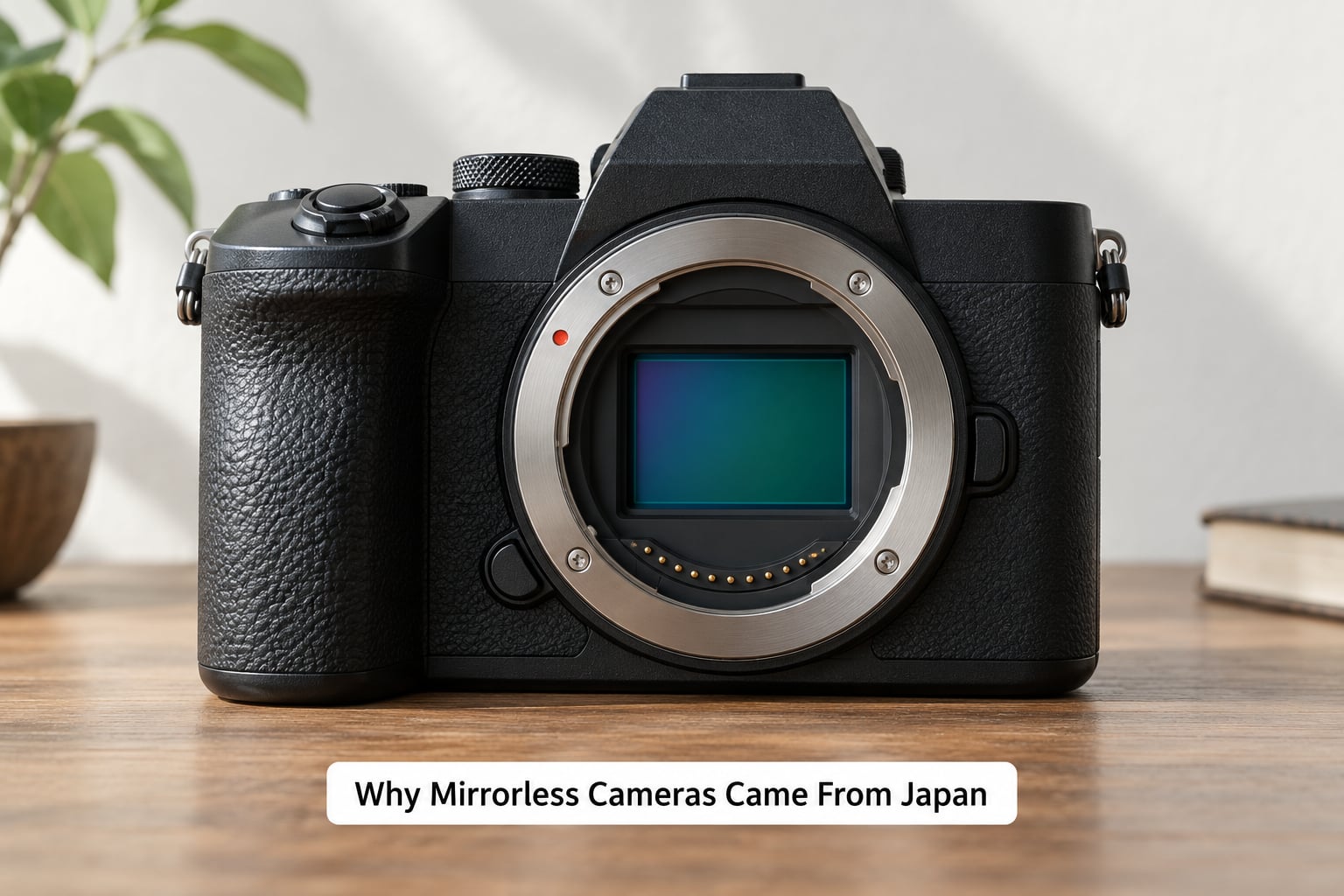
The short answer is that Japan’s camera industry had already solved the three hard problems mirrorless depends on. Precision mechanics for the body and lens mount, sensor and image-processor production for the imaging chain, and high-resolution screens for live view and the electronic viewfinder, or EVF. Add a home market that bought small cameras in enormous volume and a willingness to walk away from a fifty-year-old mechanical idea, and the conditions for a mirrorless system were in place before they were anywhere else.
What Japan did not have first was the idea. A camera with no reflex mirror existed long before 2008. Leica rangefinders from the 1920s were mirrorless by definition, and Epson built the RD-1 in 2004 by putting a digital sensor in the body of a rangefinder. Those designs were small in number, expensive, and sold as curiosities. What changed in Japan was not invention but durability: making the mirrorless body a mass-market product with a lens mount people could build a career around.
Two other conditions mattered. Japanese camera divisions often sat inside much larger electronics companies, so a modest camera business could absorb a risky bet that a camera-only company could not. And the 2008 financial crisis hit exactly as the first mirrorless bodies were shipping, which throttled the R&D budgets of the companies that had just committed to the format. Japan got the first real mirrorless systems, and then had to live with the consequences for a decade.
What Is a Mirrorless Camera?
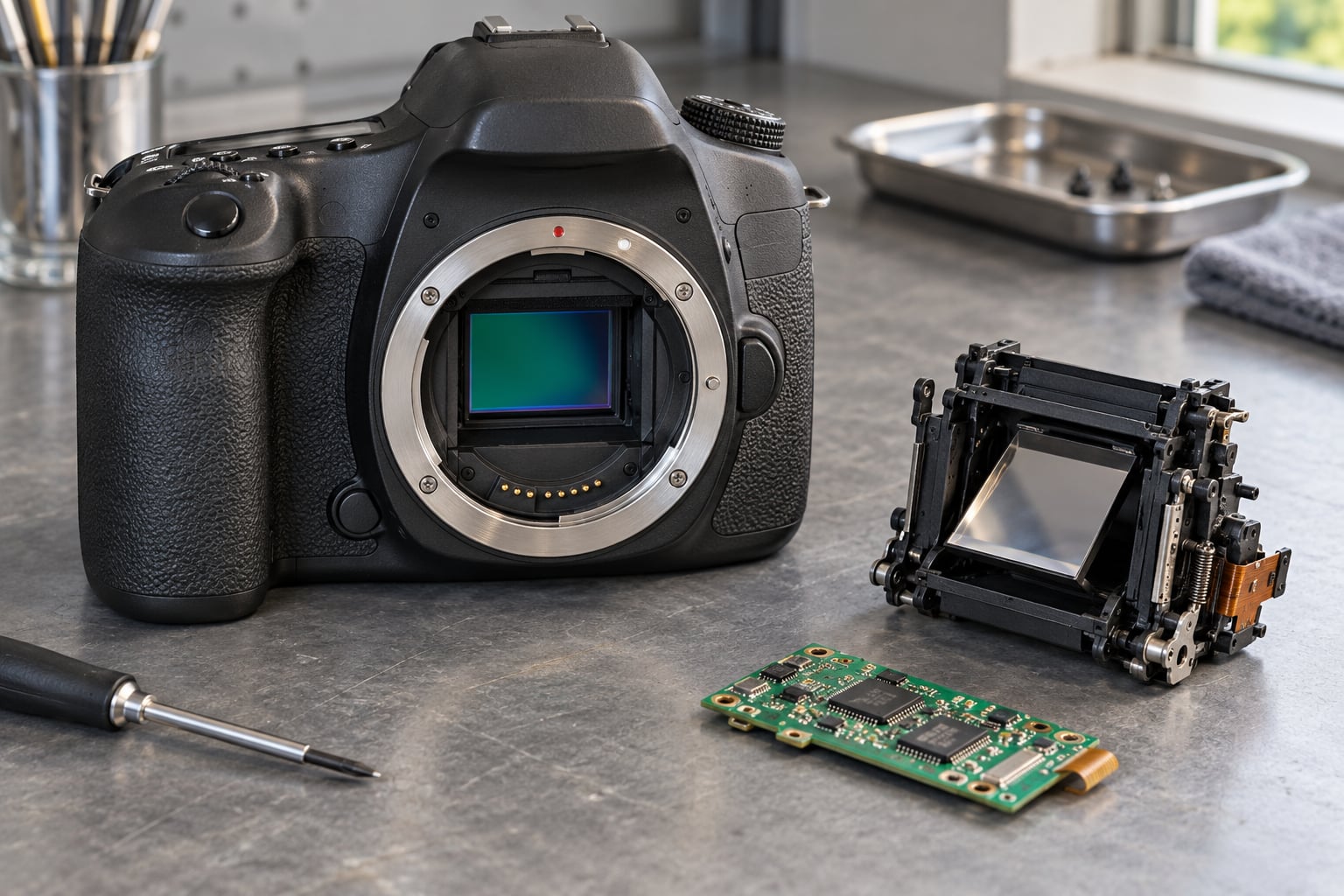
A mirrorless camera is a camera that has taken the reflex mirror out of the path between lens and sensor. In an SLR, that mirror bounces light up into an optical viewfinder and flips out of the way for the fraction of a second each shot. A second mirror behind it feeds a dedicated autofocus module. Remove both, and the sensor can sit much closer to the mount.
That single deletion causes a chain of consequences worth knowing. The short backfocus distance, measured as flange focal distance, lets the body be thin and the lens mount close to the sensor. Without the mirrorbox, autofocus has to be done by the sensor itself, either by detecting contrast differences as the image sharpens or by reading light through pairs of masked pixels. Framing comes from an EVF or the rear screen rather than a moving optical finder, and shooting is silent and continuous because there is no mechanism to cycle.
For decades the tradeoff was obvious and unfavourable. An EVF lagged the sensor, had visible pixel structure, and ran through batteries. Contrast-detect autofocus was slow and hunting by modern standards, and small sensors struggled with noise. That is why most people said mirrorless cameras were not a replacement for anything, and why the first generation read as a clever toy rather than a serious tool.
How did Japanese companies invent modern mirrorless cameras?
The modern mirrorless camera is usually dated to 2008, when Olympus and Panasonic announced the Micro Four Thirds standard together and shipped the Olympus E-P1 and Panasonic G1 within weeks of each other. The reason that date matters more than the earlier experiments is that it was a standard, not a product. A shared mount let lens designers at both companies build for the same system, which meant photographers could change bodies and keep their glass.
Sony followed in 2010 with the NEX, Fujifilm entered in 2011 with the X series, and the category filled out fast. The technical dam broke in 2012, when the Olympus OM-D E-M1 put phase detection pixels on the sensor itself, giving a mirrorless body the kind of autofocus that professionals had been trained to expect.
| Year | System or model | Manufacturer | Why it mattered |
|---|---|---|---|
| 2004 | RD-1 | Epson | Digital sensor in a rangefinder body, but a curiosity priced for collectors |
| 2008 | Micro Four Thirds standard, E-P1, Lumix G1 | Olympus and Panasonic | A shared mount and a shared specification, the first mirrorless system rather than a product |
| 2009 | Lumix GH1 | Panasonic | Showed a mirrorless body could be a working video camera |
| 2010 | NEX-3 and NEX-5 | Sony | Put a large sensor and full-frame ambition inside a small body, and sold a lot of them |
| 2011 | X series, Nikon 1, Pentax Q | Fujifilm, Nikon, Pentax | Proved the design was a category, not a two-company experiment |
| 2012 | OM-D E-M1 | Olympus | On-sensor phase detection autofocus, the last serious objection answered |
| 2012 | Leica M8 | Leica | Rangefinder lineage finally digitised, and a reminder the idea was never Japanese-only |
| 2013 | Sony A7 series | Sony | Full-frame mirrorless with on-sensor phase detection, which reset the spec for everyone |
| 2018 | EOS R, Z series | Canon, Nikon | The DSLR’s two biggest names abandoned the mirror and reset their mounts |
| 2020 | OM Digital Solutions listing | Formerly Olympus | Made public how fragile a Japanese camera business had become inside a larger group |
Why Japan Had the Right Camera Market
Ask why so many camera brands are Japanese and the honest answer is a stack of reasons that reinforced each other for about eighty years. Japan rebuilt its precision manufacturing base after the war, learned the SLR reflex design and patented around it, and turned camera making into a national export industry alongside lenses, binoculars and scientific optics.
The customer mattered as much as the factory. Japan developed an unusually strong compact-camera culture, and the word for a point-and-shoot, keikaibi, carries the sense of carrying something with you always. A country where a large share of households expected to own a good pocket camera produced enormous volumes of small-sensor engineering: fast autofocus, on-chip processors, rear screens, tiny lenses and low-power design. That expertise is exactly what a mirrorless body is made of.
The market also let a company fail cheaply. Because cameras were one product line among many, a Japanese maker could introduce a system nobody asked for and see within a year whether it worked. When Micro Four Thirds caught on at home, it exported. By 2013, mirrorless bodies were outselling DSLRs in Japan, and photographers there had already normalised the small body that other markets were still treating as a compromise.
How did compact cameras lead to interchangeable-lens mirrorless?
The transfer of skill from compacts to interchangeable-lens bodies was almost literal. Live view was already solved in point-and-shoot cameras, which have always pointed a sensor at a screen instead of a mirror. So were pocket-sized bodies, tiny lenses, fast startup, in-body stabilisation on compacts long before it reached a pro body, and the image processors that turn a noisy sensor into a usable photograph.
Olympus ran this argument hardest. The E-Series took the small body seriously, with the E-P series aimed directly at people replacing a compact, and the OM-D line scaled that into a weather-sealed, pro-style shape. Panasonic pushed the same size logic with the Lumix G, and leaned on its video capability, which was a natural fit for a company whose main business included television and broadcast gear. The Leica lens-design partnership on early Lumix bodies gave the system optics credibility it had not earned on its own.
Sony’s NEX was the bolder swing. Rather than accept a smaller sensor, Sony used its semiconductor division to put a large sensor and fast on-sensor phase detection into a body with a short flange distance. The NEX lens lineup was widely criticised for being undersized for its own mount, and that perception stuck for years, but the strategy of pairing big sensors with small bodies is the single decision that produced the modern camera as most people now picture it.
How Sony, Olympus, and Panasonic Created Competing Standards
Three Japanese companies tried to define mirrorless and each took a different bet on what a buyer would accept. The result was three incompatible systems competing for the same customers, which slowed the format’s early growth and eventually handed the category’s centre of gravity to Sony.
| Company | Early approach | Launch-era system | Contribution |
|---|---|---|---|
| Olympus | Compact pro-style bodies, small sensor accepted as a feature | Micro Four Thirds, 2008 | Cofounded the standard and built the deepest lens range on the small-sensor format |
| Panasonic | Video-first, leaning on a Leica lens partnership for optics credibility | Lumix G, 2008 | Turned mirrorless into a serious motion camera and kept the standard alive when bodies were slow |
| Sony | Largest sensor in the smallest body, using in-house semiconductor capability | NEX, 2010, then full-frame E-mount in 2013 | Raised the resolution of what a mirrorless camera had to deliver, and pulled the industry after it |
The disagreement was about sensor size, and it was mostly a disagreement about customers. Olympus and Panasonic argued that a smaller sensor let the body be genuinely pocketable, which mattered most to the compact-camera customers who were the obvious early adopters. Sony argued that photographers would always want more light and more detail, and that a small body with a small sensor was just a small camera with worse files.
Both were right, which is why there is still no single universal mirrorless standard. A photographer who started on Micro Four Thirds and wanted a better sensor had to change brands. A photographer who bought full-frame Sony glass in 2013 could never put those lenses on an Olympus body. Every mount switch since has repeated the same lesson: the lens ecosystem, not the camera, is what people stay for.
Why Mirrorless Cameras Did Not Become Popular Immediately
Early mirrorless cameras were genuinely worse, and saying otherwise flatters them. The EVFs were coarse and lagged, battery life was poor, and continuous autofocus was slow and visibly hunting. A photographer raised on an optical finder will describe the first ten minutes with an OM-D as disorienting, and that reaction is still common on photography forums decades later. It is not nostalgia for a better viewfinder; it is a reasonable response to a worse one.
Price made it worse. Entry-level DSLR bodies were cheap and had years of service left, while mirrorless bodies cost more and gave buyers a smaller viewfinder and fewer lenses. Forum users named cost as the single biggest reason they did not switch, and the sunk cost of existing Canon and Nikon glass a close second. Nobody abandons a decade of lenses for a smaller body.
Then there was timing. The first mirrorless systems shipped into the 2008 financial crisis, which cut consumer spending and corporate R&D at the same moment the new category needed engineering help most. Olympus and Panasonic had committed years and money to a standard, and their product cycles stayed slow through the early 2010s. On r/M43 the standard story became part sensor politics: the argument that a smaller sensor can never match a larger one, repeated often enough to keep the format feeling like a compromise long after autofocus and stabilisation had stopped supporting that case.
Canon and Nikon stayed out until 2018, and their reasons are the mirror image of the Japanese makers’ advantages. Their professional customers had bought into a system, so every year of delay protected revenue and loyalty. A phase-detect module and optical finder were still good, and a new mount would strand every lens already sold. When they finally moved, they also had the largest installed base of photographers to move and the most to lose getting it wrong.
Nobody involved expected the change to take a decade. Mirrorless did not replace the DSLR quickly. It replaced it slowly, then all at once, after on-sensor phase detection, in-body stabilisation and usable video made the optical finder look like the limitation it always was.
How mirrorless cameras changed the global camera industry
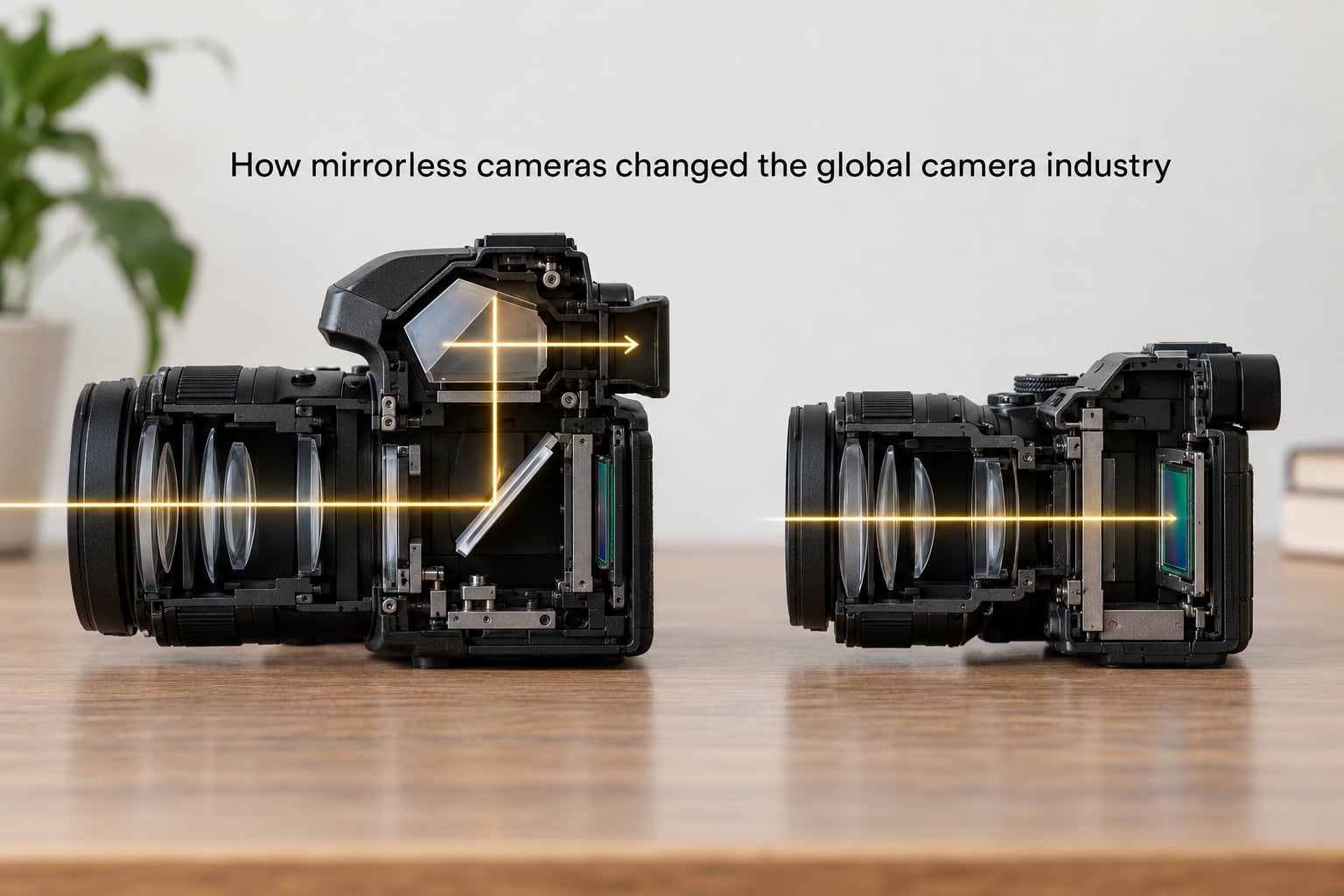
Removing the mirror was only the first change. It shrank the depth of the camera, which freed room for battery, stabilisation hardware and processors, and it let every manufacturer put the same autofocus technology in every body regardless of tier. Sensor output that used to be throttled by a mechanical shutter’s cycle rate became usable for video, and once autofocus was computed on the sensor, moving and still photography used the same focus engine.
Japan’s role in that shift is distinct from everyone else’s. German makers supplied the optical and mechanical craft that made SLRs good in the first place. American engineers defined the single-lens reflex in the 1920s and much of the later autofocus theory. The Japanese contribution was the sensor, the small body, the short flange distance, and the decision to build a whole system around them. The timing also came from Japan: the 2008 launch, the 2012 autofocus breakthrough, the 2013 full-frame reset.
The counterpoint is worth stating. The mirrorless idea was not Japanese. Leica had been making mirrorless cameras since the 1920s and digitised its M rangefinder in 2009. The Epson RD-1 anticipated the design in 2004. What Japan supplied was the industrial and market system that turned the idea into the default.
That system is being tested now. Chinese makers have been building credible mirrorless cameras with fast autofocus and full-frame sensors, and the parts they depend on are largely the same sensor and mount ecosystem Japan built. What Japan has going for it is a supply chain and a lens library that took fifty years to assemble, and what it has working against it is a domestic market that shrank as smartphones took over the job of the keikaibi.
The trade shows. A small Japanese brand can survive on a shrinking home market by selling abroad, but the company that has to survive is usually the one whose camera division is a rounding error inside a bigger electronics group, and that is not a stable base for a craft with a hundred-year history behind it.
Frequently Asked Questions
Did Japan invent the first mirrorless camera?
No. Mirrorless cameras existed before Japan entered the category, because any rangefinder has no reflex mirror. Leica built them from the 1920s and Epson’s RD-1 put a digital sensor in one in 2004. Japan’s contribution was different: Japanese companies built the first mirrorless interchangeable-lens standard that became a mass-market product.
Who made the first commercially successful mirrorless camera?
Olympus and Panasonic, together, in 2008. They announced the Micro Four Thirds standard and released the E-P1 and Lumix G1 within weeks of each other. The point is not either single body but the shared mount, which let both companies grow a lens range. That is what made mirrorless a system rather than a curiosity.
Why did Japanese camera makers develop mirrorless systems?
Because they had the parts and the customers. Japan had decades of precision optical manufacturing, sensor and processor expertise from consumer electronics, and a large domestic market for small cameras. Mirrorless bodies are mostly electronics, sensor work and compact design, which is exactly what Japanese companies were already good at. Japanese camera makers also had less to lose by starting over.
Were mirrorless cameras invented because DSLRs were failing?
Not really. DSLRs were selling well when the first Micro Four Thirds bodies appeared, and the category that mirrorless took over from was the compact camera. Japanese makers treated the small-sensor compact as the machine to replace, and kept the sensor size and body size for years. The DSLR only fell once autofocus, stabilisation and video had clearly moved on.
How did Sony, Olympus, and Panasonic differ in their early mirrorless systems?
Olympus and Panasonic chose Micro Four Thirds and accepted a smaller sensor, betting that a genuinely pocketable body would win over compact-camera owners. Panasonic leaned into video and a Leica lens partnership. Sony’s NEX refused the small sensor, putting a large one in a short body. Sony’s bet set the format’s direction, and its full-frame E-mount in 2013 raised the standard for everyone.
Conclusion
Why mirrorless cameras came from Japan is not a story about one clever idea appearing in one country. It is a story about a manufacturing base, a compact-camera market and a set of corporate incentives that lined up at the same time, and only in Japan. The idea itself was older and more widely spread; the system that outlived every other attempt was Japanese.
If you want to follow the history yourself, take an early mirrorless body and a current one and look at what survived. The short flange distance, the pocketable shape, the sensor doing the autofocus, the viewfinder replaced by a screen, the silent shutter. Every one of them was visible in 2008, and the modern Japanese camera industry is largely the argument for why they stayed.