Japan automates convenience stores because a shrinking working-age population cannot staff tens of thousands of shops that promise to be open around the clock. Why Japan automates convenience stores is not really a story about robots being exciting; it is a staffing arithmetic problem that hardware is being asked to solve. What you see inside a konbini today is a coordinated system, not one magic machine, and most locations still have people on site.
I have spent a while reading the vendor announcements, the operator interviews and the skeptical thread discussions, and the pattern is consistent: automation is being deployed where the labor math hurts most, and it is being kept where a human still adds something customers notice. Below is the breakdown, the technology, and the parts that do not work as smoothly as the demos suggest.
Table of Contents
- 1Why Japan Automates Convenience Stores
- 2What Problems Is Japan Trying to Solve?
- 3How Does a Japanese Convenience Store Use Automation?
- 4What Does the Shopping Experience Look Like?
- 5Why Japan Automates Convenience Stores: The Technology
- 6How Does Automation Affect Store Workers?
- 7Does Automation Mean Japan Has No Cashiers?
- 8What Are the Limits and Trade-Offs?
- 9What Does This Model Mean for Retail and Technology?
- 10Frequently Asked Questions
- 11Why does Japan automate convenience stores?
- 12Are convenience stores in Japan fully unmanned?
- 13What technology is used in Japanese convenience stores?
- 14Does automation remove all cashier jobs?
- 15Why is Japan’s convenience-store model hard for other countries to copy?
- 16Conclusion
Why Japan Automates Convenience Stores
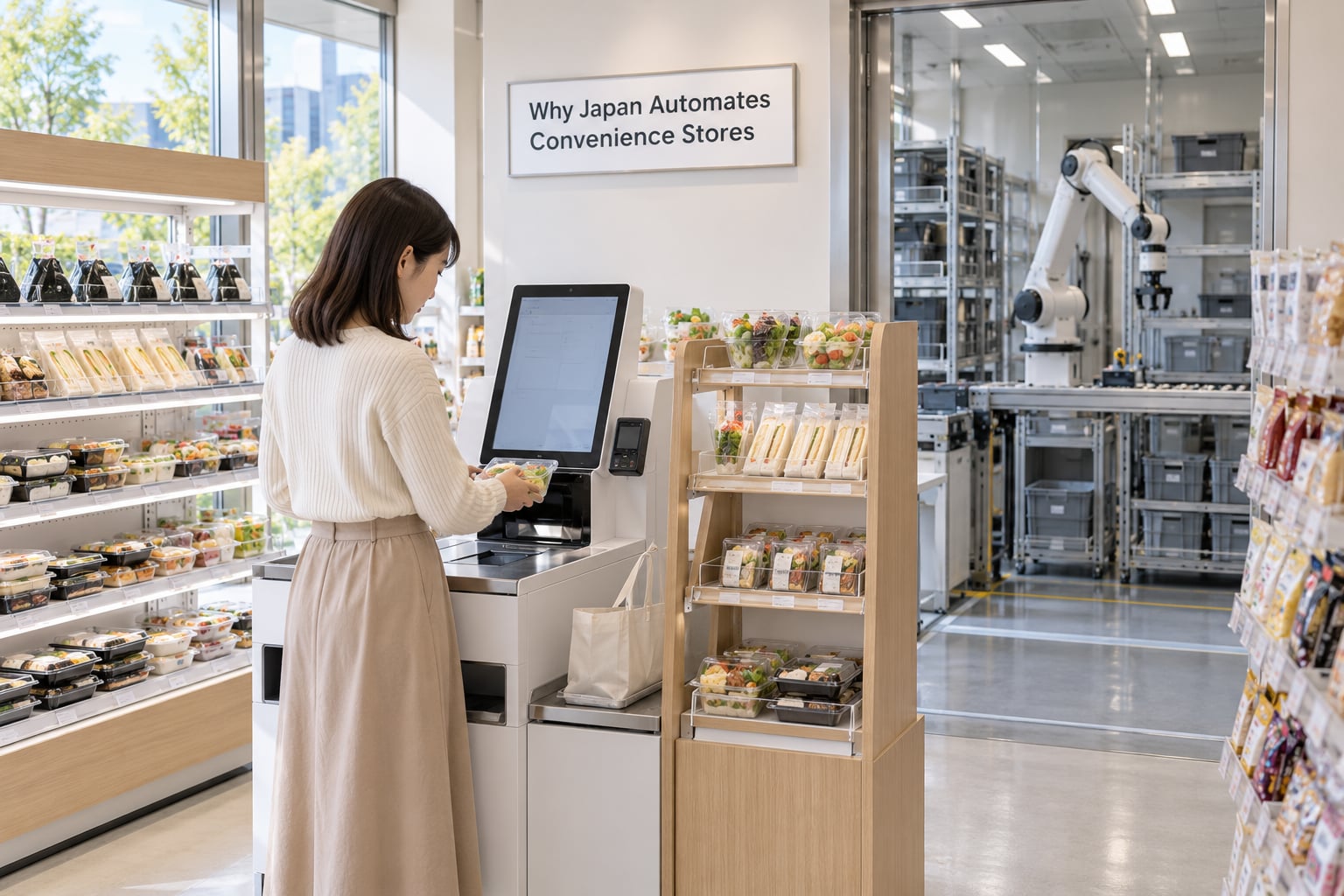
The short answer is a collision between demography and service expectations. Japan has roughly the population of California spread across a very dense, very urban retail landscape, and convenience stores are expected to serve a hot bento, a printed ticket, a bank transfer, a cold beer and a pack of cigarettes at two in the morning. That promise has always been kept with a thin layer of full-time staff plus a large part-time workforce, and the part-time workforce is shrinking faster than the chains can replace it.
Retirement is the visible side. Minimum wage increases and tighter rules on working hours make the arithmetic worse, because a store that used to cover the 1am to 5am shift with three people now has difficulty staffing one. Store density is the less discussed side: the network was sized for a larger working-age population, and the population has moved on.
So the answer to why Japan automates convenience stores is mostly about hours. Machines are good at covering the hours nobody wants, moving heavy drinks at three in the morning, and keeping a payment terminal alive. They are not good at explaining a refund, judging a customer who looks lost, or cooking something to order. That split is where every real store ends up.
What Problems Is Japan Trying to Solve?
Strip away the technology and there are six pressures pushing in the same direction. Each one is a business problem first and an engineering problem second.
- Demographics. A declining birth rate and a large retiring cohort mean the pool of people available to work a Saturday night shift keeps shrinking. Any store open 24 hours needs either more hours from fewer people or a different way to cover them.
- Part-time turnover. Convenience retail runs on part-time staff, and that pool is now competitive with food service, delivery driving and warehouse work. Retention is hard, so a store can lose a trained person and spend months rebuilding a rota.
- Rising labor cost. Wage increases in Japan have been phased in over several years rather than announced overnight, which gives chains time to plan, but it still moves labor from a cost line toward a strategic problem.
- Long opening hours. A convenience store that closes at midnight stops being a convenience store. The 24-hour promise is the product, and automation is the only realistic way to keep it with a smaller crew.
- Store density in tight urban space. Most konbini are small, with a narrow floor and a back room full of equipment. There is no floor space to expand the staff area, so productivity has to come from equipment.
- Service breadth. A Japanese convenience store sells food, tickets, prepaid cards, photocopies, laundry services, bank transfers and alcohol. Every one of those is a task that used to require a person at the counter.
Not one of these pressures says the store should be empty of humans. They say the store should need fewer people per hour, especially at night, which is a much narrower and more achievable target.
How Does a Japanese Convenience Store Use Automation?
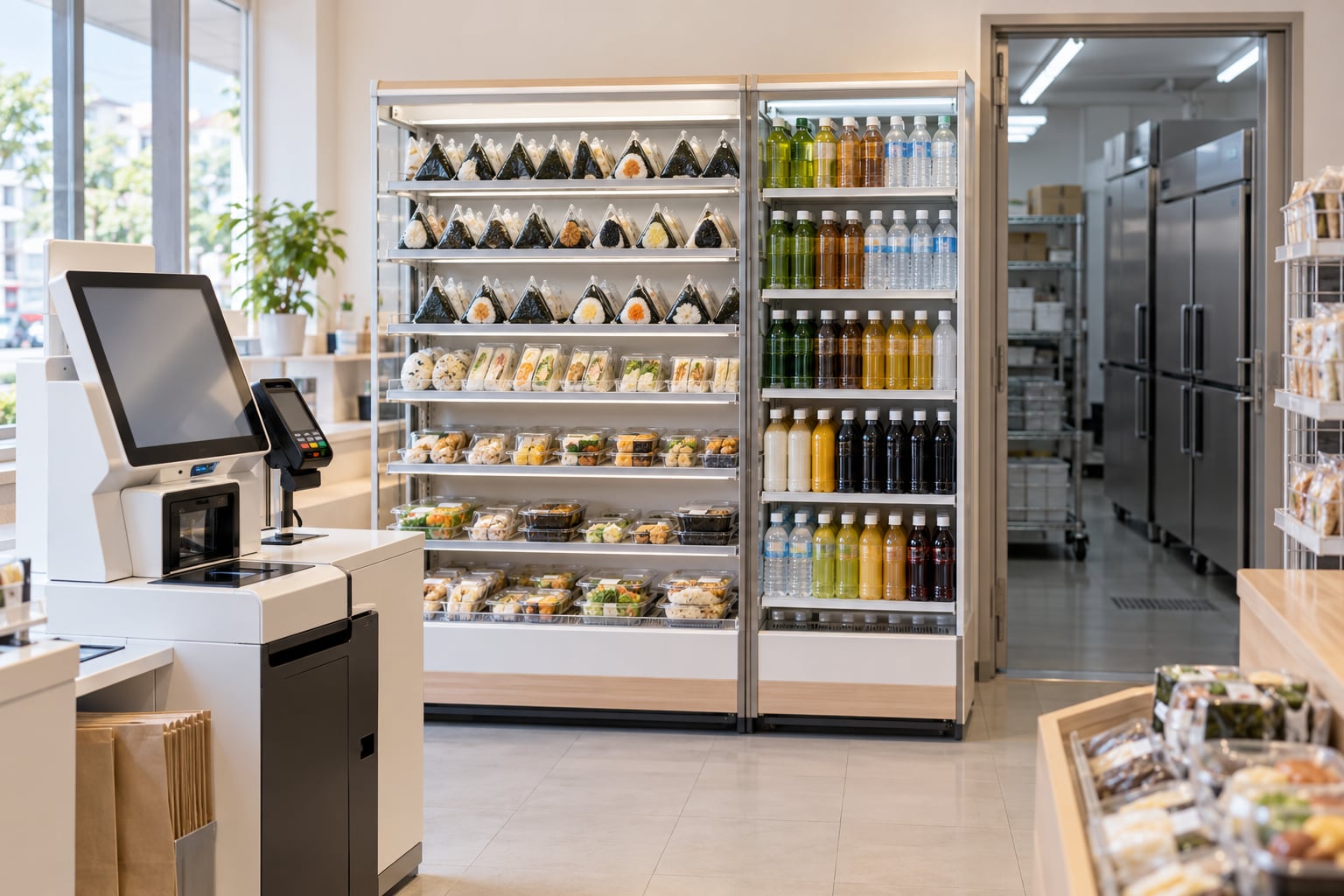
Two layers, mostly. The customer-facing layer includes self-checkout kiosks, touch-activated price rails, digital signage, camera-based queue and product analytics, and in some trial stores an avatar on a screen that handles questions and, in certain formats, age verification for tobacco sales. Payment is increasingly tap, phone or cashless, with cash still accepted at nearly every counter.
The back layer does the invisible work: robots that replenish chilled drinks and move from the back room to the sales floor, automated fried-food cooking, floor cleaning machines, refrigerated back rooms sized to hold a full day of deliveries, and inventory systems that use image recognition to judge what is left on a shelf. Electronics shelf labels show up in some formats to change prices without a printed tag.
Practice varies a lot by chain, by store size, and by which equipment supplier built the back room. A flagship demonstration store in Tokyo and a neighborhood location on a suburban road can be running entirely different systems on the same day.
What Does the Shopping Experience Look Like?
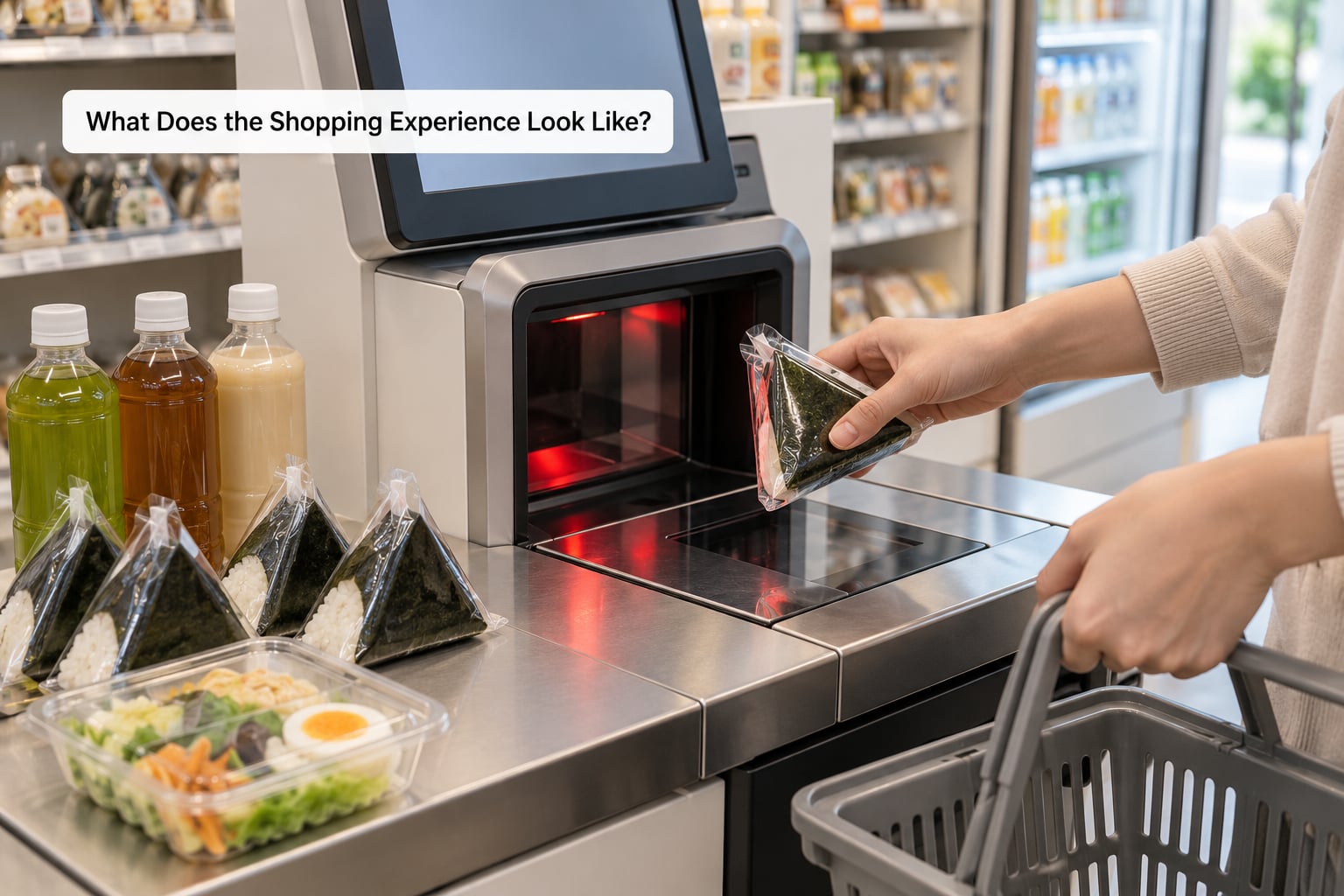
Entering is mostly unremarkable. A door, sometimes a facial-recognition reader in trial locations, then the sales floor. A camera system counts shoppers, measures how long the queue is, and watches what people pick up, which feeds both the digital signage and the ordering decisions for the next delivery.
At the till, you scan each item yourself, bag it yourself, and pay. In the Lawson Real×Tech demonstration store, which opened in June 2025 in Tokyo, touching a price rail lights up a product page on a screen, and an avatar guides the checkout flow. Elsewhere you may find a staffed register next to a self-checkout lane, and a human right there, because a person is still faster with a full basket or an unfamiliar coupon.
Food is the part people notice most. Fresh items are cooked on a schedule rather than to order, so availability depends on volume rather than on whether someone is free to fry it. Pick up a heated bun, and a microwave is usually a few steps away. Pay, take your receipt, go.
What you will not find in most locations is a truly empty shop. Threads on r/japannews and r/singularity are split on this, and both sides have a point: many people visiting automated stores report shorter or no queues and full shelves, and equally many still saw a person on the floor when they walked in.
Why Japan Automates Convenience Stores: The Technology
Each piece of equipment exists because a specific task became expensive or hard to staff. Here is the mapping, with the limitation attached to each one, because the limitation is usually what determines whether a system gets rolled out to the next store.
| Automation goal | Common technology | Operational benefit | Limitation |
|---|---|---|---|
| Replenishing chilled drinks | Shelf robots such as Telexistence TX SCARA, built for FamilyMart and Lawson | Covers the overnight and early-morning gap that staff avoid | Limited autonomy, so it needs a fallback when it misjudges a shelf |
| Grabbing stock from high shelves | Telescopic arm robots including TX Ghost | Reaches the top rows of a tall drink chiller safely | Slow cycle times, and still a machine moving glass and plastic |
| Remote takeover | Teleoperation from a control room, operators in the Philippines wearing VR headsets | One operator can watch roughly 50 robots and step in on exceptions | Reported error rate of about 4 percent, so human judgment is part of the loop, not a backup |
| Reducing checkout time | Self-checkout, RFID-tagged items, walk-through payment in trial formats | Shortens queues at peak times such as the evening commute | Mixed baskets and payment errors push shoppers to the staffed lane |
| Knowing what is on the shelf | Computer vision and edge-AI sensors, including the Sony IMX500 platform | Reduces blind spots and waste on short-lived prepared food | Camera-based analytics raises real privacy objections |
| Preparing hot food | Automated fryers and scheduled cooking cycles | Hot items available at any hour without a cook on shift | Production is forecast-based, so end-of-night waste is a recurring issue |
| Cleaning and floor care | Autonomous floor cleaning machines | Takes repetitive work off the overnight shift | Breakdown during a shift with no staff on site |
| Assisting customers | AI avatar on a screen, including age-verification prompts for tobacco | Handles simple questions and routine checks consistently | Struggles with complaints, refunds and anything unusual |
Two patterns stand out. The successful systems are the boring ones, like drink replenishment and floor cleaning, where the task is repetitive and the environment is controlled. And the robots with the most attention are the ones with the least autonomy, which is exactly why the tele-operation model is where a lot of the real work sits.
How Does Automation Affect Store Workers?
Mostly it reorganizes the job rather than deleting it. The overnight shift that used to be three people becomes one person overseeing machines, or a smaller crew covering a wider area. Restocking heavy cases moves from a human back to a robot arm, and the time that frees up goes to food quality, cleaning, and the floor.
New roles appear as well. Chains now need people who can manage a robot fleet, handle exceptions when the system is unsure, and keep a store presentable when the till runs itself. That is a different skill set from what a chain hired for five years ago.
I would not claim mass job losses from this, and neither does the available evidence. The honest statement is that headcount per store is falling faster than store count, and the difference is being absorbed by reduced coverage at the hours that were hardest to staff. Chains differ here, and so do formats.
Does Automation Mean Japan Has No Cashiers?
No. It means some registers are self-service and a human is close enough to fix a problem. A store that mixes a self-checkout lane, a staffed counter and a back-room robot is the normal case, not the exception.
There are good reasons to keep a person present. Payment is still genuinely complicated, with cash, cards, phone, prepaid cards, tickets and utility bills in the same basket. Age-restricted sales need a check that many formats handle with a screen prompt, though some customers and some regulators expect a human confirmation. And an elderly or first-time visitor in a small store at night deserves someone to ask.
Reliability is the other reason. A checkout that fails at 2am has to reach someone. Chains build that into the design, which is why a person remains part of the architecture even in a heavily automated site.
What Are the Limits and Trade-Offs?
Capex is the first one. Robots, chiller systems, camera networks and a purpose-built back room cost real money per store, and the payback depends on labor savings that vary by location. A busy urban site can justify it faster than a quiet rural one.
Downtime is the second. A 24-hour store with nobody on site cannot wait for a repair visit, so maintenance contracts and remote diagnostics matter as much as the robot itself. If a payment system or a refrigeration unit fails during a quiet night, the customer is standing in a closed shop with no one to call.
Privacy is the third. Camera systems that watch which products a person picks up are functionally close to behavioral tracking, and consumers notice. Chains have to explain data retention clearly, or the technology becomes the story instead of the service.
Then there are the hard physical ones. Glass bottles break. Prepared food has a shelf life that forecast models only approximate. Complex baskets defeat automated payment. And a store built on hospitality, the Japanese idea of anticipating what a customer needs before they ask, resists automation at the exact point where the service is most personal. Automation works best where the process is already standardized.
What Does This Model Mean for Retail and Technology?
The transferable lesson is that the store is the product. Japan’s advantage is not any single robot; it is tight urban space, dense supplier delivery routes, a cultural expectation of fast service, and a product mix of standardized items that a machine can handle. Automation plus that infrastructure works, and the pieces are hard to separate.
That is also why the model does not export easily. Wages, store size, delivery frequency, product mix and customer tolerance all differ. A robotics company can sell a shelf robot anywhere, but the store economics behind it often cannot move.
For founders and marketers, the practical takeaway is to look at which hours, tasks and products are actually painful before reaching for hardware. Japanese chains started with the boring overnight work, not the front counter, and that is the pattern that tends to hold up.
Frequently Asked Questions
Why does Japan automate convenience stores?
Because the labor to staff them no longer exists in sufficient numbers. A shrinking working-age population and a harder part-time job market collide with a 24-hour promise, so chains use robots, self-checkout and tele-operated systems to cover the hours people will not work. The goal is fewer staff hours per store, not empty shops.
Are convenience stores in Japan fully unmanned?
Only a minority. Most locations mix self-checkout with a staffed counter, a back room and visible staff on the floor. Trial formats go further, with camera entry, price rails and avatar-assisted shopping, but stores carrying tickets, prepaid cards, hot food and tobacco still tend to keep people. Automated is common; unmanned is the exception.
What technology is used in Japanese convenience stores?
Shelf robots from Telexistence refill chilled drinks, including TX SCARA and TX Ghost arm models. Remote operators in the Philippines take over through VR when a robot stalls. Stores also use self-checkout and RFID checkout, computer vision and edge-AI sensors such as the Sony IMX500 platform, automated fryers, floor cleaning robots and avatar screens.
Does automation remove all cashier jobs?
No. It reduces the hours needed per store, particularly overnight, and it shifts the role toward machine supervision, restocking, food quality and customer handling. Chains report lower staffing per location rather than closed stores, and the impact differs by chain and format. New jobs also appear around robot fleets and exception handling.
Why is Japan’s convenience-store model hard for other countries to copy?
The store is the product, and the economics come from Japanese conditions: dense cities, small footprints, frequent supplier deliveries, a product mix of standardized items and customers who expect fast service. Change wages, store size, delivery frequency or service expectations and the automation math breaks. The robots travel, the business model does not.
Conclusion
So why Japan automates convenience stores comes down to a single stubborn fact: the stores must stay open, and the people who used to open them at 3am are not there anymore. Everything else, from drink robots to VR headsets in Manila to avatars on screen, is a response to that.
If you want to understand the model, look at four things together: labor pressure, standardized products, very tight urban space, and customers who will not accept a slow shop. Japan automates the whole system around those four, not one piece of futuristic hardware, and that is the part most easily missed when the topic gets reduced to a robot video.