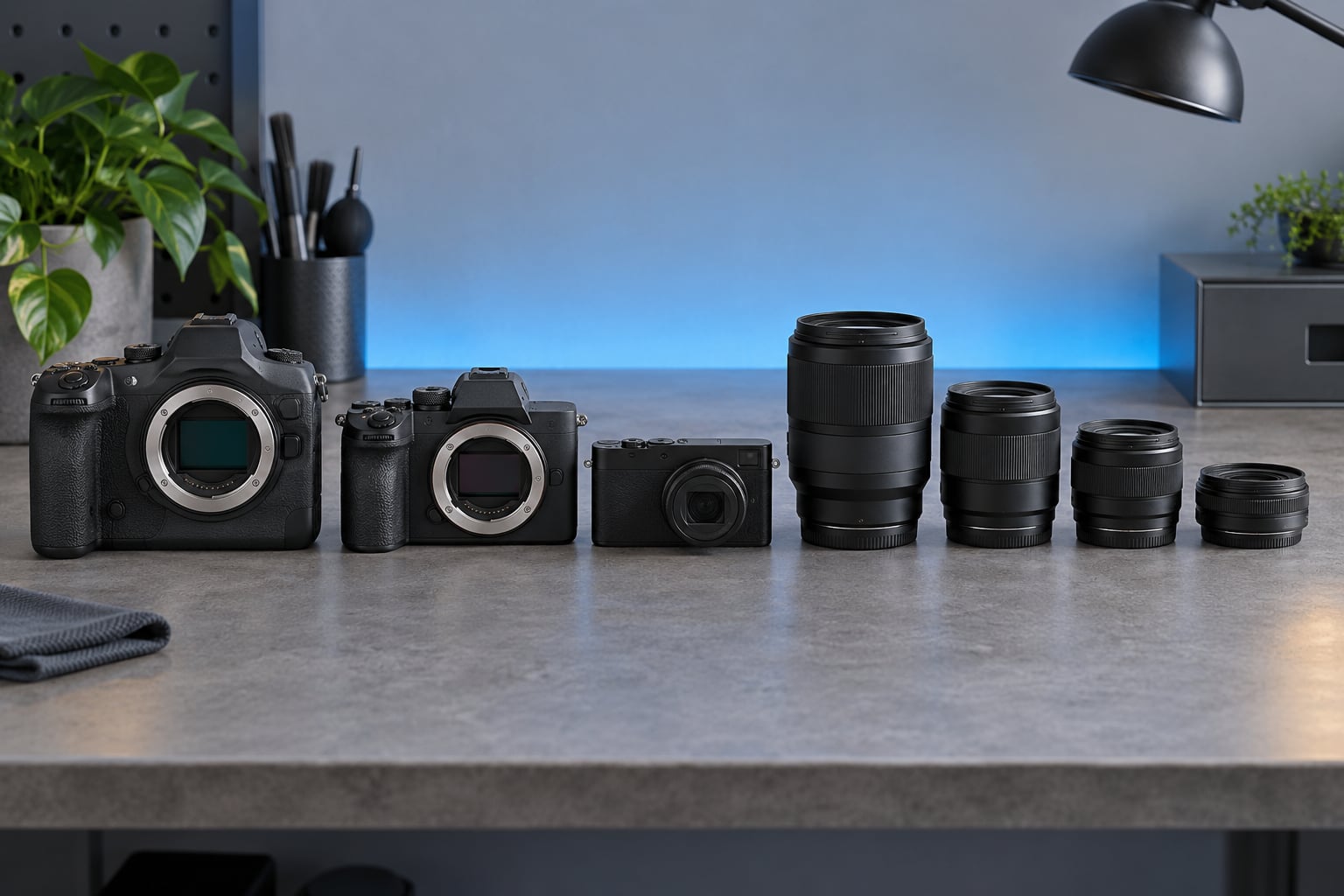
Japanese camera makers stayed competitive because they kept changing what the product was while defending what made them good. Kodak invented the digital camera and lost anyway, which tells you the invention was never the hard part.
Start with the paradox. In 1975 an engineer at Kodak built the first self-contained digital camera, and roughly forty years later Kodak filed for bankruptcy. Meanwhile a company that started as a lens supplier for a German rangefinder ended up selling more cameras than anyone on earth. Knowing how Japanese camera makers stayed competitive means looking at manufacturing, iteration speed and product decisions, not at who filed the patent first.
Table of Contents
- 1How Japanese Camera Makers Stayed Competitive in the Digital Era
- 2Vertical integration: making it all in house
- 3How Japanese camera makers stayed ahead of the curve
- 4Leading new formats instead of defending old ones
- 5The lens ecosystem as a business moat
- 6Price segmentation from entry to professional
- 7Export-first from the very beginning
- 8Why Were Japanese Camera Makers So Strong?
- 9How Did Japanese Makers Respond to Digital Cameras?
- 10How Did Japanese Makers Compete With Smartphones?
- 11Why Did Mirrorless Cameras Matter?
- 12How Lenses, Autofocus, and Video Reinforced the Strategy
- 13Where Japanese Camera Makers Are Still Competitive
- 14What Limits Remain?
- 15Frequently Asked Questions
- 16Why are Japanese camera makers still relevant when smartphones dominate?
- 17Did Japanese manufacturers invent mirrorless cameras?
- 18How did Japanese camera companies compete in the transition from film to digital?
- 19Why are lenses often considered more important than the camera body?
- 20What made Japanese mirrorless cameras competitive with established systems?
- 21Can Japanese camera makers recover volume in the consumer market?
- 22Conclusion
How Japanese Camera Makers Stayed Competitive in the Digital Era
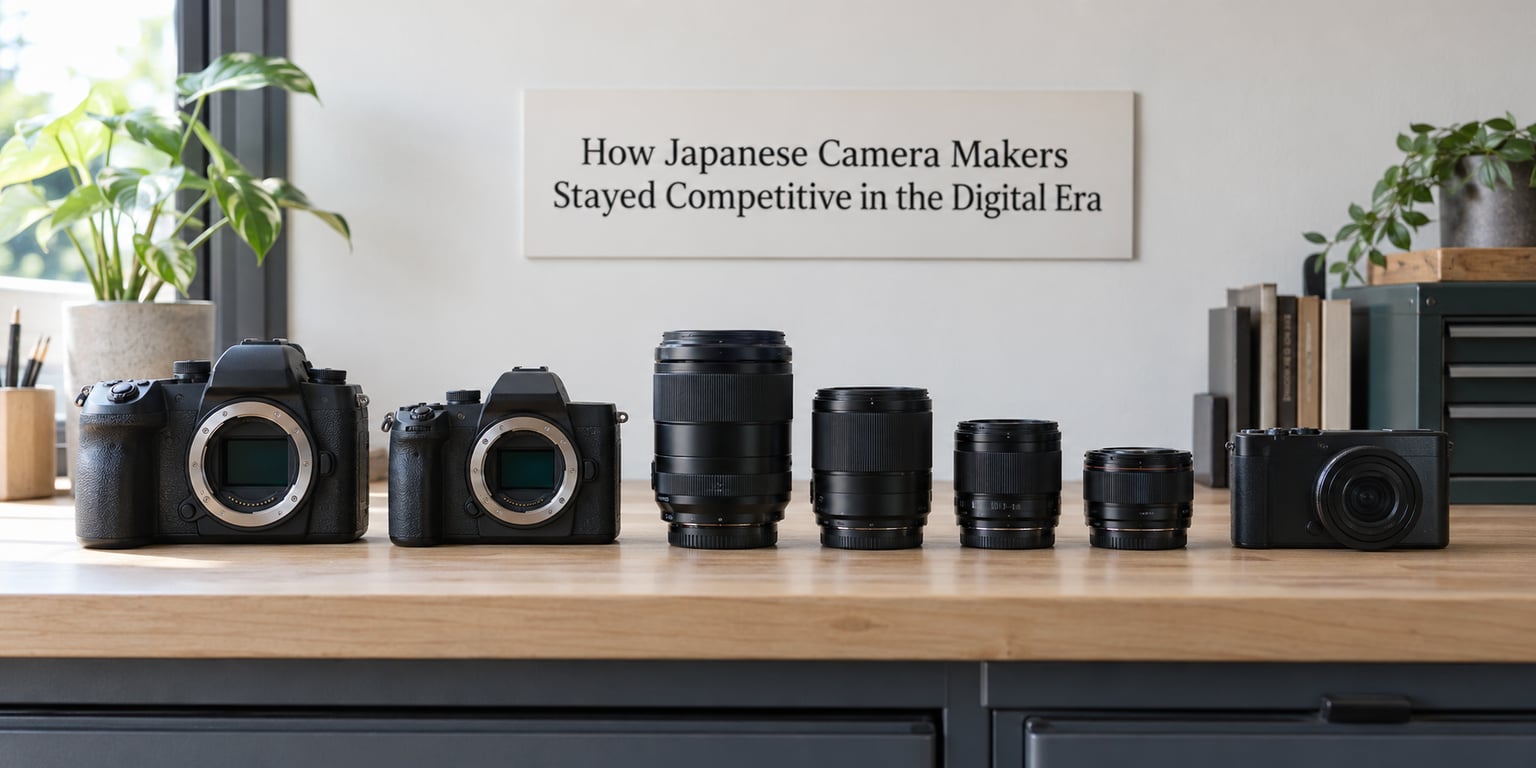
They stayed competitive by running seven strategies at once: keeping design, sensors and manufacturing in house, releasing new models on short cycles, leading each new format rather than defending the old one, building deep lens line-ups that make switching expensive, covering every price tier, exporting from the start, and moving into professional video when consumer volume collapsed.
Canon, Nikon, Sony, Fujifilm, Olympus, Minolta, Pentax and Konica each ran a different subset of that list, but every surviving maker ran the first four. Those are the ones that compound.
Vertical integration: making it all in house
Japanese makers designed their own lenses, shutter mechanisms, sensors, processors and bodies, and much of the manufacturing stayed in Japan. That control let them change a part without renegotiating with a supplier, which is why new models could ship a year or two after an idea was agreed.
How Japanese camera makers stayed ahead of the curve
Short cycles were the quiet advantage. A manufacturer could launch a body, watch what photographers and reviewers disliked, and revise within eighteen months. Western companies had to plan around longer product cycles and heavier fixed costs, so a mistake stayed expensive for years.
Leading new formats instead of defending old ones
Canon pushed electronic autofocus and then the EOS lens mount. Nikon moved early on digital reflex bodies. Sony arrived with the E-mount already attached to a slate of third-party lenses. Each switch cost short-term revenue and bought a decade of relevance.
The lens ecosystem as a business moat
A mount is a promise. Once you own three lenses, the cheapest upgrade is a body from the same brand, so lens sales pull body sales forward for a decade. It is the strongest economic moat in the business, and it is also the thing photographers fear most when a brand changes direction.
Price segmentation from entry to professional
Each maker ran a ladder rather than a single product. Consumer compacts earned attention and shelf space, APS-C bodies captured enthusiasts, and full-frame professional models carried the margin. The low end also gave engineers a way to move components down the range over time.
Export-first from the very beginning
Domestic Japanese demand for serious cameras was small, so export was not an afterthought. Minolta built its reputation on focused production aimed at overseas buyers, and most rivals followed. A business that could not sell at home learned to sell everywhere very quickly.
Why Were Japanese Camera Makers So Strong?
The foundations were older than the camera boom. Precision machining, metalworking and small-batch craft already existed in Japan before the war, and wartime work in optical instruments for the German and American sides gave engineers a hard technical education at industrial scale.
Canon began in 1937 as a supplier of lenses for Leica rangefinder cameras. Nippon Kogaku, founded as a joint venture with German optics firms, became Nikon and quickly claimed a reputation for quality. Minolta, Asahi (later Pentax), Konica and Olympus each built around a specialist skill, whether that was shutters, lenses or light meters.
What the postwar industry added was a dense supplier network near a single manufacturing corridor, plus an export-first habit. Cameras were treated as a manufacturing problem with a marketing wrapper, and the wrapper mattered less than the ability to hold tolerances and ship on schedule.
Two other factors reinforced the base. Japanese makers standardised around the 35mm film frame early, which made lenses interchangeable in a way that encouraged volume. And keiretsu banking ties meant a firm could fund a long product cycle without the quarterly pressure a US public company would face.
How Did Japanese Makers Respond to Digital Cameras?
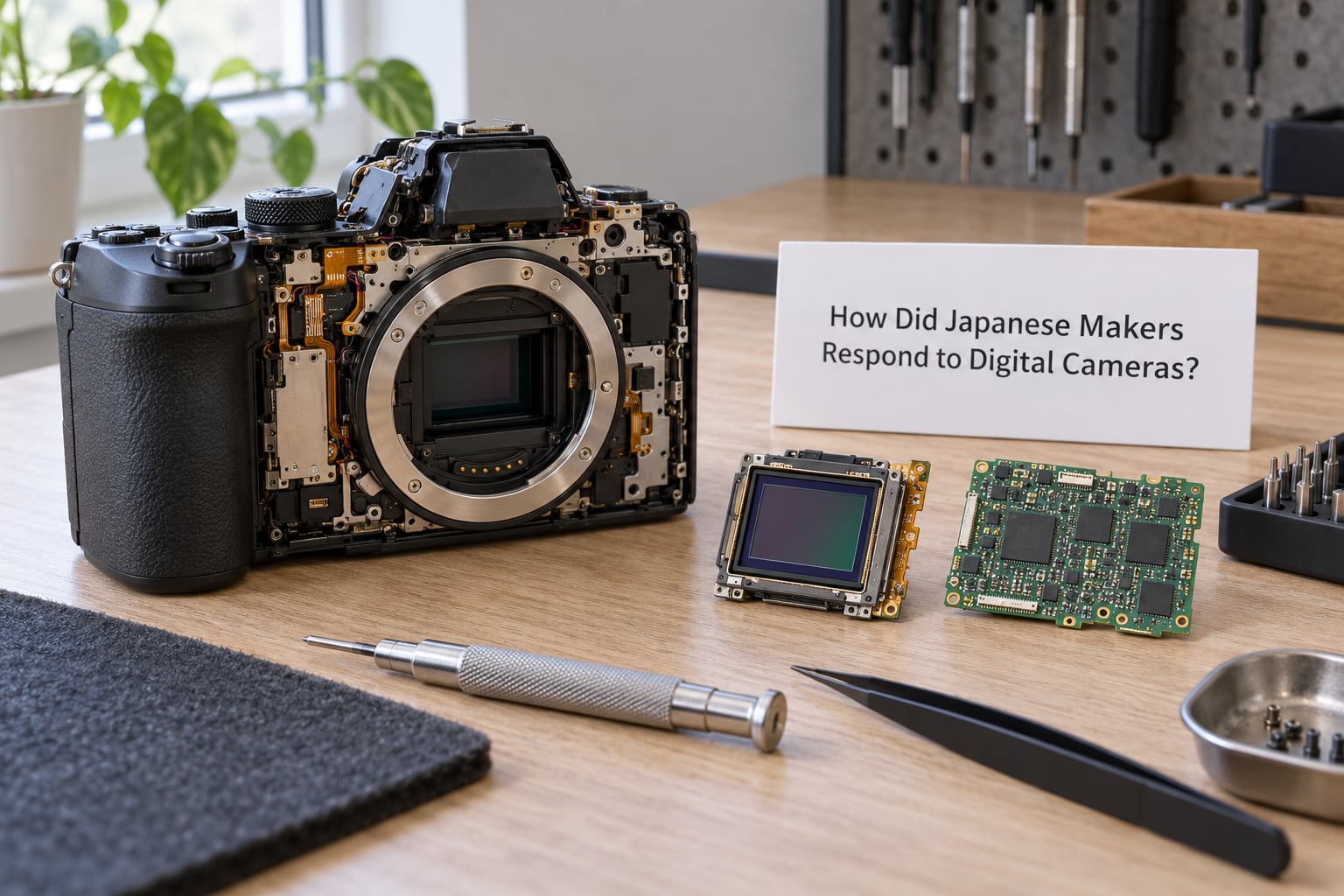
They treated digital as a shorter-cycle business and rebuilt their skills around electronics. Film makers knew chemistry and glass. Digital required CMOS sensor design, noise control, image processors, compression, LCD panels, storage formats and firmware, so the companies that invested hardest in in-house electronics ended up ahead.
Canon released the EOS D30 in 2000 and followed with the 300D and the full-frame 1D Mark III, which put Canon at the centre of the professional digital world. Nikon had entered reflex digital earlier with the D1 and D2, and its long lenses made it instantly credible in sports and wildlife. Sony arrived with sensor manufacturing already in the building, an advantage nobody in the camera industry had before.
The awkward part was the compact camera. Japanese manufacturers had built enormous scale in small point-and-shoot models, and smartphones erased that category almost overnight. The companies that had overbuilt commodity compacts lost the most from it.
How Did Japanese Makers Compete With Smartphones?
They stopped competing on the phone’s terms. A smartphone camera is unbeatable for convenience and unbeatable for quality at arm’s length, so the remaining professional cameras had to offer what a phone cannot: optical zoom, a real sensor, interchangeable glass, high burst rates and dependable autofocus in bad light.
That is where long-zoom compacts, weather-sealed bodies and small fixed-lens cameras found their market, and where professional video work kept a large slice of the engineering base alive. Professionals on the DPReview forums have long argued that margin lives in cinema and pro video rather than in consumer stills, and the corporate behaviour matches the argument.
There is a counter-trend worth naming. Younger shooters keep buying small digital and film cameras for the way they look and behave, not for image quality. Forum regulars note the practical trust signal that comes from a camera bought years ago still working today, which is exactly the durability reputation Japanese makers built over decades.
Why Did Mirrorless Cameras Matter?
Mirrorless mattered because it let Japanese makers delete mechanical complexity without giving up the parts they were best at. Removing the reflex mirror and viewfinder assembly cut weight, thickness, vibration and cost, and left room for a sensor that could move or for a stabiliser built into the body.
The features that made digital cameras good survived the move intact or got better. On-sensor phase-detect autofocus turned the imaging sensor itself into the autofocus module, which produced the near-silent, fast, always-working focus that defines current mirrorless bodies. In-body stabilisation arrived in mirrorless first. Autofocus subject recognition was mostly worked out on mirrorless bodies.
Sony and Fujifilm committed early and used time to build mount depth. Canon entered later but brought a large professional user base with it. Nikon’s Z system arrived after its long delay in mirrorless, a misstep that photographer communities have criticised repeatedly, and one reason users still rank Canon and Sony mounts as the safest long-term bets.
How Lenses, Autofocus, and Video Reinforced the Strategy
Lenses are where the strategy becomes money. A mount that stays open for fifteen years invites third-party makers to develop for it, so third-party lenses appear early, buyers spend more, and the brand collects mount revenue without manufacturing every lens itself. That feedback loop is why mount stability now gets treated as a product feature.
Autofocus is where the electronics skill shows. Competitive shooting depends on tracking a subject across a frame while the camera makes thousands of corrections a second, which is a processor and sensor problem rather than a mechanical one. Japanese makers that own the sensor pipeline control the response curve, and they tune it in ways that feel like brand character.
Video reinforced all of it because professional video is a sensor, codec and lens problem wearing a camera body. Stabilisation, colour science, log profiles and long recording behaviour decide whether a body can earn money on a set. Fujifilm’s film simulations made colour a selling point photographers could name in advance; Sony’s sensor scale made low-light and video the default argument for its system.
Where Japanese Camera Makers Are Still Competitive
Japanese makers remain competitive where a sensor, glass and a processor have to work together, and where the buyer is paid for the result. Interchangeable lenses, professional video, cinema cameras, scientific and space imaging, industrial imaging and specialised compacts are all areas where the last ten years added capability instead of removing it.
CIPA shipment statistics for digital cameras in 2022 show how concentrated that position became. Canon held 46.5 percent of the global market, Sony 26.1 percent, and every other maker, Nikon included, competed in what remained.
| Brand | 2022 digital camera shipments | Share of global total |
|---|---|---|
| Canon | 3.35 million | 46.5% |
| Sony | 1.88 million | 26.1% |
| All other makers | Combined remainder | 27.4% |
Brand by brand, the positions differ. Canon leads on volume, lenses and dual-lens body options. Sony leads on sensor technology, autofocus and video, and its E-mount attracts third-party makers. Nikon holds a devoted base with exceptional optics and long telephoto lenses. Fujifilm grew through distinct film simulations and a deliberate move to APS-C. OM System inherited Micro Four Thirds, the small-sensor system co-developed with Olympus and still prized for size. Panasonic kept the format commercially alive while treating stills as a side business. Ricoh and Pentax serve compact and enthusiast niches with committed audiences.
Scientific imaging is a quieter strength. NASA has flown Nikon lenses on missions for decades, an endurance record that opened when the optics worked and stayed shut when they kept working.
What Limits Remain?
Volume will not come back. Nikkei Asia reported the seven leading Japanese digital camera makers expecting worldwide sales to fall about 29 percent in a single year to 64.23 million shipments, and the direction has been one way for more than a decade. No strategy recovers a category a phone already won at a lower price with better convenience.
Technology cycles also run against them. Phone makers ship new cameras yearly with large sensor teams and no legacy mount to protect, while a camera body takes years of validation and a lens takes longer. Premium systems keep rising in price, which narrows who the industry can serve and makes every new entry point feel expensive.
Consolidation is the industry’s own argument about itself. Olympus sold its imaging business to private equity, rebranded as OM System, and Panasonic’s still-camera operation has repeatedly been treated as a margin add-on to its professional video arm. Discussants on photography forums put it plainly: when a segment shrinks, companies either get bought or they go bust. That is not a prediction of failure for the big three. It is an explanation of why the list of Japanese camera brands keeps getting shorter while the survivors keep getting stronger.
Frequently Asked Questions
Why are Japanese camera makers still relevant when smartphones dominate?
A phone handles convenience shots well, and it always will. Japanese makers compete on what a phone cannot do: optical zoom, interchangeable lenses, a large sensor, high burst rates and autofocus that survives bad light. They also sell to people paid for the result, in press, sport, wildlife, events and film work, where a missed frame costs money.
Did Japanese manufacturers invent mirrorless cameras?
They refined and commercialised the format rather than conceiving it alone. Olympus and Panasonic defined the Micro Four Thirds standard in 2008 as a way to remove the reflex mirror while keeping interchangeable lenses, and Sony, Panasonic, Olympus and Fujifilm introduced the first mirrorless system cameras around 2010. Earlier prototype work existed elsewhere, including at Kodak and in academic labs.
How did Japanese camera companies compete in the transition from film to digital?
They rebuilt around electronics instead of chemistry. Sensor design, noise control, image processors, compression, LCD screens and storage moved in-house, and product cycles shortened so new models arrived every year or two. Makers who moved early, such as Canon and Nikon, converted their professional credibility to digital; makers over-invested in commodity compact cameras had the most to lose.
Why are lenses often considered more important than the camera body?
Glass is what sets image quality, and a lens lasts far longer than a body. A fifteen-year-old lens still produces usable files while a fifteen-year-old body often cannot. Because the mount ties lenses to the brand, buying into a system means buying the upgrade path too, which is why photographers judge a mount’s longevity more carefully than any specification on the box.
What made Japanese mirrorless cameras competitive with established systems?
Deleting the mirror removed weight, cost and vibration, and freed space for stabiliser hardware and a movable sensor. Features that were invented for mirrorless, including on-sensor phase-detect autofocus, in-body stabilisation and reliable subject-recognition tracking, pushed the format ahead rather than behind. A mature lens ecosystem then gave buyers a reason to switch that did not exist in 2010.
Can Japanese camera makers recover volume in the consumer market?
Not the volume they had, and the honest answer is no. Compact point-and-shoot sales collapsed as phones improved, and nothing rebuilds that in a way that makes economic sense. The recoverable part sits in higher-value segments instead: full-frame stills, professional video, cinema, lenses and industrial imaging, where margins and engineering depth protect the business from unit-count declines.
Conclusion
Tradition did not keep Japanese camera makers competitive. Adaptability did. Kodak held the original digital patent and the brand, and it still lost, because owning an invention is not the same as being organised to ship one every year or knowing which category to abandon. Canon, Nikon, Sony and Fujifilm survived by moving first into digital, first into mirrorless, and out of compact cameras when staying put started to cost more than leaving.
If you are buying rather than studying history, start by matching the category to the job. A point-and-shoot or a phone covers everyday shooting. A mirrorless body with interchangeable lenses covers everything from sport to events. A dedicated cinema or pro video setup covers paid motion work. Decide which job you actually have, then buy the system with the lenses that job needs, because the lenses are the part you will keep longest.