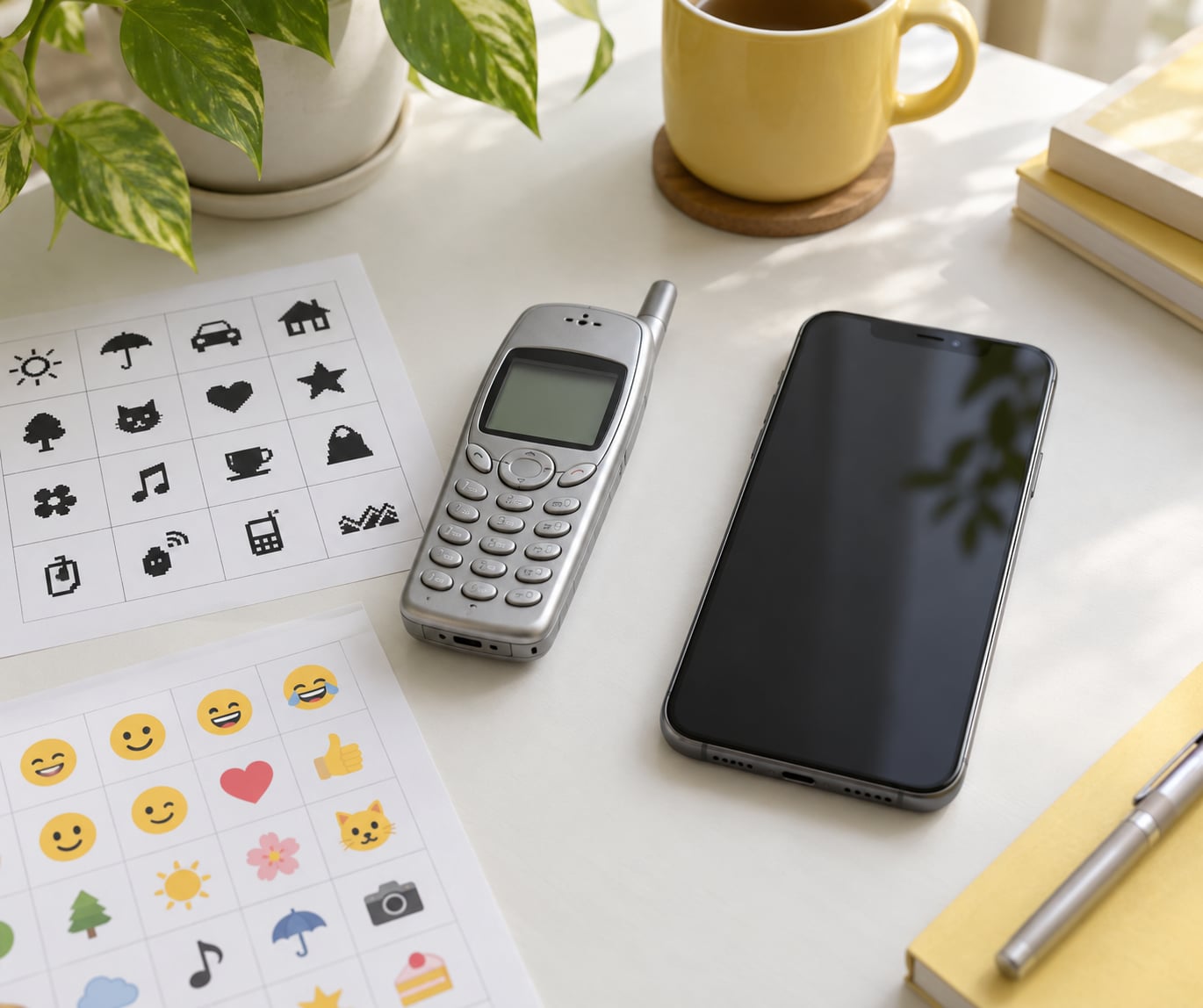
Emoji were invented in Japan in the 1990s, when mobile phone screens were too small and message limits too tight for words alone. The first widely recognized set came from designer Shigetaka Kurita at NTT DoCoMo in 1999: 176 tiny black-and-white picture symbols built for a 12×12 pixel grid, made to carry meaning inside i-mode’s 250-character mail limit.
That single inventor story is only half right, and it’s the half that keeps getting repeated. Emoji grew out of a Japanese mobile culture that already had emoticons, kaomoji and pager symbols before Kurita drew anything, and the global system that followed needed engineers at Google, Apple and the Unicode Consortium as much as it needed one designer.
Table of Contents
- 1What Are Emoji and Where Did They Come From?
- 2What the original 176 covered
- 3How Emoji Were Invented in Japan’s Mobile Phone Era
- 4How emoji were invented in Japan before NTT DoCoMo
- 5Why kaomoji and emoticons came first
- 6From NTT Docomo’s 1999 Emoji to 3G
- 7The Main People and Teams Behind Japanese Emoji
- 8How Did Emoji Reach the Internet and Become Standard?
- 9What Changed When Emoji Became Global?
- 10Who owns emoji and who gets paid for them
- 11Why Are Many Popular Emoji Symbols Animals?
- 12A Timeline of Emoji’s Invention and Adoption
- 13Frequently Asked Questions
- 14Who invented emoji?
- 15Did NTT Docomo invent all emoji?
- 16What does the word emoji mean?
- 17Were emoji invented before smartphones?
- 18Are emoji Japanese characters or symbols?
- 19How did Japanese emoji become global?
- 20Conclusion
What Are Emoji and Where Did They Come From?
An emoji is a pictographic character, not an illustration you paste in. The word is Japanese: e (絵) means picture, moji (文字) means character. Together they describe small images that live inside text, so a sentence can carry tone as well as meaning.
They came from Japanese mobile phones. Picture symbols had to survive a 12×12 pixel grid, a monochrome screen and a keypad with a dozen buttons, which is a design problem far harsher than drawing for a desktop. Once those symbols were standardised into Unicode, any computer could display them, and a phone-specific shortcut became part of everyday digital language.
That distinction matters more than it sounds. An emoji occupies one slot in a text message, so it travels, reflows and scales like a letter does, even though most people pick it from a grid of pictures rather than typing it. A sticker, by comparison, is a large image that replaces a whole message, and Japan still prefers those.
What the original 176 covered
The first set is worth looking at closely, because almost everything in it came from a real communication need rather than decoration.
- Weather and nature: sun, cloud, rain, snow, wind, umbrella, moon phases
- Emotion and body: a heart, a smiling face, a smiling face with open hands, footprints
- Everyday objects: a key, a bag, a pencil, a telephone, a television
- Travel and infrastructure: cars, trains, aircraft, ships, traffic signs and signals
- Calendar and identity: zodiac signs, astrological symbols, blood types
- Food and leisure: bowls, cups, utensils, a cake, a beer mug, music and sport symbols
How Emoji Were Invented in Japan’s Mobile Phone Era
The conditions that made emoji useful arrived before the symbols did. Through the 1990s Japanese phone messaging was expensive, screens measured a few lines of text, and entering kanji meant tapping a multi-step keypad sequence for every single word.
Young users in particular were already working around this. They borrowed the sideways smiley :) from Western chat rooms and ASCII art, and they built kaomoji, Japanese text faces such as (^_^) and (^o^)/, entirely out of characters already on the keypad.
How emoji were invented in Japan before NTT DoCoMo
Picture symbols were already circulating before 1999. Sharp’s PI-4000, released in 1994, shipped a set of around 160 symbols that users could insert into messages, and rival carriers including J-Phone and au developed their own collections through the late 1990s.
People who used Japanese feature phones in the mid-1990s recall those symbols feeling familiar long before any smartphone existed, and pager screens had already trained users to read tiny glyphs at a glance. The point is not that these sets were the first ever, but that they prove emoji arose from a shared problem rather than from one inspired moment.
Why kaomoji and emoticons came first
An emoticon arranges ordinary characters into a face: :), :'(, :|. A kaomoji does the same thing with typographic marks and is designed to be read upright, like Japanese vertical script: ¯_(ツ)_/¯ is the shrug most Japanese users reach for.
Both solved the same problem emoji later solved. The three are easy to mix up, so here is how they differ.
| Type | What it is | Example | Best at |
|---|---|---|---|
| Emoticon | Keyboard characters read sideways | 🙂 | Old forums and plain text systems with no image font |
| Kaomoji | Typographic face read upright, built from Japanese-style marks | (^_^) | Emotion range in text-only apps popular in Japan |
| Emoji | A single pictographic character in the text stream | ☀ | Colour, objects, weather, reactions across platforms |
From NTT Docomo’s 1999 Emoji to 3G
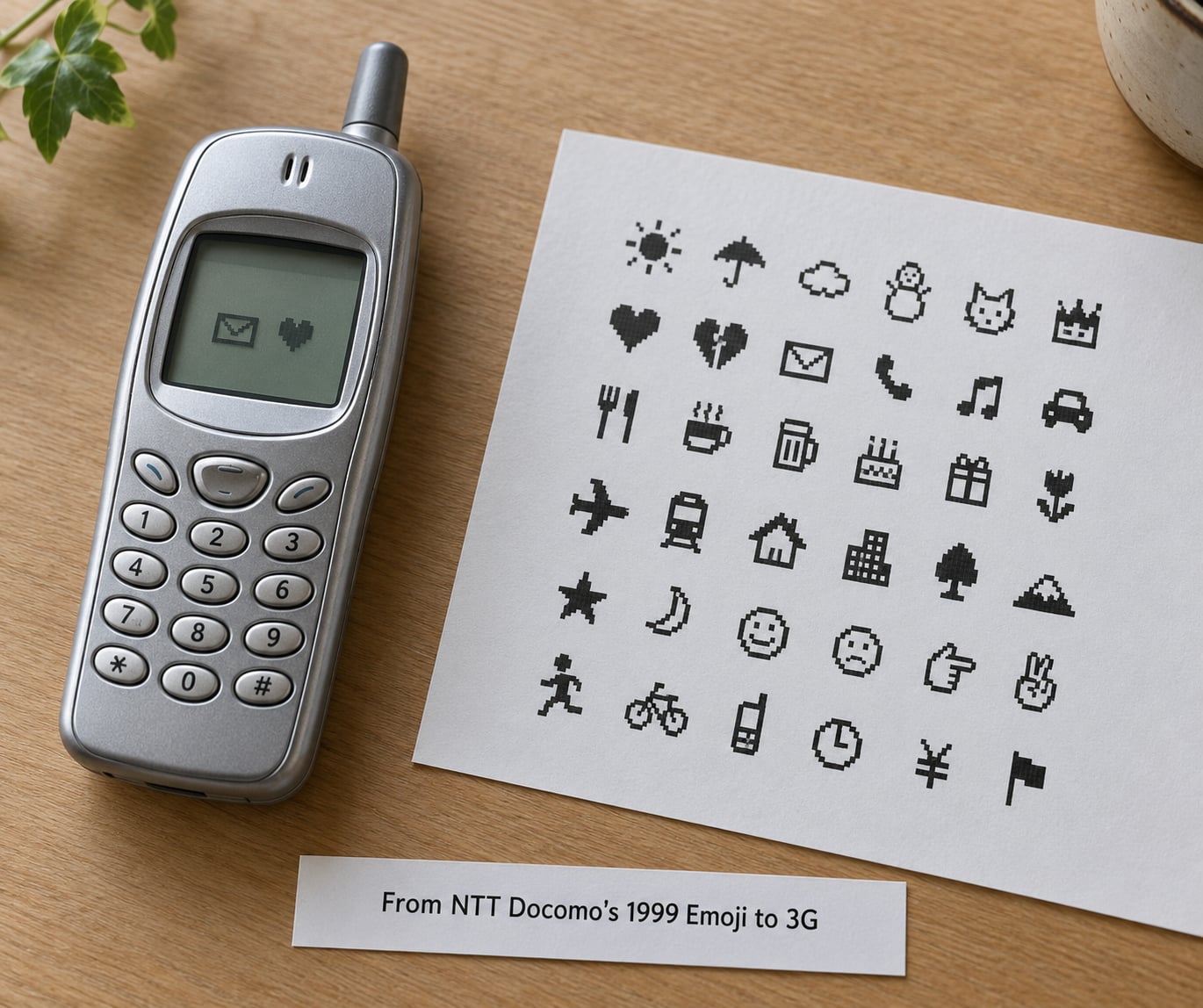
Kurita worked on NTT DoCoMo’s i-mode team, the mobile internet service that turned Japanese phones into small web browsers. The design brief he described was mostly a constraint brief: i-mode mail allowed 250 characters, handsets showed 12×12 pixels per character, and the first displays had no colour at all.
The first set shipped in 1999 with 176 symbols in monochrome. Weather icons, moon phases, zodiac signs, blood types, food and a heart came first because those were the things people actually wanted to say in a short message. Colour arrived later, once screens could handle it, and a rare pick in the early drafts was rejected outright as too juvenile for a business carrier.
The influence ran through the whole Japanese market fast. When DoCoMo launched 3G handsets, other carriers answered with their own emoji sets, some of which became so distinct that Japanese users today recognise a symbol’s carrier origin at a glance. Meanwhile Europe was developing its own small sets for SMS, so Japan was not working alone, just doing it earlier and with more of them.
The Main People and Teams Behind Japanese Emoji
Shigetaka Kurita is usually called the inventor, and he drew the 176 symbols that became the reference set. He has said the job was done in weeks and that his pay did not rise for it. His inspirations were ordinary Japanese visual material: weather symbols from forecast broadcasts, kanji, manga and traffic signs.
Behind him sat larger teams. DoCoMo’s i-mode group supplied the platform and the constraints, and rival carriers supplied the competitive pressure that pushed the design forward. Kurita himself has pointed out that he was not working from nothing.
Then the standards layer took over. Google’s Kat Momoi, Mark Davis and Markus Scherer pushed the 2007 request to Unicode. Apple’s Yasuo Kida and Peter Edberg followed with a much larger proposal. Paul Galloway, who acquired the original DoCoMo handsets and printed sheets for New York’s Museum of Modern Art in 2016, called the set digital hieroglyphics, a description curators have repeated since.
How Did Emoji Reach the Internet and Become Standard?
The technical obstacle was encoding. Inside Japan, the symbols lived in a proprietary encoding tied to one carrier, so a message containing one could not travel to another network or to a desktop computer and render correctly. A symbol that looked fine on a handset simply became an empty box anywhere else.
Japanese computing already leaned on encodings such as Shift-JIS to squeeze kanji into limited byte space, so a carrier-specific pictograph had nowhere in the standard system to sit. Someone receiving the message in Europe, on an early desktop or in an SMS gateway had no way to know what the bytes were supposed to become.
Unicode was the exit door. In 2007 Google asked the consortium to start allocating code points for pictographic characters. Apple followed in 2009 with a proposal covering 625 emoji drawn from the carrier sets, and Unicode 6.0 in 2010 accepted 521 of them.
Adoption then moved through product releases rather than standards meetings. iOS 5 shipped an emoji keyboard in 2011, which put the characters one tap away on the iPhone and turned them from a novelty into a habit. Android added them in 2013, and once both platforms rendered the same symbol identically, using them stopped being a special choice.
What Changed When Emoji Became Global?
What spread worldwide was a snapshot. A symbol that meant one thing inside a 1999 Japanese mailbox could mean something else outside it, and no standards body can fix a meaning, only a code point.
The set also grew away from its original design. The early pictographs were monochrome, symbolic and mostly about weather, travel and objects; colour, skin tone modifiers, food, flags and professions arrived later, in part because designers outside Japan asked for them.
Japan itself kept going its own way. Japanese platforms developed a huge parallel vocabulary of their own, and LINE stickers, large illustrated characters rather than small characters, remain more popular there than emoji ever became. It is not unusual for a Japanese user to send a sticker where someone elsewhere sends one small face.
Generations also read the same symbol differently. A crying face can mean genuine sadness to one reader and heavy irony to another, and the gap between older and younger users is a recurring complaint on Reddit threads about emoji. The safe assumption is that an emoji sent without a word carries whatever tone the sender was feeling, not whatever tone the receiver expects.
Who owns emoji and who gets paid for them
Nobody owns the characters. Unicode code points are free for anyone to implement, and no company collects a fee when you use a smiling face. That is why the set spread as fast as it did, and it is also why the designers themselves rarely profited from it.
The indirect money went somewhere else. Emoji translator and consultant roles appeared in job listings, and custom brand emoji became a marketing product once businesses wanted a symbol customers recognised instantly. Kurita has said he received no direct payment for the work that made him famous, which is a strange outcome for a design that runs through nearly every phone on earth.
Why Are Many Popular Emoji Symbols Animals?
Animals drew well. A cat, a dog or a fish is readable at 12×12 pixels in a way a detailed object is not, and a drawing that survives being shrunk stays useful on every screen size.
Japanese design culture has long used animals as stand-ins for people and feelings, from the tanuki and fox figures in traditional prints to mascots on vending machines, trains and public campaigns. Zodiac signs and seasonal imagery follow the same logic, since both map cleanly onto a small grid.
The popular claim that every animal emoji represents a specific Japanese shrine or a fixed piece of folklore has no support. Some individual symbols have been read into local meanings, but the set was designed for everyday messaging, not as a set of coded references.
A Timeline of Emoji’s Invention and Adoption
| Year | What happened |
|---|---|
| 1994 | Sharp releases the PI-4000 with roughly 160 picture symbols for messages |
| 1990s | Rival carriers build their own emoji sets; emoticons and kaomoji spread on Japanese phones |
| 1999 | Shigetaka Kurita designs 176 monochrome 12×12 symbols for NTT DoCoMo’s i-mode mail |
| 2000s | Colour emoji arrive on 3G handsets; Japanese carrier sets diverge from one another |
| 2007 | Google formally asks the Unicode Consortium to support pictographic characters |
| 2009 | Apple submits a proposal covering 625 emoji for standardisation |
| 2010 | Unicode 6.0 accepts 521 emoji, making them cross-platform |
| 2011 | iOS 5 adds an emoji keyboard to the iPhone |
| 2013 | Android adds emoji support, closing the platform gap |
| 2015 | Skin tone modifiers arrive, widening who the characters can describe |
| 2016 | The original DoCoMo handsets enter the Museum of Modern Art collection |
Frequently Asked Questions
Who invented emoji?
Shigetaka Kurita, a designer on NTT DoCoMo’s i-mode team, drew the 176-symbol set that launched in 1999 and became the reference for everything after it. No single person invented emoji, though. Picture symbols appeared on Japanese phones before him, including Sharp’s PI-4000 in 1994, and turning that carrier-specific collection into a global standard took years of work by engineers at Google, Apple and the Unicode Consortium.
Did NTT Docomo invent all emoji?
No. DoCoMo created the most influential early set and donated its designs to the standard, but rivals such as au, J-Phone and SoftBank developed their own collections, and Apple and Google contributed hundreds of new symbols during standardisation. Even the original 1999 set drew on weather broadcasts, kanji, manga and traffic signs that already existed.
What does the word emoji mean?
It is Japanese. The word combines e, meaning picture, with moji, meaning character. Kaomoji uses the same second half and refers to text faces such as (^_^) that are built from typographic marks and read upright. The word entered general English usage through products and dictionaries well after Unicode standardised the characters in 2010.
Were emoji invented before smartphones?
Yes, by more than a decade. The first set shipped in 1999 on i-mode phones with monochrome screens, a numeric keypad and a 250-character message limit. Smartphones arrived years later, and emoji were already a normal part of messaging by then. The smartphone did not create the demand, it just made the same symbols easier to send.
Are emoji Japanese characters or symbols?
They are characters, but not Japanese characters. Emoji sit alongside letters in a message as text symbols, and after 2010 they live in the Unicode Standard as code points shared by every platform. They were designed in Japan and carry Japanese design influence, yet the characters themselves are not kanji, hiragana or katakana and are not read as words.
How did Japanese emoji become global?
Carrier-specific symbols could not render on other networks, so they had to be standardised. Google petitioned the Unicode Consortium in 2007, Apple proposed 625 emoji in 2009, and Unicode 6.0 approved 521 of them in 2010. An emoji keyboard in iOS 5 in 2011 and Android support in 2013 then turned a standards decision into an ordinary habit.
Conclusion
Start at 1999, with 176 black-and-white symbols drawn for a 250-character message limit on a Japanese feature phone. That single set is the clearest place to begin, but it only makes sense once you see it as one step in a longer line: pager symbols, Sharp’s earlier experiments, rival carrier sets, and finally the years of standards work that carried Japanese pictographs onto every screen.