Japanese factory automation differs from US factory automation less in hardware than in philosophy. Japanese plants push intelligence into each individual workcell to hold quality and keep changeovers short, while US plants usually buy coverage, throughput and lower cost per part on long, high-volume runs. The robots are largely the same class of machine. The reason they sit in different places is the production problem each country is actually solving.
That framing matters for anyone evaluating a capital project, moving a production line between countries, or trying to explain why a Japanese plant runs unattended over a weekend and a US plant of the same size does not.
Updated for 2026. Numbers on robot density follow International Federation of Robotics (IFR) reporting and change annually, so treat them as ranges rather than fixed values.
Table of Contents
- 1How Japanese Factory Automation Differs from the US at a Glance
- 2Japan and the US by the Numbers
- 3What robot density does and does not tell you
- 4The Players: Who Builds Japanese Automation
- 5The adoption paradox: Japan builds the robots, then hesitates to use them
- 6Automation Strategy and Investment Priorities
- 7The two countries automate for different reasons
- 8Small lots change the economics completely
- 9Where the money goes
- 10Robotics, Equipment, and Factory Layout
- 11Fixed integrated cells versus modular deployment
- 12Layout tells the story
- 13Industry examples
- 14Labor, Skills, and the Human Role
- 15Software, Controls, and Data Integration
- 16A short glossary of the terms that come up
- 17Supply Chains and Production Conditions
- 18China complicates the comparison
- 19Which Should You Choose?
- 20What a US plant can borrow from Japanese practice
- 21Frequently Asked Questions
- 22Is Japanese factory automation more advanced than US factory automation?
- 23What is the main difference between Japanese and US manufacturing automation?
- 24Do Japanese factories use more robots than factories in the US?
- 25Why do Japanese factories often emphasize reliability and process discipline?
- 26Can a US manufacturer adopt the same automation model as a Japanese factory?
- 27Which industries show the clearest differences between Japanese and US factory automation?
- 28Conclusion
How Japanese Factory Automation Differs from the US at a Glance
The table below is the short version. Each row is a place where the two systems genuinely diverge, not a case of one country being ahead across the board.
| Dimension | Japan | United States |
|---|---|---|
| Primary automation driver | Filling unfilled posts from an aging workforce, plus holding quality at the point of work | Lower cost per part, higher throughput, and flexibility across product mix |
| Robot density | Roughly 300 to 400 industrial robots per 10,000 manufacturing employees, and the world’s largest exporter of industrial robots | About 295 robots per 10,000 manufacturing employees, among the highest in the world |
| Typical lot size | Small to medium lots, frequent changeovers, high mix | Long runs, larger lots, stable product families |
| Cell design | Fixed, tightly integrated cells where robot, machine, tooling and sensing are engineered as one unit | Modular cells and standalone machines tied together by software rather than by mechanical integration |
| Quality model | Jidoka and poka-yoke: the line stops itself when something goes wrong so the defect never travels downstream | Inspection and rework stations, statistical process control, and more end-of-line sorting |
| Management method | Toyota Production System: kaizen, just-in-time, gemba walks, visible Andon boards | Lean programs borrowed from Japan, but batch-and-queue scheduling persists in many plants |
| Software layer | Strong equipment-level control, PLC and CNC integration, production discipline on the floor | Cloud MES/WMS, analytics, machine vision with AI inspection, interoperability across mixed fleets |
| Supplier base | Domestic robot and machine-tool giants: FANUC, Yaskawa, Mitsubishi Electric, Keyence, Omron | Mix of Japanese, European, Chinese and US integrators, plus a large software and AI vendor layer |
| Strongest industries | Automotive and precision machining, electronics, semiconductor equipment, small-lot high-mix parts | Automotive, food and beverage, packaging, e-commerce fulfillment and large-scale warehouse automation |
| Where each falls short | Warehouse and logistics automation lags well behind its robot exports; SME suppliers are thin | Changeover discipline is weaker, cell integration is slower, and skilled mechatronics labor is scarce |
Japan and the US by the Numbers
Robot density is the number that gets quoted, and it is worth reading carefully. The IFR counts industrial robots per 10,000 manufacturing employees. On that measure Japan sits roughly in the 300 to 400 range, the US sits around 295, and China has climbed to about 470. Japan built most of the robots in all three countries.
So the ranking on paper reads China, then Japan, then the US, and every one of those three figures is within a factor of two of the others. That is a narrow spread for a claim about national competitiveness, which is why robot density alone makes a poor answer to how Japanese factory automation differs from the US. Density says how many machines sit on the floor. It says nothing about whether the line stops when a part is bad, how long a set-up takes, or whether anyone looks at the data the next morning.
What robot density does and does not tell you
| Metric | Japan | United States | China |
|---|---|---|---|
| Industrial robots per 10,000 manufacturing employees | Roughly 300 to 400 | About 295 | Roughly 470 |
| Share of global robot production | World’s largest producer, roughly a third to two fifths of global output | Small share, heavy importer | Rising fast |
| Warehouse and intralogistics automation | Lags behind its own robot exports | Advanced, driven by e-commerce scale | Expanding quickly |
| Automation priority on the shop floor | Quality at the source, unattended hours, shortage cover | Cost per part, throughput, flexible changeover | Installed volume, cost, coverage |
| Software and analytics layer | Equipment-level control, on-floor production discipline | Cloud MES and WMS, AI vision, interoperability | Fast-growing domestic platform layer |
| Core weakness | SME capital depth and slow domestic adoption | Changeover discipline and integration capacity | Software depth and mixed-vendor interoperability |
Figures move year to year and definitions differ slightly between sources, so treat these as directional. If you need them for a decision, pull the current IFR release rather than quoting a blog.
The Players: Who Builds Japanese Automation
The clearest structural difference between the two countries is who supplies the equipment. Japan has a deep, vertically connected robotics industry that has been refining the same product families since the 1970s.
- FANUC is the largest supplier of industrial robots and also makes CNC systems and control software, which is why its robots and machines integrate so cleanly on the floor.
- Yaskawa Electric builds robots and servo motors, the motion layer that matters for precision.
- Mitsubishi Electric covers drives, PLCs, robots and factory automation as one group, and has been shifting more assembly to China to serve that market locally.
- Keyence wins on sensors, vision and inspection rather than on robot arms, and its products show up almost everywhere.
- Omron works in controls, machine vision and factory automation software, closer to the data layer than to the mechanical cell.
Add the machine-tool builders, the reducer and servo suppliers underneath them, and you get the dense supplier network that makes a Japanese cell possible to design and to keep running. US plants buy from a mix of these same Japanese suppliers, European automation names, Chinese robot makers and a large US software and integrator layer.
The adoption paradox: Japan builds the robots, then hesitates to use them
Japan is the world’s largest producer of industrial robots and runs one of the highest robot densities on earth. It also exports most of them. Domestic adoption is slower than the export figures imply, and the reason is structural rather than technological.
A large share of Japanese manufacturing sits in small and midsize firms with order books of a few hundred parts at a time and no capital budget for an integrated cell. Those same firms absorb a disproportionate share of the aging workforce. Meanwhile the sectors where volume and capital exist, like logistics and warehousing, still run a lot of manual picking and manual handling because the system integration work, not the robots, is the hard part.
So the industry is real, deep and self-perpetuating, and it is exporting its own solution to a market that is not fully ready to absorb it. Anyone looking at Japan as a template should separate the equipment sector from the average factory on the floor. The two are not the same thing.
Automation Strategy and Investment Priorities
The two countries automate for different reasons
Japanese manufacturers automate because they are short of people and cannot afford to lose quality as the workforce retires. A Hacker News discussion put it plainly: in Japan, the robot is not coming for your job, it is filling a vacancy. That framing changes the capital math, because the alternative to a robot is not a cheaper worker, it is an empty station.
US manufacturers automate because the return has to clear on cost per part. A line running a single product family for years can absorb a large fixed fixture, a dedicated robot and a long commissioning schedule, because the cost spreads across hundreds of thousands of units. That is a fundamentally different approval process from a Japanese plant automating a cell that runs 200 different parts a year.
Small lots change the economics completely
The hardest automation problem in the US is not the assembly line. It is the job shop: aerospace machining, medical devices, industrial components, contract manufacturers. Lots are small, machines are general purpose, and set-up time eats most of the day. Six-axis robot cells designed for high-volume assembly rarely pencil out here, which is why multi-tasking 5-axis machining centers with pallet systems and automated tool management are often the better buy.
Japan’s machine-tool industry went at this problem early. The pitch was unattended hours: set up the pallet queue on Friday, let a 5-axis machining center run through the weekend with probing and tool management handling the variables, and have a person review it Monday morning. When the economics are framed as unmanned hours returned rather than headcount removed, small-lot production becomes automatable.
Where the money goes
A Japanese plant capital request usually starts with a cell and a quality argument. A US plant capital request usually starts with a labor-availability argument and a throughput target. Neither is wrong, but they produce different machines on the floor: one integrated, deeply engineered and expensive per station; the other modular, cheaper per station and easier to expand later.
Robotics, Equipment, and Factory Layout
Fixed integrated cells versus modular deployment
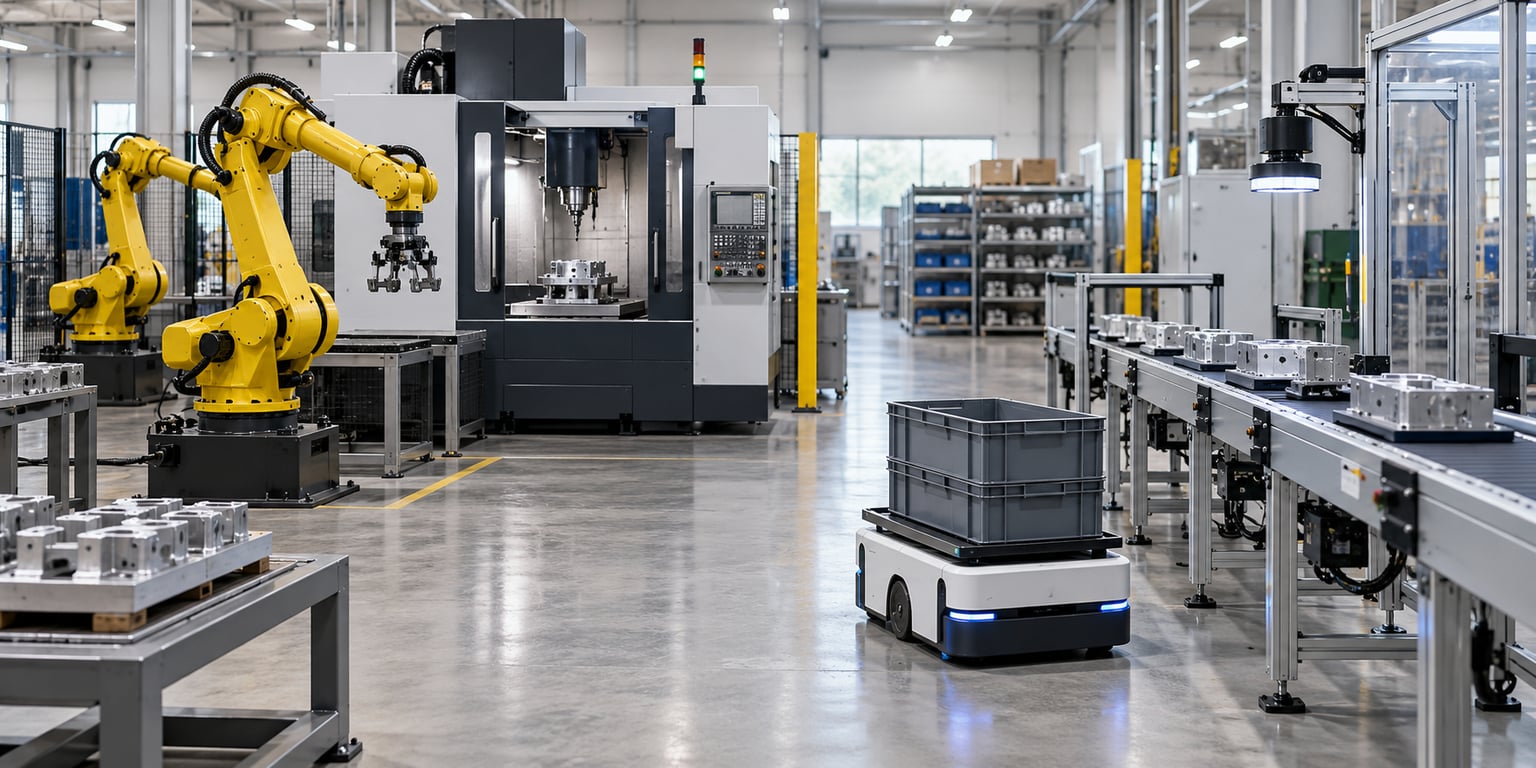
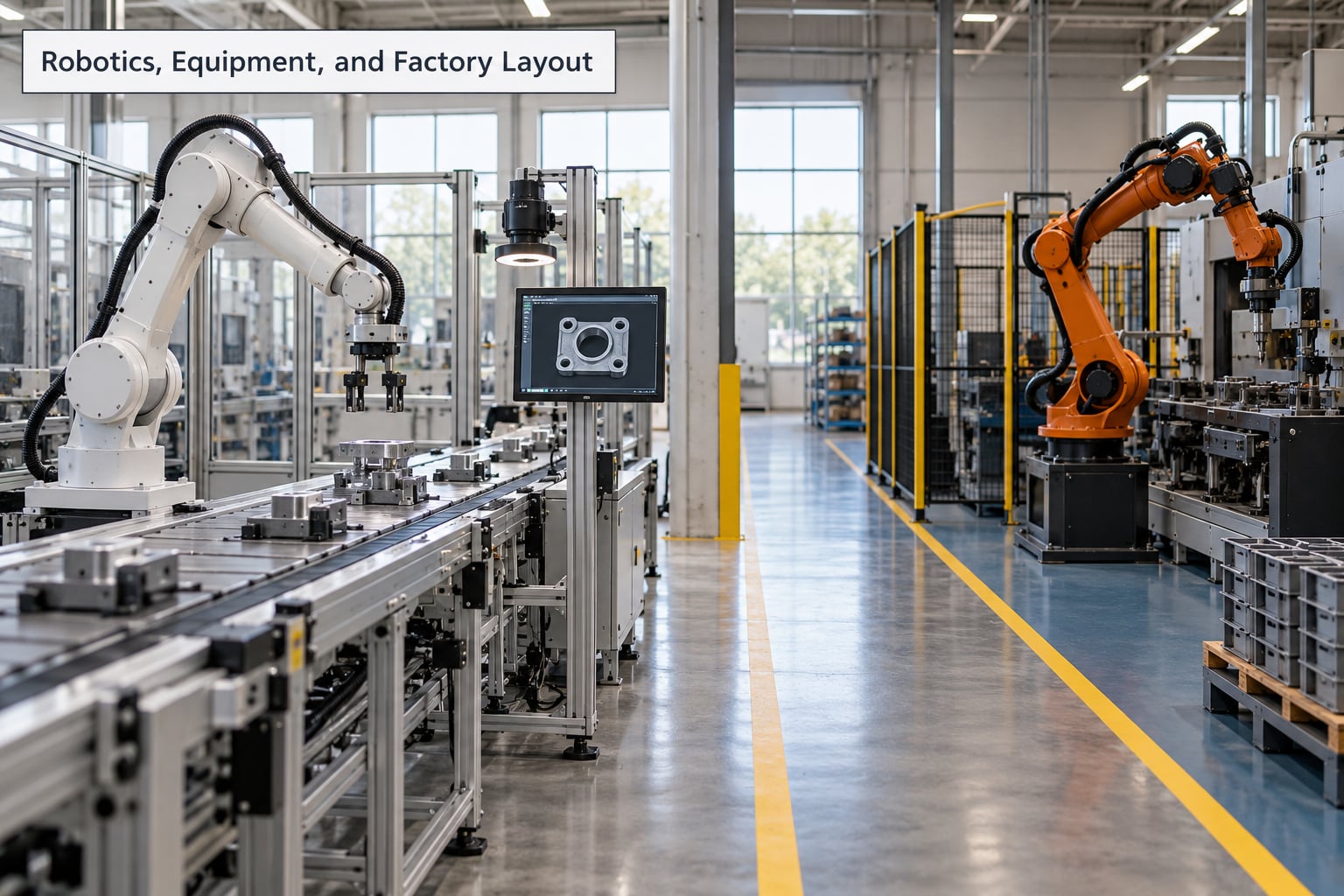
In a Japanese automotive or precision machining plant, the robot, the machine tool, the fixture, the tooling and the sensing are specified together. The cell is designed so that a known family of parts runs with known motion, known fixtures and known inspection. Changeover happens through preset tooling, quick clamps and offset data loaded from the control. This is why Japanese cells are expensive and why they hold their performance for years.
US plants more often standardize on modular assets: a robot here, a vision station there, an AMR moving totes between them, with the orchestration done in software. That approach is cheaper to deploy, scales further across a building, and is much easier to retrofit into an older facility. It is also harder to make bulletproof at the part level.
Layout tells the story
Japanese plant layouts tend to run long, straight, single-direction flows with short travel distances between operations and a strong visual signal system for problems. Materials move on dedicated paths, often automated, and the layout itself is designed to make deviation visible. US layouts more often mix manual and automated zones, put inspection near the end of the line, and absorb more changeover in the middle of the flow.
Industry examples
In automotive assembly, both countries run similar heavy six-axis robot lines, though US lines often carry more model variants on shared tooling to spread the capital. In electronics, Japanese vision and placement know-how is a genuine strength, and so is US AI-assisted inspection on the same task. In packaging and food, US palletizing and case-handling deployments are extensive because the volumes are enormous and the products are forgiving. In warehouses, the US is far ahead: Japan builds most of the robots and still automates a smaller share of its warehouse space than US operators do.
Labor, Skills, and the Human Role
The workforce model is where the cultural difference is hardest to see in the equipment list. Japanese manufacturers have historically been reluctant to displace people, and that resistance slows adoption in ways that look irrational from outside. It also produced something genuinely useful: technician careers built around maintaining robots. These gray-collar and purple-collar roles treat the robot as equipment to be understood, which is part of why uptime stays high.
US plants lean more on system integrators and vendor support for the same work, which is faster to get running but creates dependency on outside expertise. The shortage of mechatronics and controls talent is a problem in both countries, and in the US it is compounded by the software skills required to wire MES, WMS and vision systems into older equipment.
Automation reshapes the job rather than deleting it. Operators shift from running the machine to supervising several cells, fault-fixing first and monitoring OEE. Maintenance becomes more predictive, with vibration, thermal and spindle-load data feeding maintenance schedules instead of fixed calendar intervals. Quality roles move from inspecting samples to owning process capability. None of that works without people who understand both the mechanics and the controls.
Software, Controls, and Data Integration
Japan’s strength sits at the equipment layer. Decades of in-house control design by FANUC, Yaskawa, Mitsubishi Electric and Omron mean the PLC, the CNC, the robot controller and the servo system are tightly married, and the data they produce is consistent and trustworthy. Production discipline on the floor, visible Andon boards, and a culture of stopping the line when something is wrong complete the picture.
The US strength sits above the equipment layer. Cloud MES and WMS platforms, AI vision inspection, digital twins and analytics that turn uptime data into decisions have moved faster in the US than in Japan, partly because US operations software is a competitive market and partly because US plants carry more mixed-vendor fleets that need a common layer.
A short glossary of the terms that come up
Robot density is industrial robots per 10,000 manufacturing employees, the standard measure used to compare countries. Takt time is the pace the customer sets, and every operation must fit inside it. Lights-out manufacturing means running a machine or cell with no operator present, usually overnight or over a weekend. AMR is a self-navigating mobile robot that routes itself around obstacles; an AGV follows a fixed path or magnetically guided route. MES tracks production on the floor, WMS tracks inventory in the warehouse, and WES coordinates equipment and labor in between.
Supply Chains and Production Conditions
Automation design is mostly a consequence of production conditions, and the two countries have different ones. Japan’s supplier base is dense: robot makers, servo and reducer suppliers, machine-tool builders and component vendors sit close to each other, so an engineer can get a fix or a custom cell built quickly. That density is itself an automation advantage, and it is hard to copy.
US plants pull from a wider, more international supplier pool, with more dependence on imported controls, sensors and machine components. That makes sourcing more resilient in some cases and more expensive in others. It also means integrators have to bridge mixed-vendor fleets, which is where software and interoperability work pays off.
Demand patterns differ too. Japanese production is shaped by a shrinking domestic market and export demand from a smaller number of large customers, which favors stable, disciplined lines. US demand is more varied and more project-driven, which favors flexible cells and the ability to bring up new products fast.
China complicates the comparison
Any Japan-versus-US framing has to account for China, which has more robots per worker than either. Recent estimates put China at roughly 470 robots per 10,000 manufacturing employees, ahead of both Japan and the US. China also installs robot volume at a scale neither Japan nor the US matches. A US automation decision made in isolation from Chinese competitive pressure is a decision made with one card missing.
One useful distinction is that Japan stacks intelligence per cell while China covers production with robots at breadth. Where Japan competes is quality per part, uptime and the intelligence inside a workcell. Where China competes is installed base and cost. A US plant usually needs its own answer rather than a copy of either.
Which Should You Choose?
Use the production problem to pick the model, not the country.
- Stable high-volume production: Japanese-style integrated cells, with robots engineered together with the machine and tooling, pay off fastest because the set-up cost spreads across the run.
- Small-lot high-mix machining: unattended multi-tasking machining with automated pallet and tool management beats robot cells. Target set-up time reduction before anything else.
- Warehousing and fulfillment: US deployment patterns are the more useful reference, largely because of scale in e-commerce logistics and mature integrator coverage.
- Digital integration: if the equipment is already there, buy the software layer first. US MES, WMS and AI vision platforms are the fastest route to measurable gains.
- Operating across both countries: standardize the data and controls layer, then let each plant’s cell design follow its own lot sizes and labor conditions.
What a US plant can borrow from Japanese practice
Most of what Japanese factories do well transfers without buying a single robot. Gemba walks, where managers and engineers stand on the floor and watch the work, cost nothing. Visible Andon boards make problems stoppable and visible instead of hidden. Poka-yoke builds mistake-proofing into the fixture rather than into a training manual. Error-proofing changeover with preset tooling and proven work instructions shortens set-up more cheaply than a robot will.
TPM, with operators doing basic maintenance on the equipment they run, changes uptime more reliably than a software rollout. And keeping a small, empowered improvement loop at cell level, the kaizen cadence, does more than a large capital program that arrives with a fixed specification.
The harder transfer is cultural. Stopping the line to fix a problem rather than letting a supervisor push through a schedule is a management decision, not a shop-floor one. US plants that adopt it tend to lose throughput for a few weeks and gain it back, then keep it.
Frequently Asked Questions
Is Japanese factory automation more advanced than US factory automation?
Not in a simple sense. Japan has more industrial robots per worker and builds most of the world’s robots, but US plants are stronger in software, AI inspection and large-scale warehouse automation. Japanese plants automate for quality and to cover missing workers, US plants automate for cost per part and throughput, so the hardware looks similar and the results differ.
What is the main difference between Japanese and US manufacturing automation?
The main difference is philosophy rather than equipment. Japanese plants engineer robots, machines, tooling and sensing as one fixed cell and stop the line when something goes wrong, so quality holds and changeovers stay short. US plants more often automate for coverage and volume, wiring mixed fleets together with software and inspecting near the end of the line.
Do Japanese factories use more robots than factories in the US?
Roughly, yes, though the gap is modest and shifting. Japan sits around 300 to 400 industrial robots per 10,000 manufacturing employees against roughly 295 in the US, and both figures move each year. China has pulled ahead of both, at about 470 per 10,000 employees, which complicates any simple Japan-versus-US ranking.
Why do Japanese factories often emphasize reliability and process discipline?
Three forces push it: aging workers they cannot replace, a quality culture built on jidoka and poka-yoke, and a supplier base that rewards dependable equipment. When a line stops itself on a defect, the problem gets fixed at the source instead of traveling downstream, which is the whole point of the Toyota Production System and the reason Andon boards sit at the front of the floor.
Can a US manufacturer adopt the same automation model as a Japanese factory?
The cell design can transfer, the culture takes longer. Fixed integrated cells, preset tooling and poka-yoke fixtures work anywhere. What does not transfer is the willingness to stop the line for a quality problem; that is a management decision, and US plants that make it usually see a short dip in throughput followed by better first-pass yield.
Which industries show the clearest differences between Japanese and US factory automation?
Small-lot, high-mix machining shows the clearest gap, since Japan automated unattended 5-axis production early and US job shops still rely on manual set-up. Warehousing shows the opposite gap, with US e-commerce logistics automation far ahead of Japan. Automotive assembly looks similar in both countries, so it is the least useful place to learn the difference.
Conclusion
The honest answer to how Japanese factory automation differs from the US is that the machines are comparable and the objectives are not. Japanese plants automate to hold quality, cover vacancies and survive short runs, so the intelligence sits inside each workcell. US plants automate to reduce cost per part and lift throughput, so the intelligence increasingly sits in software above the equipment.
Evaluate five things before choosing a model: your production volume and lot sizes, how much changeover you actually have, whether your workforce can support more automation or is already short, how well your equipment and software integrate, and what your supply chain can reliably deliver. Get those right and the country matters far less than the answers.
One more thing belongs in any 2026 automation plan. China has more robots per worker than either country, so the benchmark is moving regardless of which playbook you pick.