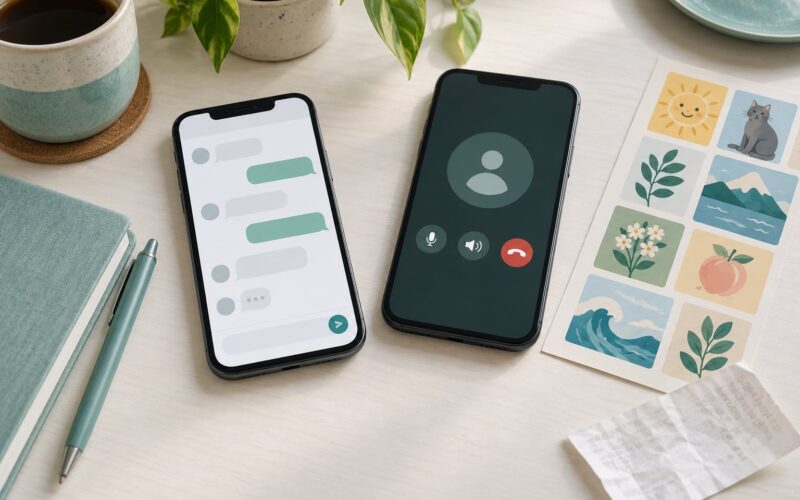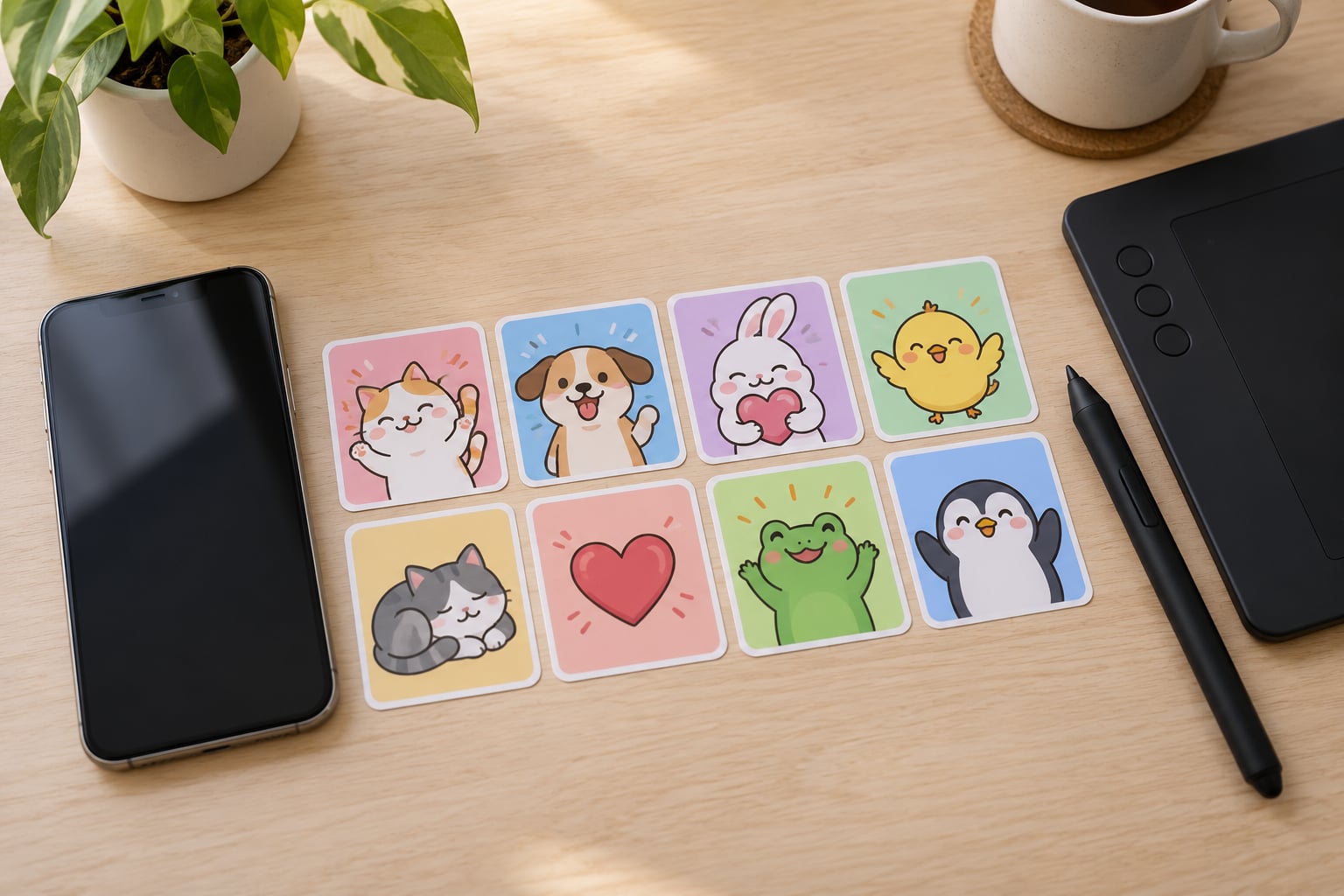
Japanese messaging stickers became a business because a free messaging app solved a texting problem with pictures, then charged for those pictures. LINE launched paid sticker packs alongside the app in 2011, and creator-industry reporting puts cumulative sticker sales past 120 billion yen by 2025. LINE reports more than 224 million monthly active users worldwide, with roughly 84 million of them in Japan.
Those numbers come up a lot in discussions of the LINE sticker business model, so I’ll date them as I go and flag where they are estimates. Nothing here is affiliate content or a product page.
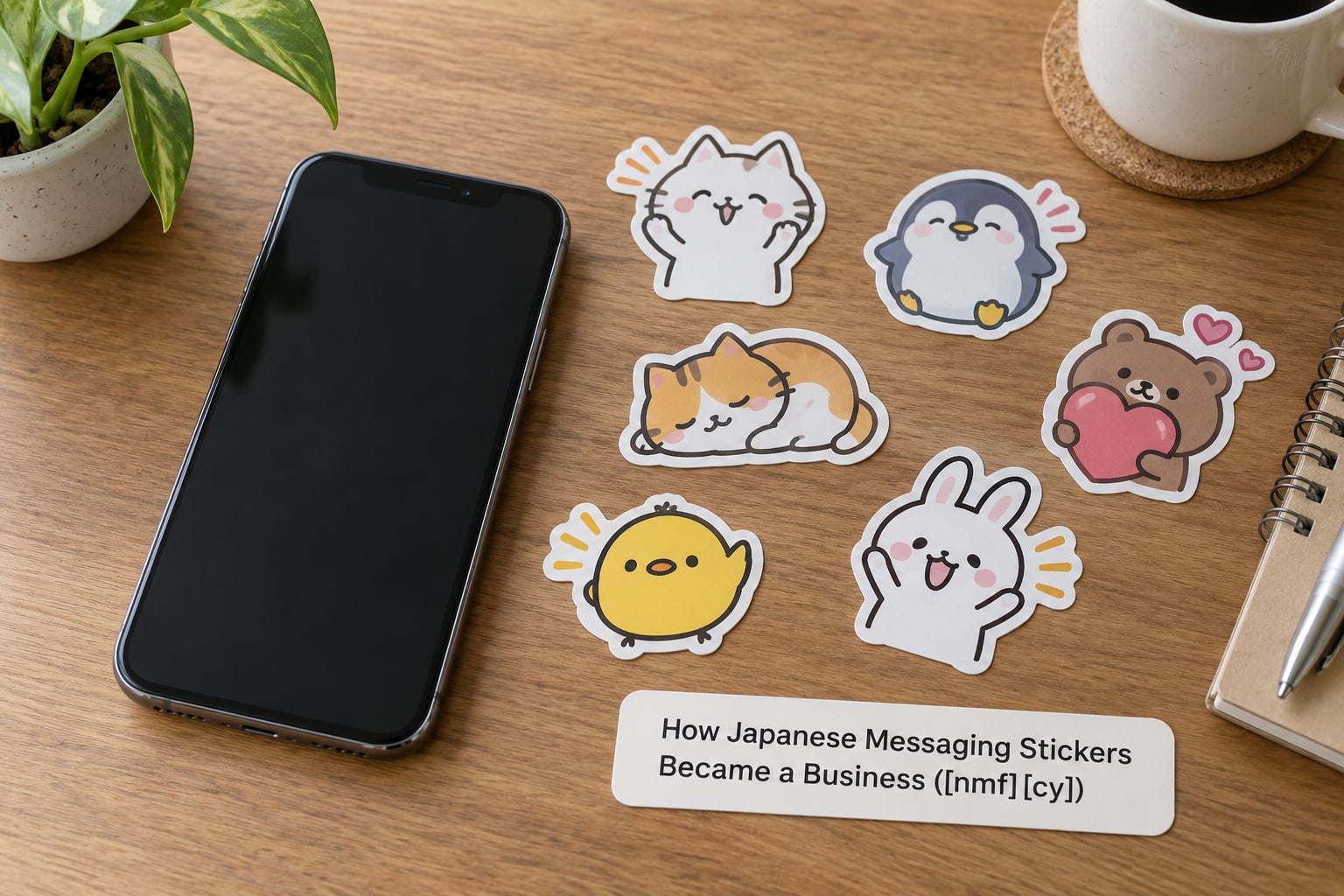
Table of Contents
- 1What Are Japanese Messaging Stickers?
- 2How Did Messaging Stickers Become Popular in Japan?
- 3How Japanese Messaging Stickers Became a Business
- 4Which Platforms Made the Business Possible?
- 5How Do Sticker Creators Make Money?
- 6Why Do Brands Use Japanese Messaging Stickers?
- 7What Made These Stickers Different From Emoji?
- 8How Did Japanese Sticker Culture Influence Global Apps?
- 9Frequently Asked Questions
- 10Where did stickers originate?
- 11Did the Japanese invent emojis?
- 12What is the Japanese concept of kawaii?
- 13Why do people buy stickers when emoji are free?
- 14How much do LINE sticker creators earn?
- 15Why are Japanese stickers so popular outside Japan?
- 16Conclusion
What Are Japanese Messaging Stickers?
Japanese messaging stickers are small illustrations, usually a recurring character with a short caption, that you send inside a chat instead of typing a sentence. You tap the sticker, it appears in the conversation, and the other person reads your mood instantly.
Three things separate a sticker from the alternatives people used before it. It’s bigger than an emoji, so it carries a whole scene rather than one symbol. It usually belongs to a named character with a backstory. And it stays available forever once you buy it, which turns a chat reaction into something you reuse daily.
In everyday Japanese conversations they fill the gaps where directness would be awkward. A blunt sentence about a colleague becomes harmless if a rounded cartoon cat is holding the message for you.
How Did Messaging Stickers Become Popular in Japan?
Stickers were not invented for a chat app. They arrived first as physical goods, then as a behavior, and the app just gave that behavior a container.
The design vocabulary came from kawaii, the Japanese idea of cute that shaped character goods, stationery, and pop culture merchandise for decades. The delivery method came from sticker bombing, known as botpuru, the habit of covering notebooks, lockers, and bicycle frames with overlapping decals until the surface disappears. Collecting stickers was already normal. Collecting them was already a hobby with its own rules.
Two technical events did the rest. NTT DoCoMo released 176 pictographic characters on mobile phones in 1997, which put simple expressive images into every pocket in the country and trained people to expect them. Then feature phones made long typed messages genuinely painful to send, so a picture that took two taps replaced a paragraph that took thirty seconds.
Japan had 80 million-plus mobile subscribers and heavy texting by the late 2000s. LINE arrived in 2011 into a population that already sent images as shorthand. The format was not imported. It was waiting for a pipe.
How Japanese Messaging Stickers Became a Business
Japanese messaging stickers became a business when LINE turned an already-normal habit into a paid in-app purchase. Buyers pay a small price for a pack, reuse it endlessly, and the app takes a cut of every sale while splitting the rest with the artist or brand behind the characters. No banner ads, no subscription, no interruption to the chat itself.
The chain runs in eight steps:
- Physical decals build the habit. Sticker collecting and sticker bombing make the object familiar and desirable before any phone is involved.
- Emoji normalize the tap. Pictographs on mobile phones from 1997 teach users that a two-second image is a legitimate way to speak.
- Feature phones create the pain. Slow typing and small screens make text-heavy messaging frustrating at exactly the moment phones go mainstream.
- LINE launches in 2011 with paid sticker packs built in. Monetization is a launch-day feature, not a later bolt-on, and free stickers keep the base installed.
- Adoption scales through the network. A sticker is more useful when the person on the other end has the same pack, so every install raises the value of the previous one. LINE’s user base has since passed 224 million monthly actives, with roughly 84 million in Japan.
- The emoji era arrives around 2015. Emoji get standardized and go global. Stickers hold their ground because they carry characters and captions, which emoji do not.
- Rivals adopt the format. Facebook and Messenger add sticker stores, and Asian rivals such as KakaoTalk run the same paid-pack model on their own closed stores. Japan exported a mechanic, not just an aesthetic.
- The creator market opens up. Individual artists and small studios can publish packs without a publisher or a business plan, and by 2025 cumulative sticker sales had passed 120 billion yen according to creator-industry reporting.
The important part is step four. Most messaging apps were free and stayed free by selling attention to advertisers. LINE chose a purchase small enough to feel like nothing and repeated often enough to compound.
Which Platforms Made the Business Possible?
The business runs on one structural decision: every messaging app runs its own closed sticker store. A pack sold inside one app cannot be sold in another, which keeps buyers, catalogs, and payouts inside a single closed loop.
That closed store is exactly why the format works commercially, and it is also the constraint creators complain about most. A pack designed for LINE has to be re-cut and re-exported for every other platform, because each one enforces its own size, format, and review rules.
| Platform | Sticker era | How it makes money | Creator access |
|---|---|---|---|
| LINE | Launched 2011 with the app | Paid packs, low price, no chat ads | Open submission, revenue share |
| KakaoTalk | Early 2010s, strong in South Korea | Paid packs and character goods | Partner and official accounts |
| Facebook Stickers | Mid-2010s | Free in the feed, some paid packs | Creators and brands supply art |
| Messenger | Mid-2010s | Free, tied to the wider platform ecosystem | Brand and creator programs |
| Telegram | Later | Custom packs and premium features | User-made packs, limited payout |
| 2010s | Paid sticker sets inside a payment-led app | Brand and IP partnerships |
The table above is a broad sketch of how each app treats stickers rather than a pricing comparison, and feature sets shift with app releases. LINE’s position is unusual because it pairs the store with payments, an in-app currency called LINE Coins, and a huge domestic audience at the same time.
How Do Sticker Creators Make Money?
Creators make money through direct pack sales split with the platform, plus brand collaborations and licensing that sit on top of that. The registration flow is short: create the artwork, register the account on LINE Creators Market, submit at least eight stickers with a title, description, icon, category, and tags, set the price, pass content review, and go on sale.
The base price point most packs use is 120 yen, with higher tiers around 240 and 370 yen for animated or larger sets. Here is roughly how a standard sale divides up:
| Step | Approximate amount on a 120 yen pack | Who takes it |
|---|---|---|
| Listed price | 120 yen | Buyer pays through LINE Coins |
| App store distribution fee | About 30 percent | Apple or Google |
| Platform share | Remainder after fees | LINE, covering hosting, store, and payouts |
| Creator payout | Roughly 35 percent of the listed price | The artist or rights holder |
Two details in that table matter more than the headline share. Purchases are per pack and unlimited in use, so a pack that becomes part of someone’s daily vocabulary keeps earning without new work from the creator. And because payouts are tied to volume rather than a flat fee, a pack that finds its audience can keep generating for years.
The design advice circulating in creator communities is more practical than it sounds. Thick outlines survive being shrunk into a chat bubble. Strong color contrast survives a bright phone screen in daylight. Big eyes and an open mouth read at a glance, which is the whole job. Clear categories and tags matter because the store is crowded and discovery is the real bottleneck.
Wider income usually comes from adjacent lines: character merchandise, commissioned work for brands that want a familiar face in a campaign, and licensing to publishers or anime properties. Platform income is the floor, not the ceiling.
Why Do Brands Use Japanese Messaging Stickers?
Brands use stickers because a familiar character says more, faster, than an advertisement can. A cup of tea with a sleepy face communicates tone before a sentence is read, and it does it inside a channel the user already opens dozens of times a day.
The mechanics on the brand side run through an Official Account, which is a business profile that can publish messages, push coupons, and drop sticker campaigns. Brands use that combination for seasonal moments, where a sakura or New Year pack does more work in January than a full campaign would.
The funnel is simple enough to be reusable: a sticker pack brings in people who like the character, the Official Account gives them somewhere to be reached again, and coupons or rewards turn the attention into a purchase. It is unusually cheap for a channel with this much reach in Japan, and it fits the platform’s identity as an app that does not interrupt you with ads.
What Made These Stickers Different From Emoji?
Emoji are a universal vocabulary of single symbols, standardized so that one character means roughly the same thing everywhere. Stickers are a local creative market, and that difference shapes everything about how the two formats compete.
- Character depth. A sticker series implies a world, a running joke, or a cast. An emoji is designed to be understood without context.
- Collecting. People buy packs and complete sets. Nobody collects emoji in the same way, because they already have all of them.
- Regional style. Japanese packs lean on pastel palettes, rounded shapes, and heavy outlines for readability in a chat bubble.
- Commercial independence. Stickers are sold and licensed. Emoji ship free inside the OS or app and belong to whoever made them.
- Customization. The same base sticker can appear in regional, seasonal, and licensed variants, which keeps the format fresh.
That is why sticker sales kept growing in markets where emoji became the default answer to the same need. They were never competing for the same job.
How Did Japanese Sticker Culture Influence Global Apps?
The format spread because users already knew it. When Facebook and Messenger added sticker stores in the mid-2010s, the feature needed no explanation to anyone who had used a Japanese messaging app.
KakaoTalk in South Korea is the clearest parallel, running paid character packs at scale with deep ties to its own entertainment industry. WeChat folded sticker sets into a payments-led app. Telegram added custom packs with a much smaller payout story. In each case, the mechanic travelled further than the specific characters.
What did not travel is the surrounding culture. The collecting habit, the seasonal release rhythm, and the willingness to pay a small price for emotional shorthand are strongest in Japan, where LINE also holds a scale that made the closed-loop model pay off. Elsewhere stickers are a popular feature, rarely the business Japan made of them.
Frequently Asked Questions
Where did stickers originate?
Modern adhesive stickers trace back to American printing, where die-cut paper and vinyl decals became cheap by the nineteenth century. In Japan the format became a cultural object through kawaii character goods and the sticker bombing habit of covering notebooks and lockers with decals. The chat sticker came later, when LINE put a store for them inside a messaging app in 2011.
Did the Japanese invent emojis?
Not the word, and not quite the category. NTT DoCoMo released 176 pictographic characters for mobile phones in 1997, widely credited as the first emoji set. The standardized emoji used today was proposed by a Japanese company but formalized by the Unicode Consortium, and those glyphs now ship free on every phone, unlike messaging stickers.
What is the Japanese concept of kawaii?
Kawaii roughly means cute, and it carries more weight in Japan than the English word does. It describes an aesthetic and an emotional register built on rounded forms, small features, soft colors, and helplessness rather than power. That vocabulary shaped character design, packaging, and sticker art for decades before any of it reached a messaging app.
Why do people buy stickers when emoji are free?
Emoji cover single symbols and ship free with the phone. Stickers carry a character, a caption, and a scene, so they carry tone that a symbol cannot. People also buy them once and reuse them, which suits an in-chat format better than a one-off symbol. The sticker earns its price through expression and identity, not through novelty.
How much do LINE sticker creators earn?
It depends entirely on volume. A standard 120 yen pack pays the creator roughly 35 percent of the listed price after the app store takes about 30 percent, so the unit economics are thin and the totals come from packs that sell in large numbers repeatedly. Most packs earn very little. A small number of hits have gone on earning for years because buyers reuse them daily.
Why are Japanese stickers so popular outside Japan?
The appeal travels better than the business model does. Rounded cute characters, seasonal releases, and a collectible format read clearly in any language, and a sticker pack needs no translation. What does not travel is the economics, which depend on a closed store, a huge domestic audience, and a culture that already treats collecting stickers as normal.
Conclusion
The sticker business was not invented as a business. It grew out of a collecting habit, met a texting problem, and only then got priced. LINE’s decision to monetize inside a closed store with a purchase small enough to feel trivial is the piece worth remembering.
If you want to judge a sticker business, look at four things: how many people the platform can actually reach, whether the character holds up outside the chat bubble, whether people buy a second and third pack, and whether the character can travel into merchandise or licensing. Everything else is decoration.